
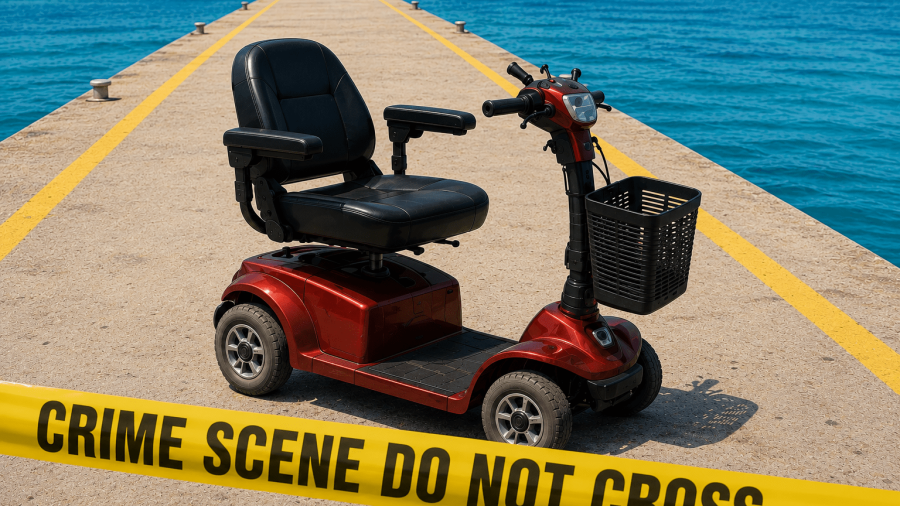
On May 9, 2026, an 88-year-old woman lost her life at Carnival’s Celebration Key destination in the Bahamas. She was riding a mobility scooter on the pier when she fell into the ocean. Her husband, watching it happen, jumped in after her. Despite the efforts of emergency responders, she did not survive.
I have spent my career representing passengers and crew members injured on cruise ships. When I read about what happened at Celebration Key, several things immediately stood out: pier design, a policy gap around mobility scooter training, and a pattern of preventable incidents the industry keeps failing to address. Taken together, they paint a picture of a tragedy that was not just foreseeable. It was foreseen.
The Celebration Key Pier
Celebration Key opened in July 2025 as Carnival’s flagship private destination in the Bahamas. It is a $600 million resort built exclusively for Carnival passengers, and by all accounts, it is stunning. But there is something important missing from that pier: a physical barrier between the walking surface and the ocean.
This is not unique to Celebration Key. Cruise ship piers generally do not have guardrails along the water’s edge because the open space is needed to secure mooring lines and allow gangways to connect. That operational reality is understandable. What is harder to accept is the gap between what passengers experience at Celebration Key versus what they would experience at a pier built under Florida or U.S. standards.
Consider the difference. At PortMiami and Port Everglades, passengers never set foot on an open pier. They move from the terminal directly into the ship through enclosed boarding bridges, essentially airport jetways. A fall into the water is structurally impossible. At ports like Key West, the pier edges are lined with concrete bull rails, raised curbs typically 8 to 12 inches high, that act as a physical stop for anyone who wanders too close or loses control of a wheeled device.
At Celebration Key? The pier surface is flush and open. The only warning is yellow paint on the concrete, and it is not everywhere.
Those design features are not accidents of good planning. In the United States, they are legal requirements. The Americans with Disabilities Act (ADA) mandates that any accessible route, meaning any path that a passenger using a wheelchair or mobility scooter is expected to travel, must be stable, firm, and free of hazards, including unguarded drop-offs. OSHA’s shipyard and marine access standards require fall protection at unprotected edges where workers and passengers face a risk of falling into the water. The Florida Building Code and local county regulations add yet another layer of enforceable requirements on top of that. They are the law, and any pier operating under U.S. jurisdiction must meet them.
Here is what is striking. Carnival operates terminals and piers across the United States and complies with every one of those requirements at each of them. The moment they build a pier in the Bahamas, those protections disappear. Is it because the legal obligation to protect passengers evaporates the moment the project crosses into a foreign jurisdiction? The answer is simple: the legal obligation evaporates the moment the project crosses into a foreign jurisdiction. That is a choice cruise lines make, and passengers deserve to know it. Passengers deserve to know that the safety standards protecting them at their home port may not follow them to their destination.
Under general maritime law, vessel owners and pier operators owe every passenger a duty of reasonable care. Cruise lines are often held to the even higher standard of a common carrier, meaning their obligation to provide safe ingress and egress is non-delegable. When a pier design creates a condition where a person using a mobility device, or a small child walking with her family, can go over the edge with nothing to stop them, that is a question worth asking in a courtroom.
International engineering standards for cruise terminals, specifically PIANC guidelines, recommend physical edge stops such as bull rails or curbs, precisely to prevent wheeled traffic from going over unprotected edges. These are recognized best practices that Celebration Key, as a brand-new, $600 million facility, had every opportunity to incorporate.
The Mobility Scooter: Who Is Responsible When Nobody Teaches You How to Use It?
The second issue this tragedy raises involves mobility scooters and the way cruise lines handle them.
Carnival, like most major cruise lines, encourages passengers who need mobility assistance to bring their own scooter or rent one through its preferred vendor, Scootaround. The rental process is simple: you book online or by phone, and in most cases the scooter is waiting in your stateroom when you board. That sounds convenient, and for many passengers it is a genuine lifeline. Without it, they could not enjoy a cruise vacation at all.
But here is what no one tells you: there is no training.
Carnival’s own published policies address scooter dimensions, battery types, storage requirements, and corridor rules in considerable detail. What you will not find anywhere in those policies is a requirement that passengers demonstrate they know how to operate the device safely, or that anyone from Carnival or Scootaround walks them through the controls before they head out onto a borderless, curbless pier.
Scootaround describes its staff as “trained professionals” who help passengers select the appropriate mobility scooter for their needs. But selecting a scooter is very different from training someone how to safely operate it aboard a cruise ship. There does not appear to be any routine hands-on instruction, safety demonstration, or individualized guidance for elderly or first-time users navigating crowded terminals, sloped gangways, tight ship corridors, or areas near open edges.
The investigation has yet to reveal whether the passenger who died on May 9 owned her scooter or rented it from the cruise line. We do not know whether she was experienced with the device or was using one for the first time on this trip. The autopsy results have not been released, and the investigation is ongoing. But those questions matter enormously, both to understanding what happened and to determining who bears responsibility for it.
A cruise ship is not a shopping mall or a hospital corridor. It involves motion, wet surfaces, inclines, gangways, crowded decks, and tight transitions. The open pier at a destination like Celebration Key adds yet another layer of complexity. Placing an elderly passenger on a mobility scooter in that environment, with no verification of their ability to operate it and no physical safeguards at the pier’s edge, is a combination that the industry should have addressed long before now.
When Two Failures Become One Tragedy
Here is what I think is critical to understand, and what I believe any jury would understand as well.
Neither of these failures, the unprotected pier edge or the absence of scooter training, had to be catastrophic on its own. But Carnival made both choices simultaneously. They built a pier with no physical edge protection. And they actively encourage passengers with limited mobility to rent motorized scooters, deliver those scooters with zero operational instruction, and send those passengers out onto that same pier.
You do not need to be a safety engineer or a prophet to know where that leads. You just need to pay attention.
And here is what makes this legally significant: Carnival had already been put on notice. On December 21, 2025, less than five months before this woman died, a four-year-old child fell off the same pier and into the water between the ship and the dock. Her mother jumped in after her. The story went viral, made international news: Carnival was aware.
In the law, we call that notice. Before December, a defense attorney might have argued that Carnival could not have anticipated the danger. After December, that argument no longer exists. The company knew the pier edge was creating serious risk for guests. This is not Murphy’s Law. This is a foreseeable outcome that followed from two documented, deliberate design and policy choices. And it will continue to happen until those choices are reversed.
What Needs to Change
The fixes here are not complicated. Celebration Key needs physical edge protection, whether bull rails, raised curbs, or another engineered solution that creates a mechanical stop before the waterline. That is not a radical ask for a $600 million facility. It is standard practice at virtually every comparable pier operating under U.S. jurisdiction.
And the cruise industry needs to take scooter safety seriously. That means a mandatory operational briefing for any passenger renting or bringing a motorized scooter aboard, particularly elderly or first-time users. Mobility-challenged passengers deserve an actual conversation with an actual human being before someone drives off a pier.
What This Means for Passengers
If you or someone in your family uses a mobility scooter on a cruise, please take this seriously. Ask questions before you board. Understand how the device operates, including how to brake quickly and how it handles on inclines. Be especially cautious near any open pier edge, where yellow lines may be the only thing standing between you and the water.
And if you or a loved one has been injured in a cruise-related incident, whether on a pier, a gangway, a ship deck, or anywhere else, know that maritime law provides specific protections for passengers that are very different from what you would find in a standard personal injury case. These cases require attorneys who understand general maritime law and how it applies to cruise passengers. The results can be significant, and the window to act is often shorter than people expect.
The woman who died at Celebration Key on May 9 was someone’s wife, someone’s mother, possibly someone’s grandmother. She was on vacation. She deserved better protection than a stripe of yellow paint on a concrete pier. So does every passenger who follows her onto that dock.
Thomas Scolaro is a maritime and cruise injury attorney, founding partner at Scolaro Law / USinjury.Law, representing passengers and crew members in cases involving cruise ship injuries, pier accidents, and maritime negligence.