
Free: download our 2027 Luxury Cruise Calendar →
For many adventurous travellers, the biggest thing holding them back from booking an Antarctic expedition isn’t the cost or even the distance, it’s the Drake Passage.
I’ve heard it countless times, and after traveling to Antarctica on four separate cruises, I understand why. The Drake has a reputation. It’s often described as one of the roughest stretches of ocean on Earth, with dramatic waves, rolling ships, and the very real possibility of seasickness. Those stories can feel intimidating, especially if you’ve never experienced open ocean conditions before.
But here’s the reality: the Drake Passage is not always as wild as its reputation suggests, and today, you have more options than ever when it comes to how you get to Antarctica.
So how rough is the Drake Passage, really? This will differ each day as I found out. It’ll either be the “Drake Lake” or the “Drake Shake.” The Drake Lake refers to calmer crossings, when the sea is relatively smooth, and the journey feels manageable. The Drake Shake, on the other hand, is when the ocean lives up to its reputation, with rolling swells and more dramatic movement.
From my own experience I found that now two crossings of the Drake Passage are the same. Roughly 70% of crossings are calm to moderate, meaning you’ll feel movement. About 30% bring more challenging conditions, the kind that earn the Drake its legendary status. Truly rough crossings are less common, and perfectly glassy conditions are quite rare.
Even on calmer sailings, though, it’s important to set realistic expectations. You are crossing open ocean, and movement is part of the experience. Summer wave heights can still range between 8 and 15 feet, which is enough to remind you that you are at sea.
The traditional route to Antarctica involves sailing from Ushuaia, at the southern tip of South America. These itineraries typically run 10 to 12 days. You’ll spend about two days crossing the Drake southbound, another two days returning north, and five to six unforgettable days exploring the Antarctic itself.
There’s something special about doing it this way. Sailing the Drake feels like a rite of passage, a sense that you’ve truly “earned” your arrival. Along the way, you’ll spot seabirds gliding effortlessly over the waves and, if you’re lucky, whales breaking the surface in the distance. Onboard lectures from expert guides add depth and anticipation, helping to understand the landscapes and wildlife you’re about to encounter.
But there is a trade-off.
Four days in open ocean is a significant portion of your trip. If you’re prone to motion sickness, or simply short on vacation time, that can feel like a big commitment. On one of my own crossings, the seas were spicy enough that many passengers, including my husband, took seasickness meds and stayed inside their cabins for a day or two. The seasickness passed, but it’s a factor worth considering.
The good news is that today several operators offer fly-based expeditions from Punta Arenas, dramatically changing how you can experience the journey. Instead of spending two days crossing the Drake, you can take a two-hour flight directly to King George Island in the Antarctic where your expedition ship awaits.
Companies such as Antarctica21, Quark Expeditions, Silversea Cruises, Lindblad Expeditions, and Aurora Expeditions offer a range of fly-based options.
The most straightforward is the fly/fly itinerary. You skip the Drake Passage entirely, flying both ways and maximizing your time in Antarctica. These trips can be as short as nine days, with more opportunities for landings, wildlife encounters, and Zodiac excursions. For travelers concerned about seasickness, or those working within limited vacation time, this option can be a game changer.
Then there’s the fly/cruise (or fly/sail) option, which offers a middle ground. You fly one direction and sail the other, giving you a taste of the Drake without committing to it twice. This is a good choice for travelers who are curious about the experience but want to limit their exposure.
Choosing between these options comes down to a few key considerations.
First, seasickness. While only a portion of crossings are truly rough, almost everyone feels some degree of motion. If that uncertainty is weighing on you, flying reduces the risk.
Second, time. Skipping the Drake can save three to four days, which is substantial, especially for travelers balancing work and vacation.
Third, cost. Fly-based expeditions are typically more expensive due to the logistics of charter flights. For some, that added cost is well worth the trade-off in comfort and time.
Fourth, flexibility. Flights in this part of the world are weather-dependent. Delays can happen, so it’s wise to build a buffer into your travel plans. I once was required to stay aboard an expedition vessel for 2 extra days waiting for our charter flight to arrive due to inclement weather.
Working with a travel advisor with expertise in booking Antarctica Tour packages is advisable.
And finally, packing. Charter flights often come with stricter luggage limits, usually around 15 kilograms, so you’ll need to pack thoughtfully. I’ve done it more than once, and while packing was a challenge, it felt like a personal accomplishment to travel light for a change.
After four Antarctic journeys, here’s what I know for certain: the fear of the Drake Passage should not be the reason you don’t go. Yes, the crossing can be unpredictable. Yes, seasickness is a possibility. But most crossings are tolerable, and even when they’re not, they are temporary.
What waits on the other side is something far more powerful.
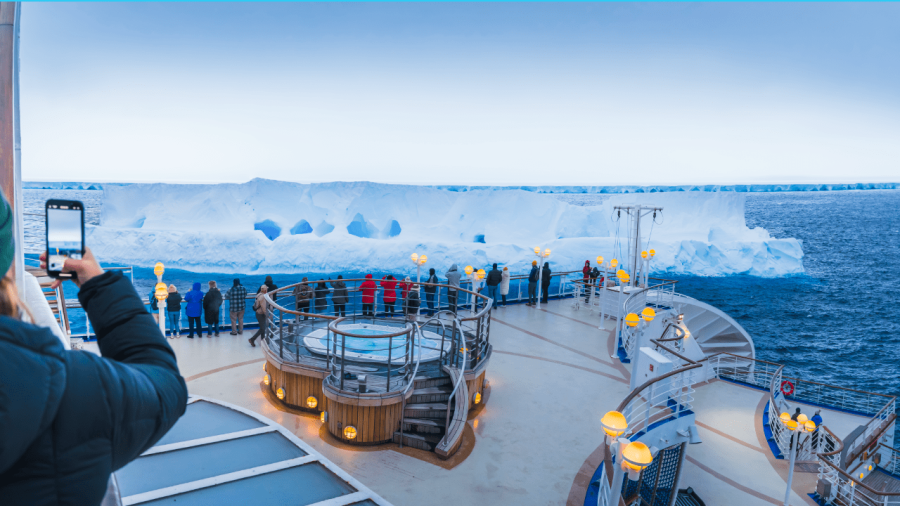
Antarctica is not just a destination, it’s an experience that stays with you. The first sight of towering icebergs, the sound of seabirds, the odours coming from the penguin rookeries, and the stillness of the landscape, were unlike anywhere else I’ve travelled to.
And now, you get to choose how you arrive.