

Cruise ship waiters are among the most visible crew members on any cruise.
They’re the friendly faces who greet you at breakfast, remember your coffee order at lunch, and guide you through multi-course dinners each evening. And because they seem to be everywhere at once, many guests are curious about how much they actually earn.

If you’re thinking about working at sea yourself, or simply want to understand where your gratuities go, it helps to know what affects a cruise ship waiter’s pay and what life is really like behind the scenes.
How Much Waiters Make
Rather than guessing at how much cruise waiters make, I’ve been able to pull together some research from the website Shiplife.
This is a site that covers all kinds of information about working on cruise ships – and it allows cruise staff to anonymously share details of their salary, to help others find out how much they could earn in a similar career.

From that data, I’ve been able to work out some averages for you.
- Junior/Assistant Waiters: $1,210 per month
- Senior Waiters: $1,435 per month
- Head Waiters/Team Leaders: $1,965 per month
- Room Service Waiters/Bell Person: $850 per month
These are base salary only – they don’t include tips, gratuities or commissions. Which is important, as you’ll see…
And of course, it varies quite a lot by cruise line. So read on for more info about which cruise lines pay the most, and the least.
Junior/Assistant Waiters
Junior or assistant waiters support the main dining team by carrying trays, resetting tables, serving drinks and helping with orders. It’s an entry-level position that involves long hours but offers a clear path to promotion.
The lowest reported monthly salary for a junior waiter was $550 for Celestyal Cruises.
The highest reported salaries for these positions are on Virgin Voyages, at $1,800.
| Cruise Line | Assistant Waiter Salary (USD) |
|---|---|
| Celestyal Cruises | 550 |
| Costa Cruises | 717 |
| Carnival Cruise Line | 770 |
| Adora Cruises | 850 |
| Marella | 850 |
| MSC Cruises | 850 |
| Crystal Cruises | 998 |
| Norwegian Cruise Line | 1,000 |
| Hapag-Lloyd | 1,100 |
| Disney Cruise Line | 1,160 |
| Holland America | 1,180 |
| P&O Cruises | 1,200 |
| Royal Caribbean | 1,200 |
| SAGA | 1,200 |
| Silversea | 1,350 |
| Regent Seven Seas | 1,400 |
| Celebrity Cruises | 1,500 |
| Hurtigruten | 1,500 |
| Oceania Cruises | 1,525 |
| Princess Cruises | 1,600 |
| Seabourn | 1,650 |
| Viking Cruises | 1,650 |
| Virgin Voyages | 1,800 |
Senior Waiters
Senior waiters are responsible for their own station, taking orders, managing guest relationships and ensuring meals run smoothly from start to finish. They typically earn more because they handle greater responsibility and receive a larger share of gratuities.

There’s less data for these roles – some cruise lines may only use assistants and heads. Of those that have salary information available, Aroya Cruises pays least but Princess Cruises pays quite generously.
| Cruise Line | Senior Waiter Salary (USD) |
|---|---|
| Aroya Cruises | 971 |
| MSC Cruises | 978 |
| Norwegian Cruise Line | 1,100 |
| Carnival Cruise Line | 1,200 |
| Cunard Line | 1,400 |
| Hurtigruten | 1,500 |
| P&O Cruises | 1,550 |
| Seabourn | 1,700 |
| Crystal Cruises | 1,800 |
| Princess Cruises | 1,950 |
Head Waiters/Team Leads
Head waiters oversee sections of the dining room, support the wider service team and handle any guest issues or special requests. Their role is more supervisory, and they often earn higher gratuities thanks to their leadership position.
Costa Cruises pays $760 for this senior role, while Virgin Voyages offers over 4x that amount, at $3,225.
| Cruise Line | Head Waiter Salary (USD) |
|---|---|
| Costa Cruises | 760 |
| Fred Olsen | 900 |
| Celestyal Cruises | 1,300 |
| Carnival Cruise Line | 1,400 |
| Cunard Line | 1,500 |
| TUI Cruises | 1,520 |
| Disney Cruise Line | 1,540 |
| Silversea | 1,600 |
| Celebrity Cruises | 1,615 |
| MSC Cruises | 1,700 |
| Phoenix Reisen | 1,775 |
| Royal Caribbean | 1,780 |
| Holland America | 1,925 |
| Princess Cruises | 2,000 |
| P&O Cruises | 2,025 |
| Norwegian Cruise Line | 2,025 |
| Azamara | 2,400 |
| Regent Seven Seas | 2,500 |
| Seabourn | 2,700 |
| Oceania Cruises | 2,900 |
| Viking Ocean | 2,970 |
| Crystal Cruises | 3,150 |
| Virgin Voyages | 3,225 |
Room Service Waiters
Room service waiters deliver meals directly to guests’ cabins, often working across a 24-hour schedule depending on the ship.

Earnings can vary widely as tipping behaviour differs for in-cabin service compared to the dining room.
| Cruise Line | Room Service Waiter Salary (USD) |
|---|---|
| Costa Cruises | 625 |
| MSC Cruises | 625 |
| Celestyal Cruises | 780 |
| Royal Caribbean | 829 |
| Disney Cruise Line | 850 |
| Viking Ocean | 850 |
| Norwegian Cruise Line | 878 |
| AIDA | 930 |
| Carnival Cruise Line | 958 |
| Celebrity Cruises | 1,200 |
Factors That Impact Wages For Cruise Waiters
Cruise ship waiters don’t all earn the same amount. Their income varies considerably depending on the cruise line, the region where the ship sails, their level of experience and the type of dining venue they work in.
One of the biggest influences is the cruise line itself.
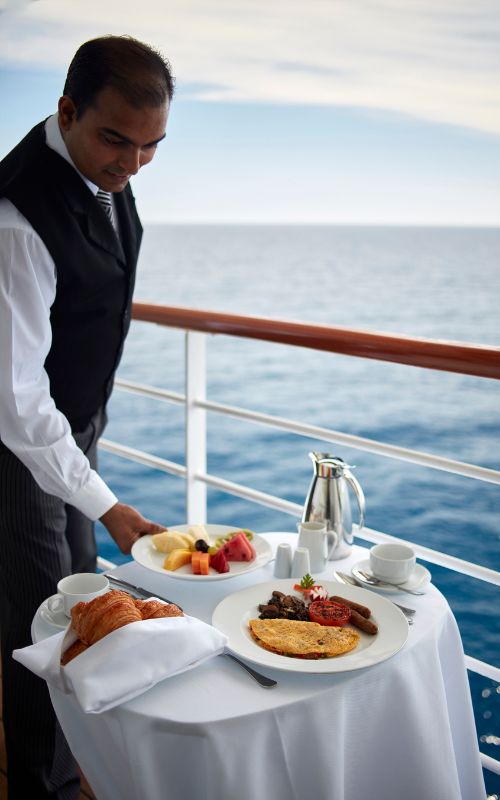
Luxury brands such as Regent Seven Seas, Silversea and Seabourn tend to offer higher basic wages and more generous tipping environments.
Mainstream lines like Carnival, Royal Caribbean, Norwegian and MSC generally sit somewhere in the middle, although earnings can still be excellent when gratuities are strong.
Smaller or budget-focused cruise lines can offer lower starting pay, though this may be balanced out by an attractive itinerary or faster career progression.
Where the ship is sailing also matters more than people realise. North American passengers typically tip more readily, and that can have a noticeable effect on a waiter’s total monthly income.

Cruises in the Caribbean, Alaska or Mexico are often the most lucrative.
By contrast, cruises departing from Australia or parts of Europe can result in lower take-home pay simply because tipping culture differs from region to region.
Experience plays an important role too. Junior waiters usually assist more senior team members, and so their share of the gratuity pool is smaller.
Once promoted to a full waiter, earnings increase significantly. Head waiters, who oversee larger sections of the dining room, can earn more again thanks to additional responsibility and a larger share of service charges.

It’s also worth noting that not all restaurant roles are equal.
Those working in speciality dining venues often earn more because guests are more inclined to tip after a fine-dining meal.
Main Dining Room waiters, on the other hand, rely heavily on the standard gratuity system. Buffet roles tend to be the least well paid because tipping is much less common in a self-service environment.
Tips For Cruise Waiters
Tips form a major part of a cruise ship waiter’s earnings. Most cruise lines add an automatic daily gratuity to every guest’s account, and a large portion of this goes directly to the dining team, including waiters, assistant waiters and head waiters.
On lines such as Royal Caribbean, this service charge is around US $18.50 to US $21.00 per person, per day, depending on the cabin category.

This is pooled and shared among hundreds of front-of-house crew. When guests remove this charge – which cruise lines strongly discourage – it reduces the entire pot, not just the income of the waiter who happened to serve that table.
Suggested read: Can You Refuse Cruise Gratuities?
Many guests do still choose to give additional cash tips, particularly at the end of longer cruises when they’ve built a rapport with their waiter.
For some crew members these extra envelopes can make a measurable difference, especially during peak holiday seasons or on voyages with a large number of returning cruisers.

Speciality dining restaurants are another source of additional income. While a service charge is usually included, diners often add something extra for particularly attentive service, and those working in these venues can see a meaningful boost in their monthly pay.
Working Hours for Cruise Ship Waiters
To understand a waiter’s salary, you also have to consider their working hours. A typical day can stretch from early morning until late evening, with only short breaks in between. Most waiters work every day for the duration of their contract, which normally lasts between six and nine months.
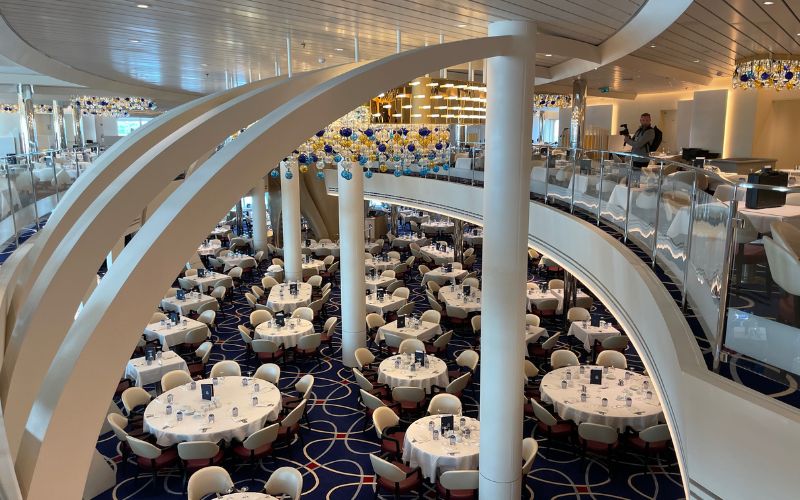
The day usually begins with breakfast service, followed by a short rest before lunch.
After another brief gap they return to prepare the dining room ahead of dinner, which is the busiest and most time-consuming shift. Even once the final course has been served there are still tables to reset, side stations to organise and cleaning tasks to complete.
All in all, many waiters work between ten and sixteen hours each day. It’s physically demanding work involving heavy trays, thousands of steps and constant interaction with guests.
But for those who thrive in a fast-paced environment and enjoy providing good service, it can also be an incredibly rewarding career.
Benefits That Add to the “Real” Salary
When comparing cruise ship salaries to land-based hospitality jobs, it’s important to factor in the difference in living costs.
Cruise ship employees have very few expenses while working at sea, which means they’re often able to save a far greater proportion of their earnings.

Accommodation, food and laundry are provided at no cost. Medical care on board is free, uniforms are supplied, and crew are offered discounted drinks in the crew bar.
Part of the reason that medical care is covered is because waiters – and all crew – undergo very strict medicals before they begin a contract. So any illness or medical issue onboard isn’t going to be as a result of something pre-existing – meaning cruise lines are more inclined to pay.
Read more: Cruise Ship Waiter Reveals The Intense Medical Exams They Have To Pass
Many cruise lines also pay for flights to and from the ship at the start and end of each contract, which is a huge saving for anyone travelling from overseas.
Because they aren’t paying rent, utility bills, transport costs or groceries, many waiters are able to save far more than they could working in a land-based restaurant – especially if they receive strong gratuities during their contract.
Some waiters report that they are able to only spend their tips and send all of their salary home to their families.
How Cruise Waiter Pay Compares to Other Cruise Ship Jobs
Waiters generally sit somewhere in the middle of the cruise-ship pay scale.
Their earnings can be very good when tips are strong, meaning they often earn more than youth staff, room stewards, buffet attendants and some bar staff.
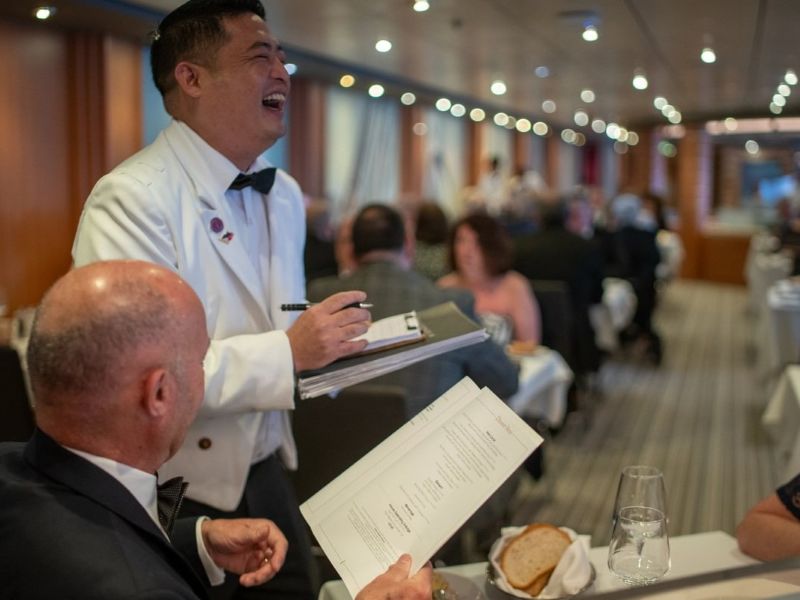
However, they typically earn less than casino staff, spa employees, chefs, dancers, nurses, engineers and the ship’s senior officers.
It’s a role with a wide earning range and excellent potential, but it isn’t one of the very highest-paid positions on board.
Here are some average salaries, as a comparison:
| Job | Approximate monthly earnings |
|---|---|
| Doctor | $9,750 |
| Chief engineer | $9,000 |
| Captain | $8,200 |
| Guest entertainer | $6,000 |
| Firefighter | $5,300 |
| Nurse | $5,100 |
| Cruise director | $4,900 |
| Chef | $3,650 |
| Massage therapist | $3,650 |
| Casino dealer | $3,300 |
| Waiter | $3,300 |
| Beauty therapist | $3,300 |
| Nail technician | $3,300 |
| Hairdresser | $3,300 |
| Dancer | $3,100 |
| Gift shop assistant | $2,400 |
| Photographer | $2,300 |
| Musician | $2,150 |
| Plumber | $2,150 |
| Bartender | $2,000 |
| Youth staff | $2,000 |
| Room steward | $2,000 |
| Security guard | $1,600 |
Read more: How Much Do Cruise Ship Workers Make?
How to Become a Waiter on a Cruise Ship
Most cruise lines require previous experience in a hotel or restaurant, together with strong English-language skills and a proven ability to deliver friendly, professional service. Working on a ship also requires a good level of physical fitness, as the long hours and constant movement can be demanding.
Applicants must hold a valid passport and will need to pass medical checks before joining the ship. They also need to be comfortable living in close quarters, sharing a cabin and working away from home for months at a time.

Recruitment is usually done either through a cruise line’s own careers website or via approved hiring partners in different regions. Some positions are filled internally too, with buffet staff or assistant waiters being promoted into more senior roles.
Pros and Cons of Being a Cruise Ship Waiter
Being a waiter on a cruise ship can offer excellent earning potential, especially when gratuities are high.
Crew also enjoy very low living costs and the opportunity to travel to destinations they may never otherwise visit.

Many waiters progress quickly into more senior roles, and for those who enjoy hospitality it can be an exciting international career.
However, the job is not without its challenges. The hours are long, days off are rare, and living conditions can be tight.
Income can vary from one contract to the next depending on the itinerary and passenger mix, and time away from family can be difficult, particularly on longer contracts.
TODAY’S BEST CRUISE DEALS!
Don’t miss these offers…
Final Word
Cruise ship waiters work incredibly hard, but the rewards can be substantial – especially once gratuities and the lack of living expenses are taken into account.
It’s a role that offers the chance to save well, gain valuable experience and see the world at the same time.
For anyone considering a career at sea, it’s worth weighing up the long hours and lifestyle alongside the financial benefits. For many, the opportunity to travel while earning a strong income makes it a compelling choice.
Related Posts
If you found this interesting, please share!

Source link