The least crowded cruise ships are the ones with the most space per guest, measured by the passenger space ratio: a ship’s gross tonnage divided by its guest count at double occupancy. Small luxury ships score between 70 and over 100. The roomiest mainstream ships, such as Disney’s newest ships and Cunard’s Queen Mary 2, score in the mid-50s. Most Carnival ships sit around 32 to 34.
Free: download our 2027 Luxury Cruise Calendar →
Below we explain how the ratio works and compare 21 current ships, worked out from published tonnage and capacity figures as of October 2026. We also cover the things the ratio does not tell you, which can matter just as much once you are on board.
What Is the Passenger Space Ratio?
The passenger space ratio (PSR), also called the space-to-guest ratio, is a quick way to compare how much room each guest gets on different ships. The formula is simple:
Space ratio = gross tonnage ÷ guests at double occupancy
Gross tonnage (GT) sounds like weight, but it is not. It measures a ship’s total enclosed volume, so it covers cabins, restaurants, theatres, corridors, crew areas and machinery spaces. One gross ton is roughly 100 cubic feet (about 2.83 cubic metres) of enclosed space. Open decks are not counted.
Double occupancy means two guests in every cabin. Cruise lines use this figure as their standard capacity, and it is the fairest basis for comparison. In practice many cabins hold a third or fourth guest, which is why the figures in our second table also matter.
As a rough guide:
- Under 30: likely to feel busy at peak times
- 30 to 40: typical of high-capacity mainstream ships
- 40 to 50: roomy for a big ship
- 50 to 70: premium and upper-premium territory
- 70 and above: luxury ships, where queues are rare
Cruise Ship Space Ratio Comparison (2026)
We worked out every ratio in this table ourselves, using each ship’s gross tonnage and standard (double-occupancy) capacity from the cruise lines, shipyard announcements and reputable maritime sources. Published figures can differ slightly between sources, and refits change them, so treat the ratio as accurate to within a point or so.
| Ship | Cruise line | Gross tonnage | Guests (double occupancy) | Space ratio |
|---|---|---|---|---|
| Ilma | Ritz-Carlton Yacht Collection | 46,750 | 448 | 104.4 |
| Silver Ray | Silversea | 54,700 | 728 | 75.1 |
| Seven Seas Grandeur | Regent Seven Seas | 55,254 | 746 | 74.1 |
| Explora I | Explora Journeys | 63,900 | 922 | 69.3 |
| Disney Destiny | Disney Cruise Line | 144,000 | 2,508 | 57.4 |
| Allura | Oceania Cruises | 68,000 | 1,200 | 56.7 |
| Queen Mary 2 | Cunard | 149,215 | 2,695 | 55.4 |
| Viking Star | Viking | 47,800 | 930 | 51.4 |
| Disney Adventure | Disney Cruise Line | 208,108 | 4,222 | 49.3 |
| Legend of the Seas | Royal Caribbean | 250,800 | 5,610 | 44.7 |
| Icon of the Seas | Royal Caribbean | 248,663 | 5,610 | 44.3 |
| Norwegian Aqua | Norwegian Cruise Line | 156,300 | 3,571 | 43.8 |
| Celebrity Xcel | Celebrity Cruises | 141,420 | 3,260 | 43.4 |
| MSC World America | MSC Cruises | 216,638 | 5,228* | 41.4 |
| Sun Princess | Princess Cruises | 177,882 | 4,300 | 41.4 |
| MSC Seashore | MSC Cruises | 170,412 | 4,540 | 37.5 |
| Rotterdam | Holland America Line | 99,935 | 2,668 | 37.5 |
| Norwegian Getaway | Norwegian Cruise Line | 145,655 | 3,963 | 36.8 |
| Carnival Celebration | Carnival Cruise Line | 183,521 | 5,374 | 34.1 |
| Carnival Paradise | Carnival Cruise Line | 71,925 | 2,124 | 33.9 |
| Carnival Venezia | Carnival Cruise Line | 135,225 | 4,208 | 32.1 |
*MSC does not widely publish a double-occupancy figure for MSC World America, so we used two guests in each of its 2,614 cabins.
A few things stand out. The two biggest ships in the world, Royal Caribbean’s Icon-class ships, have more space per guest than many smaller ships. Disney’s ships have the most space of any mainstream line because the line designs its cabins for families and counts only two guests per cabin in its standard figure. Carnival is at the bottom of the major US lines on almost every ship, old or new.

The Least Crowded Cruise Ships and Lines
Luxury lines: the most space per guest
If crowds are your main worry, a luxury ship is the surest fix. Ritz-Carlton’s Ilma works out at over 100 gross tons per guest, more than three times the figure for a typical Carnival ship. Silversea’s Silver Ray (about 75), Regent’s Seven Seas Grandeur (about 74) and Explora I (about 69) are not far behind. These ships also carry far more crew per guest, so you will rarely wait at a bar or for a table. If you are choosing between the top lines, our Silversea vs Seabourn comparison covers the differences beyond space.
Upper-premium options at a lower price
Oceania’s Allura (about 57) and Viking’s ocean ships (about 51 on the original Viking Star design) offer generous space and an adults-focused feel for less than full luxury fares. Viking does not allow guests under 18, which also keeps pool decks quiet.
Least crowded mainstream cruise lines
- Disney Cruise Line: Disney Destiny and Disney Wish work out at about 57, the best of any big-ship line. Disney Adventure, which started sailing from Singapore in March 2026, comes in at about 49.
- Cunard: Queen Mary 2 (about 55) is an ocean liner built with wide public rooms and long promenades. Cunard’s newer Queen Anne is far less roomy, at about 38.
- Royal Caribbean: Icon of the Seas and Legend of the Seas, delivered in June 2026, both sit around 44 to 45.
- Norwegian and Celebrity: Norwegian Aqua (about 44) and Celebrity Xcel (about 43) are among the roomiest new ships from these lines. Older Norwegian ships, such as Norwegian Getaway (about 37), are tighter.
- Princess and Holland America: Sun Princess (about 41) and Rotterdam (about 37.5) have middling ratios. They often feel calmer than the numbers suggest because they carry fewer children and have less going on at night.
The Most Crowded Cruise Ships Among Major Lines
At the other end of the scale, Carnival’s ships are consistently the most densely filled among the big US lines. Carnival Venezia, which was built as a Costa ship and now sails from New York, works out at about 32. Carnival Celebration (about 34) and the older Carnival Paradise (about 34) are similar. MSC’s Seaside-class ships, such as MSC Seashore (about 37.5), are also on the busier side.
A lower ratio does not mean a bad cruise. Lower density is one reason these lines can offer low fares, and many guests are happy with a lively ship. A low space ratio is not the same as poor reviews, either: for ships that guests rate badly, see our separate guide to the worst cruise ships based on real reviews.
Why a Full Ship Can Feel Much More Crowded
This is the part most space ratio lists skip. Cruise lines quote capacity at double occupancy, but many cabins sleep three, four or more. During school holidays family ships often sail well above their double-occupancy figure. The table below shows what happens to the ratio when every berth is filled.
| Ship | Ratio at double occupancy | Maximum guests | Ratio when completely full |
|---|---|---|---|
| Icon of the Seas | 44.3 | 7,600 | 32.7 |
| Disney Destiny | 57.4 | 4,116 | 35.0 |
| Disney Adventure | 49.3 | 6,700 | 31.1 |
| Celebrity Xcel | 43.4 | 3,937 | 35.9 |
| MSC World America | 41.4 | 6,764 | 32.0 |
| Carnival Celebration | 34.1 | 6,500 | 28.2 |
| Carnival Venezia | 32.1 | 5,260 | 25.7 |
Carnival Venezia drops to about 26 when completely full, and Disney Adventure’s large number of family cabins means its ratio falls from 49 to about 31. Icon of the Seas falls from 44 to about 33. Ships rarely sail with every bunk taken, but summer, spring break and Christmas sailings come closest. If you want space, pick term-time dates when fewer cabins hold third and fourth guests.
Other Factors That Affect How Crowded a Ship Feels
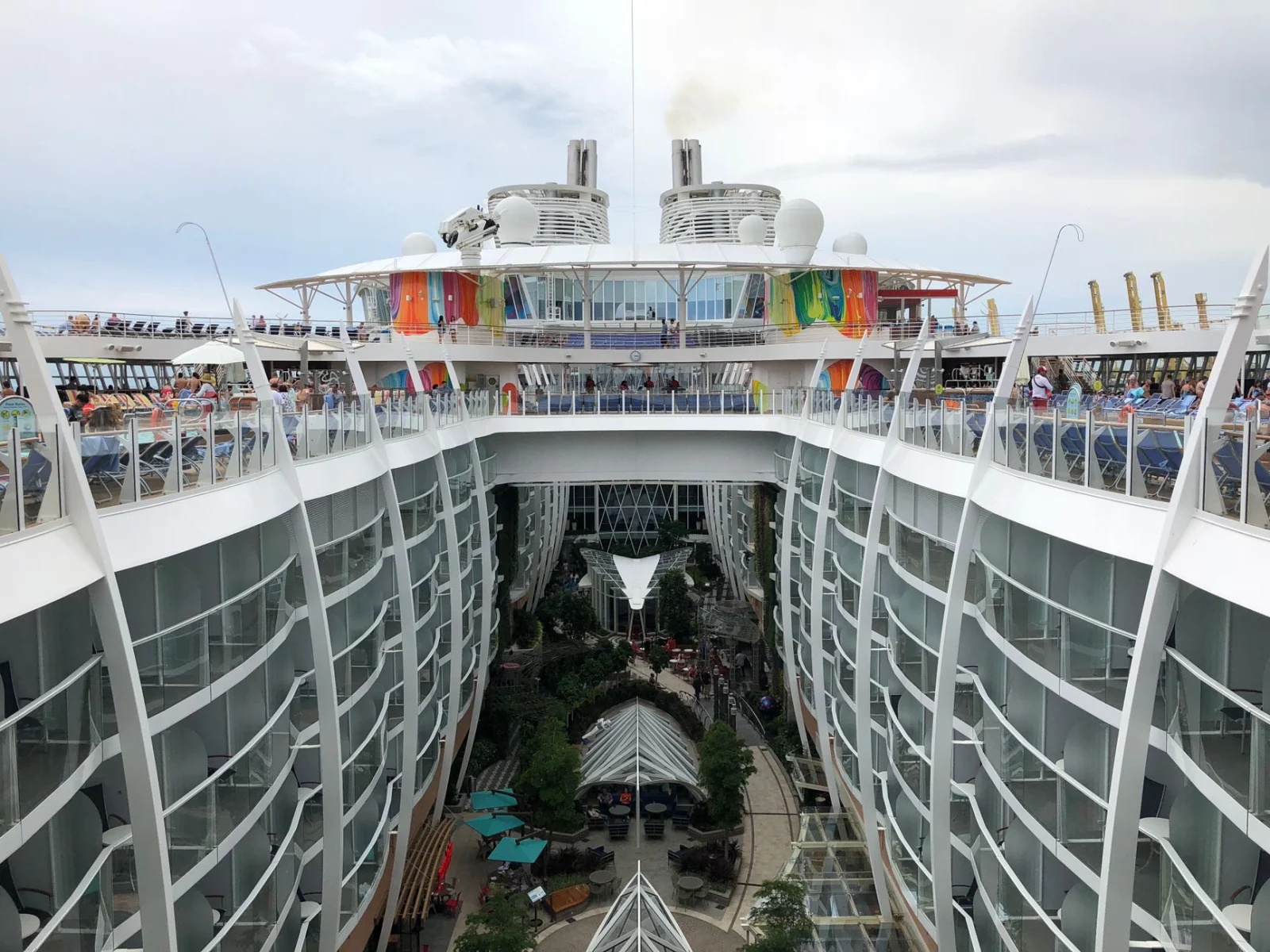
- Layout and flow. Ships divided into “neighborhoods”, such as Royal Caribbean’s Oasis and Icon classes, spread people out. Ships with one central atrium and a single main pool deck bunch people together.
- Number of venues. More restaurants, bars and pools mean shorter queues, even with the same ratio. Buffets at breakfast and pools at noon on sea days are the usual pinch points.
- Itinerary. Port-heavy cruises empty the ship each day. Sea days and short weekend cruises fill pool decks.
- Private enclaves. MSC Yacht Club, NCL’s The Haven and Celebrity’s Retreat give suite guests their own pools, lounges and restaurants, so their space ratio is far better than the ship average. For everyone else on board the ratio is slightly worse, because the enclave takes space out of the shared areas.
- Crew-to-guest ratio. More crew means faster service, quicker embarkation and fewer queues, which feels like more space.
- Ship design. Some of the tonnage is behind the scenes, such as large theatres, water parks or big crew areas. Two ships with the same ratio can feel quite different.
How to Find a Less Crowded Cruise
- Check the space ratio first. Divide the gross tonnage by the double-occupancy capacity on the line’s ship page.
- Sail outside school holidays. Late April to May and September to early December are usually quieter on Caribbean and Mediterranean routes.
- Choose longer cruises. Sailings of 10 nights or more attract fewer families and fewer short-break party groups.
- Use port days. Staying on board when most guests go ashore gives you pools, spas and lounges almost to yourself.
- Eat at off-peak times. Late breakfast, an early lunch or the main dining room instead of the buffet avoids the worst queues.
- Consider a suite enclave on a big ship if you want megaship attractions with a quiet place to retreat to.
FAQs
What is a good passenger space ratio on a cruise ship?
Below about 30 tends to feel busy, 35 to 45 is typical for modern mainstream ships, and 50 or more feels noticeably spacious. Luxury ships usually sit between 60 and 100-plus.
Which cruise ships are the least crowded?
By the numbers, small luxury ships such as Ritz-Carlton’s Ilma, Silversea’s Silver Ray, Regent’s Seven Seas Grandeur and Explora I have the most space per guest. In the mainstream market, Disney’s Wish-class ships and Cunard’s Queen Mary 2 score highest.
Which mainstream cruise ships are the most crowded?
Carnival ships generally have the lowest ratios among big US lines, from about 32 to 34 at double occupancy. Carnival Venezia works out at about 32, and drops to around 26 if every bunk is filled.
What month are cruise ships least crowded?
Ships are usually fullest during school holidays: summer, Christmas, New Year and spring break. Sailings in late April and May, or September to early December (outside Thanksgiving week), tend to carry fewer children and fewer third and fourth guests per cabin, so the ship feels quieter.
Is a bigger cruise ship more crowded?
Not necessarily. Icon of the Seas carries far more people than Carnival Paradise, yet it has more space per guest. The ratio, the layout and how full the ship is matter more than raw size.