
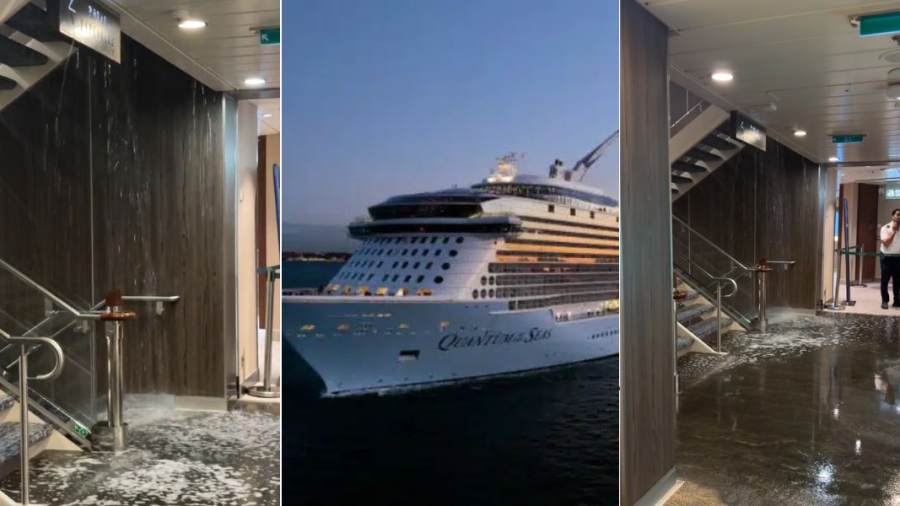
A water leak aboard Royal Caribbean’s Quantum of the Seas created an unexpected waterfall down a public stairwell near the ship’s Royal Esplanade during a recent Mexican Riviera voyage.
The incident, which appears to have been caused by a burst pipe near a restroom facility, was quickly contained by crew members with no lasting impact on subsequent sailings.
Passengers aboard Quantum of the Seas documented the dramatic scene as water cascaded down one of the vessel’s public stairwells, creating what appeared to be an impromptu waterfall in the heart of the ship.
Video footage posted to social media shows water flowing from upper decks and pooling at the base of stairs near the Royal Esplanade, the central public space aboard Quantum-class vessels where shops and dining venues are concentrated.
The Royal Esplanade spans Decks 4 and 5 on Quantum of the Seas, serving a similar function to the Royal Promenade found on many other Royal Caribbean ships. This area typically serves as the social hub of the vessel, making the location of the leak particularly visible to passengers moving through the ship.
Crew members can be seen in the footage already responding to the situation, placing barriers to redirect foot traffic even as water continued to accumulate. The swift response demonstrates the protocols cruise lines have in place for such mechanical failures.
Burst Pipe Near Restroom Identified As Likely Culprit
Passengers who witnessed the incident have clarified that the flooding originated from a burst pipe located near the men’s restroom at the midship elevators on Deck 5. The leak occurred whilst the ship was sailing near Cabo San Lucas during stormy weather, leading some to initially speculate that weather conditions might have contributed to the problem.
However, guests aboard the sailing confirmed that the storm was merely coincidental timing rather than the cause of the pipe failure. “It was a burst pipe by the men’s room at the midship elevators, the storm was coincidence,” noted one passenger who experienced the incident firsthand.
Burst pipes aboard cruise ships, whilst certainly inconvenient, are not uncommon mechanical failures given the extensive plumbing systems required to service thousands of guests and crew members. Modern cruise ships contain miles of piping carrying fresh water, grey water, and sewage throughout multiple decks, with constant pressure and usage creating potential failure points over time.
Timeline Of Incident Remains Somewhat Unclear
The precise date of the water leak has proven difficult to pinpoint with absolute certainty. The video was posted to social media on 4th September 2026, with the original poster indicating the incident occurred “last week.”
However, passengers involved in online discussions about the leak suggested it actually took place closer to 25th August 2026, nearly two weeks before the video appeared online. This discrepancy highlights how news of shipboard incidents can sometimes take time to circulate beyond those directly affected.
Adding to the timeline confusion, passengers on Quantum of the Seas’ subsequent sailing departing on 31st August 2026 reported no visible signs of any water damage whatsoever. One guest specifically commented that upon boarding for the four-night cruise from 31st August to 4th September, there were “absolutely no signs of a prior water leak whatsoever.”
Additionally, no photographs or discussions of flooding appeared in the dedicated Facebook community group for the 31st August sailing, suggesting either that the leak occurred earlier or that repairs were completed extraordinarily quickly.
Rapid Cleanup Leaves No Trace For Following Passengers
The efficiency of Royal Caribbean’s maintenance and housekeeping teams appears evident from passenger reports following the incident. Despite what the video shows as substantial water accumulation in a public area, subsequent guests found the affected spaces completely restored.
This rapid response reflects standard industry practice when dealing with water emergencies aboard cruise ships. Specialised equipment including industrial wet-dry vacuums, dehumidifiers, and air movers can dry out affected areas within hours, whilst maintenance crews simultaneously address the source of the leak.
The fact that no itinerary changes were necessary and that following sailings proceeded without issue suggests the damage was contained to cosmetic and easily repairable elements. Had the pipe failure affected critical systems or caused structural concerns, Royal Caribbean would likely have needed to cancel or modify subsequent voyages whilst conducting more extensive repairs.
Royal Caribbean has not issued any public statement regarding the incident, which is typical for mechanical failures that are resolved quickly without passenger injury or significant disruption to operations.
Quantum Of The Seas Currently Operating Mexican Riviera Programme
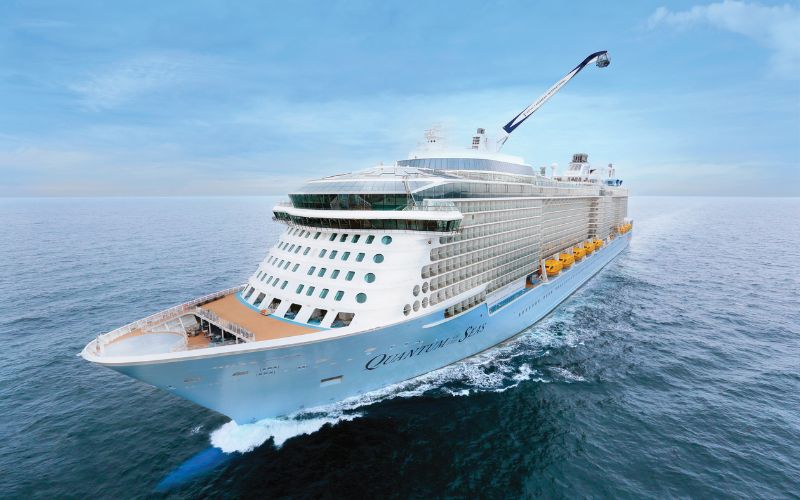
Quantum of the Seas, which accommodates 4,180 passengers at double occupancy, is currently homeported in Los Angeles offering a variety of Mexican Riviera itineraries. The 168,666-gross-tonne vessel has been sailing these routes through 22nd September 2026, providing West Coast passengers with convenient access to popular Mexican destinations.
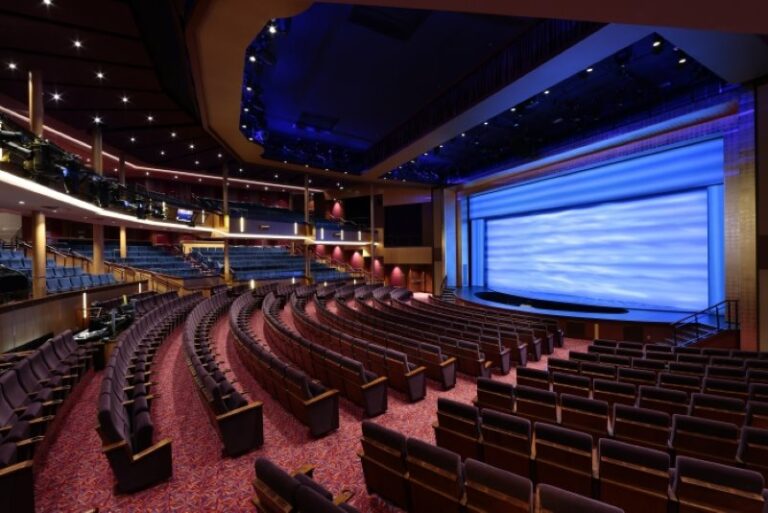
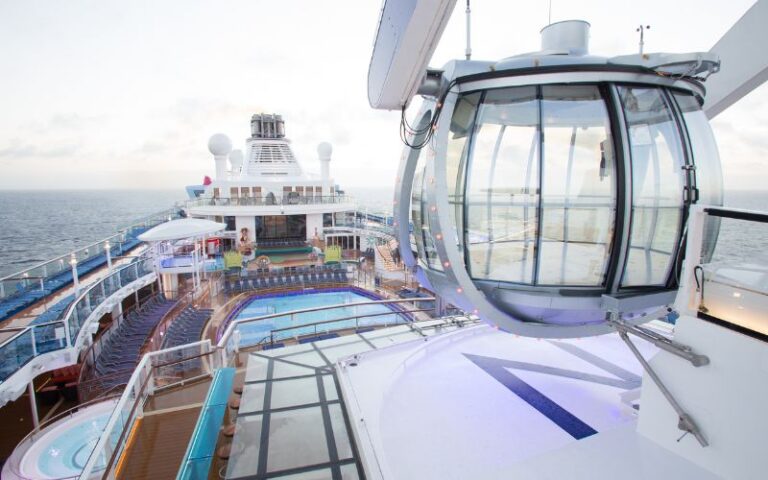
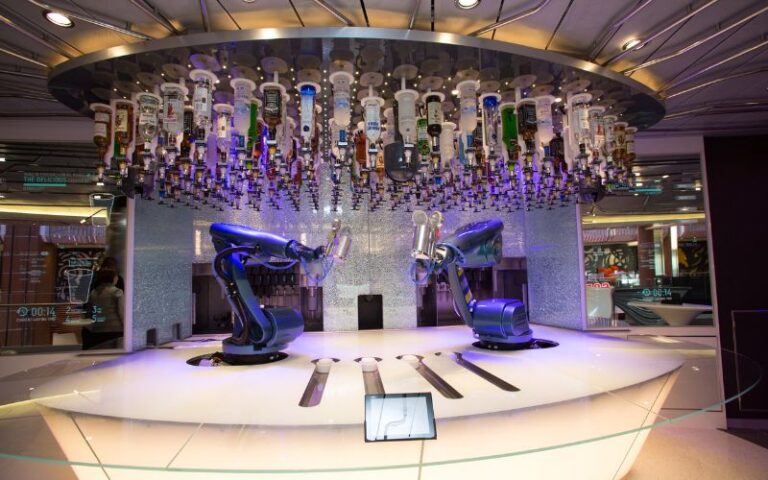
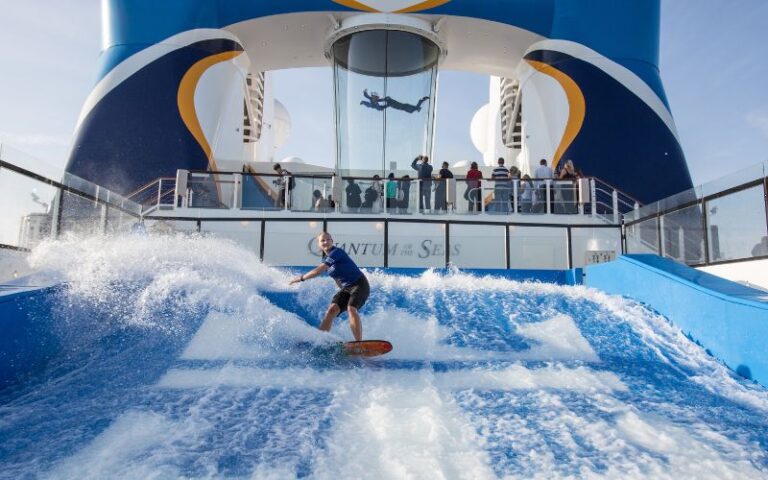
The ship represents Royal Caribbean’s Quantum class, which debuted in 2014 with innovations including the North Star observation capsule, RipCord by iFLY skydiving simulator, and the Two70 entertainment venue featuring transformative spaces and robotic screens. Quantum of the Seas specifically entered service in November 2014 and has sailed from various homeports around the world throughout her career.
Following the conclusion of her Mexican Riviera season, Quantum of the Seas is scheduled to embark on a repositioning voyage on 26th September 2026. This one-way journey to Brisbane will take passengers through ports in California, Hawaii, and French Polynesia, offering an extended transpacific cruise experience.
Extended Australian Season Planned Through April 2027
Once arriving in Brisbane, Quantum of the Seas will remain deployed in Australia through mid-April 2027, offering round-trip cruises to various South Pacific destinations. This seasonal deployment has become increasingly common for Royal Caribbean, which regularly positions ships in the Southern Hemisphere during the austral summer to capture demand from both local and international guests.
The extended Australian season allows the line to serve a market where cruise demand has grown substantially over the past decade. Australian passengers have demonstrated strong appetite for both short getaways and longer voyages exploring neighbouring islands and coastal destinations.
Following her Australian deployment, Quantum of the Seas will return to North American waters to operate seven-night Alaskan itineraries. This positioning places the vessel in one of cruising’s most popular seasonal markets, where demand for Inside Passage voyages remains consistently strong during the northern summer months.
Pattern Of Similar Incidents Across Multiple Cruise Lines
The Quantum of the Seas leak represents just one example of similar incidents occurring across the cruise industry with some regularity. On 28th July 2026, what appeared to be another burst pipe aboard Royal Caribbean’s Allure of the Seas caused extensive flooding affecting multiple guest staterooms.
That incident proved more disruptive than the Quantum leak, as water entered passenger accommodations rather than just public spaces. Guests affected by cabin flooding typically receive compensation including cabin upgrades, onboard credit, or future cruise credits depending on the severity of the impact to their voyage.
Beyond Royal Caribbean, other major cruise lines have experienced comparable water incidents in recent months and years. Princess Cruises’ Enchanted Princess dealt with a similar situation in May 2026, whilst MSC Cruises’ MSC Seaview experienced flooding in January 2026.
P&O Cruises’ Azura also encountered water issues in January 2025, demonstrating that these mechanical failures occur across vessels of varying ages and from different shipbuilders. The commonality of such incidents reflects the complexity of marine plumbing systems operating continuously in a saltwater environment with constant motion and vibration.
Multiple Causes Can Trigger Shipboard Flooding Events
Whilst burst pipes represent perhaps the most frequent cause of unexpected water accumulation aboard cruise ships, several other factors can lead to similar flooding situations. Sprinkler system malfunctions, whether triggered by false alarms or mechanical failures, can release substantial volumes of water into public spaces and staterooms.
Pool overflows present another potential source of flooding, particularly on ships with innovative water features or pools positioned on upper decks. Wave action in rough seas can cause pool water to slosh over edges faster than drainage systems can handle, sending water flowing into adjacent spaces.
Clogged or malfunctioning toilets, whilst less dramatic, can also cause significant localised flooding when waste water backs up into cabins. Given that modern mega-ships might have more than 2,000 bathrooms serving passengers and crew, the statistical likelihood of toilet-related issues occurring during any given cruise is relatively high.
Regardless of the specific cause, cruise line protocols emphasise immediate response to contain water damage, protect electrical systems, and restore affected areas to normal condition. Crew members receive training on emergency response procedures, and ships carry extensive supplies of repair materials and drying equipment specifically for addressing such situations.
The maritime environment presents unique challenges for maintaining complex mechanical systems, with salt air, constant motion, and intensive daily use all contributing to wear on plumbing, electrical, and HVAC systems. Modern cruise ships represent floating cities requiring the infrastructure to support thousands of occupants, making occasional failures an accepted operational reality that lines plan for and address as efficiently as possible.
For passengers concerned about such incidents, travel insurance policies with trip interruption coverage can provide financial protection should flooding or other mechanical issues significantly impact a cruise experience. However, the industry’s strong track record of rapid response means most water leaks result in minimal passenger impact beyond temporary inconvenience.
Want the best Royal Caribbean deal?
Get a free quote from Cruise Mummy’s trusted travel agent, with exclusive onboard credit and expert help at no extra cost.