
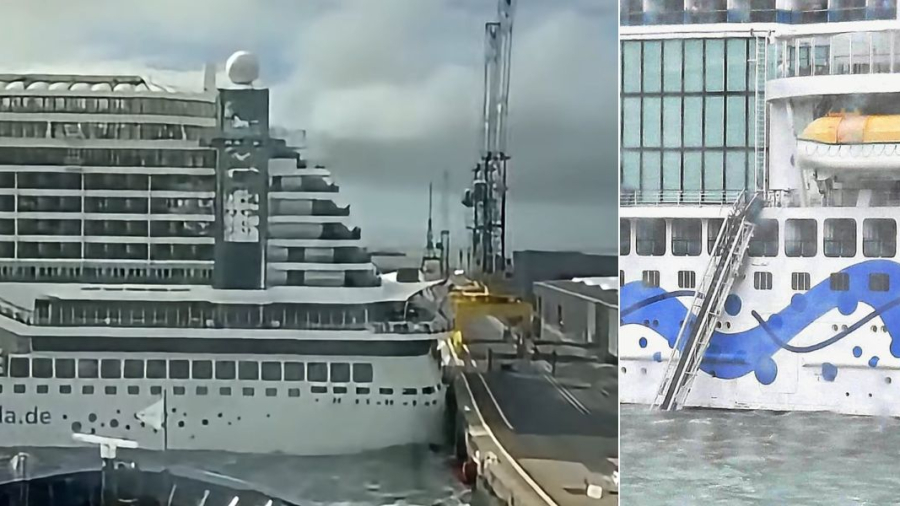
AIDA Cruises’ AIDAperla broke free from her berth in Le Havre, France, on 8th September 2026. This occurred after strong winds severed the ship’s forward mooring lines, causing the vessel to drift backwards and strike a quay wall.
No injuries were reported among passengers or crew, but the 3,286-guest vessel missed her next scheduled port call in Zeebrugge whilst undergoing inspections and awaiting clearance from the classification society.
The incident unfolded around 4:00 p.m. local time. AIDAperla was berthed at the Port of Le Havre during a 7-night cruise that had departed Hamburg on 5th September.
Weather Underground records indicate wind gusts reached approximately 35 miles per hour during Tuesday afternoon, creating hazardous conditions in the harbour. Witness videos shared on social media captured the moments immediately following the mooring line failure.
The footage shows the 125,572-tonne vessel drifting backwards after breaking free, with her stern making contact with the quay infrastructure. The impact appeared to occur relatively slowly as the ship was pushed by the wind, but the sheer size of the vessel meant even slow-speed contact could cause significant damage.
Gangways Torn Away as Vessel Drifts in Harbour
During the incident, both passenger gangways connecting the ship to the dock were torn away from their moorings as AIDAperla drifted. Photographs shared by passengers aboard the vessel show one gangway hanging precariously from the port side, creating a floating hazard in the harbour.
The gangway damage presented immediate logistical challenges for port authorities and the cruise line. Approximately 500 AIDAperla guests were ashore on organised excursions at the time of the incident and found themselves temporarily unable to return to their ship.
The floating debris also posed navigation risks to other vessels in the busy French port, which handles both commercial shipping and cruise traffic year-round.
Port Operations Suspended as Emergency Response Mobilised
HAROPA PORT, the authority managing Le Havre, temporarily closed harbour operations whilst emergency crews worked to secure the wayward vessel and clear obstructions from the water. Multiple tugboats were deployed to assist AIDAperla.
They worked to halt her drift and manoeuvre her back towards her original berth position. The port closure affected other vessels as well.
TUI Cruises’ Mein Schiff 3, which was also docked in Le Havre at the time, had to be held in position by tugboats to prevent a similar incident. The precautionary measures resulted in a two-hour departure delay for Mein Schiff 3 as port authorities worked to stabilise conditions and ensure safe navigation.
By 9:22 p.m., HAROPA PORT issued a statement confirming that AIDAperla had been successfully secured at her berth once again. Passengers who had been stranded ashore were safely boarding the vessel, and no injuries had been reported either aboard the ship or on the dock.
Navigation through the port gradually resumed as crews continued to assess the situation.
Comprehensive Inspections Required Before Departure Clearance
AIDA Cruises confirmed in official statements that the vessel made contact with the quay and is now undergoing thorough inspection by both the cruise line’s technicians and local authorities. The company emphasised passenger and crew safety as its top priority whilst assessments continue.
According to German media reports, AIDAperla also requires formal clearance from the responsible classification society before she can depart Le Havre.
Classification societies are independent organisations that establish and maintain technical standards for the construction and operation of ships. Their approval is mandatory following any incident that could affect a vessel’s structural integrity or seaworthiness.
The inspection process includes a detailed examination of the ship’s hull, particularly the stern section that made contact with the quay. Engineers must assess whether any plating was compromised, check for potential stress fractures, and verify that all systems remain fully operational.
Rudders, propellers, and steering mechanisms receive particular scrutiny following stern impacts.
Zeebrugge Call Cancelled as Ship Remains in French Port
AIDAperla had been scheduled to depart Le Havre at 8:00 p.m. on 8th September and continue to Zeebrugge, Belgium, for a port call on 9th September. Instead, the ship remained berthed in Le Havre whilst inspections were completed and necessary approvals obtained.
AIDA Cruises subsequently cancelled the Zeebrugge call, disappointing passengers who had anticipated exploring the Belgian coastal city or participating in excursions to nearby Bruges. The cancellation represents a significant itinerary disruption for guests aboard.
Zeebrugge serves as a popular gateway to Bruges, one of Europe’s most picturesque mediaeval cities, renowned for its canals, cobblestone streets, and well-preserved architecture. Many passengers would have booked the cruise specifically to visit this destination.
As of the latest information available, AIDAperla’s next scheduled port call in Rotterdam, Netherlands, remains set for 10th September. No further confirmed itinerary adjustments have been announced. The ship is still expected to return to Hamburg as originally planned on 12th September, completing the 7-night voyage despite the Le Havre incident.
AIDAperla’s Service History and Fleet Position
AIDAperla entered service in 2017 as part of AIDA Cruises’ Sphinx-class, which represents the German cruise line’s largest and most modern vessel category. Built by Mitsubishi Heavy Industries in Nagasaki, Japan, the ship measures 300 metres in length and features 1,643 passenger cabins across 15 decks.
The vessel can accommodate 3,286 passengers at double occupancy, with a maximum capacity of approximately 3,700 guests when all berths are filled. She is staffed by roughly 900 international crew members who maintain operations and service standards across the ship’s extensive facilities.
These include multiple restaurants and bars, expansive spa and fitness facilities, numerous entertainment venues, and the distinctive AIDA Beach Club area that has become a signature feature of the line’s newer ships.
AIDAperla primarily operates Northern European and Mediterranean itineraries throughout the year. During summer months, she typically focuses on routes visiting the Baltic Sea, Norwegian fjords, and Western European ports. Winter seasons see her repositioned to warmer Mediterranean waters, calling at destinations throughout the region.
Carnival Corporation’s German Market Leadership

AIDA Cruises serves as Carnival Corporation’s German-market brand, holding the largest market share for cruise holidays among German-speaking passengers. The company has built its reputation on offering casual, active holidays with a distinctly German atmosphere aboard ship.
This includes German-language entertainment, cuisine tailored to Central European tastes, and itineraries designed for the preferences of German travellers. The AIDA fleet currently comprises 12 ships ranging from the smaller AIDAcara, which entered service in 1996, to the newest vessels in the Hyperion and Helios class.
The company has historically been an innovator in European cruising, pioneering the “club ship” concept that emphasises informal dining, active pursuits, and a younger demographic than traditionally associated with cruising.
Carnival Corporation, AIDA’s parent company, is the world’s largest cruise operator, with a portfolio including nine cruise line brands serving guests across every major market globally. The conglomerate’s scale means incidents affecting any of its vessels receive significant attention from industry observers, maritime authorities, and the travelling public.
Weather-Related Mooring Incidents Continue Industry Challenge
Mooring line failures during adverse weather conditions represent an ongoing challenge for the cruise industry. This is particularly true as climate patterns produce more frequent extreme weather events.
Modern cruise ships, whilst featuring advanced stabilisation and propulsion systems, remain vulnerable when berthed. This is especially true if wind speeds exceed the capacity of mooring equipment to hold them securely.
Ports worldwide have implemented enhanced procedures for monitoring weather conditions. This includes adjusting berth assignments or requiring additional tugboat support when forecasts indicate challenging conditions.
However, wind events can develop quickly or prove stronger than anticipated, sometimes overwhelming standard precautions. The AIDAperla incident joins several similar occurrences in recent years.
Strong winds have caused berthed cruise ships to break free from moorings. In most cases, as with AIDAperla, prompt tugboat response and professional harbour management prevent serious consequences. However, itinerary disruptions and inspection requirements are common results.
Maritime safety protocols require conservative approaches following any contact incident. Even when visible damage appears minimal, the potential for unseen structural stress or compromised watertight integrity necessitates thorough professional assessment before a vessel returns to service.
Passengers Face Itinerary Disruption and Compensation Questions
Guests aboard AIDAperla now face altered cruise plans, with the Zeebrugge call completely eliminated from their voyage. Under European Union passenger rights regulations and AIDA Cruises’ own policies, passengers may be entitled to compensation or onboard credits when scheduled ports are missed due to operational issues.
The specific compensation arrangements will likely depend on whether AIDA Cruises classifies the incident as falling under force majeure provisions. These typically exempt cruise lines from compensation obligations when circumstances are beyond their control.
Weather events generally qualify as force majeure, though the specific legal interpretations can vary. Some passengers aboard were likely booked for back-to-back voyages, combining the current 7-night sailing with the subsequent 7-night cruise departing Hamburg on 12th September for a combined 14-night holiday.
AIDA Cruises commonly markets these combined itineraries, allowing guests to experience extended voyages with varied ports of call. These passengers face particular uncertainty as they await confirmation that inspections will be completed in time for the next scheduled departure.
The following voyage is set to visit Norwegian ports including Bergen, Nordfjordeid, Alesund, and Stavanger before returning to Hamburg on 19th September. Any delay in clearing AIDAperla for service would create cascading effects for those passengers and could potentially impact subsequent sailings as well.
TODAY’S BEST CRUISE DEALS!
Don’t miss these offers…