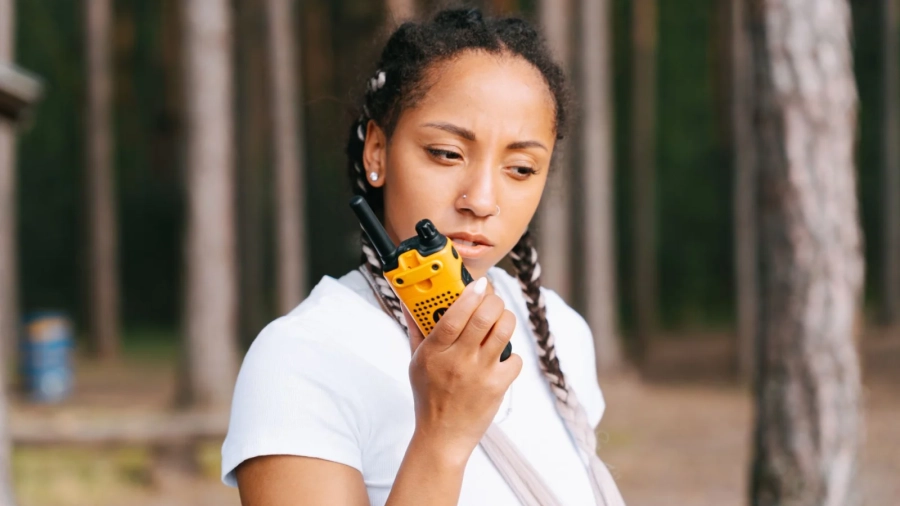
The best walkie-talkies for cruise ships are simple, licence-free FRS radios from brands such as Motorola Talkabout, Midland and Cobra, kept under 5 watts so they meet cruise line rules. They work best between nearby decks, as thick steel walls cut range sharply. On many ships, the cruise line’s own app chat is now cheaper and more reliable.
Free: download our 2027 Luxury Cruise Calendar →
That said, radios still have fans. They don’t need WiFi, kids find them fun, and there is no lag when you just want to say “meet at the buffet”. This guide covers which lines allow them, what licence rules apply, what range to really expect, which features to look for, and when you should skip radios and use your phone.
Can You Bring Walkie-Talkies on a Cruise?
On most major lines, yes, as long as your radios are small, low-powered consumer models. Ham radios and similar transmitting gear are banned on all the big lines, and policies differ, so check your line’s prohibited items page before you sail. Here is where things stood at the time of writing (October 2026):
| Cruise line | Walkie-talkies allowed? | Key rules |
|---|---|---|
| Royal Caribbean | Yes | Two-way radios are allowed up to a maximum range of 10 miles and 5 watts of power. They must be for voice only, with no external antenna. Ham radios are prohibited. |
| Carnival | Yes | Carnival has said guests can use them. It asks you to keep the volume down and switch them off during shows. |
| Norwegian Cruise Line | No | “Walkie-talkies” are named on NCL’s prohibited items list, along with ham radios and satellite phones. |
| Disney Cruise Line | Not specifically listed | Disney’s list bans ham radios and communication scanners but does not name walkie-talkies. Its Navigator app chat is free, so most families use that. |
| Other lines (MSC, Princess, Celebrity and more) | Varies | Check the current prohibited items list on the line’s official website. Security can confiscate anything they consider unsuitable. |
One useful point: Royal Caribbean’s limits are based on the range and wattage printed on the box. A radio sold as “up to 36 miles” may technically break that rule, even though it will never reach anything close to that at sea. Choose models whose specs sit within the limits so you don’t have a problem at the security scanner.
FRS vs GMRS vs PMR446: Which Type Do You Need?
Consumer walkie-talkies use one of a few radio services, and which one you can legally use depends on where you are from.
FRS (US, no licence)
Family Radio Service radios are the plug-and-play option sold in most US stores. You don’t need a licence. Power is capped at 2 watts on most channels and 0.5 watts on channels 8 to 14. For cruise use, FRS is the obvious choice: legal, cheap and well within cruise line limits.
GMRS (US, FCC licence required)
General Mobile Radio Service radios share many channels with FRS but can transmit at higher power. You need an FCC GMRS licence to use them. At the time of writing it costs $35, lasts 10 years and covers your immediate family. Many handheld GMRS radios run at up to 5 watts. That is right at Royal Caribbean’s limit, and some have removable antennas, which can raise questions at security. The extra power helps a bit through steel, but it is no miracle.
PMR446 (UK and Europe, no licence)
If you are sailing from the UK or Europe, the licence-free standard is PMR446, limited to 0.5 watts. US FRS and GMRS radios use frequencies that are not approved for licence-free use in the UK and EU. So buy PMR446 sets for European sailings, and don’t bring US radios to use on a Mediterranean or Northern Europe cruise.
Do Walkie-Talkies Work on Cruise Ships? The Range Reality
This is where expectations and reality part ways. Range claims like “25 miles” or “36 miles” assume an open, flat landscape with a clear line of sight. A cruise ship is the opposite: a stack of steel decks, fire doors, bulkheads and machinery, which together block and reflect radio signals.
In practice, you can expect:
- Same deck, open area: generally good, often from one end of the pool deck to the other.
- A few decks apart in the same section: usually workable, especially near atriums and stairwells.
- Cabin to the opposite end of the ship, many decks down: often patchy or dead.
- Inside theatres, the casino and lower interior decks: usually the weakest spots.
Two habits help. Agree on a “radio check” spot on an open deck, and move toward a window or stairwell when the signal breaks up. On the biggest ships, such as Royal Caribbean’s Icon and Oasis classes, accept that radios will cover your neighbourhood of the ship, not the whole ship.
The Best Walkie-Talkies for Cruise Ships: What to Look For
Instead of chasing the biggest range number on the box, look for features that matter on a ship. Several well-known model families tick most of these boxes:
- Motorola Talkabout T-series (FRS): widely sold in the US, with models that run on rechargeable batteries or AA batteries, and some waterproof versions (such as the floating H2O models) that suit pool decks and beach days. They are a sensible default for most families.
- Midland T-series (FRS): simple, light radios that kids can manage easily. Many sets come with privacy codes and a shared charging setup, and they are often sold in multipacks for bigger groups.
- Midland GXT series (GMRS): chunkier, higher-power radios aimed at outdoor use. They are worth considering only if you will get a GMRS licence and confirm the wattage is within your cruise line’s limit.
- Cobra RX and ACXT ranges (FRS): budget-friendly, rugged, often water-resistant pairs, and a good choice if you mainly want radios for port days and the pool.
- PMR446 sets for UK and European sailings: Motorola, Midland and Cobra all sell licence-free PMR446 versions in Europe. Buy the regional version, not the US one.
Whichever brand you choose, look for:
- Privacy codes (CTCSS/DCS): they filter out other families on the same channel, which is a real issue on busy sailings.
- USB charging: one cable you already pack, instead of a bulky charging cradle. Pack a multi-port USB charger, not a surge-protected power strip, which most lines prohibit.
- Keypad lock: stops kids (and pockets) changing the channel.
- Water resistance: handy around pools, splash pads and tender boats.
- Earpiece socket or vibrate alert: keeps you from becoming the person whose radio squawks during dinner.
- Specs within the rules: 5 watts or less, advertised range of 10 miles or less for Royal Caribbean, and a fixed antenna.
Expect to pay from around $30 to $60 for a basic FRS pair and more for waterproof or GMRS models. Prices change often, so compare a few retailers.
Are Walkie-Talkies Worth It on a Cruise in 2026?
For many passengers, the honest answer is “probably not”. Ships now have fast satellite WiFi, and cruise line apps include guest-to-guest messaging. Here is how the options compare:
| Option | Typical cost | Works ship-wide? | Best for |
|---|---|---|---|
| FRS walkie-talkies | From around $30 to $60 a pair, used again on future trips | No, it is patchy across decks | Kids without phones, port days, lines without free chat |
| Royal Caribbean app chat | Free between guests on the same sailing (connect to ship WiFi) | Yes, wherever there is WiFi | Royal Caribbean guests with phones |
| Carnival HUB app chat | One-time fee, about $5 per person at the time of writing | Yes | Carnival families on a budget |
| Disney Navigator app chat | Free | Yes | Disney Cruise Line guests |
| NCL onboard messaging | Uses ship WiFi and Free at Sea minutes or an internet package | Yes | NCL guests, since radios are banned |
| Full WiFi package | Often $20 to $30 or more per person per day | Yes, plus messages home | People who need WhatsApp, email or work access |
App features and fees change, so check what is included before you sail. If you are weighing up connectivity, our guide to cruise ship WiFi costs and cheaper alternatives breaks down package prices by line.

When Walkie-Talkies Still Make Sense
Radios still earn a place in your bag in a few situations:
- Kids and tweens without phones: a radio gives younger cruisers a bit of independence on the pool deck or at the kids’ club drop-off. If you are choosing a family-friendly ship, see our guide to the best Royal Caribbean ships for kids of each age.
- Port days and private islands: ship WiFi and app chat stop working once you are away from the ship, and roaming can be expensive. A radio set works on a beach or at a private island with no data at all.
- Groups and family reunions: one shared channel can be quicker than a dozen group chat notifications.
- Older passengers who prefer push-to-talk: there are no apps to set up or links to accept.
Cruise Walkie-Talkie Etiquette and Pre-Cruise Checklist
A little planning avoids confiscation, flat batteries and annoyed neighbours:
- Read your cruise line’s prohibited items list in the week before sailing, as rules change. NCL’s walkie-talkie ban is a recent example.
- Check the wattage and advertised range on the box against the line’s limits.
- Pack radios in your carry-on so any security question is answered at the terminal, not after your checked bag goes missing until evening.
- Fully charge radios the night before, and bring a USB charger with enough ports.
- Pick a channel and privacy code at home, then lock the keypad.
- Agree on a backup meeting point in case radios fail.
- Keep the volume low, use an earpiece in quiet spaces, and switch off in theatres, restaurants and the spa.
- Never use radios near crew working areas or anywhere you are asked not to.
Still planning your trip? Before you buy any gadgets, compare current offers in our cruise deals 2027 guide.
If you would rather use your own phone at sea, our guide to whether the AT&T cruise package is worth it compares daily passes with ship Wi-Fi.
FAQs
Can you bring walkie-talkies on a cruise?
On most big lines, yes. Royal Caribbean allows two-way radios up to 5 watts and 10 miles of advertised range with no external antenna, and Carnival allows them too. Norwegian Cruise Line is the main exception: walkie-talkies are on its prohibited items list. Always check your line’s current list before you pack.
Do walkie-talkies work on cruise ships?
They work, but not as well as the box suggests. Steel decks and bulkheads block radio signals, so expect reliable coverage within a few decks and a section or two of the ship rather than end to end. Higher, open areas such as the pool deck work best.
Do I need a licence for cruise walkie-talkies?
In the US, FRS radios need no licence. Using GMRS channels or higher power needs an FCC GMRS licence, which costs $35 at the time of writing, lasts 10 years and covers your immediate family. In the UK and Europe, only licence-free PMR446 radios should be used.
What is the best walkie-talkie for a cruise ship?
A good choice is a rechargeable FRS pair from a mainstream brand such as Motorola Talkabout, Midland or Cobra, with privacy codes, a belt clip, a keypad lock and decent battery life. Pick a GMRS model only if you are willing to get the licence and it stays within your cruise line’s power limits.
Is it cheaper to use the cruise line app instead?
Usually, yes. Royal Caribbean’s app chat between guests on the same sailing is free over the ship’s WiFi, and Carnival’s HUB app chat has been a small one-time fee, about $5 per person. That is often cheaper than buying radios, and messages get through anywhere on board.