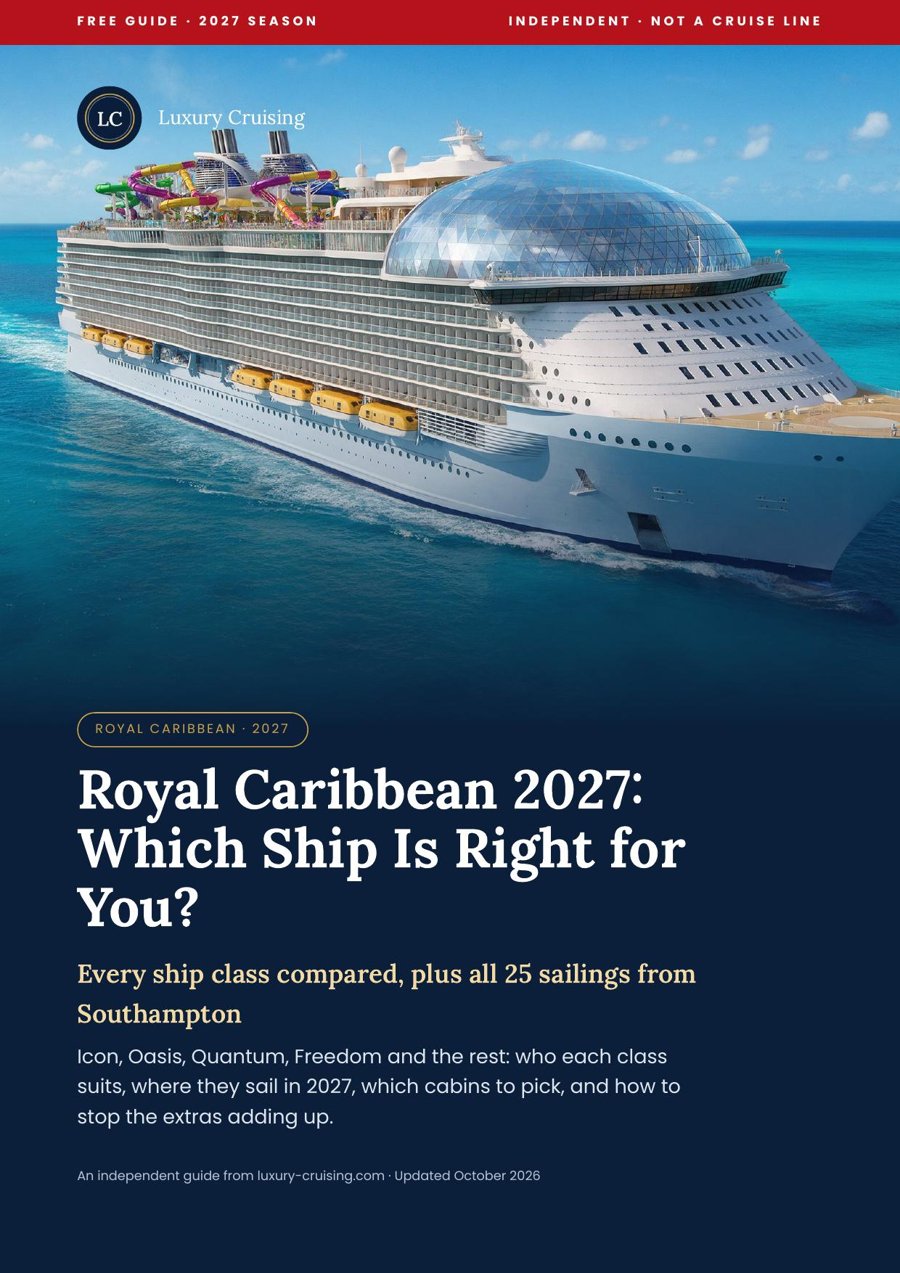

Put Icon of the Seas next to the Titanic and the gap is huge. Royal Caribbean’s ship is about 1,197 feet (365 m) long, against the Titanic’s roughly 883 feet (269 m). By internal volume it is around five times bigger: 248,663 gross tonnage against the Titanic’s 46,329 gross register tons. It also carries more than twice as many guests, at 5,610 at double occupancy and up to about 7,600 when every berth is filled. The two ships were built 112 years apart for very different jobs. One was an Edwardian transatlantic liner and the other is a resort ship for week-long Caribbean holidays. Comparing them shows how far ship design, and above all safety at sea, has come.
Free: the Icon of the Seas ship guide: cabins, dining, shows and where she sails →
Icon of the Seas vs Titanic at a glance
The table below uses Royal Caribbean and widely cited figures for Icon of the Seas. Titanic figures come from Royal Museums Greenwich, Encyclopaedia Britannica and Wikipedia, checked against each other. Historical sources sometimes disagree a little, so a few Titanic numbers are approximate.
| Feature | Icon of the Seas (2024) | RMS Titanic (1912) |
|---|---|---|
| Length overall | About 1,197 ft (364.75 m) | About 883 ft (269 m) |
| Maximum width | About 159 ft (48.5 m) | About 92.5 ft (28.2 m) |
| Size measure | 248,663 GT (often quoted as about 250,800 at launch) | 46,329 GRT |
| Decks | 20 | Around 9 to 10, depending on how they are counted |
| Passenger capacity | 5,610 (double occupancy), about 7,600 maximum | About 2,435 across three classes |
| Crew | About 2,350 | About 885 to 900 |
| Speed | About 22 knots | 21 knots service, about 23 knots top |
| Lifeboats | 17 lifeboats of up to 450 people each, plus a marine evacuation system with life rafts | 20 boats for 1,178 people |
| Swimming pools | 7 | 1 (first class only) |
| Dining and drinking | More than 40 ways to dine and drink | Class dining saloons, plus an à la carte restaurant and Café Parisien for first class |
| Fuel | Liquefied natural gas (LNG) | Coal |
Size: why gross tonnage and GRT aren’t quite the same
Both “tonnage” figures measure enclosed volume, not weight, which often confuses people. The Titanic’s 46,329 gross register tons came from the older system, where one register ton was 100 cubic feet of enclosed space. Icon’s 248,663 gross tonnage is calculated under the 1969 International Tonnage Convention, which turns a ship’s total enclosed volume into a single index number. The two scales are close enough for a rough comparison but not identical. So “about five times larger by volume” is a fair summary, while an exact ratio would be misleading. For weight, Britannica puts the Titanic’s fully laden displacement at more than 52,000 tons.
In everyday terms, Icon is about 314 feet longer than the Titanic. Its widest point (including the overhangs above the waterline) is about 66 feet wider. It also rises roughly twice as many decks. Much of that extra volume is open-air leisure space, such as waterparks, pool decks and a park planted with real greenery. Liners of 1912 had nothing like it.

Facilities: pools, dining and cabins
Activities and pools
Icon of the Seas is split into eight “neighbourhoods”, including Thrill Island, Chill Island, Surfside (aimed at young families), Central Park and the Royal Promenade. Royal Caribbean says Category 6 on Thrill Island is the largest waterpark at sea, with six slides. The ship has seven pools in all, including The Hideaway, billed as the first suspended infinity pool at sea.
The Titanic’s leisure facilities were built around first class. It had a heated saltwater swimming pool about 7 feet deep, a Victorian-style Turkish bath, a gymnasium and a squash court. Second and third class had promenade space and public rooms but none of these extras.
Dining
Royal Caribbean lists more than 40 ways to dine and drink on Icon, from the main dining room and buffet to paid venues such as Chops Grille, Izumi and the Empire Supper Club. On the Titanic, meals were organised by class. The first-class dining saloon on D Deck seated close to 600 and was described as the largest room afloat. First-class passengers could also pay extra at the à la carte restaurant or the Café Parisien. Third-class passengers ate in their own saloon on F Deck.
Accommodation
Icon has 28 cabin categories, ranging from interior rooms to the three-storey Ultimate Family Townhouse. On the Titanic, the gap between classes was stark. The grandest first-class suites had private promenades, while many third-class passengers shared basic cabins and communal bathrooms.
Speed and power
The two ships are closer in speed than you might expect. The Titanic’s service speed was 21 knots, with a top speed of around 23 knots. It needed that pace to cross the Atlantic to a schedule. Icon of the Seas is rated at about 22 knots, but it rarely needs to push hard. Caribbean itineraries are planned with short hops between ports, and cruising more slowly saves fuel. Icon runs mainly on LNG, while the Titanic burned coal shovelled by hand into its boilers by stokers.

Safety: what changed after 1912
When the Titanic struck an iceberg late on 14 April 1912 and sank in the early hours of 15 April, its 20 lifeboats could hold only 1,178 people, about half of those aboard. More than 1,500 people died. That outdated regulation was a major part of the tragedy, and the loss led directly to lasting reform.
The first International Convention for the Safety of Life at Sea (SOLAS) was adopted in 1914 in response to the disaster. The US Coast Guard credits the sinking with creating the International Ice Patrol, which still monitors iceberg risks in the North Atlantic. Today’s SOLAS rules date from 1974 and have been updated many times since. They require enough survival craft for everyone on board, along with mandatory musters and drills and continuous radio watch.
Icon of the Seas carries 17 enclosed lifeboats, each holding up to 450 people. Guests are assigned to these boats. The ship also has a marine evacuation system, with chutes leading to inflatable life rafts, mainly for crew. Together they cover everyone on board, as international rules require. Before departure, guests complete a muster drill, which on Royal Caribbean ships combines a short safety video with a check-in at your assigned station.
Cost: fares then and now
Titanic fares varied enormously. Third-class tickets started at around £7, the cheapest first-class berths were about £23, and the finest first-class suites cost up to around £870 in high season. Wikipedia’s inflation estimates put those at roughly £700, £2,300 and £86,000 in today’s money. Treat those as rough guides, since historical conversions vary with the method used.
Icon of the Seas fares change constantly with the sailing date, cabin type, and how far ahead you book. A school-holiday sailing in a family suite costs far more than an interior cabin in a quieter month. The best way to compare is to check current prices with Royal Caribbean or a travel agent. Most fares include main dining, the buffet, pools, slides and shows. Speciality restaurants, drinks packages, Wi-Fi, gratuities and some activities cost extra. If you’re planning ahead, our guide to cruise deals for 2027 covers when it usually pays to book.
Is Icon of the Seas still the biggest?
Icon is no longer one of a kind. Its sister Star of the Seas began sailing from Port Canaveral in August 2025. Legend of the Seas was delivered in June 2026 and started its first season in the Western Mediterranean in July 2026. A fourth Icon-class ship, Hero of the Seas, is expected in 2027. The Icon-class ships are listed at the same gross tonnage, so at the time of writing they share the title of the world’s largest cruise ships. To see how they compare with the rest of the fleet, see our guide to Royal Caribbean ships by size.
Symphony of the Seas vs Titanic, and other Royal Caribbean ships
Icon isn’t the only Royal Caribbean ship that dwarfs the Titanic. Symphony of the Seas, an Oasis-class ship from 2018, is often used in Titanic size comparisons because it was the world’s largest cruise ship before the Icon class arrived. Here is how the Titanic compares with a cruise ship from each era of Royal Caribbean’s fleet:
| Ship | Length | Gross tons (approx.) | Times the Titanic’s size* |
|---|---|---|---|
| Icon of the Seas (2024) | About 1,197 ft | 248,663 | About 5.4x |
| Symphony of the Seas (2018) | About 1,188 ft | 228,081 | About 4.9x |
| Freedom of the Seas (2006) | About 1,112 ft | 156,271 | About 3.4x |
| Grandeur of the Seas (1996) | About 916 ft | 73,817 | About 1.6x |
| RMS Titanic (1912) | About 883 ft | 46,329 (GRT) | 1x |
*By enclosed volume. Because modern gross tonnage and the Titanic’s gross register tons are measured slightly differently, treat the ratios as rough guides.
So in the Symphony of the Seas vs Titanic size comparison, Symphony is about 305 feet longer and nearly five times larger by volume. Even Royal Caribbean’s smallest ship today, Grandeur of the Seas, is bigger than the Titanic. Titanic versus a cruise ship of any modern size makes the same point: an ocean liner that was the largest moving object of its day would now be a small ship. See every ship in the fleet in our Royal Caribbean ships by size chart.
Conclusion
In the Icon of the Seas vs Titanic comparison, Icon is bigger, wider and taller on almost every measure, with far more pools, restaurants and space per guest. In its own day, the Titanic was a marvel of luxury and engineering. Its loss changed maritime safety for good. Today’s cruise passengers benefit every time they join a muster drill or walk past a lifeboat with room for them on board.
We have also set the Titanic beside an Oasis-class ship in Utopia of the Seas vs Titanic.
Dining is one of the biggest differences from the Titanic era, and our Icon of the Seas restaurants guide lists every venue on board today.
Icon of the Seas now shares its size record with two sisters, so check which ship is the biggest cruise ship in the world today before you book.
FAQs
How much bigger is Icon of the Seas than the Titanic?
Icon is about 314 feet longer, and its widest point is about 66 feet wider. By internal volume, it is roughly five times larger (248,663 GT vs 46,329 GRT), though the two tonnage systems are not exactly the same.
Is Icon of the Seas faster than the Titanic?
Only slightly. Icon is rated at about 22 knots. The Titanic’s service speed was 21 knots, with a top speed of around 23 knots.
Does Icon of the Seas have enough lifeboats for everyone?
Yes. It has 17 lifeboats for up to 450 people each, plus a marine evacuation system with life rafts. Together they provide survival craft for everyone on board, as international SOLAS rules require.
How many people were on the Titanic compared with Icon of the Seas?
The Titanic had about 2,200 passengers and crew aboard on its maiden voyage. Icon of the Seas can carry up to about 7,600 guests plus around 2,350 crew.
How big is Symphony of the Seas compared with the Titanic?
Symphony of the Seas is about 1,188 feet long and 228,081 gross tons, against the Titanic’s 883 feet and 46,329 gross register tons. That makes it about 305 feet longer and nearly five times bigger by volume. It also carries about 5,518 guests at double occupancy, more than twice the Titanic’s passenger capacity.
How does the Titanic compare with a Royal Caribbean cruise ship today?
Every ship in Royal Caribbean’s current fleet is bigger than the Titanic. The smallest, Grandeur of the Seas, is about 1.6 times its volume, while the largest Icon-class ships are around five times bigger.