There are some fantastic opportunities to get an incredible cruise deal if you’re willing to travel last-minute. While it’s often best to book far in advance, there are still some super-cheap deals available if you don’t mind waiting until a few weeks before you travel.
Of course, cruising last minute comes with its own set of challenges and quirks, so in this guide I’ve prepared my 7 top tips to help you make sure you get the best cruise holiday possible, even if your departure is only a few short weeks away (or less!).
1. Be Prepared To Pay In Full
One of the downsides of booking a last-minute cruise is that you’re going to need to pay your fare in full.
Booking in advance gives you the luxury of spreading the cost – paying a deposit upfront and then chipping away at the remaining balance until your final payment date, which is usually around 3 months before you sail (though this can vary).
With last-minute cruises, because you’re booking within that 3-month window, you’re going to have to pay the whole lot in one go when you book.
It’s fine if you have the cash available or have a credit card that can cover it, and since you may be getting a great deal you could actually be paying less than if you’d booked it and spread the cost.
But it’s just an important one to be aware of – make sure you do have those funds available to pay for the cruise.
2. Pack Wisely
A lot of people love the whole build-up to a cruise, including the chance to go shopping for a new holiday wardrobe. However, if you’re on a tight schedule, you might not have the time to go all-out and treat yourself to all-new clothes for your cruise.
That’s fine though – you don’t need to. There’s a good chance you’ll already have everything you need, and so packing wisely using your existing wardrobe can save you a lot of time and effort.
You might need to pack pretty sharpish, depending on how ‘last minute’ your cruise is, so having a few flexible outfits that can work for both casualwear and dinner would be a good way to go, and remember there’s always laundry services onboard if you need them.
3. Plan For Ship Days
There’s a chance that a lot of the best excursions may have limited space or be completely sold out, if you’re booking your cruise late.
With that in mind, it’s good to approach your cruise prepared to enjoy time on the ship on those busier port days.
There may be other opportunities for third-party excursions, or just to wander the port freely without a formal tour.
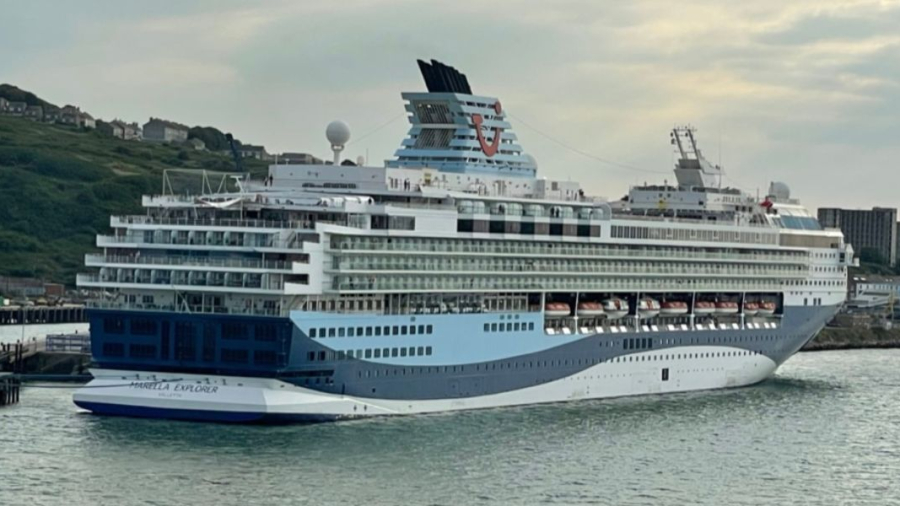
But consider spending more time on the ship too, since it’ll often be quieter – and on Marella’s cruise ships there’s always plenty to see and do, making the time spent onboard absolutely worth your while.
4. Explore Options For Getting To The Airport
Marella’s cruises all include flights to meet your ship, so the only planning you really need to do once you’ve booked is working out how to get to the airport.
It’s worth exploring your options, especially if you’d normally travel by rail and you’re looking at a last-minute booking. Train prices can be extortionate if not booked far enough in advance, and you might even find that a taxi from your door is even cheaper!
Airport parking doesn’t tend to jump up much in costs even as you get close to departure dates, so if you’re driving yourself you should still be able to get a good deal.
But it is absolutely worth exploring the options available, even if you normally have a certain way you like to travel to the airport, as you could make even more of a saving.
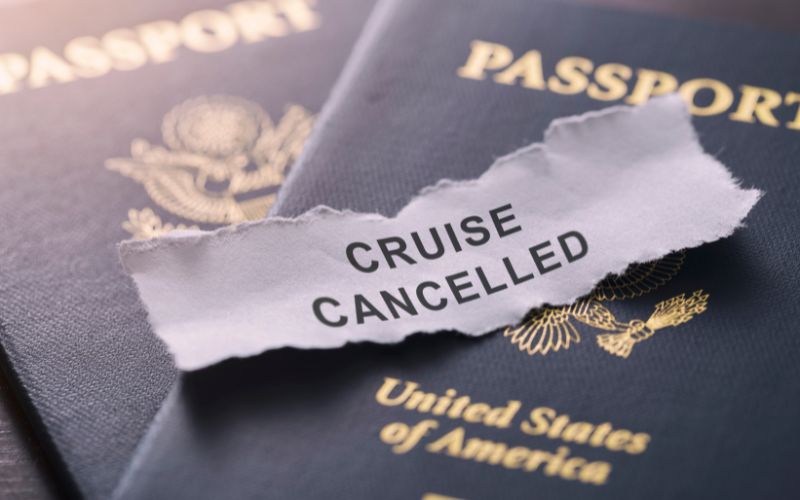
5. Check Your Passport!
A quick tip that anyone hoping to travel should always stick to – make sure your passport is valid for travel!
If you’re booking last-minute and you discover your passport doesn’t have enough time left on it, you’re going to have to book a fast-track renewal and potentially visit your nearest passport offices (which often aren’t very ‘near’ at all)…
But it is possible to get a renewed passport quickly, so don’t let it become an excuse not to book. Just check ASAP, and if you need to renew it, do it immediately as it can be very time-sensitive.
6. Be Flexible With Cabin Choice
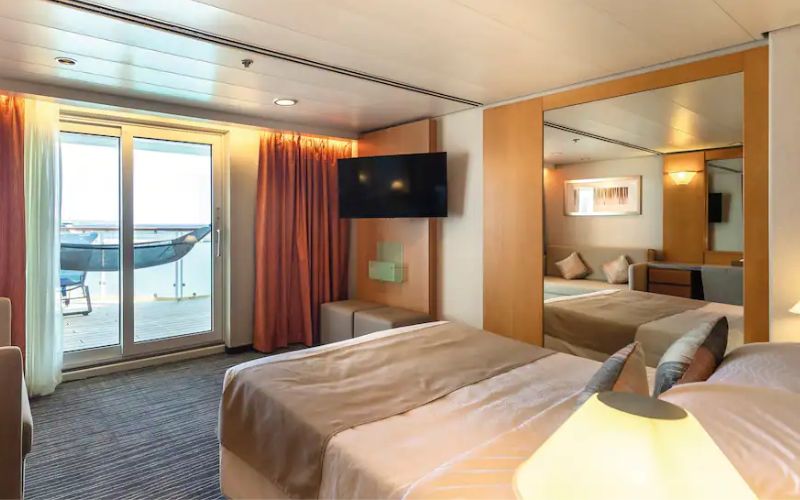
Booking a last minute cruise can mean that you have limited options with cabin availability. If you’re someone who always books a balcony cabin, you might find that they’re all sold out, and that only insides remain.
It’ll vary depending on the cruise but my advice would be, if there’s a great deal, don’t let a less-than-perfect cabin choice put you off. You never know, you might find that you love the category instead!
And even if you don’t, think about how much time you actually spend in your cabin. If you’re typically up and about, exploring the ship or the port or just relaxing by the pool, does it really matter what cabin you end up with?
7. Book An All-Inclusive Cruise Deal!
My best tip for last minute cruises is to book an all-inclusive deal, like you’d get with Marella Cruises as standard.
That way, you know everything you need to pay upfront, and there is no scrabbling around to sort out a budget.
Your flights are included, so no need to worry about sorting those separately. Tips are covered too, which is one less thing to think about.
And you get a huge range of included alcoholic and non-alcoholic drinks as well. There’s no need to pay a penny extra on a Marella cruise, if you don’t want to.
All of this just makes arranging a last-minute getaway all the easier, making it the ideal option for late bookings. And, of course, there are some amazing prices too.
Final Word
Last-minute cruises aren’t for everyone – you might not have the flexibility to take time away from work at short notice, or arrange pet-sitting services.
But I would recommend that everyone at least consider their options, especially with some of the amazing deals Marella has on offer for all-inclusive last-minute escapes.
And with these tips, you should be able to enjoy smooth sailing even in the rush of getting everything arranged in a short time frame.
Related Posts
If you found this interesting, please share!
Jenni Fielding is the founder of Cruise Mummy. She has worked in the cruise industry since 2015 and has taken over 30 cruises. Now, she helps over 1 million people per month to plan their perfect cruise holidays.
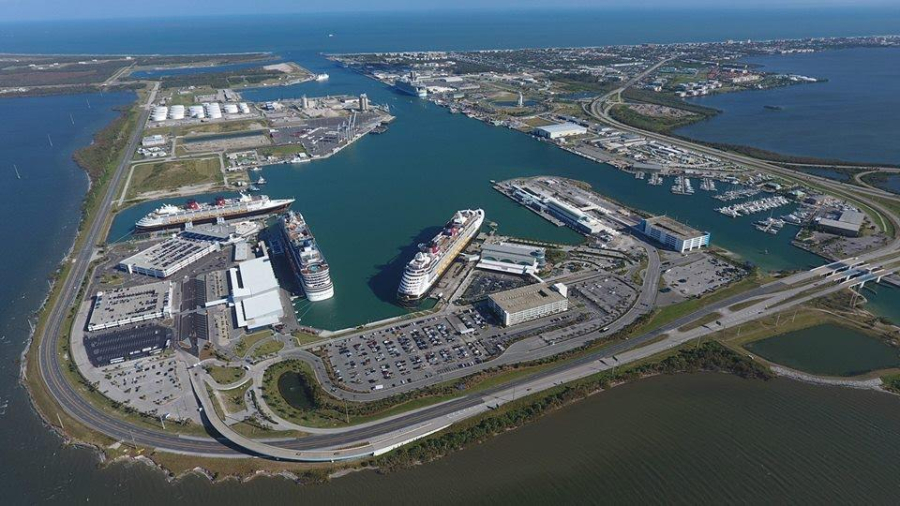
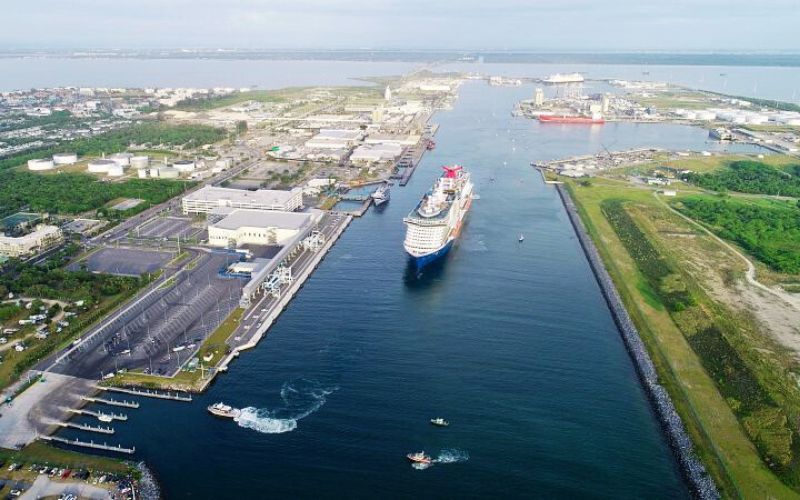
The Port Canaveral cruise port parking facility rank as the world’s second-busiest port for leisure cruise embarkations. For 2019, Port Canaveral saw more than 4.6 million passengers embarking on their cruise vacations, trailing only Port Miami’s 6.8 million.
Port Canaveral Cruise Parking
The facility is adding more terminals and cruise ships, and Cape Canaveral and the surrounding region have been developing new attractions in a bid to become a more well-rounded destination in its own right.
Port Canaveral attractions include restaurants that offer live music and outdoor seating, Jetty Park (with almost five acres of sandy beaches and fishing spots) and the Exploration Tower, which is a seven-story landmark for the area that serves as a fun and interactive that pays tribute to the heritage of the Space Coast.
For cruisers who will be driving to the port in their own vehicles, we offer you the complete guide to parking at Port Canaveral cruise ship parking.
Parking at the Port – Terminal Parking Garages
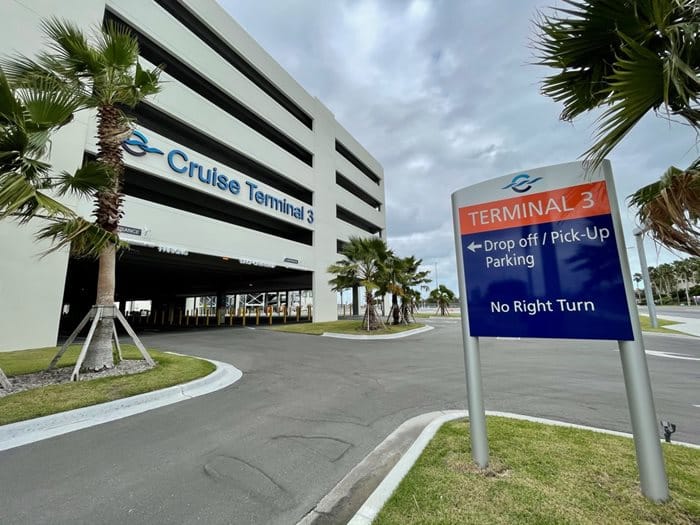
Port Canaveral cruise parking features official parking facilities directly adjacent to each passenger cruise terminal. These lots are quite pricey, with a parking fee of $17 a day (for cars, trucks and RVs). They also offer accessible parking spaces. Reservations are not required, and spaces are located close to the terminal, so there is no shuttle service.
You park and walk your bags to the terminal or drop off your luggage and cruise companions at the terminal entrance before you go park.
* Note: Rates are subject to change without notice. You can contact the Canaveral Port Authority at 321-783-7831 for the latest information.
Off-Site Lots and Shuttle Service
Cruisers also can find plenty of options for parking through private companies that offer convenient off-site parking facilities, as well as providing shuttle buses to and from your terminal. If you your looking for cheap parking at Port Canaveral this might be your best option. You have plenty of options to find a place to park for your cruise, so take some time to do some research into what will be the best solution for you.
Port Canaveral Parking
Port Canaveral Parking is the highest rated Port Canaveral cruise parking providers featuring over 2700+ Google reviews with 4.9 rating this team of experienced parking providers stand out from the crowd. Their off-site parking lot features FREE shuttles, friendly staff, and security. Their paved lot features 600 spaces with over 20 shuttles to get you to and from your ship in no time. Their current per day rate is $8.95/day.
Directions and Contact Information:
Port Parking Space at Port Canaveral
Port Parking Space at Port Canaveral is one of the newest port canaveral cruise parking providers and is the closest Port Canaveral parking facilities to the port. It actually borders the port property. Customers are raving about our their service and proximity to Port Canaveral cruise terminals. Rates per day are listed at $11.95 per day but, they check the website for ongoing promos and specials including 15% for active and retired service members.
Friendly staff to assist your party get to your ship and on your way!
Directions and Contact Information:
Park Port Canaveral
Park Port Canaveral has the closest lot to the cruise terminals. Its air-conditioned shuttles can pick you at your car and drop you and your luggage off after a five-minute drive (1.5 miles away). Park Port Canaveral takes online reservations and charges about $10 a day for parking. Parking is in an outdoor lot with 24-hour security.
Directions and Contact Information:
Park N Cruise Port Canaveral Parking
Park N Cruise offers parking services for Port Canaveral for $8.95 a day when you book online to reserve your spot. This cruise parking facility (located two miles from the port) runs complimentary shuttles to the cruise terminals every hour on the hour beginning at 10:30 a.m. and ending at 2 p.m. on embarkation day.
This is a gated parking lot with 24-hour video surveillance. Park N Cruise offers a 10 percent discount for military members and veterans, as well as 5 percent discounts for AARP, AAA and other members.
Directions and Contact Information:
GoPort
GoPort, which features a list of hotel options that include parking (see section at bottom of this article), also offers its own cruise parking package that includes the parking when you pay for shuttle service to and from the terminal. For $60 and $10 for each additional rider (up to six total travelers), you can one of the best deals out there for parking, especially if your cruise lasts a week or longer.
The parking facility is paved, lighted and gated. You get to keep your keys, and the air-conditioned shuttle ride takes about five minutes to get you to your ship.
Directions and Contact Information:
CruiseTime Parking & Shuttle
CruiseTime Parking and Shuttle is located about 10 miles from Port Canaveral, and the company offers parking spaces for $8 a day. There is shuttle service from the 24-hour secured lot to and from your ship, dropping you off and picking you up right at the boarding area. Up to four passengers per vehicle can join the shuttle for no added fee. Additional travelers beyond four people pay $5 each.
Directions and Contact Information:
Cruise Hotel Parking Option – Stay and Cruise
Dozens of regional hotels offer a “Snooze, Park and Cruise” package for Port Canaveral.
The program works like this: For example, you might book a one-night stay at Holiday Inn Orlando Airport (about 45 minutes from the port) or Best Western Space Shuttle Inn in Titusville (about 27 minutes from the port). With your park and cruise package, you get your hotel stay for one night, a parking place for one vehicle and transportation to and from the cruise port.
A complete list of the Port Canaveral area hotels offering cruise parking hotel packages is available at GoPort.com.
Hotel cruise parking can be a fantastic deal if you are planning to come in to the region a day early to take advantage of all the attractions and activities available in Orlando and the surrounding area. The packages start around $130 and average about $160. Not bad for a place to rest and refresh after your drive to town, as well as getting transfers to and from the port.
Port Canaveral Parking – FAQ
How many cruise ships homeport in Port Canaveral?
Port Canaveral currently has 13 cruise ships calling the port home (through April 2023).
How much is parking at the Cape Canaveral cruise port?
$17 a day (for cars, trucks and RVs) in the terminal parking at the port.
What is the acceptable payment methods for parking at the Port Canaveral cruise terminal?
• No cash accepted • Major credit cards (American Express, Visa, MasterCard, and Discover) • Presently, EPASS and SunPass accepted ONLYat the Cruise Terminal 3 parking garage
Can you pre pay parking at Port Canaveral?
You can’t prepay for parking for the Port Canaveral cruise terminals. However, You can pre-pay and reserve space in the many secure off-site parking options listed in the article.
When is Port Canaveral Parking open?
The hours of operation at the cruise terminal and parking garage in Port Canaveral begin at 10:30 am. This is why many shuttle providers cannot begin bringing you to the terminal until this time.
Do I need a reservation to park at Port Canaveral cruise terminal?
No, You can simply arrive and park. Be sure to drop your bags off first curbside with a porter before parking. As shuttles are not provided.
Where to park for a cruise from Port Canaveral?
You have many choices. You can park at the actual cruise terminal in parking garages at the Port Canaveral cruise terminal where your ship will be docked.
This is normally the more expensive option priced at $17 a day.
Your other option is to park in secured off-site parking where you park your cruise and you and your luggage take shuttle the port and they drop your off curbside.
Can I find covered parking at Port Canaveral?
Covered parking is available at Port Canaveral for cruise passengers.
Where can I find parking for disabled passengers at Port Canaveral?
Port Canaveral provides parking for disabled passengers in designated areas.
Can I start my cruise directly from Port Canaveral?
Yes, you can start your cruise from Port Canaveral and enjoy the convenience of onsite parking.
What cruise lines sail from Port Canaveral?
Port Canaveral hosts various cruise lines, including Royal Caribbean Cruise and MSC Cruises.
Are any parking packages available for cruise passengers at Port Canaveral?
Yes, you can find parking packages that include shuttle services and parking for the duration of your cruise.
What are some cruise tips for parking at Port Canaveral?
When parking at Port Canaveral, arriving early to secure parking is recommended, especially during peak cruise seasons.
What should I know about Port Canaveral before starting my cruise?
Before you start your cruise, please be sure to familiarize yourself with the official Port Canaveral cruise parking area, shuttle services, and the location of off-site cruise parking options.
You need cruise insurance when you travel – but you shouldn’t assume that, once you have a policy in place, you’re covered in every eventuality.
There are actually quite a lot of scenarios where you won’t be covered, or at least not by most cruise insurance policies – some have extras or might just vary.
It’s always important to read the terms – I know it’s boring, especially if you’re paying for a policy on the same day you book your cruise like you should – but you need to know what’s covered and what isn’t.
Let’s look at what you typically won’t be covered for:
1. Injuries while intoxicated
If you have a drink package, you’re probably going to spend most of your cruise technically intoxicated. If you don’t, you’re probably not getting your money’s worth.
And you don’t need to be roaring drunk and doing silly things for your insurance not to pay out.
I recently took a cruise with a friend who ended up in the medical centre at midnight. A rather large, drunk person stumbled backwards into her and stamped on her foot, ripping off her toenail and causing quite a bloodbath, before quickly fleeing the scene without so much as an apology.
As she was in so much pain, I filled out the paperwork for her, and one of the questions was about how many alcoholic drinks she had consumed that day.
The accident wasn’t her fault at all, but I’m sure that if she had needed to claim on her insurance, they wouldn’t have paid out. Luckily, the ship kindly waived any fees.
2. Missing the ship
Whether it’s embarkation day for your cruise, or you’ve been off exploring a port on an exciting adventure, there’s one thing you always have to remember – it is your responsibility to make sure you are on the ship before she sails away.
It doesn’t matter if there was traffic that delayed you getting to the port, or if you booked a proper excursion.
If you aren’t onboard at departure time, the ship is going to sail away without you. And your insurer won’t do a thing to compensate you for it, even if it means your entire cruise is over before it started, or you end up stranded on an African island.
Missing the ship – especially in a random destination – is one of the worst things that could happen to you and you’ll have to arrange your own travel home. So just make sure you don’t.
3. Some cancelled cruises
Generally, you’ll be covered for the cost of your cruise if it’s cancelled either by the cruise line, or by your insurer. It’s not your fault if a cruise is cancelled, and you shouldn’t have to pay for it.
But…
There are some circumstances where a cruise could be cancelled and you could be left out of pocket. Not for the cruise fare itself, usually, but for parts of it.
For example if you book an inaugural cruise on a brand new ship, and the cruise line decides it’s not ready, then the cruise line will typically refund your cruise fare, but your insurer might not give you money back on your flights or other costs to get there.
Or if you book the cruise and flights separately, your insurer might not pay out in full:
And if your cruise line goes bust, but you’ve only booked with them a few weeks prior, some insurers would refuse to pay out on that. Some will have a clause in their contract where you need to have your booking for a set period of time to cover for a cruise line business failing.
If you stick to the big cruise lines, that shouldn’t be a concern.
4. Cruises bought with points or Future Cruise Credit
Not all cruises are paid for with money. Sometimes you might earn a significant number of rewards points, perhaps through a cruise line’s casino offers or with some other rewards scheme. In the UK, the Tesco Clubcard is a great example.
Or you might have earned Future Cruise Credit, maybe due to a past cruise being cancelled, and then applied that to a new cruise.
If you then have to cancel those cruises because you can no longer sail on them, in most cases that’s goodbye points. And your insurer has got no interest in paying you cash for the loss, nor can it help you get your points or credit back.
Your best bet is to appeal to the cruise line, but if the cancellation is your fault, you might just be out of luck.
5. Death of pets
Cruise travel insurance policies will cover a lot of different scenarios for you cancelling a cruise. It’s not just if you are unable to travel – say you were to get sick – but you’ll also usually be covered for the sickness or death of a loved one, who you need to stay home and care for.
As long as that loved one is a human, anyway.
Cruise insurers won’t typically pay out if your dog or cat (or whatever animal you own) becomes ill, even if it’s terminal. If you want to cancel the cruise, then the cost will be on your head.
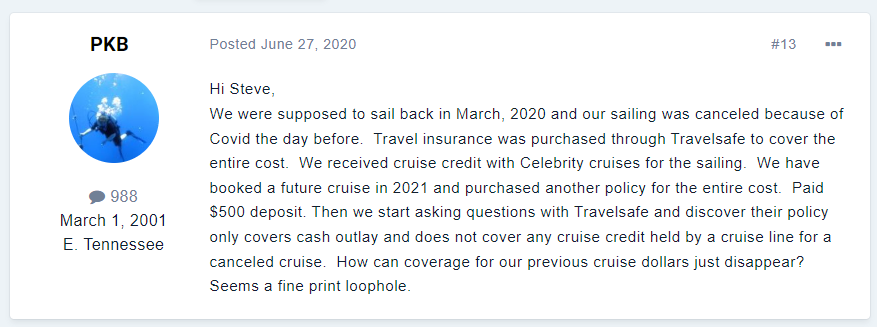
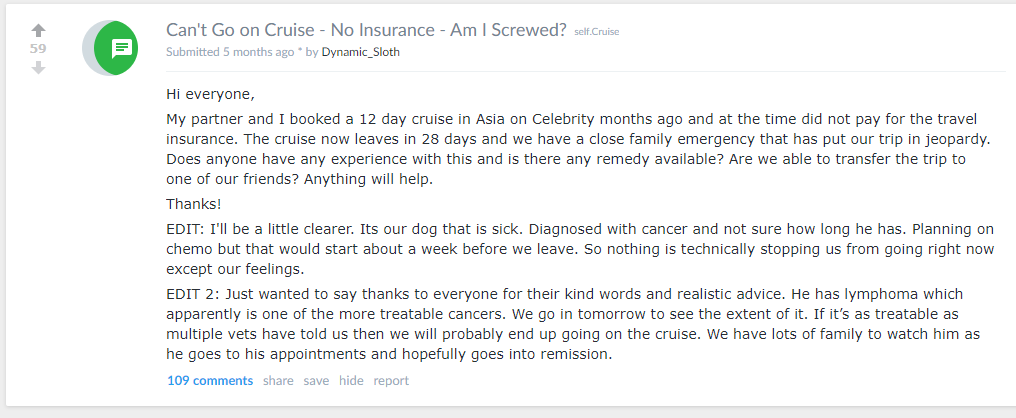
This person assumed that they were screwed because they hadn’t bought insurance, but they likely would’ve been even if they had…
6. Turmoil in port
Insurance companies don’t like nuance. They like facts and clear rules. This may impact you if your cruise is sailing to a destination where there’s a bit of unrest.
There are times when a cruise will determine a destination to be safe, but you aren’t too sure. You don’t want to take any risks, so you decide to stay onboard for the day.
However, because that’s your own choice, and you’re ignoring the official guidance that the port is safe, you aren’t able to claim for missed port cover. Because the port wasn’t missed – you just chose not to go ashore.
Even if you have a really solid reason, that you are genuinely worried about rising crime in a location, that’s on you and you can either go ashore or stay on the ship, but your insurance is not going to pay out.
7. Ignoring warnings about destinations
This one is the exact opposite of the point above.
Generally, cruise lines like to keep you safe and avoid risk. But there might be times where a destination suffers from some problems – political unrest or rising crime – but your government is a little slow to react and doesn’t put out a travel warning immediately, or they do but they only advise against visiting, they don’t tell you outright not to go.
If that happens, but your cruise ship still visits the port and you go ashore, and then something happens to you, your insurer might refuse to pay out because, in their eyes, you’ve been told it wasn’t safe.
So, you can’t win if you’re too careful, and you can’t win if you “ignore official travel advice” and take a risk…
8. Dental treatments
If you’re on a cruise and you trip on some stairs, spraining your ankle, you can go get it fixed up at the medical centre, get some painkillers, and your insurance will cover it.
Cut yourself on a broken glass? Insurance will cover it.
But a tooth infection that causes you agonising pain? Or you chip a tooth while eating? You might be out of luck.
Cruise insurers love to make sure that dental treatments are written out of your policy. If it’s something minor, and it doesn’t hurt, you’re best waiting until you get home and visiting your regular dentist.
If it’s an emergency – and infections definitely can be – then you may need to get treatment onboard and pay yourself, if your insurer refuses.
9. Spa treatments gone wrong
If you decide to treat yourself at the spa on your cruise ship, very little can usually go wrong – except maybe for a pushy member of the team who tries to get you to pay for oils and creams that you really don’t need, just because they’re on commission.
You’ll probably be fine if you stick to the massages, but if you choose a beauty treatment that is invasive, and something goes wrong, you might be stuck with the bill.
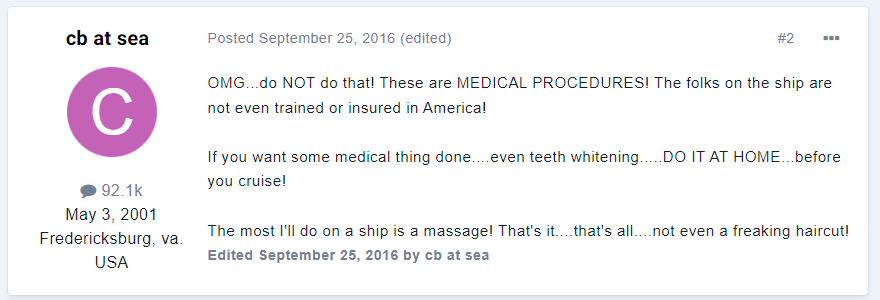
Some cruise line spas will offer botox injections and lip fillers. But, these would be classed by your insurer as medical tourism – They’ll say it’s on you since you should’ve got the work done by a doctor on land, in your own country where you’re covered medically already.
These treatments can easily go awry, so don’t risk it, especially if you’re not prepared to pay for the work to be fixed once you get home out of your own pocket.
10. Any undeclared conditions
This one is pretty obvious, but it’s still important to mention.
If you have a pre-existing medical condition and you don’t declare it when you buy your insurance policy, there is almost zero chance that the insurer will pay out for medical treatments related to that condition.
And if they find out you’ve got a condition, and then something else goes wrong, don’t be surprised if they try to find a link between them.
Insurers don’t want to pay out. They want to make money. And if they can make a case that you’re at fault because you’ve bought an invalid policy, based on non-disclosure of medical conditions, then they absolutely will do. Don’t risk it.
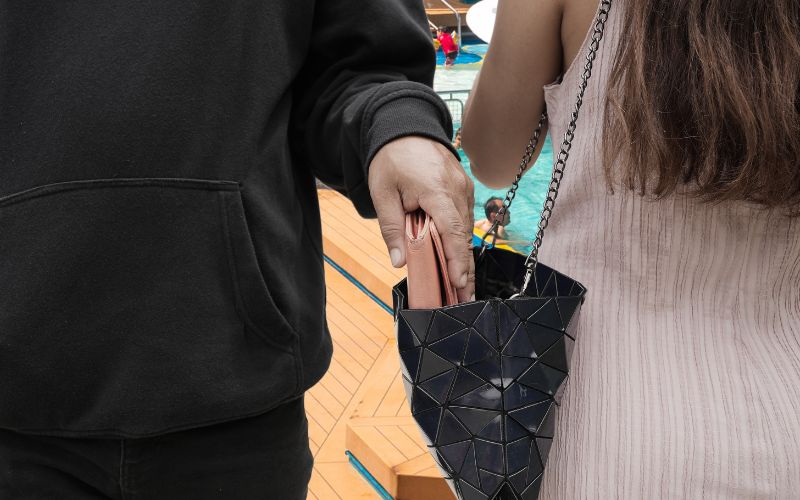
11. Theft of unattended items onboard
A minor issue that you will hopefully never have to deal with, but one that’s worth mentioning.
If you’re a victim of theft while you’re on a cruise, you should normally be able to make a claim through your insurance to cover the cost of the stolen items
But if the insurer finds out that you’ve been negligent, then they might refuse.
Anything stolen from your cabin should be covered, since those doors lock automatically. But if you take your designer sunglasses to the pool, put them down next to you and forget while you nip to the bar, and someone takes them, it might be tough luck.
For smaller items you probably won’t get too much of a grilling from the insurer, but if it’s something really valuable that would normally be covered, the insurer might ask for a ship’s report where you’d have to be honest about leaving it unattended, and then the insurer might say no.
Also, be aware that some insurers will ask you to claim for some items through your home insurance before claiming through them for certain items like laptops – they might cover you, but only if your home insurance doesn’t.
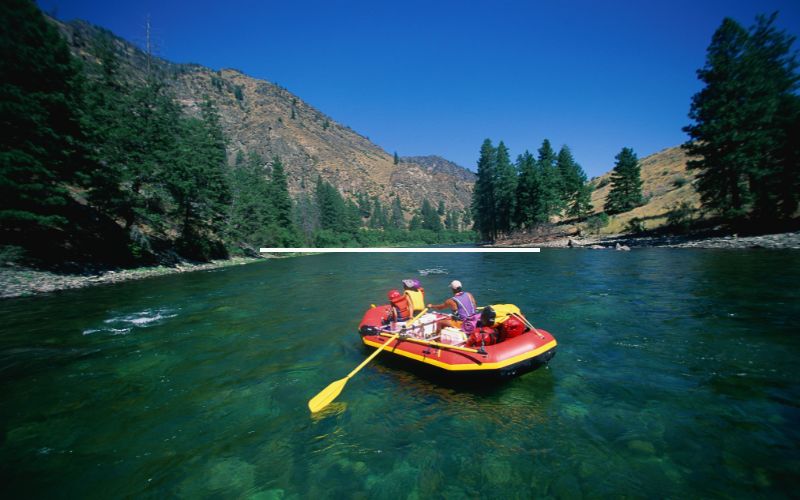
12. More extreme shore excursions
While your cruise insurance will cover you in the case of most accidents or emergencies while you’re at sea or in port, there are some activities that will fall outside your policy.
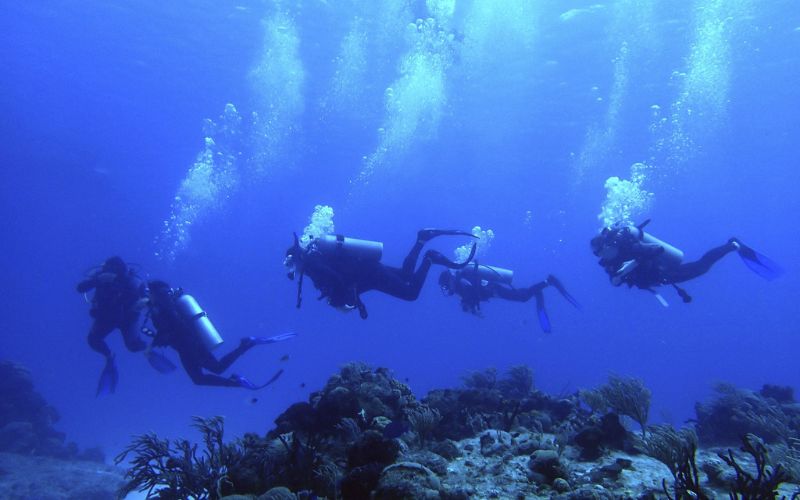
Those tend to be the more extreme shore excursions where you’re at higher risk of hurting yourself, such as river rafting, or diving with sharks.
If you don’t want to miss out on these experiences, but you also don’t want to be liable for costs if something goes very wrong, ask for specialist cover for these types of activities if they aren’t included as standard. You should be able to get extra cover, though you’ll have to pay more.
13. Changing Your Mind
Finally, some people assume that cruise insurance lets you cancel your cruise for any reason and get your money back, including just changing your mind about wanting to go.
That can be true, if you’ve specifically bought a policy that includes “cancel for any reason” cover. But you need to make sure that’s what you’ve got, as most policies will only have a limited list of acceptable reasons for cancelling if you want a pay out, and changing your mind isn’t one of them.
Your cruise line might refund you anyway, if you’re cancelling far in advance of your sail date, but if it’s close to departure and you don’t have cover which lets you cancel for any reason, you might not be able to claim any money back unfortunately.
My Recommendation
My recommendation for cruise insurance depends on where you live.
These are trusted price comparison sites that will quickly get you lots of quotes to match your exact needs.
Final Word
Did any of these surprise you? Some of them make sense, but there are others where it could definitely be harsh of the insurer to not pay out. That’s what they do though.
The good thing is that they will typically pay for the most important things – cruises cancelled outside of your control, and medical expenses while you’re at sea.
And when you’re ready to buy, I’d always recommend using a price comparison site like Compare Your Cruise Insurance (UK) or Aardy (USA) so that you can easily check a range of policy providers, and get the best price.
Related Topics
If you found this interesting, please share!
Jenni Fielding is the founder of Cruise Mummy. She has worked in the cruise industry since 2015 and has taken over 30 cruises. Now, she helps over 1 million people per month to plan their perfect cruise holidays.
Choosing the right cruise for your age can significantly enhance your travel experience. A cruise tailored to your age group ensures you can partake in activities that suit your preferences and connect with like-minded travelers.
Overview of Suitable Cruise Destinations
Award-winning Half Moon Cay, Holland America Line’s private Bahamian island, celebrated its 15th anniversary this Caribbean cruise season, and to commemorate the milestone the cruise line has enhanced island offerings and features.
Guests to the island will notice five new, colorful, two-story Beach Villas available for rent during each call. The luxury hideaways boast exclusive hot tubs on the second floor and provide private accommodations for guests while they relax and experience the island’s highlights.
Cruising through the Mediterranean provides an immersive experience in history, culture, and gastronomy. Ports of call, such as Barcelona, Rome, and Athens, offer a blend of ancient ruins, Renaissance art, and vibrant street life. Whether exploring the Colosseum in Rome, sampling tapas in Barcelona, or marveling at the Acropolis in Athens, the Mediterranean promises an enriching journey through some of Europe’s most iconic destinations.
For those seeking adventure and natural beauty, the Galapagos Islands offer a one-of-a-kind cruising experience. With its unparalleled biodiversity and pristine landscapes, the Galapagos provides an opportunity to encounter unique wildlife up close. From snorkeling with sea lions to observing giant tortoises in their natural habitat, every moment in the Galapagos is a memorable encounter with nature. Also, eco-conscious travelers know that many regional cruises prioritize sustainability and conservation efforts.
In addition to these well-known destinations, emerging cruise regions like Southeast Asia are gaining popularity among travelers seeking new experiences. Cruising through the waters of Vietnam, Thailand, and Indonesia allows passengers to explore ancient temples, bustling markets, and serene beaches. From the limestone karsts of Halong Bay to the vibrant street food scene of Bangkok, Southeast Asia offers a sensory-rich journey filled with diverse cultural encounters. This region’s mix of tradition and modernity promises an unforgettable cruise experience for adventurous travelers.
Factors to Consider
Several factors play a pivotal role in ensuring an enjoyable experience tailored to your preferences when considering which cruise to embark on. From the demographic makeup of fellow passengers to the array of onboard activities and accommodation options, each element contributes to the overall ambiance and suitability of the journey. By carefully evaluating these factors, you can pinpoint the perfect cruise that aligns seamlessly with your age group and personal preferences. When selecting a cruise, several factors should be considered to ensure an ideal fit for your age group.
Age Range of Fellow Passengers
The age range of fellow passengers can significantly influence the atmosphere and onboard activities. Some cruises cater to families with young children, while others are ideal for adults seeking a quieter and more sophisticated environment.
Types of Activities Available on the Cruise
Different cruises offer a variety of onboard and off-shore activities, ranging from thrilling water sports to cultural tours and fine dining experiences. It is essential to choose a cruise that aligns with your interests and desired level of excitement.
Length and Itinerary of the Cruise
The length and itinerary of the cruise are crucial considerations. Some prefer shorter cruises with multiple port stops, allowing for various experiences, while others may prefer longer voyages with more sea days for relaxation and unwinding.
Accommodation Options on the Cruise
Cruise ships offer a range of accommodation options, from standard cabins to luxurious suites. When selecting the perfect accommodation on the cruise, consider your desired comfort level and budget.
Cruise Destinations for Different Age Groups
Different age groups often seek distinct experiences when embarking on a cruise adventure. From the vibrant energy of youth to the refined tastes of seniors, various destinations cater to the preferences of each demographic. Whether it’s the pulsating nightlife of the Mediterranean for young adults, the tranquil beauty of the Greek Islands for middle-aged travelers, or the serene luxury of river cruising for seniors, there’s a perfect destination awaiting every age group’s exploration.
Young Adults (18-30)
For young adults seeking adventure and vibrant nightlife, cruises that visit destinations such as the Mediterranean or the Caribbean offer a blend of exciting shore excursions and lively onboard entertainment options.
Middle-aged Adults (30-50)
Middle-aged adults often value a mix of relaxation and cultural exploration. Cruises to destinations like the Greek Islands or the fjords of Alaska provide opportunities for rejuvenation and discovering new cultures through guided tours.
Seniors (50+)
Seniors prefer cruises that offer a more relaxed pace and luxurious amenities. Destinations like the Rhine River or the Norwegian fjords provide scenic beauty and opportunities for leisurely exploration. However, amidst the excitement of planning a dream cruise, it’s crucial to consider the importance of securing adequate travel insurance. The best travel insurance for seniors Canada ensures peace of mind, covering unforeseen medical emergencies, trip cancellations, or lost luggage, allowing seniors to enjoy their well-deserved vacation without worrying about unexpected expenses.
Tips for Choosing the Perfect Cruise
Choosing the ideal cruise entails carefully considering various factors to ensure a memorable and satisfying voyage. From researching cruise companies to evaluating costs and considering seasonal weather patterns, each aspect is crucial in selecting the perfect cruise experience. Following these tips, you can embark on a journey tailored to your preferences and budget, promising unforgettable moments at sea.
Research Cruise Companies and Read Reviews
Before booking a cruise, research various cruise companies and read reviews from past passengers. This will give you valuable insights into the quality of service, onboard experience, and overall satisfaction.
Consider the Season and Weather of the Destination
The season and weather of the destination can significantly impact your cruise experience. Be mindful of hurricane seasons, extreme temperatures, or monsoons that might affect your desired destination.
Evaluate the Cost of the Cruise
Determine your budget and compare the prices of different cruise options. Factor in additional expenses such as shore excursions, onboard gratuities, and specialty dining to ensure you choose a cruise within your financial means.
Conclusion
Selecting the perfect cruise for your age is crucial to ensure a memorable and enjoyable experience. Consider important factors such as the age range of fellow passengers, types of activities available, length and itinerary, and accommodation options. Research cruise companies, evaluate the cost, and consider the season and weather of the destination. By carefully considering these factors, you can confidently choose a cruise that suits your preferences and embark on an unforgettable journey. So, don’t delay begin planning and book the perfect cruise that caters to your age group today!
Could picking the right season make your cruise even better? I’ve learned a lot from cruising in different months and researching different cruise itineraries, so I want to share some tips with you.
Choosing the right time to go can really change your experience. This article will help you see how each season can be different so you can pick the best one for your trip.
Winter Cruises
Winter might not be the first season you think of when planning a cruise, but it offers unique itineraries that can lead to a memorable cruise. Here’s why you might consider cruising in the cooler months…
Winter is arguably the best time to cruise the Caribbean. The warm and mostly dry weather provides a perfect escape from colder northern climates. This season sees less rainfall and more sunny days, which is ideal for beach activities and water sports.
Additionally, the sea is usually calmer during these months, meaning smoother sailing conditions.
Similar to the Caribbean, Southeast Asia enjoys its dry season during the North American and European winter months. This timing avoids the heavy monsoons that can disrupt travel at other times of the year. Winter is an excellent time to explore vibrant cities, indulge in the street food culture, and experience the region’s stunning natural landscapes.
Cruising to Australia and New Zealand during the northern hemisphere’s winter coincides with the southern hemisphere’s summer, making it an ideal time to explore these destinations.
You can experience everything from the urban attractions of Sydney and Melbourne to the natural wonders of the Great Barrier Reef and New Zealand’s national parks.
There are plenty of opportunities for outdoor activities, such as snorkelling, hiking, and exploring local cultures. The warmer weather and extended daylight hours provide ample time to enjoy the vast array of activities available in these countries.
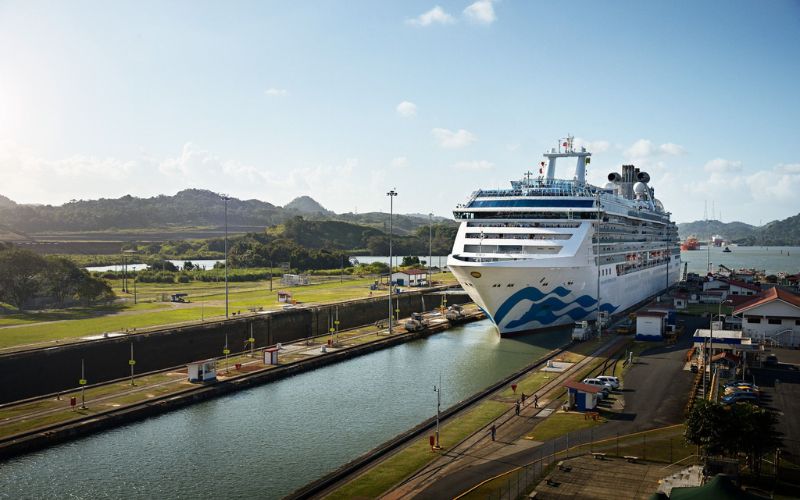
A winter cruise through the Panama Canal offers a journey through one of the world’s most incredible engineering feats, combining history with a stunning tropical environment. This route allows you to witness the complex lock systems in operation and explore the diverse ecosystems and communities that line this historic waterway.
One of the most appealing aspects of winter cruising is the reduced crowds. With the exception of the holiday weeks around Christmas and New Year, ships are not at full capacity. This means more space in public areas, shorter queues for onboard amenities, and a more laid-back atmosphere.
Winter cruises offer unique experiences that can’t be found in other seasons. While beach days might be off the table in some ports, you can enjoy seasonal activities like visiting Christmas markets in Europe or taking wildlife tours in less crowded environments. These one-of-a-kind experiences can make winter cruises particularly special.
Finally, winter can be a great time to find cruise deals, especially in the early part of the season. With the exception of Christmas and New Year holiday cruises, many lines offer attractive prices to fill cabins. January, in particular, can see some of the year’s lowest prices, making it an excellent choice for budget-conscious travellers.
Spring Cruises
Spring cruising is popular for its mild weather and the fresh start nature gets during this time. It’s a great season for visiting places known for their natural beauty and lively cultural events.
The Mediterranean shines in spring as it starts to warm up, but it isn’t too hot yet. This is the best time to visit cities and old sites in Italy, Greece, and Spain because there aren’t as many tourists, and the scenery is beautiful with everything in bloom.
In Japan, spring is all about cherry blossoms. These blossoms are important to Japanese culture and incredibly pretty.
Cruises during this season let you join the local cherry blossom festivals and see parks and temples covered in pink and white flowers. The weather is also nice for checking out both old and new attractions in Japan.
The Caribbean is also great in spring. It’s safe from hurricanes and not too hot yet. The islands look amazing, with lots of greenery, and the weather is just right for beach activities and water sports.
Spring cruises often coincide with local festivals and events. In Europe, for example, you might catch spring flower festivals and outdoor concerts, giving you a taste of local life and customs.
Finally, spring breathes life into the outdoors, making it a perfect time for nature walks and wildlife spotting.
Choosing a spring cruise means seeing the world wake up after winter, participating in fun local events, and enjoying the pleasant weather. This mix of beautiful sights, fun activities, and good weather makes spring a great choice for cruising.
Summer Cruises
Summer cruising allows you to experience outdoor adventures and cultural richness under the warm sun, but choosing the right itinerary requires considering a few key factors.
For those seeking a cooler escape filled with natural wonders, Alaska offers breathtaking experiences, from watching glaciers calve in Glacier Bay National Park to wildlife sightings in Denali National Park.
The long daylight hours are perfect for activities such as kayaking and hiking. Alternatively, Northern Europe offers a culturally rich experience with its beautiful fjords and lively cities like Stockholm and Copenhagen, where summer festivals and outdoor dining are abundant.
However, while popular, the Mediterranean and Caribbean are very crowded during summer. For these regions, consider selecting itineraries that visit less crowded spots or travel during the shoulder months to avoid the peak tourist seasons.
Additionally, it’s important to note that late summer coincides with hurricane season in the Caribbean, which typically runs from June to November. This period can see unpredictable weather, so it’s advisable to plan a cruise earlier in the summer or choose an itinerary that can be flexibly adjusted.
Booking early and planning your port visits for mornings or late evenings can help mitigate the impact of crowds. Also, opting for cruises that offer unique local experiences or those that cater to specific interests such as gastronomy, history, or nature can significantly enhance your experience.
Autumn Cruises
Autumn cruising combines the mild, pleasant weather with the stunning visual changes of the season, making it a perfect time for those looking to escape the summer crowds and experience the tranquil beauty of nature’s transformation.
During this season, New England and Canada become prime cruising destinations, offering spectacular views of vibrant fall foliage. The shores and hillsides turn into a canvas of orange, red, and yellow, and the cooler weather makes exploring charming port towns rich in history and culture all the more enjoyable.
Similarly, the Mediterranean offers a quieter, yet still warm, retreat perfect for visiting ancient ruins, sipping coffee in outdoor cafes, and strolling the cobblestone streets of Italy, Greece, and Spain without the intense heat or crowds of summer.
River cruises in Europe, such as those along the Rhine, Danube, and Seine, are also particularly appealing in the fall. These cruises provide breathtaking views of medieval towns and landscapes draped in autumn colours, and passengers can often participate in seasonal cultural activities like local wine harvest festivals.
My family on an A-Rosa river cruise ship
This time of year is also excellent for wildlife enthusiasts, as cooler temperatures encourage animals to be more active during the day, enhancing opportunities for sightings.
Aside from the natural and cultural perks, autumn cruising typically offers better deals, with cruise lines eager to fill cabins after the high-season rush.
This combination of fewer tourists, reduced prices, and the seasonal beauty of autumn makes cruising during these months a highly appealing option for a relaxed cruise.
The Bottom Line
The best cruise itinerary depends largely on what experiences you value most. You can craft an itinerary that offers the most enjoyment and satisfaction by aligning your travel with the natural advantages of the seasons and your interests.
NEW DEALS JUST RELEASED!
Don’t miss these hot cruise offers…
Here’s a quick guide to help you decide:
Weather Preferences: Consider what type of weather you enjoy most. If you prefer mild temperatures and the beauty of spring or autumn, consider destinations like the Mediterranean or the Canadian Maritimes during these seasons. For those who love warm weather and sunshine, the Caribbean and Southeast Asia during their dry seasons are perfect.
Crowd Comfort Level: If you prefer avoiding crowds, spring and autumn are generally less busy than summer. Destinations like the Mediterranean are quieter, and you can enjoy the locale without the rush. Winter, especially early December, is a quieter time for Caribbean or Panama Canal destinations.
Cultural Interests: Think about what cultures and activities interest you. For example, if you’re fascinated by historical sites, a spring cruise to the Mediterranean allows you to explore ancient ruins without the boiling weather. If you’re interested in natural beauty and wildlife, consider an autumn cruise to New England or a spring journey to Japan during cherry blossom season.
Event Timing: Many destinations have specific events or natural phenomena that may be appealing. For example, winter cruises to Norway are ideal to experience the Northern Lights. Similarly, if you enjoy festivals, look for cruises that align with local events like Europe’s spring flower festivals or Japan’s cherry blossom season.
Budget Constraints: Consider your budget, as cruise prices can fluctuate based on seasonality. Late spring and late autumn often offer transitional weather with potentially lower prices. Winter can also offer significant discounts, excluding the holiday weeks.
NEW DEALS JUST RELEASED!
Don’t miss these hot cruise offers…
Related Posts
If you found this interesting, please share!
Jenni Fielding is the founder of Cruise Mummy. She has worked in the cruise industry since 2015 and has taken over 30 cruises. Now, she helps over 1 million people per month to plan their perfect cruise holidays.
If you’re about to book a cruise and then plan on booking your travel insurance immediately with the first provider you can find, you need to slow down.
Don’t get me wrong – booking your insurance quickly is the right thing to do – but just diving in without properly considering it could lead you to some serious problems further down the line.
These tips will help you to make sure you get a policy that’s right for you – one that’s not too expensive, but also one that has you covered should anything go wrong while you’re on your cruise.
1. The day you book should be the day you buy insurance
The right thing to do when booking a cruise is to then pay for your cruise insurance on the same day, but you still need to do your research and check different policies.
But yes – once the cruise is booked, get the insurance booked. And there are two main reasons for that.
Firstly, you want your cancellation cover to be in place as quickly as possible, because you never know what might happen. You might book a cruise, but then the next day it gets cancelled and you’re out of pocket. Or something happens to you or someone you’re travelling with, and now you can’t go.
If you’ve booked your insurance already, you can make a claim. If you were waiting, then you’re out of luck – you can’t book it after the problem has come to light.
The second reason is related to pre-existing medical conditions. If you have any, then you need to make sure you book your insurance typically within 2-3 weeks of paying your deposit on your cruise (it’ll vary slightly by provider).
If you don’t, then the insurance isn’t valid. That’s because, the further out you cancel a cruise, the more money the cruise line will give you back as a refund – and therefore, the less an insurer has to pay to top you up.
With pre-existing conditions, they want you to have your insurance as soon as possible, to mitigate some of the risk.
2. You have to be honest about pre-existing conditions
I know that cruise insurance can be expensive, but that doesn’t mean you can lie when you take out your policy to cover up any pre-existing conditions you or your travelling group might have.
Insurers are not the kind to just give you a payout without doing some investigation work, and so if you try to make a medical claim while you’re sailing, or you cancel before you travel because of a medical problem, they are going to then make sure you didn’t have any undeclared conditions that caused the issue.
And when (not if) they do find out, you’re not going to get a penny out of them.
So you might have saved a little bit by covering up your conditions, but then if you suffer something along the lines of the horror stories of people who didn’t have insurance, you might be thousands of pounds/dollars in debt.
Don’t take the risk. List everything, and at least then you’ll know you’re covered.
3. It’s your responsibility to update your policy if needed
The fact that cruise insurance companies want you to get your insurance as soon as possible, especially if you have pre-existing conditions, does not let you get away with it if your circumstances then change later.
By taking insurance out on the same day you book your cruise, you might be paying for the policy up to a years in advance. And a lot could happen in that year – including the unfortunate chance that you might develop a medical condition.
If that condition doesn’t stop you cruising, but there’s a chance it could have an impact on you while you sail, you do have to update your insurer, and potentially pay a top-up for your premium.
If it’s only something minor, you’ll probably just be told that your policy can remain the same (get it in writing, though – don’t call).
Your insurance covers you for your cruise in the future, based on your circumstances now. And if those circumstances change, the policy can still be invalidated.
4. You might save money with an annual plan
Even if you only have one cruise planned right now, it’s worth doing a search to see how much an annual cruise insurance plan would cost you, compared to a single-trip policy.
You might be surprised to see that the price difference isn’t huge, and so it could be worth taking out the annual plan anyway, just in case you love your cruise so much that you book another within the next few months.
Not only that, but specialist cruise insurance can actually cover you for other types of travel too. Depending on your policy, you might be protected for land holidays within the 12 month period as well.
Always check annual prices before committing to a single trip – because two single-trip policies will definitely cost a lot more.
My Recommendation
My recommendation for cruise insurance depends on where you live.
These are trusted price comparison sites that will quickly get you lots of quotes to match your exact needs.
5. Cancellation cover is not always comprehensive
Cruise insurance is designed primarily to cover your medical costs while you’re travelling, and to protect you if your cruise is cancelled for reasons outside of your control.
But you shouldn’t assume that you’ll get the full price of your cruise back – that depends on your policy.
You’ll usually have a set amount that’s included, with the cheapest policies maybe only covering you for around £1,000 or $1,000 and the best offering you around five times that, unless you take out a specialist policy.
You also won’t get a double refund if your cruise line gives you some money back. Insurance exists to top you up if you don’t get all your fare back from the cruise line.
Again, the closer you are to your sailing date, the less you’ll get back from the cruise line – but if they give you 50% back, your insurance policy will hopefully cover the other 50%.
Just make sure you check what you’re getting, and don’t think that claiming on your insurance guarantees a full refund.
6. There may be lots of extras to consider for your policy
There isn’t just a standard cruise insurance policy that you can take out – instead, policies will have different inclusions, including some extra packages that may come with the policy or that you can pay extra to add on.
One of the most common is missed port cover, where you’ll get money back if your ship has to miss a port on your itinerary – which can happen due to the weather.
There’s also cabin confinement cover, for those rare times you might get a vomiting bug and be asked to quarantine in your cabin for 24 hours until symptoms have died down. That’s not a fun way to cruise, so you can get money back for that.
Explore your options before you buy a policy, and make sure you get good coverage for the things that matter to you – it’s better to pay a small amount extra now, than risk missing ports or being stuck in your cabin without getting any refund.
7. Not every excursion might be covered
It’s also important to note that cruise insurance doesn’t cover absolutely everything about your cruise. In fact you might be surprised by the things your cruise insurance doesn’t cover.
One that often catches people off guard is the excursions on your cruise. Typically, most will be covered. If you trip on some steps while taking a walking tour of a city, and you need treatment for a sprained ankle, you’ll be able to get help with the costs.
But cruises often have exciting excursions involving a lot of thrills, such as water sports, off-road safaris, white-water rafting or shark diving. And there’s a good chance your standard insurance policy – even one designed for cruises – won’t cover you for those.
If you’re an adrenaline junkie, make sure you check what your policy covers before you buy, and ask insurers about specialist cover for the experiences you simply can’t miss.
How To Get The Best Price
Whatever you do, don’t pay for your cruise and then just pay for the first insurance policy you find. It might not be right for you, and you might also pay a lot more than you need to.
My Recommendation
My recommendation for cruise insurance depends on where you live.
These are trusted price comparison sites that will quickly get you lots of quotes to match your exact needs.
Use a price comparison site – it’s no more effort, since you’ll be putting in the same details as you would with a single insurer, but the site will then get you a list of different quotes to choose from, so you can see at-a-glance what you’ll get depending on how much you’re willing to pay.
I’d recommend Compare Your Cruise Insurance for anyone in the UK, and Aardy for any US cruise passengers. If you live elsewhere, search online for a price comparison site for cruise insurance specifically, and you should find one.
Don’t miss my Cruise Insurance Buyer’s Guide for more information on what to expect from a policy, the typical costs and more.
Related Topics
If you found this interesting, please share!
Jenni Fielding is the founder of Cruise Mummy. She has worked in the cruise industry since 2015 and has taken over 30 cruises. Now, she helps over 1 million people per month to plan their perfect cruise holidays.
Technically, cruise insurance is not a legal requirement. But it is still essential – to the point that some cruise lines make it their policy to refuse boarding if you can’t prove you have travel insurance in place.
And that’s understandable because, if something does go wrong on a cruise, you could incur huge expenses.
Travel insurance can sometimes be expensive, but it’s not a patch on how much you could be financially ruined by something going awry at sea if you aren’t covered by a suitable policy.
In this guide, I’ll explain everything you need to know about buying cruise insurance – what it covers, what you may need to pay extra for, and the typical costs to expect.
Note: The information in this article is for information purposes only and does not constitute financial advice. Please refer to the particular terms and conditions of your insurer before committing.
My Recommendation
My recommendation for cruise insurance depends on where you live.
These are trusted price comparison sites that will quickly get you lots of quotes to match your exact needs.
Using a price comparison site is good because there is no single insurance company that will always offer the best prices, or the best coverage. It’ll depend on where you’re sailing, your medical conditions, your age, and other factors.
I’d rather recommend a comparison site so that you can get a range of quotes and find the one that best fits your needs, including coverage for some of the extras that you might want to add on to your policy.
If you live outside the UK or USA, look for a cruise insurance comparison site relevant to you. Don’t just pick a single provider and assume they’re the best because your friend got a good deal with them.
What Cruise Travel Insurance Covers
Here’s what your insurance will typically cover:
1. Cancellation
Cruise insurance covers you if your cruise has to be cancelled, provided it’s with good reason. If the cruise line cancels the cruise and refunds you, then your insurance won’t need to pay out.
But, if the cruise line cancelled and, for some reason, your fare couldn’t be refunded, or the airline cancelled and left you unable to reach the ship, you’d typically be covered. You’ll also be covered if you have to cancel your cruise for good reason, such as a medical emergency before sailing.
Your insurance won’t automatically cover you for the full cost of your cruise. The most basic policies might only offer up to £1,000 or $1,000 of cover. So if your cruise cost £2,500 in total, you’d need to decide whether you’re happy only getting part of it back, or if you want to pay more for a more comprehensive policy.
2. Emergency Medical Expenses
The other big reason to take out cruise insurance is in case of any emergency medical costs while you’re sailing, either on the ship or while visiting ports abroad.
Even if you’re cruising somewhere where you already get healthcare – for example through the UK Global Health Insurance Card, or via your private medical insurance if you’re a US resident – you’ll still want insurance to cover anything at sea or any conditions/emergencies outside your regular policy.
Note that you won’t be covered for medical expenses related to any pre-existing conditions you failed to declare when you took out the policy.
Most cruise insurance policies will have extensive medical cost cover, at least six figures and often into the £1 million + bracket. Always check though – never assume.
3. Repatriation
If your medical emergency happens while at sea or in another country, cruise insurance will typically cover repatriation costs to get you home, as soon as it’s safe to do so.
Depending on the urgency of your situation and the suitability of the hospital you’re in for treatment, your repatriation might be delayed if it’s safe to stay put, and more cost-effective.
4. Cruise Interruption
If, during your cruise, you need to attend a local hospital but you’re then deemed fit and well enough to resume your cruise, most cruise insurance policies will cover the travel costs involved to get you back to the ship.
5. Baggage
Cruise insurance will also usually cover your luggage in the event of it going missing, being stolen or being damaged during your cruise or your travel to/from the ship.
Those are the key things that are normally included in a cruise travel insurance policy, but it’s always important to read the terms and conditions of your chosen provider as they can vary.
What Happens If You Cruise Without Insurance…
Cruising without insurance is simply not a risk worth taking.
Because it’s so potentially dangerous, some cruise lines will outright ban you from sailing if you don’t have insurance. Most don’t check, but P&O Cruises in the UK is renowned for its policy of checking, and if you don’t have insurance, the cruise line won’t let you board the ship and you won’t get a refund, since you will have been deemed to have broken the contract.
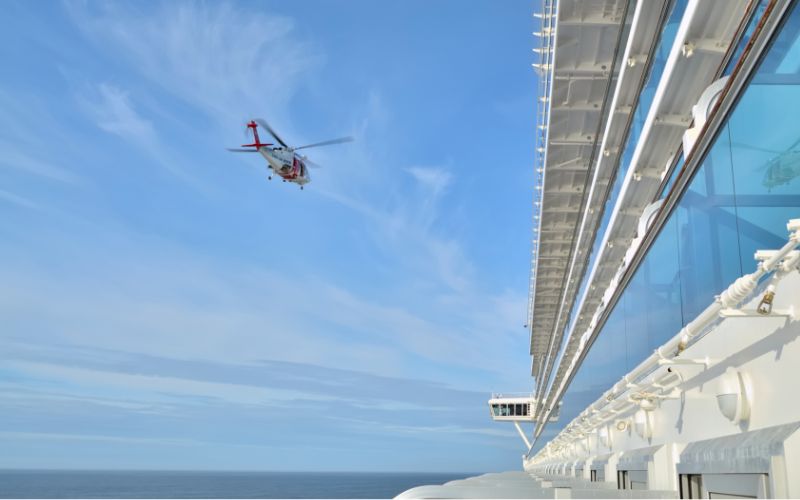
If you don’t have insurance, you could face extreme bills for your medical cover – into the hundreds of thousands of £s or $s in some cases, particularly if you have to be airlifted from the ship.
Several people have found themselves stranded while needing medical treatment, facing bills well into five figures…
It’s not just about making sure you have cruise insurance either, but making sure it covers everything you need it to, and that it’s valid.
The easiest way to invalidate your cruise insurance is to ignore pre-existing medical conditions you have, or to avoid mentioning which destination(s) you’re cruising to.
Both of these factors will influence the policy, and yes certain conditions or destinations might raise the price you pay.
But it’s better to pay a little more upfront and still have cover, than to find out your trick to save money actually leaves you unable to make a claim.
How Much Cruise Insurance Costs
There’s never going to be a set price for how much cruise insurance costs. It depends on many different factors, including your age, any pre-existing medical conditions you have, your destination/length of the cruise, and who you’re buying insurance for.
I’ve run some example quotes to give you an idea of how the different factors change the price of your cruise. These are all in GBP but you’ll find that USD prices are typically equivalent.
These are only a snapshot of options, and this isn’t meant to be a reference guide – but it illustrates the price differences you might need to expect. For the average price, I’ve tried to find cover that would likely pay for most of the cruise if you needed to cancel it, along with other inclusions.
Passenger
Travelling Group
Destination / length
Medical conditions
Minimum price
Average price
Mid-30s Adult
Solo
Med 7 nights
None
£30
£45
Mid-30s Adult
Annual
Med Cruises
None
£25
£100
Mid-30s Adults
Couple
Med 7 nights
None
£53
£80
Young Family of 4
Family
Med 7 nights
None
£77
£150
Mid-70s Adult
Solo
Med 7 nights
None
£100
£120
Mid-30s Adult
Solo
Caribbean 7 nights
None
£64
£93
Mid-30s Adult
Solo
World 80 nights
None
£550
£2,000 – but only includes a maximum £5,000 cancellation cover
Mid-30s Adult
Solo
Med 7 nights
General Anxiety Disorder
£36
£48
Mid-30s Adult
Solo
Med 7 nights
History of cancer
£320
£530
As you can see, there are so many different factors that have an impact.
The closer you are cruising to home, the less it costs, since flying you home for treatment would cost significantly less.
But age will play a big factor, as will any serious medical conditions. Minor ones can sometimes only make a very small difference to the cost, so it’s important to be honest.
There are a few ways you can bring down the cost of your cruise insurance:
1. Get a joint policy
If you’re travelling as a couple or with family, getting a joint policy to cover you all will likely work out cheaper than individual policies.
Just make sure you read the terms of any cover you’re given – you need to make sure medical costs or luggage costs are per person, not per policy.
2. Get an annual policy
Make sure you check out annual policies when shopping for your insurance deals. I always get an annual policy, but even if you only cruise once per year, it can still be worth it!
It may still be better to get an annual policy since it can cover you for non-cruise travel during the rest of the year too. And if there’s a chance you’ll cruise again later in the year, it’s definitely worth exploring this option.
3. Use a comparison site
It’s never a good idea to go direct to an insurer yourself because you might get a much better deal elsewhere. There aren’t always ‘cheap’ and ‘expensive’ cruise insurance providers – some might be cheaper for your circumstances, but more expensive for another travelling group.
Here are the cruise insurance websites I recommend…
Valuable Extras To Look For In A Policy
These extras aren’t always covered in a standard cruise insurance policy, but if they aren’t then they can be added on for a small additional fee.
1. Missed Port Cover
Missing ports on a cruise is super common. It’s happened on about a third of my cruises. Most of the time it’s due to weather, so if you book in the cheaper seasons you can expect to maybe miss a port or two.
If you’re planning to cruise to the Caribbean in hurricane season, then missed port cover is probably going to be worth it.
Missed port cover will give you some money per port missed, but the amount varies quite a lot depending on the policy. Be sure to choose one with a decent amount that’s more than the excess.
2. Cabin Confinement Cover
Being confined to your cabin is sadly also pretty common on a cruise.
If you have an illness causing you to vomit (that’s not due to seasickness) you should stay in your cabin for 24 hours, and the crew might insist on it.
Norovirus is a common cause on cruise ships, especially among children. When my daughter got it, she wasn’t allowed to leave the room for 24 hours, meaning that she and her dad missed a trip to Pisa.
If you have cabin confinement cover, you can claim some money for the time you’re not enjoying your cruise, which may help to ease the pain a little!
3. Unused Excursions Cover
If you miss ports or are confined to your cabin, you might miss shore excursions that you’ve paid for.
If you’ve booked an excursion with the cruise line and the port is cancelled, they will refund you. But third party excursions usually won’t.
Having missed excursion cover in your cruise policy means you can get some money back for those excursions as well.
My friend Emma for over $1,000 refunded on her travel insurance when she had a port cancelled. Check out this video…
I would advise that you always check the excess on your cruise policy, and make sure that the money you’ll get back for any of these extras exceeds it.
The higher the cover, the more you’ll pay upfront, so it’s a balancing act when you decide which policy you want to take out.
And if you do need to claim for cabin confinement, missed ports or missed excursions, make sure that you ask for a letter from the ship before the end of your cruise so that you can prove it to your insurer when you make a claim.
The Bottom Line
Cruise insurance is exceptionally important, so don’t rush into buying the first policy you find. But at the same time, you should be looking to book it on the same day you book your cruise – that way, if anything happens to make you need to cancel, you’ll be covered.
Always use a price comparison site to find the best deal for you. Prioritise cancellation cover, but make sure you’ve got plenty of medical cover included too. Missed port cover, and cabin confinement cover, are nice to have but don’t spend huge sums if the cover you get for them is low.
My Recommendation
My recommendation for cruise insurance depends on where you live.
These are trusted price comparison sites that will quickly get you lots of quotes to match your exact needs.
Related posts:
If you found this interesting, please share!
Jenni Fielding is the founder of Cruise Mummy. She has worked in the cruise industry since 2015 and has taken over 30 cruises. Now, she helps over 1 million people per month to plan their perfect cruise holidays.
You should never travel on a cruise without buying insurance. Too much can go wrong, and leave you with some serious problems to face up to, financially and logistically.
And that’s what these stories show. Thankfully there aren’t hundreds of horror tales out there about cruise passengers who didn’t have insurance, because most people know how important it is.
But there are some nightmare stories to share, which highlight why insurance is so important – and in some of these cases, passengers had insurance but still weren’t covered!
So let’s take a look at real horror stories related to cruise insurance so that you can see it really isn’t worth taking the risk when you book your next cruise escape.
1. Stranded In The Bahamas
One of the most shared cruise insurance nightmare stories is that of Bruce Campbell, a US tourist who took a cruise to the Bahamas with his wife, sailing with Carnival.
During the cruise, Bruce showed signs of a stroke, and had to be evacuated to a hospital in Freeport, where he was told that the hospital couldn’t manage his worsening condition and they would need to transfer. But because they had declined to take out insurance, they couldn’t afford it.
The couple set up a GoFundMe page, but that takes time and so they couldn’t get the money. The government offered to loan them the money, but as the cruise was taking place over the Christmas holidays, they would’ve had to wait for the government offices to re-open.
Eventually, they did make it home, thanks to an anonymous donor who paid $20,000 of their own money to cover the cost of the flights back to the US. Sadly Bruce did not make a full recovery and passed away a couple of days later.
Carnival did help the couple by paying the medical bills for the three days they spent in the Freeport hospital, which the cruise line wasn’t obligated to do. The couple still complained that they felt the cruise line could’ve done more, though.
This definitively shows why insurance is a must – they could have transferred to another hotel quickly and without the financial stresses involved had they been covered.
After all, not everyone will be able to find an anonymous donor willing to pay a five-figure sum to fly you home.
2. Hefty Bills Following A Fall
Denise Hammond, a US cruise passenger onboard a Carnival ship, was enjoying a Pacific cruise in late 2023 when she had a fall and fractured her hip and her arm.
She was treated onboard for three days before the ship reached Manado in Indonesia, where was was transferred to a local hospital. However, it wasn’t equipped to treat her fully, which meant a transfer to a Singapore hospital, with a cost of $60,000 for the transfer and a $40,000 deposit needed.
Instead, Denise’s daughter Rachel was able to raise enough money via GoFundMe to get Denise airlifted to a hospital in Bangkok, where she was finally able to get the surgery she needed – 13 days after her original fall!
The Hammond family claimed that Denise had “great insurance” but that the company was refusing to pay out, which reinforces the need for everyone to make sure they get comprehensive cruise cover and are insured against anything that could go wrong.
It’s reported that the insurance did at least help Denise to secure flights home after her treatment, but it’s not clear why the insurance company wasn’t helping with the massive medical bills.
3. The Gamble That Didn’t Pay Off
The Redman family took a cruise to Canada in 2022 to fulfil a dream, but it quickly became a nightmare as Chris, the mom of the family, suffered a heart attack while on the ship.
Thankfully she was able to be saved thanks to the amazing treatment of the crew on the ship, but she was transferred to a hospital in Canada which discovered more serious issues. Chris then had to be flown back to New Jersey for open heart surgery in order to save her life.
The cost of the medical care on the ship alone was $7,000 and the flight back to New Jersey, with the medical team involved, cost between $12,000 and $15,000. The total out-of-pocket expenses for the incident were well over $20,000, but the family had chosen not to get insurance.
According to the GoFundMe established by a family friend, “Deciding whether to get that insurance feels like a gamble no one wins – paying a lot of money for a week’s worth of insurance just about no one ever needs, or finding yourself with no coverage in an emergency.”
The GoFundMe page also stated that the cruise line refused to take insurance unless it had been purchased directly with the cruise line.
That’s extremely unlikely – most major cruise lines will accept proper cruise insurance whether booked through the cruise line or independently. Some small cruise lines might have a policy like this in place, but I’ve never found evidence of it.
It’s unclear whether the statement in the GoFundMe simply meant that Chris didn’t have proper cruise insurance and was hoping their regular medical insurance would cover costs, which it typically won’t.
4. “Nobody Told Us We Should Have Insurance”
Matthew Baker, CC BY-SA 3.0
While the horror stories of huge medical bills while stranded in foreign countries are (thankfully) rare, there are plenty of nightmare tales of people who’ve had to cancel a cruise before they sailed and realised they weren’t about to get a refund since they weren’t insured.
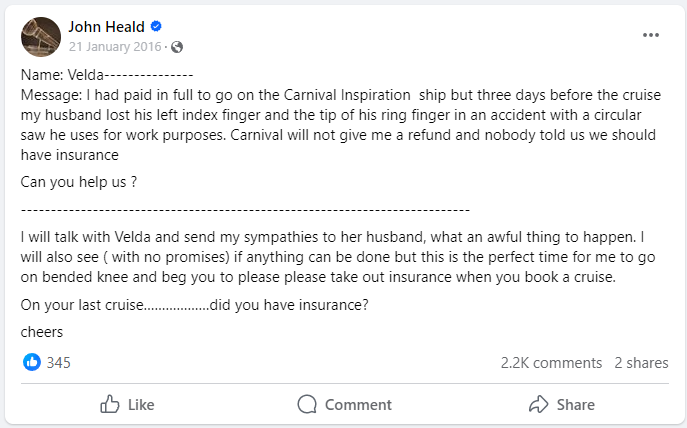
This story was sent to John Heald, the Brand Ambassador for Carnival, and detailed a couple who had to cancel their cruise due to a workplace accident three days before they were due to sail.
As it was well past the final payment deadline, the cruise line is not bound to offer a refund as per the terms of the contract guests signed. And the guests claimed that this was unfair and that nobody had told them to take out insurance.
Cruise lines always recommend guests purchase insurance. Claiming ignorance will never work – it is the responsibility of the traveller to ensure they have the proper cover in place for incidents just like this one.
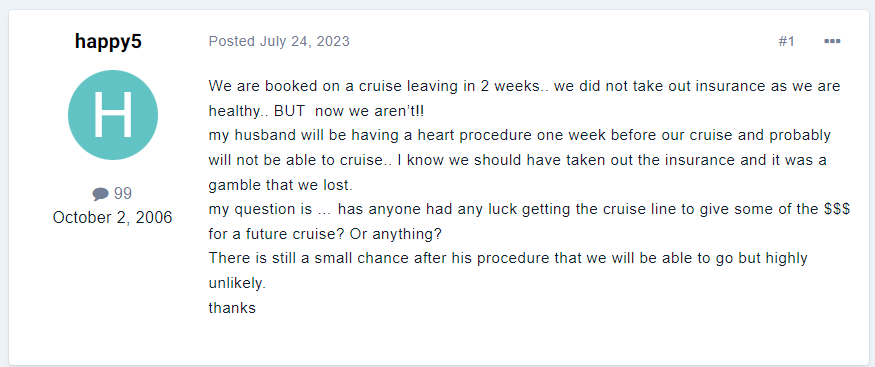
5. “We Were Healthy… Now, We Aren’t!”
Another person who admits that they took the gamble of cruising without insurance, and then lived to regret it.
This passenger booked a cruise with their partner, and because they felt healthy, they decided not to take out insurance.
Then, just a week before the cruise, the husband needed to have a heart procedure and would no longer be able to sail.
Again, the cruise line is in no obligation to give a refund, since selling the place onboard at that late stage would be extremely difficult. The contract you sign when you book your cruise states that you are liable for the fare once you get past a certain date.
Lesson learned, you would hope – don’t assume that, just because you’re healthy now, things won’t go wrong before you travel! You never know what’s around the corner for you.
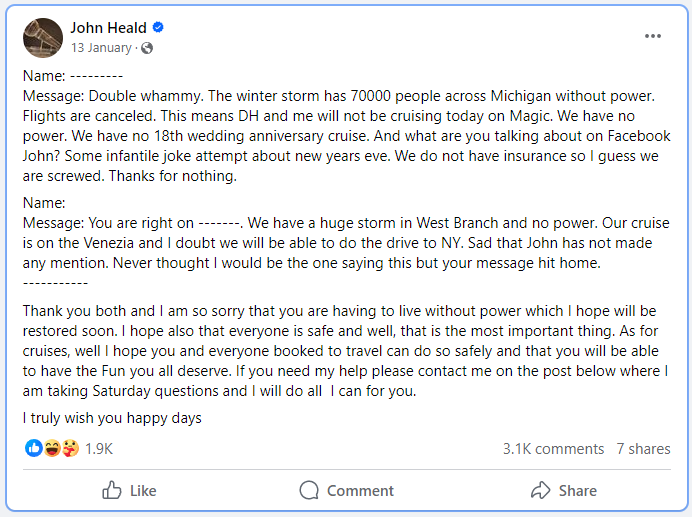
6. “I Guess We Are Screwed. Thanks For Nothing.”
Sometimes it’s not a medical issue that can prevent you from joining your cruise, but the elements.
You can’t predict the weather, especially if you’re booking a cruise months out. And if there are storms which mean you can’t even get to the ship, you need to make sure you have travel insurance for cruises that will refund you.
Because guess what – it’s not Carnival’s fault that there are storms holding up your flights either. And nor is it Carnival’s fault that you didn’t make contingency plans for your travel, and what you would do if flights were grounded due to the stormy weather.
The attitude of this person shows that they feel Carnival should bear the responsibility of the lost money, whereas if the passenger had just taken out insurance as they should’ve done, they would at least have got most of their money back and could cruise again in future.
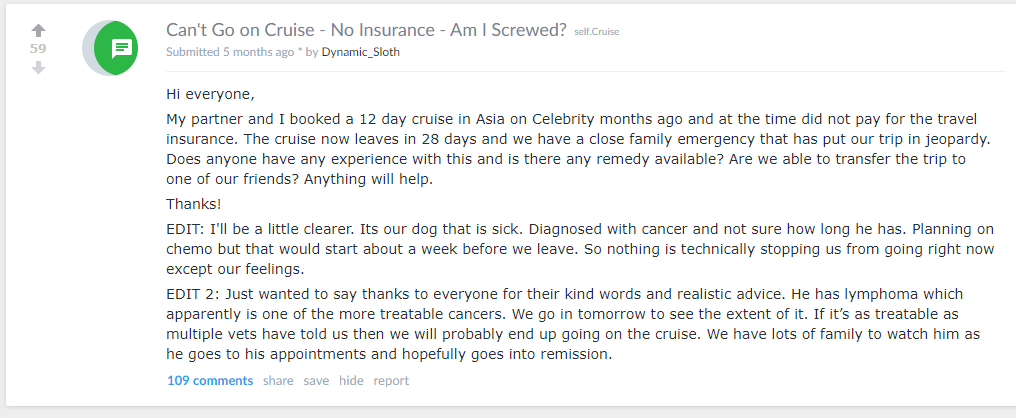
7. Close Family Emergency
This one didn’t end up being quite the horror story that it could’ve been, but it’s a great example of unnecessary stress caused by gambling.
This passenger revealed that they had a close family emergency within a month of their cruise, past the final payment deadline, and they had chosen not to get cruise insurance. They later revealed that the emergency was their dog being diagnosed with cancer.
Thankfully, as the diagnosis was further explored, it was revealed to be treatable, and it sounds like the passenger was still able to go on their cruise and leave their dog with family members during the treatment.
But take heed – it’s not just human medical emergencies that could stop you. If you have a beloved pet then something could happen with them to make you feel like you need to cancel.
Just make sure you’ve read your cruise insurance policy though, as they might only cover cancellation for human medical conditions.
Read more: X Things Your Cruise Insurance Won’t Cover You For!
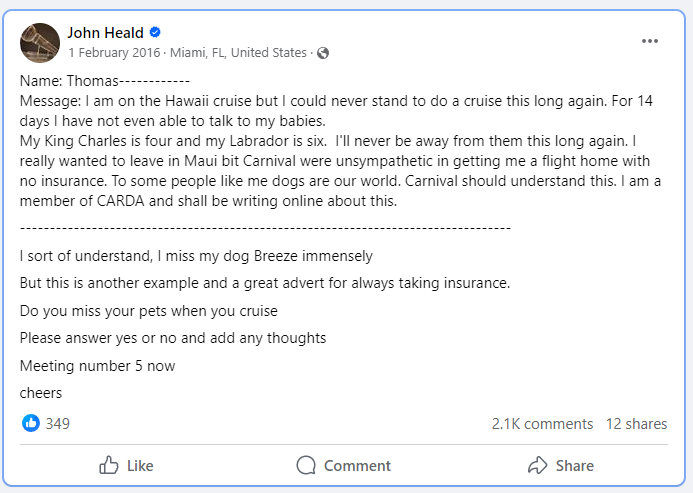
Indeed, there’s another guest who wrote in to John Heald on Facebook about cruising, dogs and insurance:
This guest didn’t take out insurance, and then while on their cruise they felt too sad to continue their sailing as they were missing their dogs too much.
But without insurance, they were unable to get a flight home without paying for it themselves, and they were unhappy that Carnival would not help. Quite what they expected the cruise line to do is another thing – should a cruise line pay to fly you home if you decide not to continue with your cruise?
Not all cruise insurance policies will cover you for cancellation just because you’ve changed your mind either, but some do offer the option of cancellation for any reason. Another reason to be careful when taking out a policy, so you know exactly what you’re covered for.
And then, if you do get dog-sick, you could at least fly home if you really needed to, and had the cover in place.
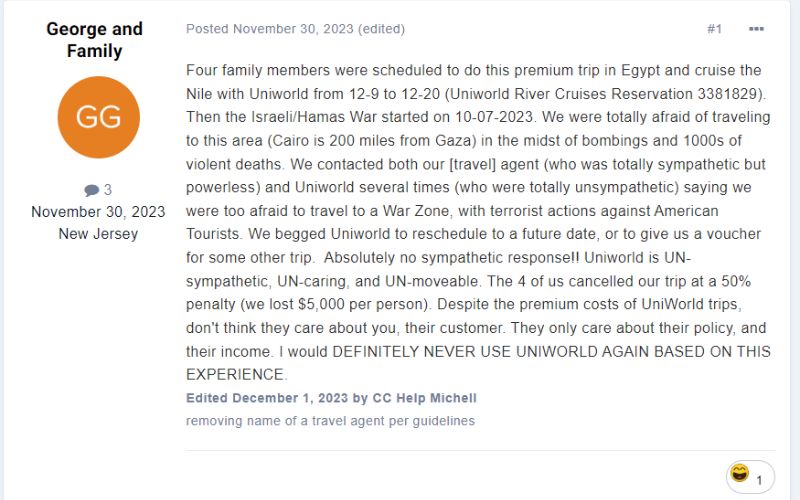
8. World Politics At Play
One more thing you can never predict when planning a cruise is what’s going to be happening in the world, and how that might impact your travel plans.
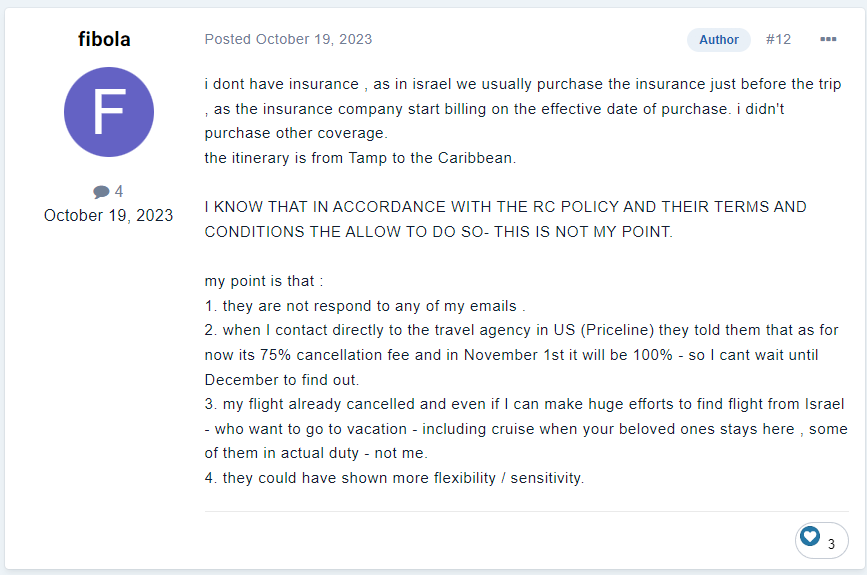
If your cruise is cancelled because of world events, the cruise line will refund you. But sometimes it isn’t quite that straightforward.
That’s a post from a cruise passenger in Israel, who had booked a cruise out of the US to the Caribbean.
Obviously, the cruise is unaffected by world events, but the passenger was unable to get a flight from Israel to the US to begin their cruise, due to the ongoing conflict in the country at the time.
They were not past the final payment date, but they weren’t too far out from their cruise, so cancelling would’ve meant sacrificing 75% of their cruise fare. They couldn’t risk leaving it longer, as that might mean losing 100% of their fare.
If they had bought insurance, they could’ve recovered most of the costs of their cruise, but they hadn’t and they claimed that it’s common in Israel to only buy insurance a few days before you travel.
They didn’t blame the cruise line for their failure to buy a suitable insurance policy, but they were angry that the company hadn’t shown flexibility to help them in this situation.
But it goes to show, you should always make sure you’re insured from the moment you’ve booked, and not to put off the purchase.
Then there’s this scenario, also related to the Israel/Palestine conflict:
The cruise line has, understandably, refused to offer a refund on the river cruise because of world events taking place 200 miles from where the cruise is sailing. The cruises aren’t cancelled, and so the guest is not entitled to a refund.
The passenger is worried about travelling there and so has lost around $5,000 per person on the trip. But if they had comprehensive cruise cover, they may have been able to get more money back.
Again, it would depend on the policy, because it wouldn’t be automatic to get a refund on a cruise that is sailing. If you choose not to cruise, that’s different from having a reason that is outside your control and that’s stopping you from cruising.
Bonus – Loyalty Points Fairness?
This story doesn’t concern insurance directly, but I found it while researching this guide and wanted to put it to you.
The passenger had to cancel their cruise close to their sailing date. They did have insurance, so would’ve received an almost complete refund from their policy, barring their excess payment. The cruise line kept their money, as it was past the final payment date.
But the passenger felt it was unfair that they wouldn’t be getting their loyalty points for the cruise. After all, they paid for it, and the cruise line got to keep the money, but the policy is you have to sail to get the points.
Who’s right? Should the passenger get their loyalty points despite only being slightly out of pocket, due to their insurance refund?
The Bottom Line
Whether it’s avoiding medical emergencies abroad, or dealing with unexpected reasons to cancel your cruise before you travel, you always have to make sure you have cruise insurance in place.
And don’t dawdle over it. Buy your insurance on the same day you book your cruise. Then if anything happens that would stop you sailing, you know you’ll at least get most of the money back.
The good news is that, for every horror story I found when researching this guide, there were hundreds of success stories where people had used their travel insurance when on a cruise, either for a medical emergency, or to get a refund before they sailed.
Make sure you check out my Cruise Insurance Buyer’s Guide for more information on what to look out for when choosing a policy, and how to get the best prices for your cruise insurance.
Related Topics
If you found this interesting, please share!
Jenni Fielding is the founder of Cruise Mummy. She has worked in the cruise industry since 2015 and has taken over 30 cruises. Now, she helps over 1 million people per month to plan their perfect cruise holidays.
When I started the Cruise Addicts website in 1999, our cruise forums were vital part of our community and continue to be today. I keep seeing articles about other cruise forums that have been created besides our very own. Could this be true? So, I searched the interwebs and found some I’d like to share with you.
Best Cruise Forums
10 Best Cruise Forums 13
With my hypercritical eye, I created what I feel is the best list of the top cruise forums today.
Cruise Forums are a great way to connect with fellow cruisers and learn the latest tips and tricks. Whether you’re a new or seasoned cruiser, a cruise forum is a great way to meet new people. You can ask specific questions related to a particular cruise brand on a sub-forum or general questions in a general topic forum.
Why Use Cruise Forums?
Some forums have sub-forums for roll calls, allowing cruisers to meet fellow cruisers on a specific cruise line’s sailing. For example, if you cruise aboard the Carnival Vista on a particular date in July, you can find this roll-call post, meet new fellow passengers online, and maybe meet up for a drink or get-together.
Here Are the Best Cruise Forums to Join:
Cruise Addicts and its popular cruise forum were established in 1999 and are celebrating their 25th year as one of the original online communities on the Internet. The forums contain different categories of the major cruise lines and relevant topics. They have an incredible amount of information—over 1.7 million posts.
The Cruise Addicts site is also unique in that it asks if you would like to use the APP version of the site, making it easier to connect from your smartphone.
Cruise Critic started in 1995 on AOL and later moved to its current web-based home. The online community has become the largest and most popular cruise forum and one of the originators of the ‘roll-call’ forum and onboard meetups.
Royal Caribbean Blog and its forums are an unofficial site created to discuss everything about Royal Caribbean. The forums and site as a whole are trusted sources of information for fans of Royal Caribbean International cruises.
In recent years, Reddit.com’s cruise-focused subreddit, r/Cruise, has grown to 595K plus members. So, we can’t ignore this incredible collection of cruisers sharing information via this forum-like platform.
The Cruise Hive Boards is a great forum focused on the major cruise lines and another great option for meeting new cruises and learning from them. The site is also an excellent resource for cruise news and information.
DIS Boards is an incredible message board focused on all things Disney. Of course, it has a section dedicated to Disney Cruise Line. You can find meet-ups, trip reports, and more. The forum has well over 63M messages and 601K members.
TripAdvisor Cruise Forum
TripAdvisor.com has its cruise forums with many posts and active users. The page’s right sidebar also has a nice collection of “Top Questions about Cruises” that some users might find helpful.
The Cruise Community Forum is heavily focused on UK cruising topics. The forum has become a leading resource for UK cruisers to share information and learn from fellow cruisers.
A trusted name in travel, the Fodor’s Travel site includes a cruise forum section that discusses cruise travel.
10. CruiseLine.com Forums
The CruiseLine.com forums is a very active community loaded with many forum topics that are a great resource.
Final Thoughts
Cruising is a remarkably social travel experience and a great way to meet new friends and socialize with friends and family. Cruise forums are an extension of this and have allowed fellow cruise travelers to continue their friendships and conversations once the cruise has ended and the planning for the next one begins. They also allow you to learn more about cruise travel from members of the forum and make great friends. I’ve seen it firsthand on the Cruise Addicts forums.
Forums have allowed members to share daily updates, breaking news, and trip reports directly from the ship years before social media existed. Forums have stood the test of time and are now well over 25 years old, with no end in sight. Forums and groups continue to be popular as people want to connect.
If you search the internet for famous quotes about the ocean and life, there are literally hundreds to choose from. This list focuses solely on the best quotes about calm, smooth seas…
And if you’re looking for calm sea quotes for Instagram, just grab one of these and slap it on a pretty sea picture!
The Best Calm Sea Quotes
A smooth sea never made a skilled sailor.
Franklin D. Roosevelt
This famous quote by the American president, Franklin D. Roosevelt, means that when everything is going well, not much skill is needed. Conversely, when things happen that test our skills, it makes us work harder and achieve more.
Storms draw something out of us that calm seas don’t.
Bill Hybels
This quote by American author, Bill Hybels, is very much along the same vein. It’s about how experiencing difficult times can build us up to become better. In these quotes, the calm sea is a metaphor for easy times.
Great people are not affected by each puff of wind that blows ill. Like great ships, they sail serenely on, in a calm sea or a great tempest.
George Washington
This quote by American president George Washington is about how you don’t need to let yourself be affected by things that are outside of your control.
In a calm sea, every man is a pilot.
John Ray
17th-century English naturalist, John Ray, used the calm sea metaphor to demonstrate how we’re all ready to offer advice when there’s no risk. But, when danger threatens, people aren’t always so keep to step forwards.
If the ocean can calm itself, so can you. We are both saltwater mixed with air.
Nayyirah Waheed
Nayyirah Waheed has been described as ‘the best poet on Instagram’. This quote is about the importance of meditation and self-reflection in achieving calm in difficult situations.
The man who has experienced shipwreck shudders even at a calm sea.
Ovid
This quote by the Roman poet, Ovid, demonstrates how traumatic experiences can have an effect on us for long after the event has finished.
But never have I been a blue calm sea. I have always been a storm.
Stevie Nicks
This line is from the Fleetwood Mac song, Storm. This is a very sad song and people have offered various insights into the meaning behind it. One suggestion is that it means that we can be calm on the outside, but some of us have ‘storms’ within us which can affect how we act.
There are some things you learn best in calm, and some in storm.
Willa Cather
This quote by American author, Will Cather, is a testament to those people that survived the Great Depression. It means that we will all encounter challenges, and what matters most is taking away lessons to help us grow.
At night, time becomes a calm sea. It goes on for ever.
Francoise Sagan
This quote by French playwright, Francois Sagan, draws our minds to how quiet and long the night is, by likening it to the view of a smooth ocean.
Timid men prefer the calm of despotism to the tempestuous sea of liberty.
Thomas Jefferson
This quote by the third US President, Thomas Jefferson, means that when liberty is abused and morality no longer guides our decisions, then tyranny will take its place.
One’s ships come in over a calm sea.
Florence Scovel Shinn
Florence Scovel Shinn was a 19th-century artist and spiritual teacher. This quote means that if you can be happy, with or without your heart’s desire, then it will suddenly appear. The calm sea is a metaphor for peace and happiness.
The courage to press on regardless – regardless of whether we face calm seas or rough seas, and especially when the market storms howl around us – is the quintessential attribute of the successful investor.
John C. Bogle
John C. Bogle is the founder of investment company Vanguard and the inventor of the index fund. His quote highlights the importance of sticking to your plan no matter what happens
Instead of passing on choppy waters to the next generation, we should endeavour to leave them a calmer sea.
Najib Razak
This quote from the Malaysian prime minister serves as a reminder of how we should strive to make the world a better place for future generations.
It is extraordinary to see the sea; what a spectacle! She is so unfettered that one wonders whether it is possible that she again become calm.
Claude Monet
With this quote, French painter Monet draws attention to how the sea can be incredibly rough, yet still becomes calm again. You could argue it’s a rough seas quote as much as a smooth sea quote.
You have to think of your career the way you look at the ocean, deciding which wave you’re gonna take and which waves you’re not gonna take. Some of the waves are going to be big, some are gonna be small, sometimes the sea is going to be calm. Your career is not going to be one steady march upward to glory.
Alan Arkin
American actor, director and screenwriter, Alan Arkin, uses the ocean as a metaphor for potential career directions in this inspirational quote.
To us large creatures, space-time is like the sea seen from an ocean liner, smooth and serene. Up close, though, on tiny scales, it’s waves and bubbles. At extremely fine scales, pockets and bubbles of space-time can form at random, sputtering into being, then dissolving.
Gregory Benford
Astrophysicist, Gregory Benford, uses the image of a smooth sea to explain the concept of space-time.
Life is like the ocean. It can be calm or still, and rough or rigid, but in the end, it is always beautiful.
Unknown
And there we finish with one more beautiful quote about the calm ocean and how it compares to life itself.
I hope that you’ve found some calm from reading these quotes about calm seas. Speaking quotes like these can help us in times of stress and worry, along with traditional methods such as meditation and the use of tools like anxiety rings and stress balls.
Do you have a favourite calm sea quote?
NEW DEALS JUST RELEASED!
Don’t miss these hot cruise offers…
Related posts:
If you found this interesting, please share!
Jenni Fielding is the founder of Cruise Mummy. She has worked in the cruise industry since 2015 and has taken over 30 cruises. Now, she helps over 1 million people per month to plan their perfect cruise holidays.