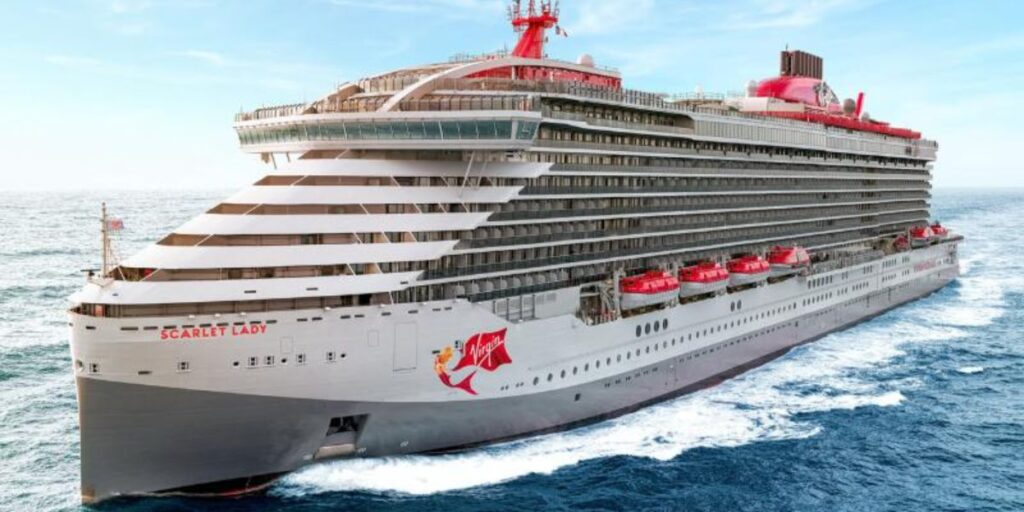
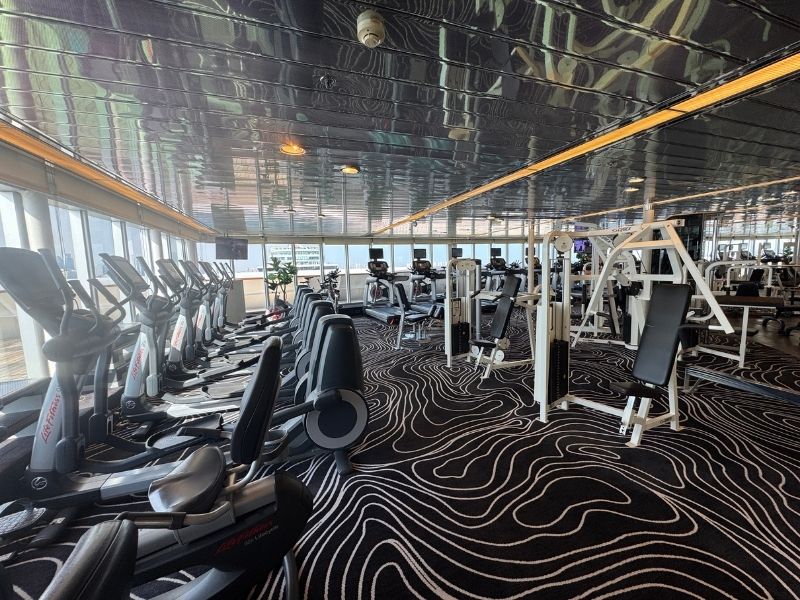
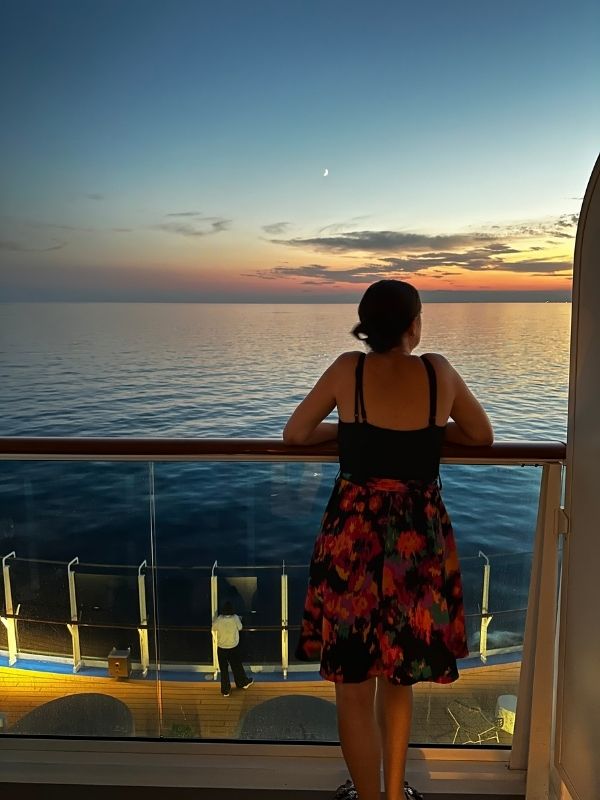
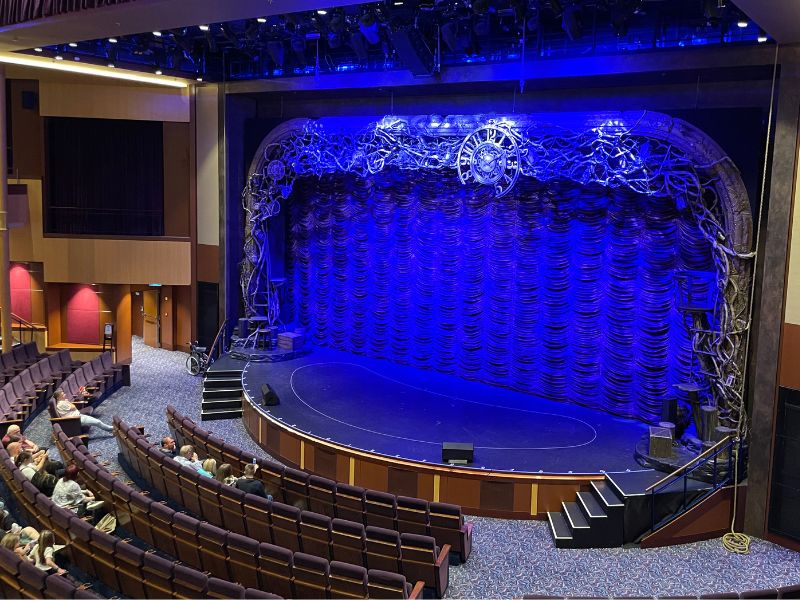
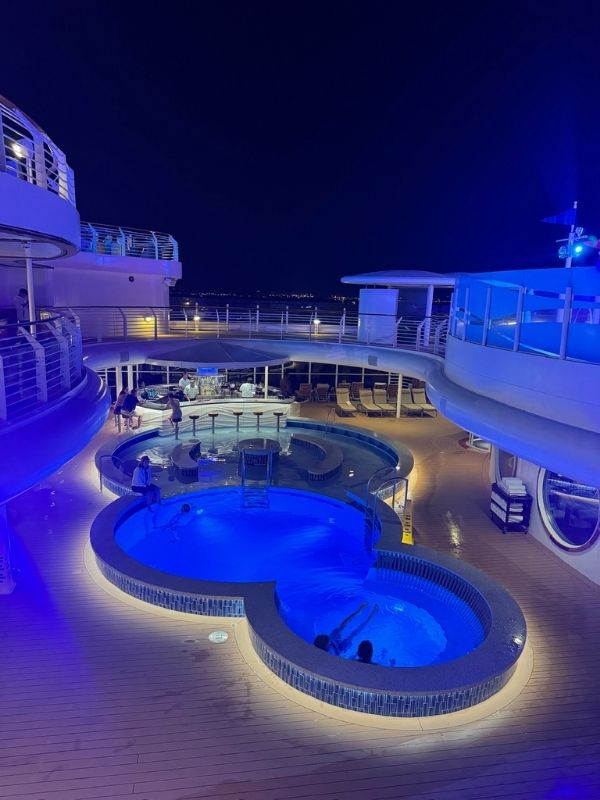
Virgin Voyages has launched its 2026 Annual Pass, offering unparalleled access to the cruise line’s fleet and an exclusive one-week stay on Necker Island, Sir Richard Branson’s private retreat in the British Virgin Islands.
The announcement comes shortly after the debut of the 2025 Annual Pass, with the 2026 package unveiled early to give travellers additional time to plan their voyages.
You’d have to assume that the cruise line saw some success with the 2025 Annual Pass to be releasing the 2026 one already, whether that’s a lot of purchases or just good PR.
Priced at $199,000, the 2026 Annual Pass provides year-round access to any Virgin Voyages ship, including the upcoming Brilliant Lady, which will sail from Seattle to Alaska starting in May 2026.
However, the cruise line has recognised that the annual pass could offer better value, and so has announced that the 2026 version will include a range of further exclusive benefits.
These include:
A week-long stay on Necker Island: Includes business-class flights, ferry transfers, and access to the 74-acre private paradise.
Daily Moët champagne delivery on demand.
A $10,000 shopping credit for onboard High Street shops on the ships.
Birthday upgrades to RockStar Quarters suites.
Four privately hosted Shore Things annually.
Up to 10 cabana reservations per year at the Beach Club in Bimini.
Personalized RockStar robes and Virgin Voyages’ signature Yellow Leaf Hammock.
The pass is valid for one year starting January 1, February 1, March 1, or April 1, 2026, depending on the chosen start date. Bookings must be finalised by March 31, 2026.
An industry first with buzz-worthy appeal
Virgin Voyages’ Nicole Huang, Senior Vice President of Sailor Experiences, explained the motivation behind the early release.
“After Richard Branson went on Good Morning America to talk about our Annual Pass, there was so much excitement and buzz. It’s truly an industry first, and there were long queues to learn more. Our voyage planners shared feedback of Sailors inquiring about 2026 now, so we thought ‘why wait?’ and added a few elements to make the package a little suite-r.”
And to help encourage sales of the annual pass, the cruise line has announced that any travel agents who facilitate a booking of an annual pass will be given a flat $10,000 commission.
Passes are available on a first-come, first-served basis although, realistically, I’m not sure if they will sell out.
With its combination of luxury cruising and access to Necker Island, the 2026 Annual Pass sets a new standard for all-inclusive travel experiences. That’s true.
But it definitely seems like more of a PR move. Still, if you have a spare $199,000 sitting in your bank account, plus extra for your flights to and from cruise ports, then why not give it a go?
Related posts
If you found this interesting, please share!
Jenni Fielding is the founder of Cruise Mummy. She has worked in the cruise industry since 2015 and has taken over 30 cruises. Now, she helps over 1 million people per month to plan their perfect cruise holidays.
A 51-year-old father-of-four tragically died on Boxing Day after jumping from Norwegian Cruise Line’s Norwegian Epic in the Caribbean, despite his family’s desperate attempts to restrain him. Dan McGilvray, a…
A Royal Caribbean passenger’s relaxing cruise turned into a costly lesson after returning home to discover a $1,300 cell phone bill, stemming from a simple but expensive mistake. The incident…
UK-based Ambassador Cruise Line and France’s Compagnie Française de Croisières (CFC) are merging to form Ambassador Group, a new European cruise brand. The combined fleet will feature three mid-size ships…
Carnival is often changing up the packages and deals that it offers to guests and so it can be hard to keep track of what’s new, what’s old and even…
P&O cruise ships come in three broad types: two very large, modern ships (Arvia and Iona), three mid-to-large family ships (Britannia, Azura and Ventura), and two smaller ships aimed mainly at adults (Arcadia and Aurora). For the most facilities, choose Arvia or Iona; for a calmer, more traditional feel, look at Arcadia or Aurora. The fleet is also about to change, with Arcadia leaving and Cunard’s Queen Anne joining in 2029.
P&O cruise ships by size and age
P&O Cruises currently sails seven ships. The table lists them from largest to smallest, which also happens to be close to newest to oldest. Passenger numbers are standard capacity, and tonnage is rounded because published figures vary slightly.
Ship
Gross tons
Guests
Entered service
Age in 2026
Who can sail
Arvia
185,600
5,200
2022
4
All ages
Iona
184,700
5,200
2021
5
All ages
Britannia
143,000
3,647
2015
11
All ages
Ventura
116,000
3,078
2008
18
All ages
Azura
115,000
3,100
2010
16
All ages
Arcadia
83,800
2,094
2005
21
Mainly adults-only
Aurora
76,200
1,874
2000
26
Mainly adults-only
Age matters less than you might expect, because refits keep the older ships current. Arcadia was refurbished in 2024 and Azura in 2025. Britannia has also had a recent refit, with new colour schemes, a larger Market Café and a redesigned Sunset Bar. Aurora has a 16-night dry dock scheduled for May 2028.
The best P&O cruise ship for you
Choosing the best P&O cruise ship is mostly a question of how much bustle you enjoy and who you are travelling with.
If you want
Look at
Why
The widest choice of food and entertainment
Arvia or Iona
The largest, newest ships, with a covered SkyDome pool area
A first cruise with a modern feel
Iona or Britannia
Plenty to do, and regular sailings close to home
A family holiday at a lower price
Azura or Ventura
Kids’ clubs and space, usually without new-ship pricing
A balance of size and atmosphere
Britannia
Big enough for variety, smaller than the two giants
A quieter, child-free cruise
Arcadia or Aurora
Smaller ships and many adults-only departures
A long voyage or world cruise
Arcadia or Aurora
These ships run the longest and most unusual itineraries
Arvia and Iona: the big, modern pair
These near-identical sisters each carry 5,200 guests and run on liquefied natural gas. Both have the SkyDome, a glass-roofed pool and entertainment space that makes them practical for cooler northern routes. Iona has an on-board gin distillery, and Arvia has the Altitude Skywalk high above the top deck. The trade-off is scale: expect more people, and more planning around popular venues.
Britannia: the middle ground
Britannia carries about 3,650 guests and has a similar range of speciality restaurants to the bigger ships. She is also home to P&O’s Cookery Club. She is scheduled to be based in Southampton all year from 2027, for the first time since her 2015 launch, which makes her a useful option if you want to avoid flying in winter.
Pool decks are a big draw on P&O's family ships. Photo: Bridgid Johnston on Pexels
Azura and Ventura: dependable family ships
Azura and Ventura are near-twins of around 115,000 tons and just over 3,000 guests. Both are family-focused, with kids’ clubs that divide children by age. They are large enough to keep everyone busy but noticeably easier to navigate than Arvia or Iona. Ventura also has a small number of solo cabins, which are worth searching for if you travel alone, as they tend to be limited.
Deployment can settle the choice. Ventura has a seven-night Scandinavia cruise planned from Southampton after New Year’s Eve 2027, while Azura runs selected Canary Islands fly-cruises.
P&O cruise ships for adults: Arcadia and Aurora
Arcadia and Aurora have long been P&O’s adults-only ships, and this is the detail most fleet guides have not caught up with. Since late 2025, P&O has been selling selected family departures on both, and families can sail on them from December 2026. Up to September 2027 there are 12 family sailings on Aurora and eight on Arcadia, concentrated around school holidays, including Christmas and summer.
Both ships keep a substantial adults-only programme, but you can no longer assume a sailing is child-free just because of the ship’s name. Check the departure itself before paying a deposit. If a child-free cruise is the reason you are booking, avoid Christmas, Easter and the summer holidays without confirming first.
The ships have different characters. Aurora is the smallest and oldest in the fleet, with a classic, traditional feel and a following among long-voyage fans; a 75-night South America Grand Tour is planned for 2028. Arcadia is known for its art collection of around 3,000 works and glass-fronted lifts, and has a 124-night world cruise in 2028.
Which ships have family facilities?
On the family departures, Arcadia and Aurora offer children’s menus, bottle warming and baby-changing, along with activities for all ages. Neither was built as a family ship, so families wanting full kids’ clubs and splash areas will generally be better served by the five all-ages ships.
Dining on P&O cruise ships
Main restaurants, the buffet and casual poolside food are included in your fare on every ship. Most ships offer two styles in the main dining rooms: Club Dining, with a set time and table, and Freedom Dining, where you turn up when you like. Britannia, for example, has the Oriental restaurant for Club Dining and the Meridian and Peninsular for Freedom Dining. Check which your ship offers before you book, as this affects the evening routine more than people expect.
Extra-charge restaurants vary by ship. Prices change, so treat these as a guide:
Sindhu (modern Indian): £25 per person, following a 2026 menu refresh, and listed by P&O across the fleet.
Epicurean (fine dining): about £40 per person on Iona in early 2026. It is on Arvia, Iona, Britannia, Azura and Ventura.
The Glass House (wine bar with small plates): on most of the fleet, including Aurora, priced by the dish.
The Beach House (relaxed, casual dining): about £11.50 per person on Iona in early 2026, and available on selected ships.
The Limelight Club (dinner with live acts, adults only): typically £30 to £45 per person, depending on the performer.
Keel & Cow and The Olive Grove: casual options on Arvia and Iona. The Olive Grove has no cover charge, though some dishes cost extra.
If food is a priority, Arvia, Iona and Britannia give you the most variety. The smaller ships have fewer venues, so check the current deck plan on the P&O Cruises ships page if a particular restaurant matters to you.
Winter deployment can decide which ship suits you. Photo: Angelo Esposito on Pexels
Where the ships sail
Most P&O cruises leave from Southampton, but winter deployment changes the picture. From October 2027 to April 2028, Iona joins Arvia in the Caribbean on 14-night fly-cruises from Barbados, Antigua and St Kitts. If you want one of the two biggest ships without a flight that winter, you will need to pick a different ship or season. If you are comparing fares for next year, our guide to cruise deals for 2027 is a useful starting point.
In October 2026, Carnival Corporation confirmed a three-way fleet reshuffle. Arcadia’s last P&O season ends on 21 August 2029, after which she moves to Holland America Line. Queen Anne, launched for Cunard in 2024, will leave after her 2028/29 World Voyage, have an extensive refit, take a new name and join P&O in May 2029. Our report on the Carnival fleet shuffle has more on the move.
A few things are still unknown. P&O has described the incoming ship as a new class for the fleet, with a different scale and onboard style, but it has not announced her new name or said whether she will be adults-only. At about 113,000 tons and around 3,000 guests, she would sit close to Azura and Ventura in size. If she is not adult-focused, Aurora would become P&O’s only mainly adults ship once Arcadia leaves.
On the announced dates, the fleet would briefly reach eight ships between May and August 2029, then return to seven. We found no announcement of Aurora leaving, and she has a dry dock booked for 2028. If you are holding an Arcadia booking in or after summer 2029, ask P&O or your agent what applies, as details of the farewell season are still to come.
FAQs
How many P&O cruise ships are there?
P&O Cruises has seven ships as of November 2026: Arvia, Iona, Britannia, Azura, Ventura, Arcadia and Aurora. Cunard’s Queen Anne is due to join in May 2029, and Arcadia is due to leave that August.
Which is the best P&O ship?
There is no single best ship. Iona and Arvia suit people who want the newest ships and the most choice, Britannia is a strong middle ground, Azura and Ventura suit families on a budget, and Arcadia and Aurora suit adults who prefer a smaller ship.
Are any P&O ships adults-only?
Arcadia and Aurora are P&O’s adult-focused ships, but they are no longer adults-only all year. Selected family sailings run from December 2026, so check the individual departure before you book.
What is the biggest P&O cruise ship?
Arvia is the largest by a small margin at about 185,600 gross tons. Her sister ship Iona is about 184,700 tons, and both carry around 5,200 guests.
Does P&O Cruises still exist?
Yes. P&O Cruises is a UK cruise line owned by Carnival Corporation, with most sailings leaving from Southampton. It is separate from P&O Ferries.
In the Carnival Dream vs Carnival Breeze debate, Breeze is the better pick for families and anyone who wants the ropes course, RedFrog Pub and Italian specialty restaurant, while Dream is the better pick for value and for a recently refreshed ship. The two are near-identical sisters, so the deciding factor is often where and how long you want to sail. That is about to change, because their itineraries effectively swap in May 2027.
Carnival Dream vs Carnival Breeze at a glance
These are two of the three Carnival Dream class ships, alongside Carnival Magic. They share a layout, so if you know one, you will find your way around the other quickly. Here is how the figures compare in November 2026.
Feature
Carnival Dream
Carnival Breeze
Entered service
2009
2012
Gross tonnage
About 128,000 to 130,000
About 128,000 to 130,000
Length
About 1,004 ft
About 1,004 ft
Guests (double occupancy)
3,646
3,690
Crew
1,367
1,386
Last dry dock
March 2026, Marseille
2022, Cadiz (next expected 2027)
Homeport now
Galveston
Galveston
Homeport from May 2027
New Orleans
Galveston
Ropes course
No
Yes
RedFrog Pub
No
Yes
Cucina del Capitano
No
Yes
Size is effectively a tie. If you want to see how they sit against the rest of the fleet, our guide to Carnival ships compared by size puts the Dream class in context.
Recent refits: which ship feels fresher?
Carnival Breeze is the younger ship, but Carnival Dream has had the more recent work. Dream spent 16 days in dry dock in Marseille in March 2026. The headline additions are modest and practical:
A Dreams Studio for professional portrait sessions
A Carnival Adventures Store for browsing and booking shore excursions
A redesigned casino with a dedicated host station
A refreshed Effy Jewelry shop
Much of the rest was technical maintenance, so this was a tidy-up, not a transformation. Most of Dream’s current food and drink lineup, including Guy’s Burger Joint, BlueIguana Cantina and Alchemy Bar, dates from a 2017 refit.
Carnival Breeze last went to dry dock in Cadiz in spring 2022, when she received the red, white and blue hull and an expanded non-smoking casino area. Carnival’s booking calendar points to another dry dock in early 2027, around late February to mid-March, though the line has not announced what it will include. If you are booking Breeze for later in 2027, she may well have changed a little by the time you board.
The two sisters share the same open-deck layout, with a few key differences. Photo: William Jacobs on Pexels
Carnival Breeze vs Dream: itineraries and homeports
Most comparisons stop at “both sail from Galveston”. That is true today, but only until spring 2027, and it could be the most important part of your decision.
Sailing before May 2027
Both ships are currently based in Galveston, but they serve different kinds of trip. Carnival Breeze runs short four- and five-night Western Caribbean getaways, usually to Cozumel, with Progreso added on the longer sailings. Carnival Dream runs longer trips of six to eight nights or more, calling at places such as Cozumel, Costa Maya, Roatan and Belize, with some longer voyages reaching The Bahamas and Celebration Key.
Sailing from May 2027
The roles then reverse:
Carnival Dream moves to New Orleans on May 16, 2027, for four- and five-day cruises to Mexico, sailing alongside Carnival Liberty.
Carnival Breeze stays in Galveston but changes to a mainly seven-night schedule on Western and Eastern Caribbean routes, with ports such as Cozumel, Belize, Grand Cayman, Nassau and Celebration Key.
So if you want a quick break from Texas, book Breeze before mid-May 2027. If you want a full week from Galveston, book Dream before that date or Breeze after it. Drivers from Louisiana, Mississippi and Alabama gain a much bigger ship at New Orleans for short cruises.
Dining on Carnival Dream vs Breeze
The free favorites are the same on both: the Main Dining Room, Lido buffet, Guy’s Burger Joint, BlueIguana Cantina, Guy’s Pig & Anchor Bar-B-Que, Mongolian Wok and Seaday Brunch. Both also have Bonsai Sushi, the Seafood Shack, the Steakhouse and The Chef’s Table at an extra cost.
The differences are few but real:
Italian: Breeze has Cucina del Capitano, a popular for-fee family-style Italian restaurant. Dream does not.
Pizza: Dream has Pizzeria del Capitano, while Breeze keeps the older Pizza Pirate.
Pub food: Breeze’s RedFrog Pub sells bar snacks and food at an extra cost.
Breeze therefore has more variety, especially if you like to book a specialty night. Cruise Critic’s editors and members nevertheless rate Dream’s dining more highly overall, so more choice does not automatically mean a better experience.
Bars and nightlife
Alchemy Bar, the BlueIguana Tequila Bar, the RedFrog Rum Bar, the casino bar and the Ocean Plaza area appear on both ships. The main difference is RedFrog Pub on Breeze, a Caribbean-themed pub that many Carnival regulars specifically seek out. Dream counters with extra lounge space, including The Song for karaoke and Sam’s Piano Bar, while Breeze has Piano Bar 88 and Limelight Lounge. Dream’s late-night spot is Caliente, and Breeze’s is Liquid Nightclub.
Sports fans should note that Cruise Critic flags a lack of a dedicated sports bar on Breeze, with games shown in the casino bar instead.
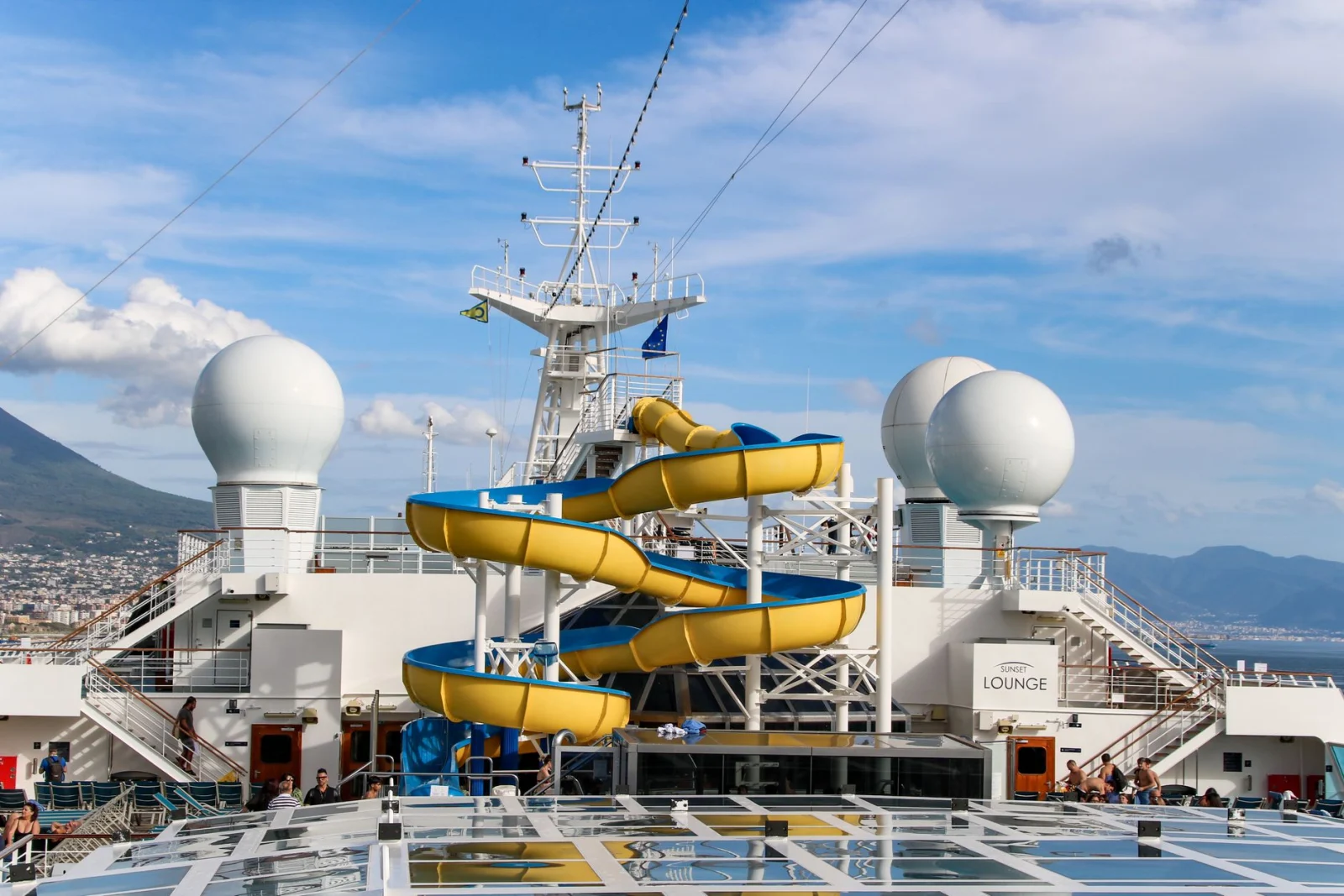
WaterWorks and its slides feature on both Dream class ships. Photo: SamFoll SF on Pexels
Activities and entertainment
Both ships offer Carnival WaterWorks with the Twister slide, mini golf, a basketball court, a jogging track, an outdoor movie screen and the arcade. The Twister has a 42-inch minimum height, at least on Dream, so check the requirement before promising a small child a ride.
The ropes course is the standout difference. It is on Breeze as part of SportSquare and is missing on Dream, along with Breeze’s outdoor gym. If you have active older kids, this alone may settle things.
In the evening, both ships have the Punchliner Comedy Club, live music in the atrium and Ocean Plaza, a casino and shows in the main theater. Cruise Critic members score Dream’s entertainment higher, 3.9 to 3.5. Older guides mention a 4D Thrill Theater on Breeze, but it was reportedly removed in 2022, so do not plan around it.
Kids, teens and the adults-only Serenity deck
Children’s programs are the same on both ships: Camp Ocean for ages 2 to 11, Circle C for 12 to 14 and Club O2 for 15 to 17. Dr. Seuss-themed activities and breakfast are offered on both, with the breakfast at an extra charge. Cruise Critic’s editors give Breeze a higher family score, 5 out of 5 against 4 for Dream, which reflects the extra activities and the food choice.
Adults on either ship get Serenity, a free retreat for guests 21 and over with two hot tubs. There is no adults-only pool on either ship.
Spa and cabins
Cloud 9 Spa and its extra-charge Thermal Suite are on both ships, so this is largely a tie. Treatments and salon services are broadly the same, and day passes vary by sailing, so check the Carnival app or your cruise planner.
Cabin sizes are the same in each category on both ships, including the popular cove balconies. As sister ships with similar layouts, your choice of location matters far more than your choice of ship: midship cabins away from the aft nightlife and the Lido overhead are usually the quietest.
Prices and value
Dream has generally been the cheaper ship per night. Cruise Critic’s lead-in fares in November 2026 start at about $42 per person per night for an interior cabin on Dream, against $54 on Breeze, and $72 against $81 for a balcony. Suites buck that trend, starting lower on Breeze. Short cruises usually cost more per night than week-long trips, and fares change daily, so compare the exact dates you want. Our 2027 cruise deals page is a good place to start if your dates are flexible.
Verdict: which ship should you choose?
Choose Carnival Breeze if you are traveling with active kids, want Cucina del Capitano or RedFrog Pub, or want a seven-night Galveston cruise after May 2027.
Choose Carnival Dream if you want the lower fare, a recently refreshed ship, a longer Galveston cruise before May 2027, or a short getaway from New Orleans after that.
Neither ship is the wrong choice. For how both compare with the rest of the fleet, see our list of Carnival ships ranked by reviews. Before booking, confirm venues on Carnival’s official Carnival Dream and Carnival Breeze pages, since dry docks can change the lineup.
Is the Carnival Dream bigger than the Carnival Breeze?
No, not in any way you would notice. Both are about 1,004 feet long and 128,000 to 130,000 gross tons. Breeze carries slightly more guests at double occupancy, 3,690 against 3,646.
Which is newer, Carnival Dream or Carnival Breeze?
Carnival Breeze is newer, having entered service in 2012, three years after Carnival Dream in 2009. Dream has had the more recent dry dock, in March 2026, while Breeze’s last was in 2022.
Does Carnival Dream have a ropes course or RedFrog Pub?
Carnival Dream does not have the ropes course or the RedFrog Pub. Both are on Carnival Breeze. Dream does have the RedFrog Rum Bar, which is a different and smaller poolside venue.
Where do Carnival Dream and Carnival Breeze sail from in 2027?
Both sail from Galveston until May 2027. Carnival Dream then moves to New Orleans on May 16, 2027, for four- and five-day cruises, while Carnival Breeze stays in Galveston and switches to mostly seven-night sailings.
Where does Carnival Dream rank among Carnival ships?
Rankings vary by source, but Cruise Critic currently gives Carnival Dream 4.5 out of 5 from its editors and 3.8 from members, slightly ahead of Carnival Breeze on both measures.
Virgin Voyages will once again offer a Season Pass for 2026. However, the adults only cruise line is adding new perks that include a week long stay at Richard Branson’s Necker Island.
Our free cruise newsletter offers the latest news and deals: Sign Up
Virgin is announcing their 2026 Season Pass earlier than last year due to popular demand. Although the price is $79,000 higher than in 2025, it will include new perks that make it even better.
Virgin’s Season Pass allows cruisers to hop from ship to ship, anytime, from anywhere in a calendar year. They can take as many cruises as they like on Virgin cruise ships.
Virgin’s 2026 Season Pass includes the following amenities:
One week stay on Necker Island, Richard Branson’s island in the British Virgin Islands
Roundtrip, business class flights and ferry transfers from anywhere in the continental U.S. to Necker Island
Birthday upgrade to a Rockstar Suite
$10,000 shopping spree in the High Street Shops
One curated, private shore excursion every three months
10 cabana rentals at the Beach Club in Bimini
Personalized RockStar robes
A signature red hammock to take home
These amenities are in addition to what was included in the 2025 Season Pass. This includes free premium WiFi, a balcony cabin, laundry service, bar tab credit on every sailing, and priority boarding. The cruise line’s Deep Blue Extras are included in the pass.
The price for Virgin’s 2026 Season Pass is $199,000 (Bitcoin is accepted as a payment option). It allows you to sail on all of Virgin’s ships, including their newest Brilliant Lady.
The Bimini Beach Club
The 2026 Season Pass is available on a first-come, first-serve basis. Cruisers can choose to start from the following four dates and the pass will be valid from one year from the desired date.
January 1, 2026
February 1, 2026
March 1, 2026
April 1, 2026
The Season Pass must be booked by March 31, 2026. Travel agents will receive $10,000 in commission for each pass they well.
Nicole Huang, Virgin Voyages’ Senior Vice President of Sailor Experiences gave the following statement:
“After Richard Branson went on Good Morning America to talk about our Annual Pass, there was so much excitement and buzz. It’s truly an industry first and there were long queues to learn more.
“Our voyage planners shared feedback of Sailors inquiring about 2026 now, so we thought “why wait?” and added a few elements to make the package a little suite-r.”
Before you go away on a Carnival cruise there are so many things that you need to prepare in advance. One of the most important could be how much cash to take with you.
Carnival cruises are not all-inclusive, so you’ll need to budget for any extras you’ll want to enjoy during the trip.
These days, cash is not as essential as it was a few years ago, so you may be wondering whether you even need to take any money away with you at all.
To help you figure out how much cash you need to take on your Carnival cruise I’ve put together this handy guide.
Here’s what most people bring
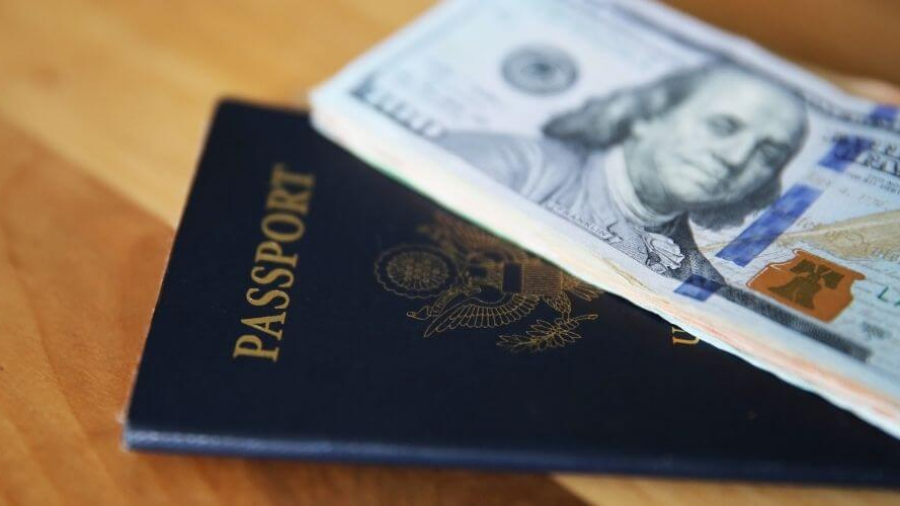
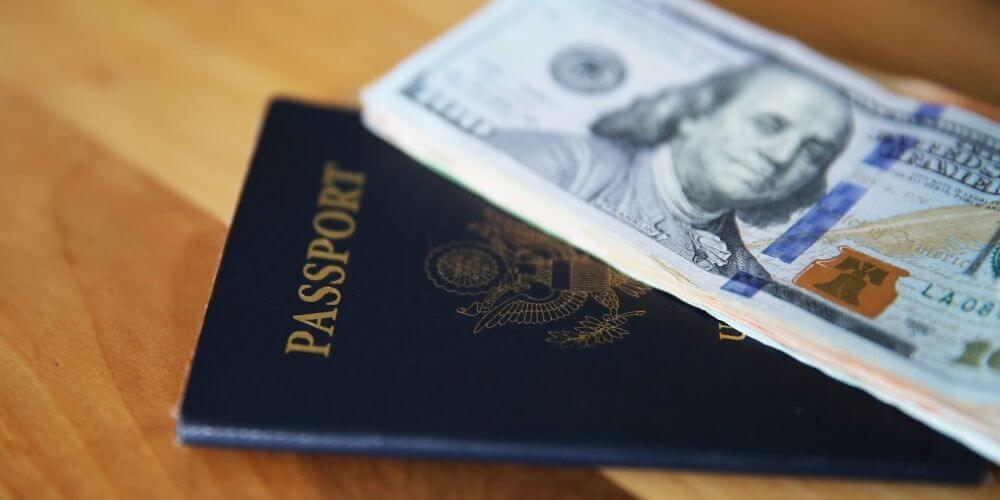
On a Carnival cruise, you should bring around $100 cash per person for each day in port and nothing for the sea days. Obviously, people’s spending habits vary a lot but this is a good guide for first-time cruisers and should mean that you have around the right amount of cash with you.
It’s wise to carry some small bills and coins, as much of the cash you’ll need will be for things like tips, vending machines and public toilets on land.
On cruise ships, you can’t pay for things with cash. But, you will need to take some cash with you to pay for taxis, tip porters at the cruise terminal and to pay for things like meals and souvenirs when you’re exploring ashore.
On a Carnival cruise, all of your onboard expenses will need to be paid for using your cruise card, which is known as a Sail & Sign card. I’ll explain more about how that works later in this guide.
Sail & Sign Card
Things like drinks at the bar, off-ship excursions and souvenirs from the onboard gift shop will all be paid for with your cruise card.
This is actually a super convenient way of paying which means all of your expenses are tied to your account and your room number. You don’t need to worry about carrying cash with you, having enough of it, or worrying about losing it.
Gratuities are also paid with your onboard account, so you don’t need to worry about having cash to tip waiters or room stewards as tips are automatically added to your bill each day.
Some people prefer to give tips in cash a the end of the cruise so that they can be sure that it gets to the right person and so that they can easily alter the amount given based upon the quality of service.
While this is fine to do, you should make sure that any cash tips are given on top of automatic gratuities. You don’t want to remove automatic gratuities and tip in cash as this takes money away from staff who work hard behind the scenes.
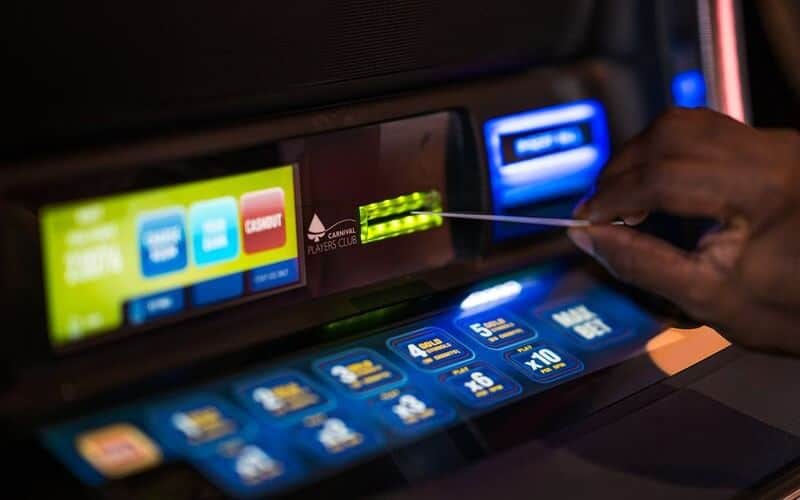
Aside from handing out tips, the only other place you can use cash on a cruise ship is in the casino. You can buy chips with cash and if you win, you’ll be paid out in cash, even if you use your cruise card to play.
You can insert your cruise card into the casino machines
So, does this mean that you don’t need to take any cash with you? Well, you might be able to get away with it if you don’t plan to leave the ship. But, almost all cruises include some days ashore.
Taking cash for port visits
When you head to shore, you should take some cash with you. Sure, you might get away with just using your credit or debit card, depending on where you are, but it is much easier to have a bit of cash on you.
Here are some of the things you might need cash for:
Taxis, buses and trains
Entrance to attractions
Souvenirs
Food and drink
Tips
Public toilets
Street entertainers
Your biggest expenses will be for taxis, meals and entrance fees to attractions when you’re on land. I have taken the cost of these to be $20, $30 and $50 to give the $100 dollar budget, but of course, this can vary widely depending on where you are and what you’re doing on your days ashore.
If you like to plan ahead you should be able to get a clearer idea of costs by looking at your destinations and preferred activities. If you plan to book lots of cruise line excursions, you’ll need less cash with you since your transport, entrance fees etc will be covered.
Conversely, if you like to arrange things yourself once onshore then you might want to budget a bit more cash per port.
When you’re on land you may be paying for taxis to get you from the port to the city centre or to see the sights. This is definitely a time when having cash can make things run smoother, particularly if you’re in a place where Ubers aren’t so common.
How much you need will obviously depend upon the distance covered, but you are probably looking at about $20 at most ports.
You may well need to use the toilet whilst you explore the sights. In most countries, this will involve a small charge which will always need to be paid in cash.
You may also want to buy some souvenirs to remind you of where you have been. There will probably be shops where you can pay for things by card, but if you like to pick up little trinkets from market stalls then it is likely that the vendor will only accept cash.
Other things that you may want to pay for whilst on an excursion include meals, attractions and tipping, so I definitely recommend that you take some cash with you for times when you are off the ship.
The Carnival Sail & Sign Card explained
Carnival’s Sail & Sign card is the cashless way to pay for everything whilst you are on your cruise. It’s also the key card to open the door to your room and your ID when you get on and off the ship.
On your first Carnival cruise, your Sail & Sign card will be blue, on your second cruise it will be red and then as you take more cruises and earn more VIFP Club points, the cards will be coloured gold, grey (platinum) and silver (diamond) to show loyalty status.
As cash is not accepted on board the Carnival cruise ships, all purchases and services onboard are paid for with the Sail & Sign Card, from drinks to souvenirs to excursions.
You set up your Sail & Sign card by linking it to a credit or debit card and then all purchases will be charged to your onboard account. A hold will be put on your bank account during the cruise and the final balance will be requested from your bank at the end of your trip.
Carnival Cruise Cash
Carnival Cruise Cash is the cash credit to your Sail & Sign account. You can add this credit to your onboard account up to two days before your cruise. This can then be used against any charge made on your account, including taxes and gratuities.
To buy Cruise Cash you can visit The Fun Shops website, once you have a cruise booked.
It is worth noting that when you add money to your Cruise Cash credit it is non-refundable and is only valid for a single voyage.
Honestly, there’s no need for you to add Carnival Cruise Cash to your account. It’s better to just rack up a bill and settle it at the end.
The main use of Carnival Cruise Cash is for people who want to give a gift to someone who’s going on a cruise. For example, if you’re going on a Carnival cruise for your honeymoon, then friends could add Cruise Cash to your onboard account as a wedding gift.
The Cruise Cash on the Carnival website is available with different vouchers for the bar, photos, entertainment etc. But you can spend it however you please once you’re onboard.
Don’t panic if you forget to pack cash!
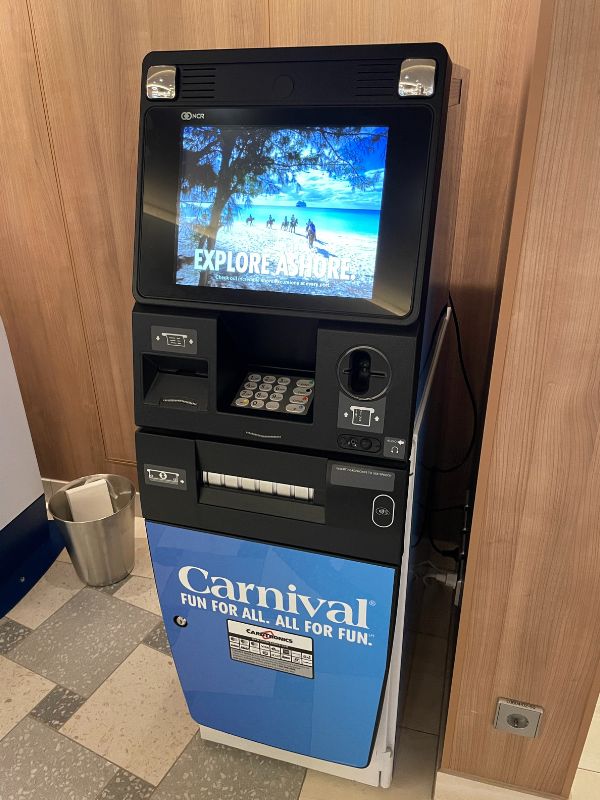
Carnival ships do have ATMs onboard so there is no need to panic if you find that you haven’t brought enough cash with you. It is worth noting that there is a $6.50 charge to use the machine. This is per transaction so it is worth getting out larger amounts at one time.
The most that you can withdraw in one transaction is $500. Sometimes Carnival ATMs may run out of cash during the cruise, but there are a couple of other ways to get cash while at sea…
You can get a cash advance at the Casino Cashier’s Window using a credit or debit card. Or you can cash a cheque at the same location. For both of these options, there is a 5.5% charge on this (with a minimum of $5.50 on advances under $100).
On Carnival cruises from Australia, it’s also possible to cash US Dollar Traveller’s cheques, and there is no fee for this.
Currency may vary but USD is a safe bet
What currency to take on a cruise largely depends upon where you are going since most of the cash you spend will be off the ship.
In many countries that you visit in the Caribbean or South America, the local vendors are likely to accept US dollars in addition to their local currency so it would be worth having some dollars with you.
Cruise ship staff are also always likely to be happy with dollars if you plan to tip in cash. If you are cruising around Europe, it is probably better to take Euros as these are accepted in most countries (not Norway or the UK though).
Adding cash to your Sail and Sign card
You can add cash to your Carnival Sail and Sign card on a cruise once you are onboard. Just visit the Guest Services desk on the first day of your cruise to add the cash that you want to spend on the ship.
A lot of people prefer to do it this way as it helps to control their spending – instead of linking a credit card, they only have the cash on the card to spend. Of course, if you then run out, you’ll need to link a credit card in order to keep spending.
I hope that this guide has helped you to decide how much cash to take on your Carnival cruise. When you are actually on the ship you won’t need any cash but, in most cases, you will need some when you are in port.
Don’t worry too much about taking the exact right amount though, if you don’t have enough there are ATMs on board the ship and around most cruise terminals.
NEW DEALS JUST RELEASED!
See the latest Carnival cruise offers…
Related posts:
If you found this interesting, please share!
Jenni Fielding is the founder of Cruise Mummy. She has worked in the cruise industry since 2015 and has taken over 30 cruises. Now, she helps over 1 million people per month to plan their perfect cruise holidays.
Singles cruises are ordinary sailings on mainstream ships where a specialist company or travel agency reserves a block of cabins for unattached travellers and runs its own private programme onboard. You get a host, mixers, group dinners and shore excursions with other singles, while the rest of the ship carries on as normal. Most organisers will also match you with a same-gender roommate so you can avoid the single supplement.
Below we explain how singles cruises work, who goes on them, what they cost, which cruise lines suit singles best, and how to meet people if you would rather sail independently.
What Is a Singles Cruise?
There are very few true “singles-only” ships. Almost every singles cruise is a hosted group sailing on a regular ship from a line such as Norwegian, Royal Caribbean, Celebrity, Carnival or Virgin Voyages. The organiser books a block of cabins (anything from a couple of dozen to a few hundred passengers) and adds its own schedule on top of the cruise line’s normal entertainment.
A typical hosted programme includes:
A welcome reception on the first evening so the group can put names to faces
Reserved tables at dinner, often rotated so you sit with different people each night
Cocktail mixers, dance lessons, quiz or game nights and themed parties
Group shore excursions that you can join or skip
An onboard host or escort who knows the group and organises the day-to-day plans
Pre-cruise online groups or message boards so you can chat before sailing
Everything in the singles programme is optional. You can join every event or simply use the welcome party to meet a few people and then do your own thing.
Who runs singles cruises?
Several long-standing US operators specialise in group travel for singles. Examples include Singles Travel International, which runs cruises as well as land tours and weekends, and Vacations To Go, whose singles department says it has hosted singles sailings for more than 20 years. Large agencies and consortia also sell hosted singles departures, and some groups are organised through Meetup and social clubs for particular regions, faiths or age brackets. Operators come and go, so check reviews, how long a company has been trading, and whether it belongs to a recognised industry body before you pay a deposit.
Singles Cruise vs Cruising Solo: What Is the Difference?
The two get mixed up, but they are not the same thing:
Most hosted singles groups skew towards people in their late thirties to sixties. Singles Travel International, for example, quotes a core age range of roughly mid-forties to mid-sixties on its own pages, while Vacations To Go runs some departures aimed at specific brackets such as 25 to 55 or 50-plus. Younger singles tend to gravitate towards short Caribbean sailings, party-themed departures and adults-only ships, whereas longer European and transatlantic voyages attract an older crowd.
Not everyone is looking for romance. Many people on singles cruises are widowed, divorced or simply have friends who do not cruise, and they want company at dinner and on tours. Ask the organiser for the expected age mix and gender balance before you book; a reputable company will tell you.
Shared dinner tables are a staple of hosted singles cruises. Photo: Travel Photographer on Pexels
How Much Do Singles Cruises Cost?
A singles cruise costs the normal cruise fare plus, usually, a modest premium for the hosted programme, which may also bundle in some excursions, drinks at the mixers or transfers. The biggest variable is the cabin.
Single supplement: Most cruise fares are priced per person based on two sharing. Booking a standard cabin alone typically means paying a supplement that can range from around 50% up to the full second fare.
Roommate matching: Most singles operators will pair you with a same-gender roommate so you pay the per-person double rate. Some guarantee a match if you book by a set date, or cover the supplement themselves if they cannot find one. Read the small print on what happens if your roommate cancels.
Solo cabins: Purpose-built single cabins are usually priced without a full supplement, but they sell out early and some lines now use demand-based pricing, so they are not always the bargain they seem.
Look out for lines running reduced-supplement offers on selected sailings, and compare the total cost of a hosted package against booking the same cruise yourself.
Best Cruise Lines for Singles
The best cruises for singles combine a lively social scene, decent solo cabin options and organised meet-ups. These lines stand out at the time of writing:
Cruise line
Solo cabins
What helps singles
Norwegian Cruise Line
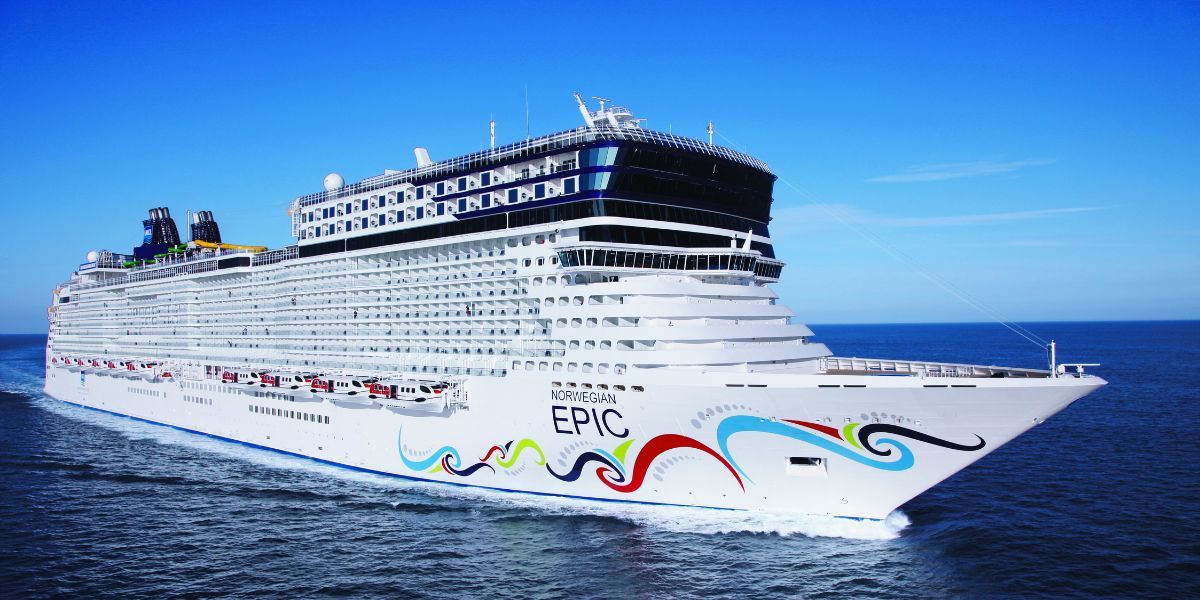
Studio cabins on many ships (Epic, Breakaway, Getaway, Escape, Bliss, Encore, Prima, Viva and others)
Key-card Studio Lounge for solo guests, daily solo meet-ups
Virgin Voyages
Solo Insider and Solo Sea View cabins
Adults-only (18+), solo meet-ups, pub crawls, communal dining
Celebrity Cruises
Single veranda cabins on Edge-class ships
Hosted solo gatherings and a solo dining table
Royal Caribbean
Studio cabins on some Quantum- and Oasis-class ships
Huge ships with plenty of activities; check for solo meet-ups in the app
Holland America Line
Single cabins on Koningsdam, Nieuw Statendam and Rotterdam; 30 Solo Verandahs planned for Oosterdam from late 2027
Solo mixers and social activities
Cunard
Single cabins on Queen Mary 2, Queen Victoria and Queen Elizabeth
Solo coffee mornings and receptions; dance hosts on selected voyages
Saga (over-50s)
Large numbers of single cabins on Spirit of Discovery and Spirit of Adventure
Singles drinks parties and solo lunches
UK lines such as P&O Cruises and Fred. Olsen also have single cabins and solo get-togethers. Solo cabin numbers change with refits and new ships, so always check the current deck plan before booking. Holland America has said its new solo balcony cabins will use dynamic pricing, so do not assume they will cost half a double.
Evening mixers make it easy to meet other single travellers. Photo: cottonbro studio on Pexels
How to Meet People on a Cruise When You Are Single
Even without a hosted group, it is easy to be sociable on a ship:
Find the solo meet-up. Many lines list a “solo travellers” or “singles” get-together in the daily schedule or app, usually on the first or second evening. Go to the first one; later ones are smaller once groups have formed.
Choose shared dining. Ask for a large shared table at dinner rather than a table for one. If you change your mind, the maître d’ can usually move you.
Join the online roll call. Cruise forums and social media groups for your specific sailing often organise meet-and-greets and private shore tours.
Book group activities. Trivia, dance classes, wine tastings, fitness classes and small-group excursions all put you next to the same faces repeatedly.
Pick the right itinerary. Port-intensive and sea-day-heavy cruises suit different people; sea days give more time to socialise onboard.
Cruise ships are generally safe, but the usual common sense applies, especially in a party atmosphere:
Keep an eye on your drink and pace yourself; drinks packages make it easy to overdo it.
Do not tell new acquaintances your cabin number until you know them well, and meet in public areas.
Let a friend at home or someone in your group know your plans in port.
Stick to ship-sold or well-reviewed excursions and be back onboard well before all-aboard time.
Save the ship’s security and guest services numbers in your phone and report anything that worries you.
Agree house rules with a matched roommate early, from bedtimes to guests in the cabin.
Is a Singles Cruise Right for You?
A hosted singles cruise is worth it if you want a ready-made social circle, someone else doing the organising and a way round the single supplement through roommate matching. It suits people who enjoy group activities and do not mind a fixed set of departure dates. If you would rather pick any ship and itinerary, keep your evenings flexible and only socialise when you feel like it, booking a solo cabin on a sociable line and joining the onboard meet-ups may give you the best of both worlds.
If you are in your twenties, our guide to the best cruise lines for young adults compares age rules, solo cabins and nightlife across Virgin, Norwegian, Carnival and more.
Very few ships sail exclusively for singles. Most singles cruises are hosted groups on regular ships, with a private programme of mixers, dinners and excursions for the singles in the group.
What age group goes on singles cruises?
Most hosted singles groups attract people from their late thirties to their sixties, but many operators run age-specific departures, such as 25 to 55 or 50-plus.
How do I avoid the single supplement on a cruise?
Book a purpose-built solo cabin, look for reduced-supplement offers, or use a singles operator’s roommate-matching service so you pay the per-person double rate.
What is the best cruise line for singles?
Norwegian Cruise Line (studio cabins and Studio Lounge) and adults-only Virgin Voyages are popular with younger singles, while Celebrity, Cunard, Holland America and, for over-50s, Saga suit those wanting a quieter, more traditional scene.
Is it weird to go on a cruise alone?
Not at all. Solo cruising is increasingly common, and many lines now build solo cabins and run daily meet-ups specifically for people travelling on their own.
The Costa Concordia is one of the most renowned cruise ships of the recent era, and not for a good reason.
Cruise ship sinkings are extremely rare these days, but the Costa Concordia proved that they can still happen – and that they can still have tragic consequences.
But since the ship sank in 2012, what’s happened to it? Is it still where it crashed, or has it been relocated?
Let’s take a look.
The ship is no more…
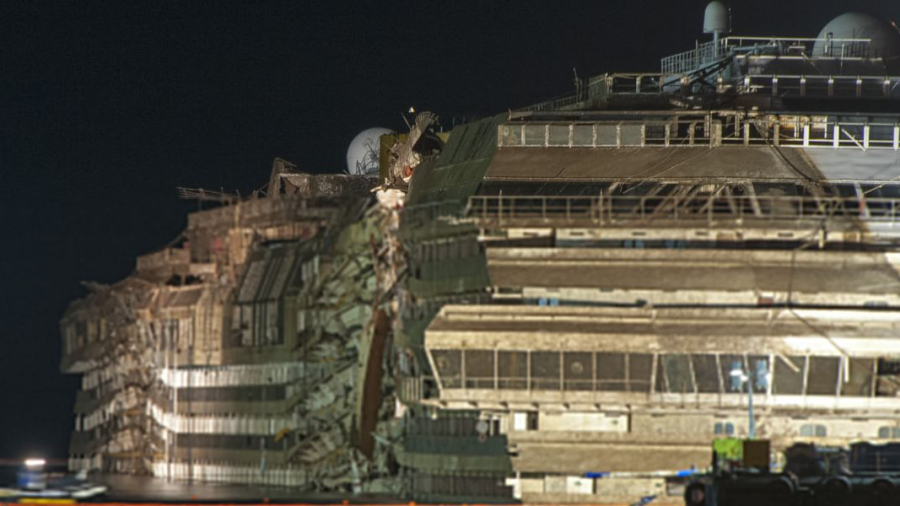
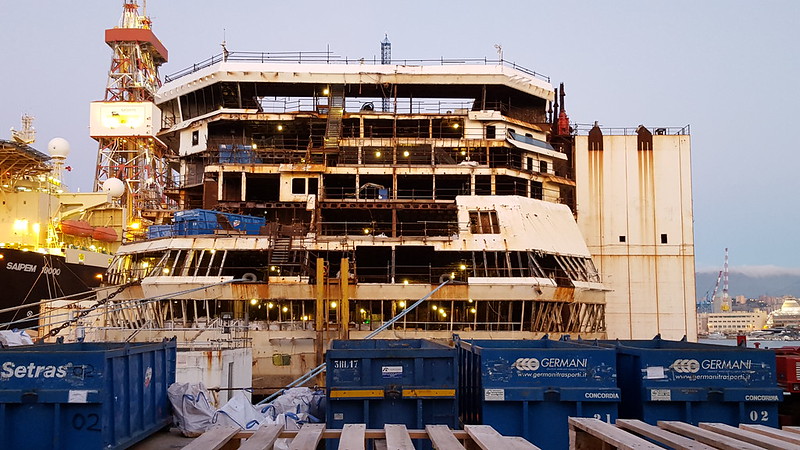
The Costa Concordia no longer exists – it has been dismantled for scrap. It lay off the coast of Giglio for over two years after the sinking, before it was recovered and towed to the port of Genoa where it was dismantled.
Photo: Rab Lawrence, (CC BY 2.0)
It’s estimated that the final cost for the salvage and scrapping of the ship was likely around $2 billion – around three times the cost of building the ship.
Scrapping the ship would only have recouped around $42 million in steel – a tiny amount compared to the huge sums spent in recovering the ship, and nowhere near even the costs of the scrapping process alone (estimated to be around $100 million).
Because the ship could not be repaired and restored to sailing condition, she was replaced in the Costa fleet by Costa Diadema, which was ordered in October 2012 and entered service for the cruise line two years later.
Costa Concordia Sinking & Salvage Timeline
13 January 2012 – Costa Concordia runs aground at around 9.45 pm and begins to take on water.
14 January 2012 – The last survivors escape the ship.
March 2012 – The fuel is removed from the ship by salvage company Smit International.
17 September 2013 – The ship is brought into a vertical position through a process of parbuckling.
14 July 2014 – The ship is slowly refloated in preparation for towing.
23 July 2014 – The ship begins its towing journey, travelling at just 2 knots (equivalent of 2 MPH).
27 July 2014 – The ship reaches Genoa port and dismantling begins.
11 May 2015 – After the initial dismantling is complete, the ship is towed to the Superbacino dock in Genoa where the upper decks will be removed.
August 2016 – The last of the sponsons are removed from the ship.
1 September 2016 – The ship is taken into drydock for the final stages of dismantling.
May 2018 – Remedial work was completed at the site of the initial salvage operation, to clean the ocean floor and remove the platform used in the parbuckling process.
To briefly explain the parbuckling process – firstly, the funnel is removed from the ship, and then a platform is built underneath the water to support the ship once it is righted.
The next step is to attach steel sponsons to the side of the ship above the water, and then partially fill these with water. The water acts as additional weight so that, with the use of cables, the ship can be pulled upright to sit on the support platform.
Once that’s done, sponsons are added to the previously submerged side of the ship to even it out, and are then emptied of water when the time comes to refloat the ship.
As for those onboard…
All of the people who died on the Costa Concordia were recovered, although it wasn’t a fast process – the last body was only recovered in November 2014, almost three years after the ship ran aground.
The last person to be found was Indian waiter Russel Rebello. He was discovered during the dismantling of the ship, after it had been transported to Genoa.
Prior to this, one Italian passenger had been missing until October 2013, when human remains were discovered. DNA testing showed that those remains belonged to Maria Grazia Trecarichi, and that Rebello was still unaccounted for.
With any cruise ship sinking incidents such as the Costa Concordia disaster, the priority is always the people onboard, and the loss of life is the real tragedy. But it is also sad to lose a ship, one that thousands of people helped to build and hundreds of crew called their home for months on end.
The scrapping of the Costa Concordia is not the headline – the 32 people who died are those who deserve our thoughts. However, the fact that such a major cruise ship ended up as scrap metal – worth less than a tenth of her cost to build – is a real shame too.
Related posts:
If you found this interesting, please share!
Jenni Fielding is the founder of Cruise Mummy. She has worked in the cruise industry since 2015 and has taken over 30 cruises. Now, she helps over 1 million people per month to plan their perfect cruise holidays.
Single supplements are fees that solo passengers pay when taking a cruise since most cabins are priced based on double occupancy.
Our free cruise newsletter offers the latest news and deals: Sign Up
Tauck has announced that they are waiving all single supplements in Category 1 cabins for cruises this year. The cruise line said that this applies to over 250 departures in 2025.
In addition to the no single supplement in Category 1 cabins, solo cruisers who book a Category 4 or 5 cabin will receive up to $1,000 off 52 departures on 22 itineraries.
For land journeys, the cruise line is reducing single supplements by up to $600 on 84 departures. This applies to 39 tours in five continents.
On its popular European tours, Tauck has reduced the single supplement by up to $400 on 42 departures of 18 different journeys, including the cruise line’s iconic 14-day Classic Italy itinerary.
Other tours with reduced solo pricing include trips in:
Germany and Central Europe
France
Spain
Portugal
Great Britain
Scandinavia
Land journeys in North America are up to $300 off with the biggest savings being on trips to Asia, Africa, Latin American and the Middle East. These tours are up to $600 off the single supplement fares.
Tauck CEO, Jennifer Tombaugh, gave the following statement this change in cruise fares for solo travelers:
“As much as our solo guests appreciate the great savings, they also embrace the wonderful sense of assurance and support they feel when traveling with Tauck. In addition, they love that all of the planning and logistics are taken care of.
“Everything they would normally have to arrange by themselves – hotel and restaurant reservations, sightseeing, on-site navigation and transportation – all are expertly handled by Tauck. All our guests need to do is select their trip and departure date, and we do the rest.”
Tauck is a family-owned river cruise line that’s celebrating their 100th anniversary in 2025.
I love big cruise ships, but I also hate crowds. That’s a tricky one, right?
However, if going on 40 cruises has taught me anything, it’s that ships are only crowded because everyone tries to go to the same places at the same times!
My experience has taught me when the busy times are for each venue on the ship. And so if I want a quiet day, I’ll plan my own itinerary that goes against the norm. It’s so much more relaxing that way.
If you fancy giving that a go, here’s my itinerary for a quiet day.
7 am – Breakfast
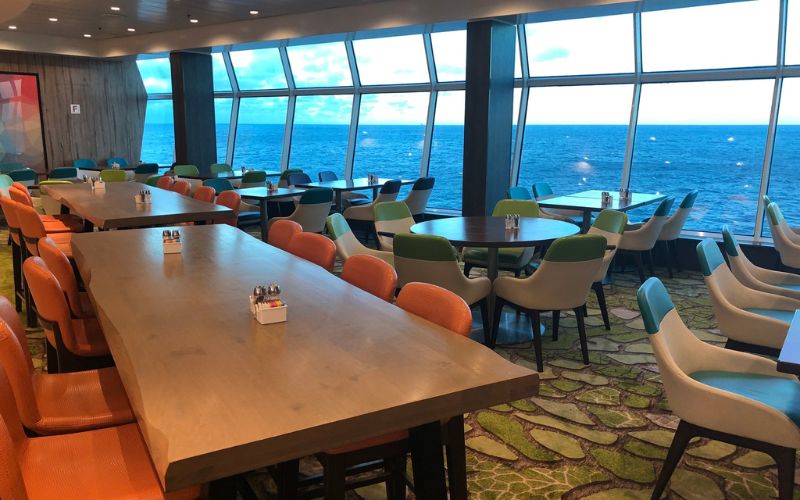
On a sea day, most people will take the opportunity to have a lie in and will head to the buffet 30 mins before it closes. On big ships that enfore handwashing, you’ll have to queue to get inside and then do several laps before you spot a free table.
But if you’re willing to get up early and arrive at the buffet when it opens, you can have your pick of virtually any table, and the hottest freshest food too!
8 am – Swim in The Pool
While you may see a few people putting towels down, the pool area is virtually empty before 9am.
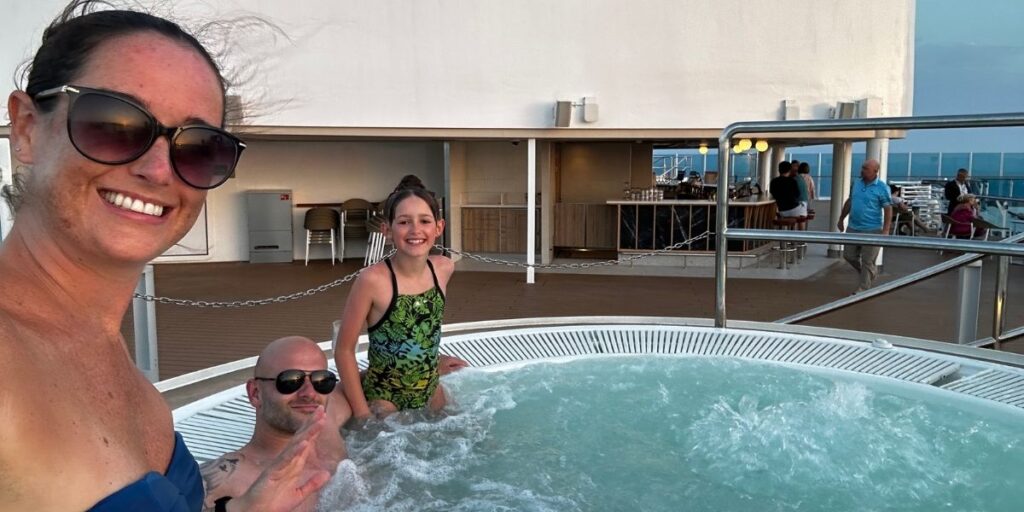
So if you want to swim some lengths, have a hot tub to yourself or even go down the water slides without queueing at the top, now is the perfect time.
Whatever you do, don’t go to the gym. It will be rammed at this time. We’ll save that for later.
10 am – Enjoy The Entertainment
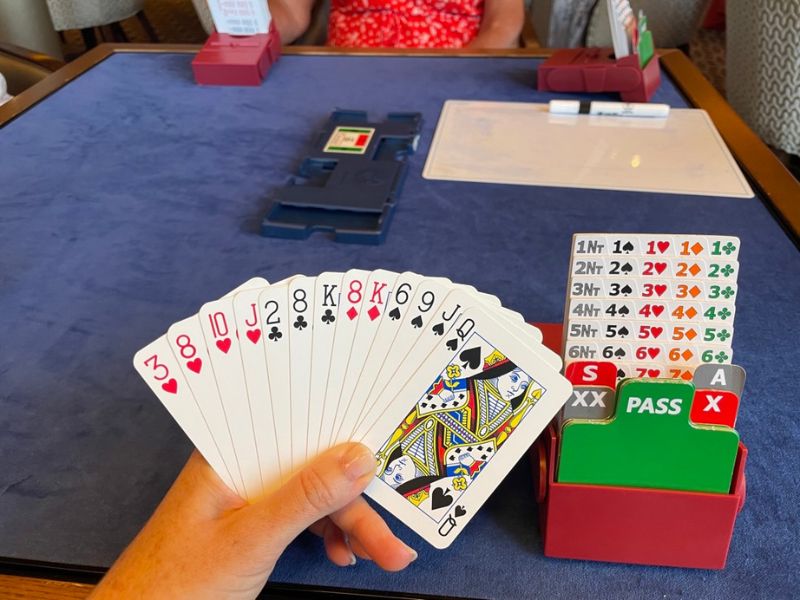
Cruise ships have all kinds of entertainment inside, such as dance classes, trivia, lectures, cookery classes and art workshops. When I cruised with Fred. Olsen I played bridge every day at 10 am and it was so relaxing!
So take a look at the daily planner that the cruise line gives you and decide which one you fancy.
11 am – Visit The Casino
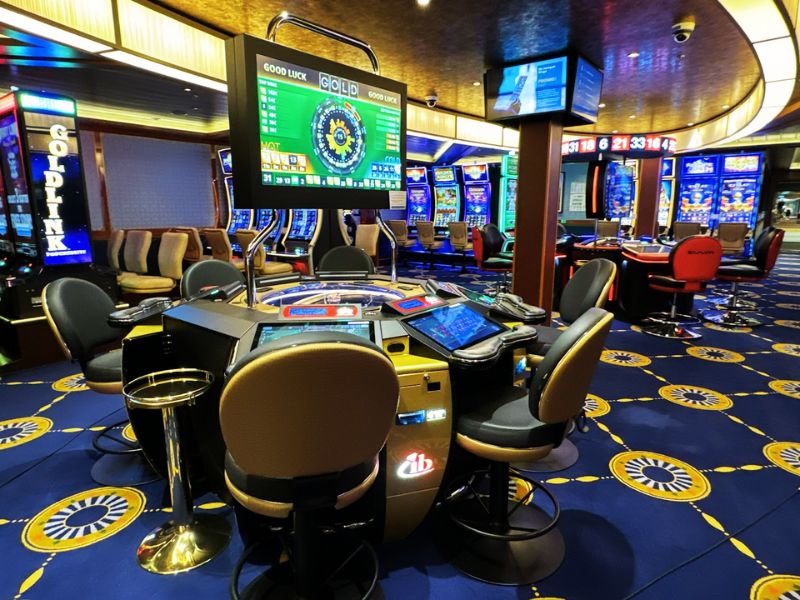
On cruise ships, Maritime law states that the casinos are only allowed to open when the ship is in international waters. That means that a sea day is a great time to go.
On some ships, the slots are open the whole time the ship is at sea. Table games might not open until later, so check your ship’s schedule for the exact times.
But if you want your pick of any machine, the morning is a great time to go.
12 pm – Lunch in the Main Dining Room
You ate breakast early, so by 12 pm you’ll probably be ready for lunch. Meanwhile, everyone who had breakfast at 10 is nowhere near hungry.
For some reason, a lot of people forget that the main dining room exists at lunch time. Instead, they crowd into the buffet or grab a burger or a slice of pizza to eat by the pool.
If you’re one of the first people to arrive at the main dining room for lunch it will be very quiet, meaning you get quick service and a relaxed atmosphere.
1 pm – Go To The Pub
Many people don’t visit the indoor bars on a cruise ship until the evening. So now’s the time to enjoy a quiet pint.
If you fancy a go on the pool table or the dart board, now’s the time that it’s most likely to be available.
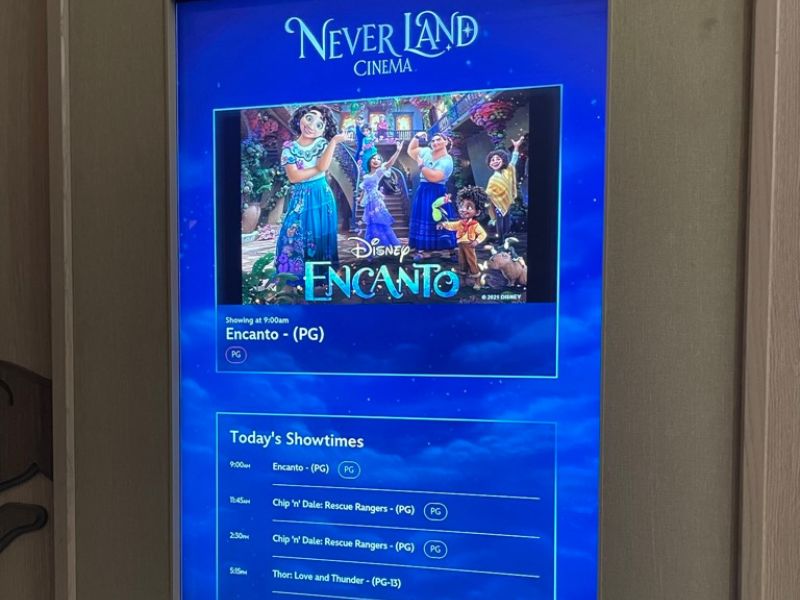
2 pm – Watch A Movie
Many cruise ships have onboard cinemas which can be hard to get into after dinner.
However, if you head to a matinee showing, you should have no problem getting a seat.
If your ship doesn’t have a cinema, you may be able to enjoy a movie on the TV in your stateroom. Failing that, grab a book from the library and enjoy some chill time.
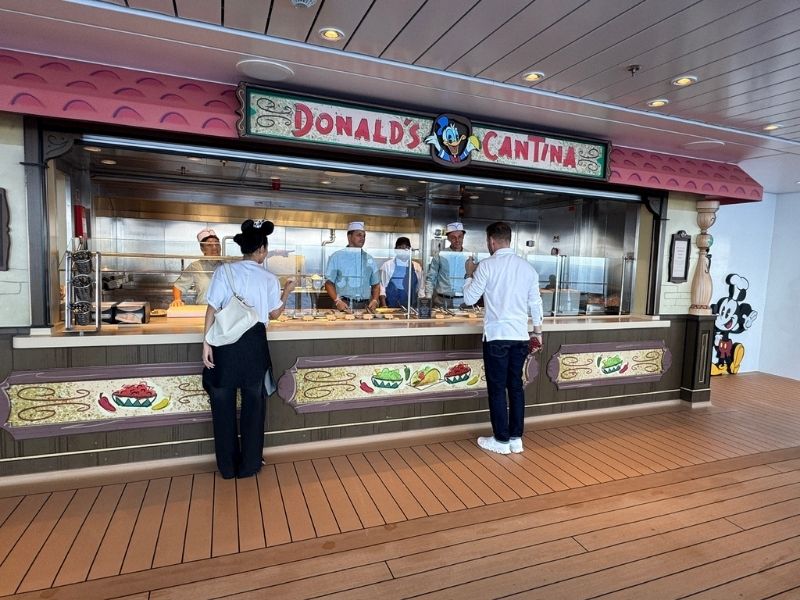
4 pm – Enjoy A Poolside Snack
I love the food by the pool on cruise ships. While the poolside snack bars can get very busy at lunchtime, if you arrive at 4pm you can treat yourself to a salad, tacos, pizza, hot dog or fries without having to queue.
Most people don’t want to eat at this time as it’s too close to dinner. But don’t worry, dinner is a still way off for us.
5 pm – The Most Fun Activities
Cruise ships generally have two dining times, early and late. Families usually choose the early one, so by 5pm they’re all getting ready for dinner.
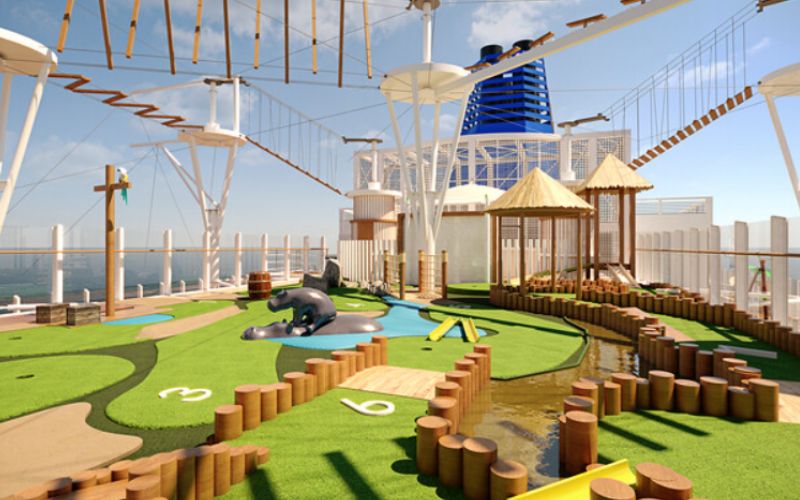
This is the perfect time to have a go at all the activities that have been busy with kids. Depending on your ship and it’s schedule, you might be able to have a go on the mini golf, the rock climbing wall, the sports court or the bowling alley without it being crowded with children.
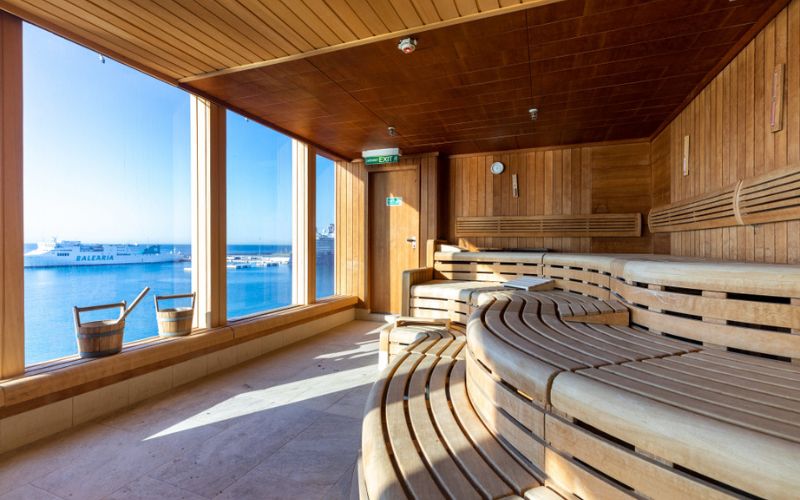
6 pm – Relax In The Spa
There’s nothing more frustrating than paying for a pass to the thermal suite and then not being abler to use it because the steam room, sauna and hot tub are all full.
Instead, I like to head there at about 6pm when it’s much quieter and you have a much better chance of finding a vacant heated bed to relax on.
7 pm – Hit The Gym
Most cruise ship gyms are open for guests from 6 am until 10 pm. In reality, very few people visit the gym in the evening.
You may find that 10 pm until 6 am, the gym is reserved for crew members. However, on the biggest and newest ships, crew members have their own gym, so the gym may be open 24 hours.
8pm – Get Ready For Dinner
This is one of the busiest time on the ship. Everybody is out and about. The bars will all be full with people having either an after-dinner drink or a pre-dinner drink, depending on their dining time.
But don’t worry, we’ll be heading back to the room to get changed for dinner.
If you have a balcony, now’s the time to enjoy a quiet glass of wine on it. If you’re luck, you’ll watch the sunset without anyone spoiling your view.
9 pm – Dinner
If you’re cruising with kids then dining at 9 pm won’t work for you. But if you’re child-free, then later is better if you want to avoid the rush.
If your ship has flexible dining times, you should have no problem with arriving at 9 pm for dinner. I find that this is the quietest time.
If there are fixed times, then choose the later one, which may be 8.30. You can arrive up to 15 minutes late without a problem, but I wouldn’t leave it any later than that.
Or, for an even more relaxed experience, I recommend that you opt for either the buffet or a speciality restaurant. These are always the quietest places to eat un the evening.
10 pm – Watch A Show
You’ll need to check your daily planner for the showtimes for your ship. But I usually find the later shows to be quieter, particularly if the show starts at 10 pm or later and the ship has a lot of children.
11 pm – Go For A Walk
I love the outside areas of a cruise ship at night. The pools always look so pretty when they’re lit up. And if you’re lucky, they might still be open so you can enjoy a late-night dip.
If your ship has a promenade deck it will be empty at this time, so you can enjoy a peaceful evening stroll.
In warm weather, the outdoor bars will be open until late so why not head out and enjoy a nightcap under the stars before bed?
NEW DEALS JUST RELEASED!
Don’t miss these hot cruise offers…
What Do You Think Of This Itinerary?
The ship being too busy is a common complaint on large cruise ships. But it is one that you can avoid.
Choosing a smaller ship will certainly help. I’ve cruised on ships with just 100 guests, and they have bars and restaurants that can seat every single guest at the same time, so you never have to worry about getting a seat. Plus, with just three or four decks, there’s never a queue for the elevator as most people never us it!
I would also recommend avoiding cruises in the school holidays if you can. That’s because each ship squeezes on a lot more people when children are involved.
Let’s take Icon of the Seas, for example. Royal Caribbean’s ship accommodates 5,610 guests, based on two people in each cabin…
But, when every cabin is at maximum capacity and additional beds are used for kids, the ship accommodates 7,600.
That’s an extra 2,000 people!
Related Posts:
If you found this interesting, please share!
Jenni Fielding is the founder of Cruise Mummy. She has worked in the cruise industry since 2015 and has taken over 30 cruises. Now, she helps over 1 million people per month to plan their perfect cruise holidays.