When you’re already paying a not-inconsiderable amount for your cruise holiday, it can then feel like a bit of a kicker when you have to add insurance on top of that.
And then when you see the prices, you might be wondering what’s going on. Cruise insurance can be way more expensive than other types of travel insurance.
That’s no excuse not to get it though. You do need it. You don’t want to end up like these people.
Here’s why it can cost more than regular insurance, so you can see that it’s often justified.
1. You’re At Sea
The most basic but obvious reason for cruise insurance being more expensive than other travel insurance is the fact you’re often at sea.
And that means two things:
You don’t have access to all the medical facilities you might need immediately
It can be a lot harder to get you to a hospital if things get serious
On most cruises, you’re going to be within a day or two of a port of call, so you can get to a hospital or other medical centre for non-urgent treatment without too much stress.
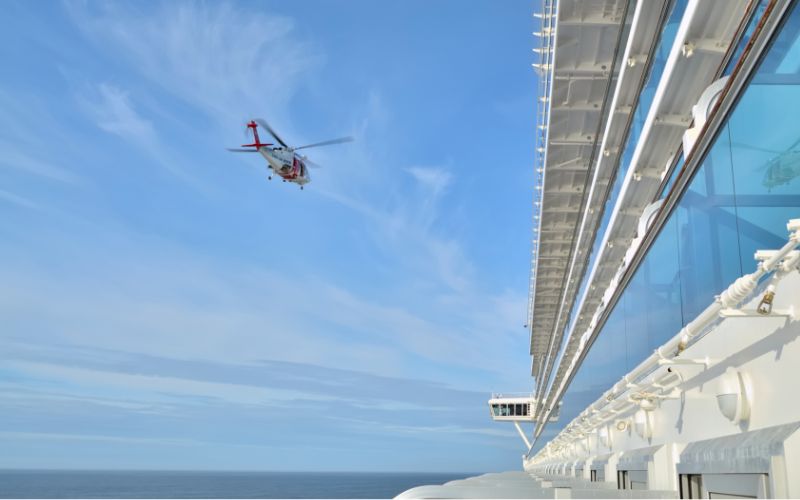
But if something serious happens, you’re going to have to manage with the onboard medical facilities, or you’ll looking at an emergency evacuation – either causing the cruise ship to change course, or a helicopter coming to pick you up.
As you can imagine, these are all extremely expensive solutions – and so cruise insurance needs to be high because the insurance companies need to make enough money to cover all the costs when they do need to pay out.
The vast majority of people who buy cruise insurance aren’t going to need airlifting to hospital, but for the occasional ones that do, insurers need to earn enough to cover those costs and still turn a profit.
2. You Visit Multiple Countries
Visiting multiple countries on one holiday will push the prices of your insurance up, because it adds an extra layer of uncertainty to your situation if something does go wrong.
This could be because the insurer has to account for the fact that you might need assistance in one of the countries with limied healthcare, even if the majority of your cruise ports have excellent hospitals.
Or there’s the factor of what happens if you get sick, but then recover. You can’t just hop in a taxi after being discharged from hospital to get back to your hotel. Your insurer will need to pay for flights so that you can catch up with the ship.
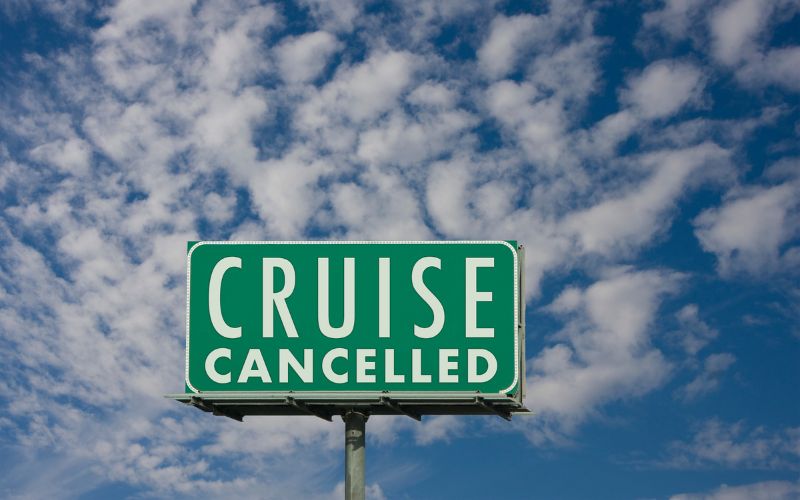
3. Cruises Are More Liable To Be Cancelled
Cruise insurance doesn’t just cover the cost of medical problems, but it’s also used to help cover the costs of cancelled cruises. And cruises are going to be cancelled more than other types of holiday.
That’s because of various factors including problems with the ship, or stormy weather – issues which can affect a hotel but not to the point that it usually causes you to have to cancel your entire trip. But with a cruise, those factors can be much more problematic.
It’s also a lot harder for a cruise company to offer you an alternative at short notice. If a flight is cancelled because of bad weather, you’ll normally be offered a different flight within a day or so. Or if a hotel is overbooked, you’ll be transferred to another.
But that can’t happen with cruise ships since there aren’t enough ships from the same cruise line, in the same part of the world, with enough spare cabins. This means more outright cancellations, and therefore more insurance payouts.
4. Drinks Packages Exist
Cruise lines certainly like to make sure their guests are having fun, and one way they’ll often do that is to permit guests to book a drinks package.
These offer unlimited drinks during the day, which means that guests can easily become intoxicated, and essentially remain that way during the entire cruise, just topping themselves up each morning.
To be clear though, you aren’t going to be able to claim on your insurance for injuries or accidents that occur while you are intoxicated. That’s just going to wipe out any claim you might have.
But if you’re injured by someone else who is drunk – accidentally or, heaven forbid, on purpose – then you could potentially make a claim.
And with so many people using drinks packages to their fullest, that’s a lot of potential for accidents or even assaults to occur, which in turn means higher premiums to cover that cost.
5. Cruises Are Still Popular With Older Guests
While cruise ships have definitely started to become a lot more family-focussed, adding facilities aimed at kids and at younger adults, there’s still a huge proportion of passengers that are older, with many people still cruising into their 70s, 80s, 90s and sometimes even older.
Naturally, that means those passengers are at higher risk of making claims, as they’re more likely to have existing medical conditions that could cause problems, or they’re just more likely to suffer from injury or illness while sailing.
That means they will pay a significantly higher cost for cruise insurance, but it will also drive up prices for multigenerational families too.
If you’re cruising with parents/grandparents, be aware that a family policy might be a lot more expensive than you planned for.
6. Airlines Are Losing More Luggage Than Ever
Does it seem like airlines are just getting worse? Well when it comes to baggage handling, statistics show that they are, with the latest statistics showing that 26 million bags were lost in a year.
That’s including all travel, but many cruise passengers will fly to their ship and so it’s their cruise travel insurance that’s responsible for the flight. You wouldn’t typically buy separate travel insurance for the cruise and the flight portions of your trip.
So, with more bags going AWOL, that means more payouts by insurers, which means higher costs. It doesn’t contribute to cruise insurance being more expensive than other travel types, but it does partially account for it being expensive in itself.
7. People Often Take More Risks When Cruising
When you’re cruising, you don’t tend to just stay on the ship. You’ll spend a lot of time in port, exploring each city or town that you visit, and you might also take part in various shore excursions that might involve some adventurous activities.
These could include horse riding along the beach, or a safari tour – things that are thrilling, but that might increase your risk levels compared to a more relaxing beach holiday. And that can make insurance costs be higher.
However, the most extreme shore excursions likely won’t be included in your cruise insurance, so you need to check that when you take out a policy. If you’re planning on swimming with sharks, or any water sports, you might need to take out specialist cover – which, again, will add even more expense.
8. The Chances Of Becoming Ill Can Be Higher
Cruise lines will try to deny it, but sickness bugs such as norovirus can be surprisingly common. You aren’t guaranteed to get sick when you cruise, but there is an increased risk – because, if you’re on a ship, illnesses get onto every surface and no matter how hard the crew works, germs spread.
So there’s a potentially increased risk of getting sick when you’re cruising, which could result in you needing to claim for medical issues, or maybe cabin confinement if you’ve added that onto your policy.
9. Cruises Are Often Longer Than Land Holidays
While this won’t apply if you’re booking a shorter cruise, bear in mind that many cruises last longer than your typical 7-14 night land holiday.
Some may last 18-21 nights, or you could be on a much longer itinerary, and that means much higher insurance prices.
It’ll scale up too, for the length of your trip. Don’t expect a 4-week cruise to have double the insurance of a 2-week cruise. You’re likely more at risk the longer you sail, so the insurance costs might ramp up considerably for those longer sailings.
Instead of just going direct to one insurance provider, using a comparison site means you’ll get the best prices possible, and a wider choice of policies with different levels of cover.
My Recommendation
My recommendation for cruise insurance depends on where you live.
These are trusted price comparison sites that will quickly get you lots of quotes to match your exact needs.
And just like with most types of insurance, it’ll vary on which provider is cheapest for you – what’s expensive for one family might be cheap for another depending on their cruise, medical history and more.
Jenni Fielding is the founder of Cruise Mummy. She has worked in the cruise industry since 2015 and has taken over 30 cruises. Now, she helps over 1 million people per month to plan their perfect cruise holidays.
You should never travel on a cruise without buying insurance. Too much can go wrong, and leave you with some serious problems to face up to, financially and logistically.
And that’s what these stories show. Thankfully there aren’t hundreds of horror tales out there about cruise passengers who didn’t have insurance, because most people know how important it is.
But there are some nightmare stories to share, which highlight why insurance is so important – and in some of these cases, passengers had insurance but still weren’t covered!
So let’s take a look at real horror stories related to cruise insurance so that you can see it really isn’t worth taking the risk when you book your next cruise escape.
1. Stranded In The Bahamas
One of the most shared cruise insurance nightmare stories is that of Bruce Campbell, a US tourist who took a cruise to the Bahamas with his wife, sailing with Carnival.
During the cruise, Bruce showed signs of a stroke, and had to be evacuated to a hospital in Freeport, where he was told that the hospital couldn’t manage his worsening condition and they would need to transfer. But because they had declined to take out insurance, they couldn’t afford it.
The couple set up a GoFundMe page, but that takes time and so they couldn’t get the money. The government offered to loan them the money, but as the cruise was taking place over the Christmas holidays, they would’ve had to wait for the government offices to re-open.
Eventually, they did make it home, thanks to an anonymous donor who paid $20,000 of their own money to cover the cost of the flights back to the US. Sadly Bruce did not make a full recovery and passed away a couple of days later.
Carnival did help the couple by paying the medical bills for the three days they spent in the Freeport hospital, which the cruise line wasn’t obligated to do. The couple still complained that they felt the cruise line could’ve done more, though.
This definitively shows why insurance is a must – they could have transferred to another hotel quickly and without the financial stresses involved had they been covered.
After all, not everyone will be able to find an anonymous donor willing to pay a five-figure sum to fly you home.
2. Hefty Bills Following A Fall
Denise Hammond, a US cruise passenger onboard a Carnival ship, was enjoying a Pacific cruise in late 2023 when she had a fall and fractured her hip and her arm.
She was treated onboard for three days before the ship reached Manado in Indonesia, where was was transferred to a local hospital. However, it wasn’t equipped to treat her fully, which meant a transfer to a Singapore hospital, with a cost of $60,000 for the transfer and a $40,000 deposit needed.
Instead, Denise’s daughter Rachel was able to raise enough money via GoFundMe to get Denise airlifted to a hospital in Bangkok, where she was finally able to get the surgery she needed – 13 days after her original fall!
The Hammond family claimed that Denise had “great insurance” but that the company was refusing to pay out, which reinforces the need for everyone to make sure they get comprehensive cruise cover and are insured against anything that could go wrong.
It’s reported that the insurance did at least help Denise to secure flights home after her treatment, but it’s not clear why the insurance company wasn’t helping with the massive medical bills.
3. The Gamble That Didn’t Pay Off
The Redman family took a cruise to Canada in 2022 to fulfil a dream, but it quickly became a nightmare as Chris, the mom of the family, suffered a heart attack while on the ship.
Thankfully she was able to be saved thanks to the amazing treatment of the crew on the ship, but she was transferred to a hospital in Canada which discovered more serious issues. Chris then had to be flown back to New Jersey for open heart surgery in order to save her life.
The cost of the medical care on the ship alone was $7,000 and the flight back to New Jersey, with the medical team involved, cost between $12,000 and $15,000. The total out-of-pocket expenses for the incident were well over $20,000, but the family had chosen not to get insurance.
According to the GoFundMe established by a family friend, “Deciding whether to get that insurance feels like a gamble no one wins – paying a lot of money for a week’s worth of insurance just about no one ever needs, or finding yourself with no coverage in an emergency.”
The GoFundMe page also stated that the cruise line refused to take insurance unless it had been purchased directly with the cruise line.
That’s extremely unlikely – most major cruise lines will accept proper cruise insurance whether booked through the cruise line or independently. Some small cruise lines might have a policy like this in place, but I’ve never found evidence of it.
It’s unclear whether the statement in the GoFundMe simply meant that Chris didn’t have proper cruise insurance and was hoping their regular medical insurance would cover costs, which it typically won’t.
4. “Nobody Told Us We Should Have Insurance”
Matthew Baker, CC BY-SA 3.0
While the horror stories of huge medical bills while stranded in foreign countries are (thankfully) rare, there are plenty of nightmare tales of people who’ve had to cancel a cruise before they sailed and realised they weren’t about to get a refund since they weren’t insured.
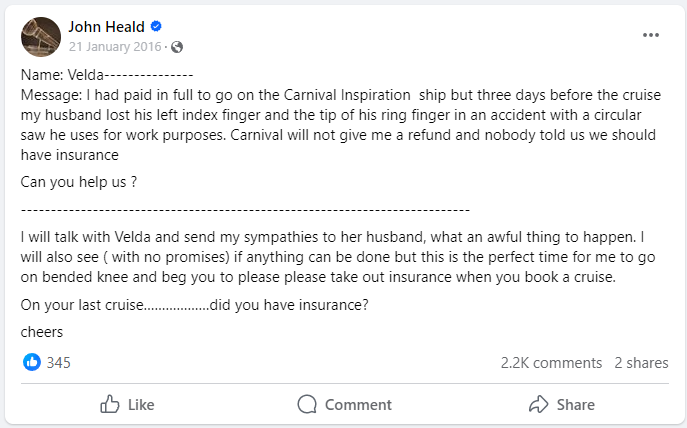
This story was sent to John Heald, the Brand Ambassador for Carnival, and detailed a couple who had to cancel their cruise due to a workplace accident three days before they were due to sail.
As it was well past the final payment deadline, the cruise line is not bound to offer a refund as per the terms of the contract guests signed. And the guests claimed that this was unfair and that nobody had told them to take out insurance.
Cruise lines always recommend guests purchase insurance. Claiming ignorance will never work – it is the responsibility of the traveller to ensure they have the proper cover in place for incidents just like this one.
5. “We Were Healthy… Now, We Aren’t!”
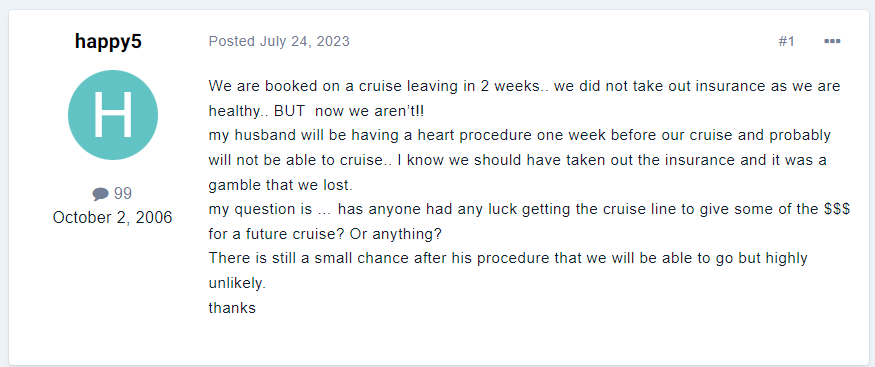
Another person who admits that they took the gamble of cruising without insurance, and then lived to regret it.
This passenger booked a cruise with their partner, and because they felt healthy, they decided not to take out insurance.
Then, just a week before the cruise, the husband needed to have a heart procedure and would no longer be able to sail.
Again, the cruise line is in no obligation to give a refund, since selling the place onboard at that late stage would be extremely difficult. The contract you sign when you book your cruise states that you are liable for the fare once you get past a certain date.
Lesson learned, you would hope – don’t assume that, just because you’re healthy now, things won’t go wrong before you travel! You never know what’s around the corner for you.
6. “I Guess We Are Screwed. Thanks For Nothing.”
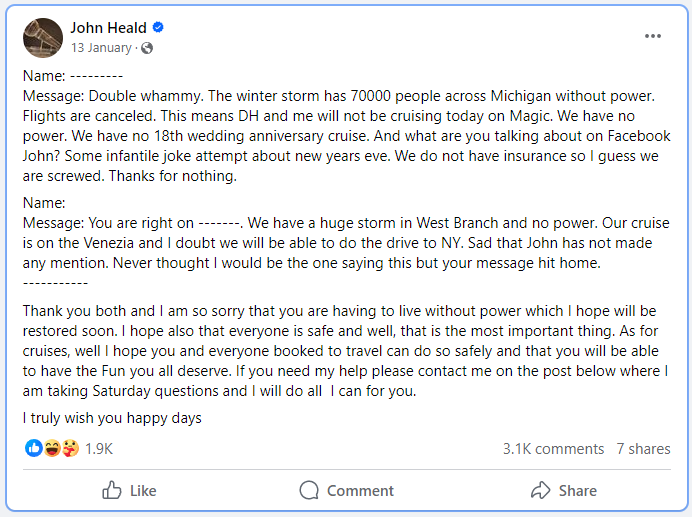
Sometimes it’s not a medical issue that can prevent you from joining your cruise, but the elements.
You can’t predict the weather, especially if you’re booking a cruise months out. And if there are storms which mean you can’t even get to the ship, you need to make sure you have travel insurance for cruises that will refund you.
Because guess what – it’s not Carnival’s fault that there are storms holding up your flights either. And nor is it Carnival’s fault that you didn’t make contingency plans for your travel, and what you would do if flights were grounded due to the stormy weather.
The attitude of this person shows that they feel Carnival should bear the responsibility of the lost money, whereas if the passenger had just taken out insurance as they should’ve done, they would at least have got most of their money back and could cruise again in future.
7. Close Family Emergency
This one didn’t end up being quite the horror story that it could’ve been, but it’s a great example of unnecessary stress caused by gambling.
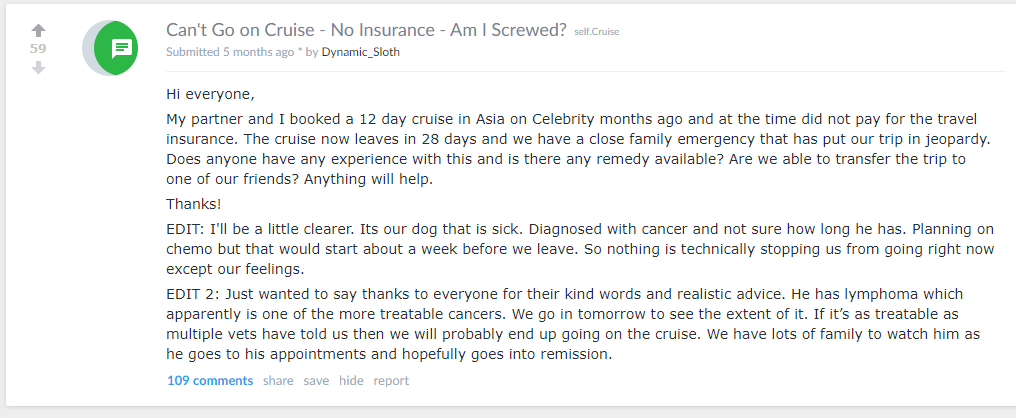
This passenger revealed that they had a close family emergency within a month of their cruise, past the final payment deadline, and they had chosen not to get cruise insurance. They later revealed that the emergency was their dog being diagnosed with cancer.
Thankfully, as the diagnosis was further explored, it was revealed to be treatable, and it sounds like the passenger was still able to go on their cruise and leave their dog with family members during the treatment.
But take heed – it’s not just human medical emergencies that could stop you. If you have a beloved pet then something could happen with them to make you feel like you need to cancel.
Just make sure you’ve read your cruise insurance policy though, as they might only cover cancellation for human medical conditions.
Read more: X Things Your Cruise Insurance Won’t Cover You For!
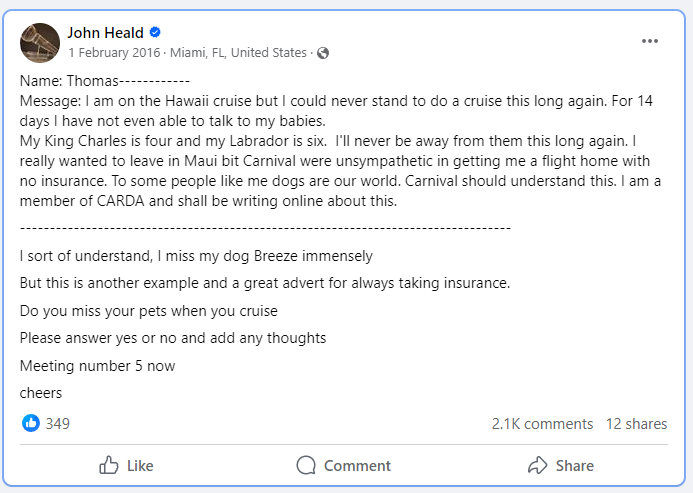
Indeed, there’s another guest who wrote in to John Heald on Facebook about cruising, dogs and insurance:
This guest didn’t take out insurance, and then while on their cruise they felt too sad to continue their sailing as they were missing their dogs too much.
But without insurance, they were unable to get a flight home without paying for it themselves, and they were unhappy that Carnival would not help. Quite what they expected the cruise line to do is another thing – should a cruise line pay to fly you home if you decide not to continue with your cruise?
Not all cruise insurance policies will cover you for cancellation just because you’ve changed your mind either, but some do offer the option of cancellation for any reason. Another reason to be careful when taking out a policy, so you know exactly what you’re covered for.
And then, if you do get dog-sick, you could at least fly home if you really needed to, and had the cover in place.
8. World Politics At Play
One more thing you can never predict when planning a cruise is what’s going to be happening in the world, and how that might impact your travel plans.
If your cruise is cancelled because of world events, the cruise line will refund you. But sometimes it isn’t quite that straightforward.
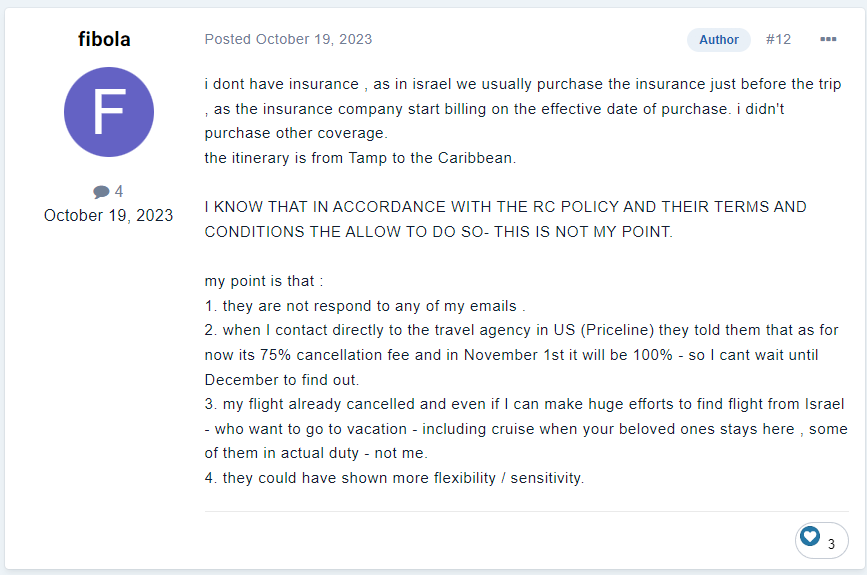
That’s a post from a cruise passenger in Israel, who had booked a cruise out of the US to the Caribbean.
Obviously, the cruise is unaffected by world events, but the passenger was unable to get a flight from Israel to the US to begin their cruise, due to the ongoing conflict in the country at the time.
They were not past the final payment date, but they weren’t too far out from their cruise, so cancelling would’ve meant sacrificing 75% of their cruise fare. They couldn’t risk leaving it longer, as that might mean losing 100% of their fare.
If they had bought insurance, they could’ve recovered most of the costs of their cruise, but they hadn’t and they claimed that it’s common in Israel to only buy insurance a few days before you travel.
They didn’t blame the cruise line for their failure to buy a suitable insurance policy, but they were angry that the company hadn’t shown flexibility to help them in this situation.
But it goes to show, you should always make sure you’re insured from the moment you’ve booked, and not to put off the purchase.
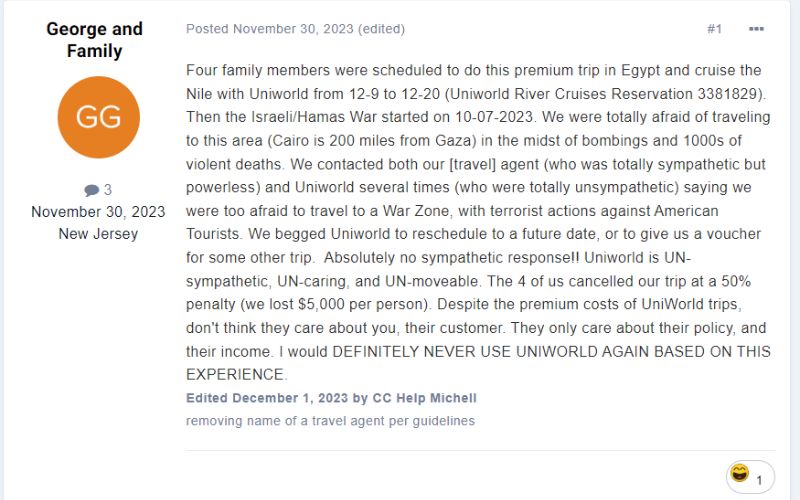
Then there’s this scenario, also related to the Israel/Palestine conflict:
The cruise line has, understandably, refused to offer a refund on the river cruise because of world events taking place 200 miles from where the cruise is sailing. The cruises aren’t cancelled, and so the guest is not entitled to a refund.
The passenger is worried about travelling there and so has lost around $5,000 per person on the trip. But if they had comprehensive cruise cover, they may have been able to get more money back.
Again, it would depend on the policy, because it wouldn’t be automatic to get a refund on a cruise that is sailing. If you choose not to cruise, that’s different from having a reason that is outside your control and that’s stopping you from cruising.
Bonus – Loyalty Points Fairness?
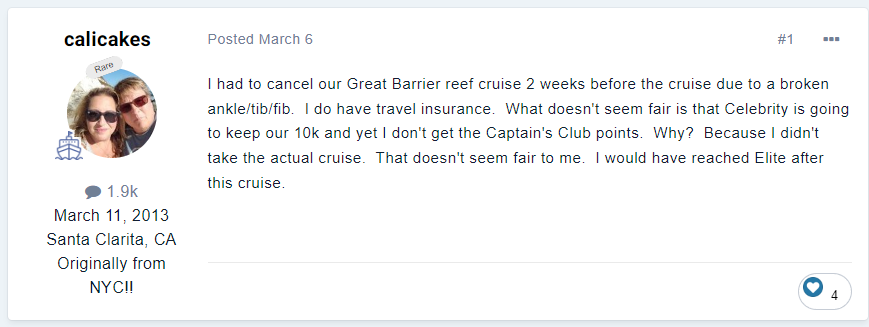
This story doesn’t concern insurance directly, but I found it while researching this guide and wanted to put it to you.
The passenger had to cancel their cruise close to their sailing date. They did have insurance, so would’ve received an almost complete refund from their policy, barring their excess payment. The cruise line kept their money, as it was past the final payment date.
But the passenger felt it was unfair that they wouldn’t be getting their loyalty points for the cruise. After all, they paid for it, and the cruise line got to keep the money, but the policy is you have to sail to get the points.
Who’s right? Should the passenger get their loyalty points despite only being slightly out of pocket, due to their insurance refund?
The Bottom Line
Whether it’s avoiding medical emergencies abroad, or dealing with unexpected reasons to cancel your cruise before you travel, you always have to make sure you have cruise insurance in place.
And don’t dawdle over it. Buy your insurance on the same day you book your cruise. Then if anything happens that would stop you sailing, you know you’ll at least get most of the money back.
The good news is that, for every horror story I found when researching this guide, there were hundreds of success stories where people had used their travel insurance when on a cruise, either for a medical emergency, or to get a refund before they sailed.
Make sure you check out my Cruise Insurance Buyer’s Guide for more information on what to look out for when choosing a policy, and how to get the best prices for your cruise insurance.
Related Topics
If you found this interesting, please share!
Jenni Fielding is the founder of Cruise Mummy. She has worked in the cruise industry since 2015 and has taken over 30 cruises. Now, she helps over 1 million people per month to plan their perfect cruise holidays.
Princess Cruises has announced a revision to two long cruise itineraries to avoid the Middle East and the Red Sea. The cruise line said that these changes were made after extensive consultation with global security experts and government authorities.
Our free cruise newsletter offers the latest cruise news and deals: Sign Up
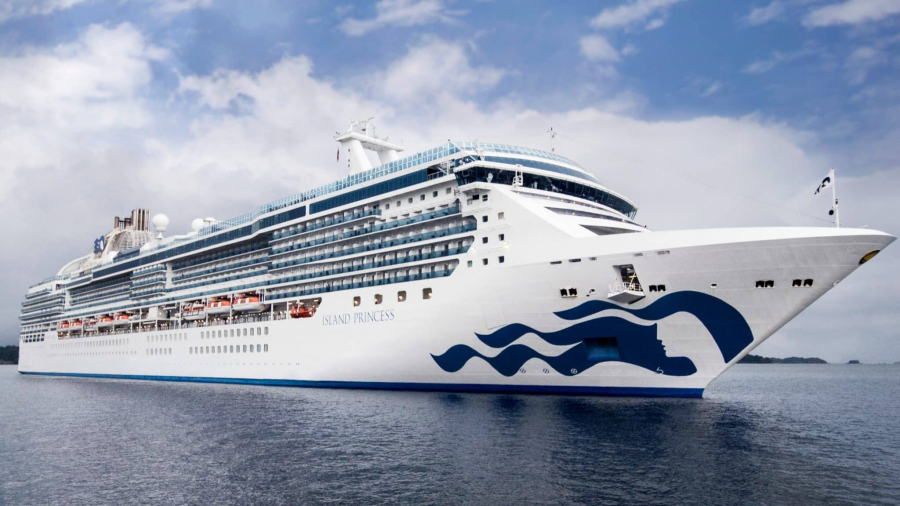
Princess Cruises is changing their two world cruises in 2025 on Island Princess and Crown Princess.
The 116 day world cruise on Island Princess will depart on January 5, 2025 from Ft. Lauderdale, Florida. The February 16 through April 9 portion of the itinerary has been changed for the safety of the guests and crew on the ship.
Guests who were booked to join the cruise in Dubai on March 14, 2025 will now embark in Cape Town, South Africa on March 9. Guests who were scheduled to disembark in Dubai will now get off in Cape Town.
Guests who will have their cruise cut short by four days will receive a refund equivalent to four days of the cruise fare. Guests who have an extra four days added to their cruise will not have to pay anything extra. All of these guests will also receive $300 in on board credit as a gesture of good will from the cruise line.
The revised portion of the cruise is as follows:
The second world cruise from Princess Cruises that is impacted by these changes is Crown Princess.
This May 31, 2025 cruise from Auckland will bypass the Red Sea and a transit of the Suez Canal. The ship will now travel to Africa instead of the Red Sea and Asia portion of the itinerary.
The new itinerary is still being finalized and Princess Cruises will announce it shortly.
Crown Princess will be the largest ship ever to sail a world cruise in 2025 at 113,000 gross tons in size.
Terry Thornton, chief commercial officer of Princess Cruises, said the following about these two changes,
“A Princess World Cruise is truly the voyage of a lifetime and after careful consideration with guidance from global security experts and government authorities, we know our guests will understand and appreciate the change to our upcoming 2025 itineraries to avoid certain areas.
These global events beyond our control have necessitated these reroutings but we are pleased to continue to ensure these world cruises retain destination-rich itineraries with incredible stops along the west Africa coast and the Mediterranean.”
Princess Cruises is one of nine cruise lines owned by Carnival Corporation. They currently have 16 ships in their fleet with one more (Star Princess) entering service in late 2025.
Learn the cruise secrets most people don”t know and cruise like a boss. Check out for a better cruise vacation. (Sponsored)
Most cruisers see disembarkation as the worst part of a cruise. After all, after a great vacation who wants to actually leave the ship.
Our free cruise newsletter offers the latest cruise news and deals: Sign Up
But logistic issues of trying to get everyone off the ship and then to fill it back up again with new passengers have always plagued the cruise industry.
Digital Debarkation is supposed to help make this process a lot easier and a lot smoother.
Carnival Cruise Line passengers were recently asked for their honest opinion on the digital debarkation process that has been rolled out for North America cruises.
This relatively new process uses the Carnival Hub app to help streamline disembarkation day. It allows guests to choose a time of departure and how many bags will need to be transported off the ship.
Brand Ambassador John Heald took to Facebook to ask his followers, “For those that have used the digital debarkation process in the last few weeks please can you give the beards and I an update as to your thoughts on how this worked.”
Here’s a breakdown of some of the main takeaways from passenger comments:
Efficiency and Ease of Use
Many passengers praised the new digital disembarkation process for its simplicity and efficiency.
One passenger described it as “a breeze” and commended the ease and speed of the process. Another traveler shared a positive experience, stating, “Loved it! Got off the ship and in our car before 8 AM this morning.”
Another passenger praised the speed of the system as well saying, “Smoothest debark this morning ever! It is really helping. Was in line and off the ship in about 15 minutes including face scanner in passport line.”
For many cruisers the goal is to get to their vehicle or flight as soon as possible, especially for those who have an early flight that morning.
Technical Challenges
Despite the positive feedback, some passengers encountered technical challenges and confusion while using the digital disembarkation system.
One traveler complained, “Horrible process…didn’t update with any information, causing us to just sit and wait around for over 2 hours.” Another passenger expressed frustration, stating, “Couldn’t figure out what to do…App kept telling me to do the process.”
Some of the issues were based on the app’s performance, something that also can be an issue when a solid internet connection is not available.
Communication and Notification Issues
Several passengers raised concerns about communication and notification issues related to disembarkation times.
One traveler highlighted the lack of alerts, stating, “It never alerted that it was time to disembark.” Another passenger echoed similar sentiments, noting, “Our time was delayed but did not get an alert…only saw it because we opened the app.”
Accessibility and Accommodations
Accessibility and accommodations for passengers with specific needs were also a point of discussion in the comments.
While some passengers expressed confidence in the system regardless of their status, others highlighted the need for improvement. One traveler noted, “We are Diamond and need wheelchair assistance…not concerned about it.”
Another passenger expressed frustration, stating, “With the elevators all jammed pack it’s not easy for wheelchair or scooters.”
Bottom Line
Overall, the introduction of the new digital disembarkation process by Carnival Cruise Line has been met with positive feedback. The concerns brought up should be simple to fix. I always love to see a cruise line asking for feedback and then taking action on the concerns brought up.
We should continue to see changes and enhancements to the debarkation process. And with cruise ships being larger and having greater capacity than ever before it’s a greater matter of importance.
When I started the Cruise Addicts website in 1999, our cruise forums were vital part of our community and continue to be today. I keep seeing articles about other cruise forums that have been created besides our very own. Could this be true? So, I searched the interwebs and found some I’d like to share with you.
Best Cruise Forums
10 Best Cruise Forums 13
With my hypercritical eye, I created what I feel is the best list of the top cruise forums today.
Cruise Forums are a great way to connect with fellow cruisers and learn the latest tips and tricks. Whether you’re a new or seasoned cruiser, a cruise forum is a great way to meet new people. You can ask specific questions related to a particular cruise brand on a sub-forum or general questions in a general topic forum.
Why Use Cruise Forums?
Some forums have sub-forums for roll calls, allowing cruisers to meet fellow cruisers on a specific cruise line’s sailing. For example, if you cruise aboard the Carnival Vista on a particular date in July, you can find this roll-call post, meet new fellow passengers online, and maybe meet up for a drink or get-together.
Here Are the Best Cruise Forums to Join:
Cruise Addicts and its popular cruise forum were established in 1999 and are celebrating their 25th year as one of the original online communities on the Internet. The forums contain different categories of the major cruise lines and relevant topics. They have an incredible amount of information—over 1.7 million posts.
The Cruise Addicts site is also unique in that it asks if you would like to use the APP version of the site, making it easier to connect from your smartphone.
Cruise Critic started in 1995 on AOL and later moved to its current web-based home. The online community has become the largest and most popular cruise forum and one of the originators of the ‘roll-call’ forum and onboard meetups.
Royal Caribbean Blog and its forums are an unofficial site created to discuss everything about Royal Caribbean. The forums and site as a whole are trusted sources of information for fans of Royal Caribbean International cruises.
In recent years, Reddit.com’s cruise-focused subreddit, r/Cruise, has grown to 595K plus members. So, we can’t ignore this incredible collection of cruisers sharing information via this forum-like platform.
The Cruise Hive Boards is a great forum focused on the major cruise lines and another great option for meeting new cruises and learning from them. The site is also an excellent resource for cruise news and information.
DIS Boards is an incredible message board focused on all things Disney. Of course, it has a section dedicated to Disney Cruise Line. You can find meet-ups, trip reports, and more. The forum has well over 63M messages and 601K members.
TripAdvisor Cruise Forum
TripAdvisor.com has its cruise forums with many posts and active users. The page’s right sidebar also has a nice collection of “Top Questions about Cruises” that some users might find helpful.
The Cruise Community Forum is heavily focused on UK cruising topics. The forum has become a leading resource for UK cruisers to share information and learn from fellow cruisers.
A trusted name in travel, the Fodor’s Travel site includes a cruise forum section that discusses cruise travel.
10. CruiseLine.com Forums
The CruiseLine.com forums is a very active community loaded with many forum topics that are a great resource.
Final Thoughts
Cruising is a remarkably social travel experience and a great way to meet new friends and socialize with friends and family. Cruise forums are an extension of this and have allowed fellow cruise travelers to continue their friendships and conversations once the cruise has ended and the planning for the next one begins. They also allow you to learn more about cruise travel from members of the forum and make great friends. I’ve seen it firsthand on the Cruise Addicts forums.
Forums have allowed members to share daily updates, breaking news, and trip reports directly from the ship years before social media existed. Forums have stood the test of time and are now well over 25 years old, with no end in sight. Forums and groups continue to be popular as people want to connect.
Royal Caribbean has released a video showing features that will be on their next new cruise ship, Utopia of the Seas.
Our free cruise newsletter offers the latest cruise news and deals: Sign Up
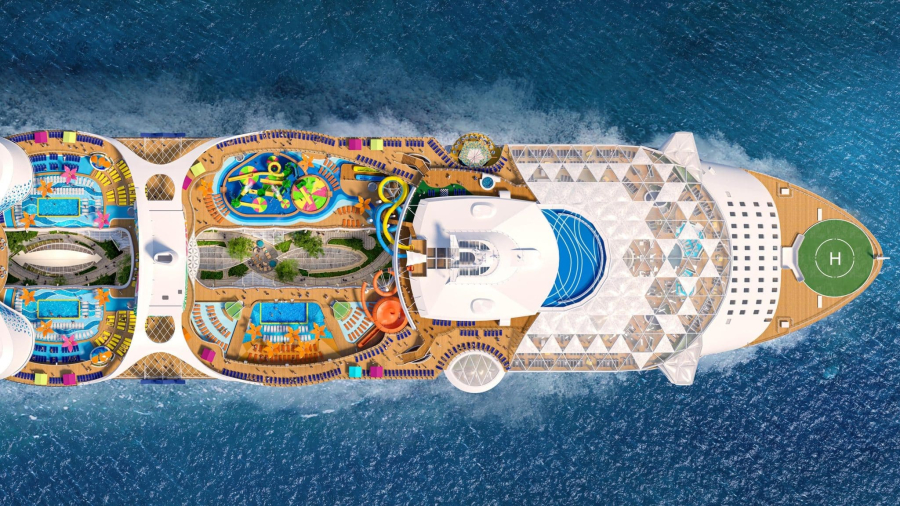
Utopia of the Seas will be Royal Caribbean’s sixth Oasis class cruise ship. It is scheduled to debut in July 2024 and will homeport at Port Canaveral, Florida.
The ship will be a gamechanger in that it will offer three and four night cruises to The Bahamas, something unheard of for a brand new cruise ship.
Royal Caribbean has released a new three minute video showing some of the features that will be on Utopia of the Seas. You can watch the video below.
Utopia of the Seas will have more than 20 drink/bar options, a little something for everyone.
The Pesky Parrot will be a brand new experience that is very different from anything that Royal Caribbean has done in the past. It is promising to be a laidback paradise with fruit-based cocktails, frozen drinks and surprises.
Royal Caribbean familiar favorites will also be on Utopia of the Seas including Lime & Coconut, Vue Bar and The Mason Jar.
The ship will have two casinos with 30 tables games and more than 370 slot machines.
The Attic will be a comedy club with perfect sightlines.
Boleros is getting an update and will have new drinks that have been popular on other Royal Caribbean ships.
Schooner, an old time favorite that offers singalongs and classic drinks.
Bell & Barley will be a lively English pub with a live guitarist.
Playmakers Sports Bar & Arcade will offer a relaxed atmosphere to play a game or watch your favorite sports team.
Utopia of the Seas will also offer a variety of non-alcoholic cocktails for those who do not drink.
All cruises on Utopia of the Seas will visit Royal Caribbean’s award winning private island in The Bahamas, CocoCay.
Cruises on the ship will also visit Nassau. The four night cruises that depart every Monday will also have one sea day.
Utopia of the Seas will debut on July 19, 2024, a three night cruise to The Bahamas.
Utopia of the Seas will be the 28th cruise ship in Royal Caribbean’s fleet.
Learn the cruise secrets most people don”t know and cruise like a boss. Check out for a better cruise vacation. (Sponsored)
This week’s special offers from Disney Cruise Line arrive with sail dates from May into late-January 2025 with even more new sailings on the Disney Wish. Currently, there are 33 unique sail dates, available with special offers available across the fleet for sailings from Barcelona, Civitavecchia, Fort Lauderdale, Galveston, Honolulu, Port Canaveral, Southampton, and Vancouver.
The Disney Dream features the most sailings at 14, the Disney Wish a close second with 13, followed by the Disney Magic at 10, and the Disney Fantasy and Disney Wonder both with 1 date. Currently, there are no offers listed for the Disney Treasure.
Florida Residents rates are up 1 to 4 sail dates, the US Military Personnel increased by 6 30 cruises, while the Canadian Resident dropped 2 to 4 sail dates.
The special offers listed below are available to book today while inventory lasts.
Special Offers for U.S. Military Personnel
Special Rates for U.S. Military Personnel (MTO) are limited to 50 staterooms per category and sailing. Pricing varies, the lowest priced category per person per night listed below. New sailings added this week are in bold. To take advantage of military cruise rates, at least one adult in each stateroom must provide Proof of Military Service. Please note: This offer cannot be combined with any other special offers or discounts. Valid for new bookings only.
Disney Dream
11-Night Mediterranean with Greek Isles Cruise from Civitavecchia (Rome) Ending in Barcelona Civitavecchia (Rome), Italy • At Sea • Chania, Greece • Piraeus (Athens), Greece • Kusadasi, Turkey • Mykonos, Greece • At Sea • Valletta, Malta • Catania (Sicily), Italy • Naples, Italy • At Sea
12-Night Norwegian Fjords and Iceland Cruise from Southampton Southampton • At Sea • Mekjarvik (Stavanger), Norway • Olden, Norway • Alesund, Norway • At Sea • Reykjavik, Iceland • Reykjavik, Iceland • Ísafjörður, Iceland • At Sea • At Sea • At Sea
13-Night Eastbound Transatlantic Cruise from Fort Lauderdale ending in Barcelona Fort Lauderdale, Florida • At Sea • At Sea • At Sea • At Sea • At Sea • At Sea • Ponta Delgada (Azores), Portugal • At Sea • Lisbon, Portugal • Cádiz, Spain • Cartagena, Spain • Valencia, Spain
5-Night Mediterranean Cruise from Barcelona Barcelona, Spain • Villefranche, France • Livorno, Italy • Civitavecchia (Rome), Italy • At Sea
7-Night Mediterranean Cruise from Barcelona Barcelona, Spain • At Sea • Naples, Italy • Civitavecchia (Rome), Italy • Livorno, Italy • Villefranche, France • At Sea
7-Night Mediterranean Cruise from Barcelona Barcelona, Spain • At Sea • Naples, Italy • Civitavecchia (Rome), Italy • Livorno, Italy • Cannes, France • At Sea
7-Night Mediterranean with Greek Isles Cruise from Civitavecchia Civitavecchia (Rome), Italy • Naples, Italy • At Sea • Mykonos, Greece • Santorini, Greece • Chania, Greece • At Sea
7-Night Mediterranean with Greek Isles Cruise from Civitavecchia (Rome) Civitavecchia (Rome), Italy • Naples, Italy • At Sea • Piraeus (Athens), Greece • Mykonos, Greece • Chania, Greece • At Sea
7-Night Western Europe Cruise from Barcelona ending in Southampton Barcelona, Spain • Cartagena, Spain • At Sea • Lisbon, Portugal • Vigo, Spain • La Coruña, Spain • At Sea
9-Night Mediterranean with Greek Isles Cruise from Barcelona ending in Civitavecchia Barcelona, Spain • At Sea • Messina (Sicily), Italy • At Sea • Santorini, Greece • Kusadasi, Turkey • Piraeus (Athens), Greece • At Sea • Naples, Italy
Disney Magic
4-Night Western Caribbean Cruise from Galveston Galveston, Texas • At Sea • Progreso, Mexico • At Sea
5-Night Western Caribbean Cruise from Fort Lauderdale Fort Lauderdale, Florida • At Sea • Cozumel, Mexico • At Sea • Castaway Cay
5-Night Western Caribbean Cruise from Galveston Galveston, Texas • At Sea • Progreso, Mexico • Cozumel, Mexico • At Sea
Disney Wish
3-Night Bahamian Cruise from Port Canaveral Port Canaveral, Florida • Castaway Cay • Nassau, Bahamas
3-Night Bahamian Cruise from Port Canaveral Port Canaveral, Florida • Nassau, Bahamas • Castaway Cay
4-Night Bahamian Cruise from Port Canaveral Port Canaveral, Florida • Nassau, Bahamas • Castaway Cay • At Sea
4-Night Bahamian Cruise from Port Canaveral Port Canaveral, Florida • Nassau, Bahamas • At Sea • Castaway Cay
4-Night Bahamian Cruise from Port Canaveral Port Canaveral, Florida • Castaway Cay • Nassau, Bahamas • At Sea
Disney Wonder
10-Night Hawaiian Cruise from Vancouver ending in Honolulu Vancouver, Canada • At Sea • At Sea • At Sea • At Sea • At Sea • Nawiliwili, Hawai’i • Nawiliwili, Hawai’i • Kahului (Maui), Hawai’i • Hilo, Hawai’i
15-Night South Pacific Cruise from Honolulu ending in Sydney Honolulu, Hawai’i • Kahului (Maui), Hawai’i • At Sea • At Sea • At Sea • At Sea • At Sea • Pago Pago, American Samoa • International Date Line (Lose Day) • At Sea • Suva, Fiji • At Sea • Nouméa, New Caledonia • At Sea • At Sea • Sydney, Australia
Special Military rates are available to all retired and active U.S. Military personnel (or spouse), including U.S. Air Force, U.S. Army, U.S. Marines, U.S Navy, U.S. Coast Guard, U.S. National Guard, U.S. Army Reserve and U.S. Department of Defense personnel. Active and retired members (or spouse) of the U.S. military must provide valid identification at time of check-in. This offer is limited to a maximum of one stateroom per military member (or spouse), per sailing. A U.S. Military service member (or spouse) is required to sail to take advantage of this offer. Activated members (or spouse) of the U.S. National Guard or the U.S. Army Reserve must also show active duty orders (active duty papers must be dated as of January 1st of the previous year to qualify).
Government taxes will vary by itinerary and are in addition to the below rates. Third and fourth Guest prices valid with 2 full-fare Guests in the same stateroom. Rates may vary by sail date and category. Other restrictions may apply. Other categories and sail dates may be available. Valid for new bookings only.
Special Offers for Florida Residents
Special Rates for Florida Residents (FLR) are limited to 50 staterooms per category and sailing. Pricing varies, the lowest priced category per person per night listed below. New sailings added this week are in bold. Please note: This offer cannot be combined with any other special offers or discounts. Valid on new and existing reservations.
Disney Dream
13-Night Eastbound Transatlantic Cruise from Fort Lauderdale ending in Barcelona Fort Lauderdale, Florida • At Sea • At Sea • At Sea • At Sea • At Sea • At Sea • Ponta Delgada (Azores), Portugal • At Sea • Lisbon, Portugal • Cádiz, Spain • Cartagena, Spain • Valencia, Spain
Disney Fantasy
6-Night Western Caribbean Cruise from Port Canaveral Port Canaveral, Florida • At Sea • Cozumel, Mexico • Grand Cayman • At Sea • Castaway Cay
Disney Wish
3-Night Bahamian Cruise from Port Canaveral Port Canaveral, Florida • Nassau, Bahamas • Castaway Cay
To take advantage of Florida residency cruise rates, proof of Florida Residency for at least one adult in each stateroom must be presented at time of check-in. Guests unable to show proper proof of Florida residency at check-in will have their cruise re-priced and the balance must be paid before being allowed to sail.
Proof of residency must be valid at the time of sailing, and includes the following: •Florida Driver’s License •Florida Identification Card
If you do not have one of the IDs indicated above, then you must provide one of the following—dated within the past 2 months—verifying a Florida residential address and your name, along with a corresponding, valid government-issued photo ID (such as passport, driver’s license, state identification card): •Monthly mortgage statement •Renter’s lease agreement •Current automobile registration, insurance policy or bill •Current homeowner’s insurance policy or bill •Current utility bill (power/phone/cable/water) •Mail from a financial institution, including checking, savings or investment account statements •Mail from a federal, state, county or city government agency Note: property deeds and P.O. boxes are not considered acceptable proofs of residency.
Children’s rates are also available to Guests ages 3 through 12 that are traveling with 2 adults in the same stateroom.
Canadian Resident Rates
Disney Dream
12-Night Norwegian Fjords and Iceland Cruise from Southampton Southampton • At Sea • Mekjarvik (Stavanger), Norway • Olden, Norway • Alesund, Norway • At Sea • Reykjavik, Iceland • Reykjavik, Iceland • Ísafjörður, Iceland • At Sea • At Sea • At Sea
7-Night Mediterranean with Greek Isles Cruise from Civitavecchia Civitavecchia (Rome), Italy • Naples, Italy • At Sea • Mykonos, Greece • Santorini, Greece • Chania, Greece • At Sea
7-Night Mediterranean with Greek Isles Cruise from Civitavecchia (Rome) Civitavecchia (Rome), Italy • Naples, Italy • At Sea • Piraeus (Athens), Greece • Mykonos, Greece • Chania, Greece • At Sea
Disney Fantasy
6-Night Western Caribbean Cruise from Port Canaveral Port Canaveral, Florida • At Sea • Cozumel, Mexico • Grand Cayman • At Sea • Castaway Cay
Disney Magic
4-Night Bahamian Cruise from Fort Lauderdale Fort Lauderdale, Florida • Nassau, Bahamas • Lookout Cay • At Sea
5-Night Western Caribbean Cruise from Fort Lauderdale Fort Lauderdale, Florida • At Sea • Cozumel, Mexico • At Sea • Castaway Cay
Special Rates for Canadian Residents with savings on prevailing rates as quoted on Disneycruise.com for non-concierge Verandah, Oceanview, and Inside Staterooms on select cruises. Pricing varies, the lowest priced category per person per night listed below. New sailings added this week are in bold. Proof of residency is required an you must mention the special offer code CAN when booking. NOTE: Offers may be applied to existing bookings if requested when calling in. This offer cannot be combined with any other special offer or discounts, or onboard credits.
The Canadian Resident rate excludes suites and categories with restrictions (VGT, OGT, and IGT). Proof of Canada residency will be required at time of check-in. Taxes, Fees and Port Expenses are not included. If booking through Disney Cruise Line’s Contact Center, you must mention code CAN. Offers may be applied to existing bookings if requested by caller. This offer cannot be combined with any other special offer or discounts, or onboard credits. Offer valid for new and existing reservations.
Please note, the offers listed are not to be taken as official quotes. Prices and availability can change at any time without notice. More importantly, the deals listed above are a snapshot in time based on DCL’s online cruise search tool.
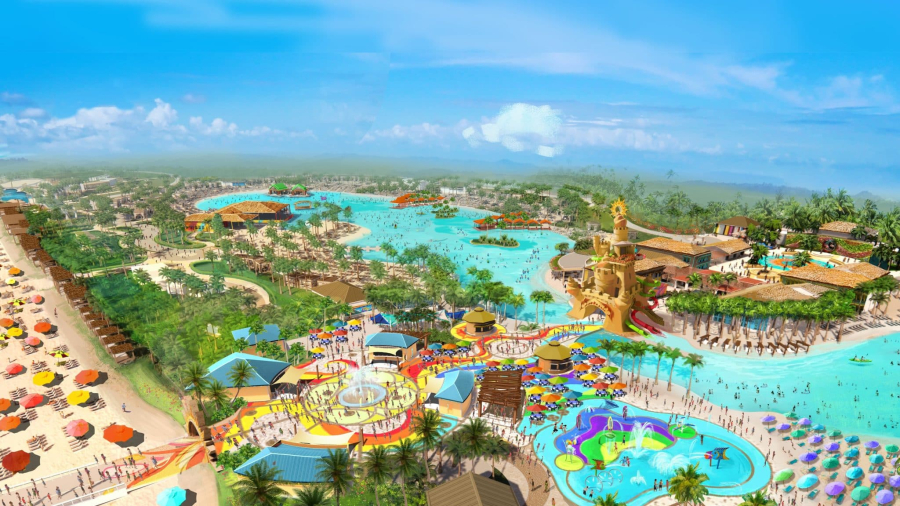
Carnival Cruise Line has purchased 5,000 Bahamian grown palm trees for their new port that is opening in The Bahamas, Celebration Key.
Our free cruise newsletter offers the latest cruise news and deals: Sign Up
The palm trees are part of Phase One of Carnival’s “Plant a Tree” initiative that will beautify the cruise line’s flagship cruise port, Celebration Key.
All 5,000 palm trees were grown from seed on Grand Bahama Island with 40% of them being purchased from small-scale growers.
“The Grand Bahama community’s enthusiastic participation has been instrumental in achieving this milestone,” said Raquel Mota, Senior Port Services Manager, Carnival Corporation. “The initiative was launched in October 2023 and we have already met our target for the first phase.
“We want to congratulate and say thank you to every local grower who took part. We encourage them to keep up the good work as Carnival Corporation intends to continuing partnering with as many Grand Bahamians as possible as we move toward the opening of Celebration Key.”
Carnival is looking to purchase a total of 200,000 locally grown plants for Celebration Key.
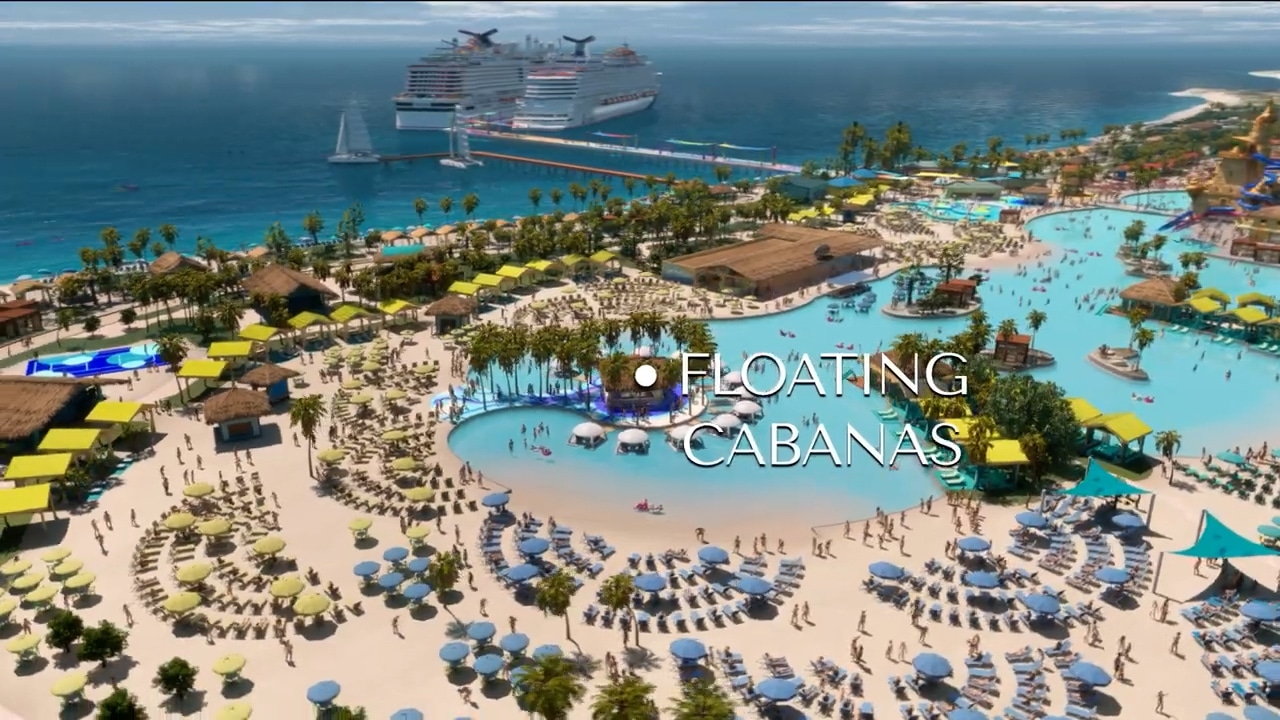
Celebration Key is currently under construction and scheduled to open in the summer of 2025. When the port first opens, it will be able to accommodate two of Carnival’s largest ships in one day.
An extension to the pier has also been announced that will double the capacity to four ships a day.
Celebration Key will be a private destination that is only visited by Carnival cruise ships.
The port will have five portals with everything from the largest freshwater pool in the Caribbean/Bahamas to an adults only area.
Carnival Vista will be the first Carnival ship to visit the port on July 19, 2025. In total, 18 different Carnival ships will visit the port on more than 500 itineraries.
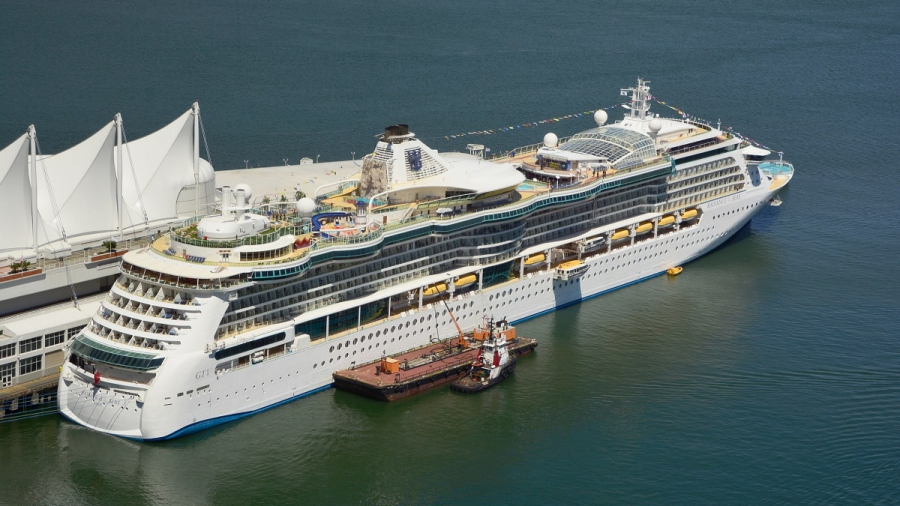
Royal Caribbean announced the cancellation of a cruise to Alaska on Radiance of the Seas today as the ship will require repairs that took longer than expected.
A letter was sent to guests who were already on the ship. These guests were expecting to start the voyage to Ketchikan and Icy Strait Point today from Vancouver.
Our free cruise newsletter offers the latest cruise news and deals: Sign Up
The first scheduled stop to Juneau had already been canceled to allow for extra time to make the needed repairs.
But apparently more time will be needed to make sure the vessel is in working order.
“As you are aware, our teams have been vigorously working to have the Radiance of the Seas prepared to set sail on our shortened April 26, 2024 sailing,” the cruise line said in a notice sent to passengers onboard.
“Despite our best efforts, circumstances beyond our control have delayed our sailing further. As a result, we’ll regrettably have to cancel our cruise,” Royal Caribbean added.
This announcement was made after passengers had already been on the ship for two days, waiting for the vessel to be repaired while in port in Vancouver.
The ship was brought back from its previous cruise early due to propulsion issues. It was expected that the technical issues would be repaired before the ship set sail on a 5-day cruise to Alaska, which was originally 7 days in duration before the need for repair cut the trip short.
“We understand the disappointment due to this unfortunate turn of events. We truly extend our sincerest apologies for the continued unforeseen disruption to your vacation,” Royal Caribbean stated in the letter.
Every passenger on Radiance of the Seas was required to disembark the ship today as the vessel remained in port.
Royal Caribbean has promised to compensate guests for the cruise cancellation.
Passengers will receive a refund in full, which will include taxes, fees, and pre-paid onboard packages.
Also, a Future Cruise Credit valued at 100% of the original cruise fare will be issued on May 10th, 2024.
For guests who had booked flights directly through Royal Caribbean, the company will automatically reschedule flights to accommodate the cancellation.
Travelers who booked their own flights will be reimbursed for change fees up to a specified limit – $250 for domestic flights and $400 for international flights.
Royal Caribbean also noted that hotel costs up to $250 per night for two nights would be covered by the cruise line.
This would help provide ample time for passengers to make arrangements to get back home.
While delays and itinerary adjustments can happen at the last minute, this also underscores the importance of cruise travel insurance.
Flights and hotel costs are being covered by the cruise line, but some situations may require other extra costs to be paid that are a direct result of this cruise cancellation.
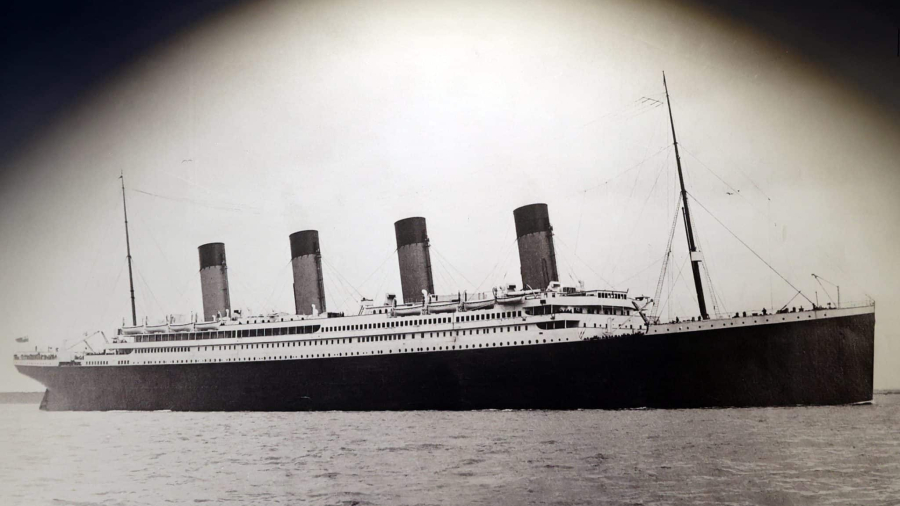
I am fascinated by the economics of the RMS Titanic, an emblem of luxury at the dawn of the 20th century. The Titanic ticket prices mirror the societal stratification of that era.
Titanic Ticket Prices
In 1912, the ticket cost on the Titanic varied significantly, reflecting the class disparities within the ship itself. For many, to inquire how much a ticket was is to understand the extravagance the legendary ship promised its first-class passengers.
With an RMS Titanic ticket costing as much as 870 pounds for a paragon suite in 1912 money—a fortune translating today into an astronomical sum—it becomes clear that journeying on the Titanic was a manifestation of the epoch’s pinnacle of luxury.
A third-class ticket wasn’t immune to hefty pricing either. While costing just 7 pounds, these prices for titanic tickets still represented a significant expenditure for the average individual of the time, revealing that even the lowest class onboard this majestic vessel necessitated a substantial financial commitment. When discussing how many tickets were on the Titanic, I find it’s an exploration of not merely currency and rates but the tangible value of an extraordinary, yet tragic, human adventure.
Getting a Ticket on the Titanic
The Titanic ticket prices are as intriguing now as they were over a century ago, prompting me to peel back the layers of history and analyze what these costs truly encapsulated. Exploring the price of Titanic tickets in 1912 also allows me to throw into stark relief how these sums equate to current financial standards, helping us gauge the accurate scale of the Titanic’s elegance and allure that appealed to its diverse group of passengers.
Key Takeaways
The cost of a ticket on the Titanic in 1912 indicated the rigid social hierarchy of that era.
Prices for Titanic tickets for a first-class suite were as much as 870 pounds, which would be close to 105,000 pounds today when adjusted for inflation.
How much were the Titanic tickets? Third-class tickets were priced at 7 pounds, nearly 7% of the yearly salary for a skilled English worker at the time.
Reflecting on the price of a ticket on the Titanic provides insight into the luxury and exclusivity that was available—and valued—aboard the ship.
RMS Titanic ticket prices, even for the most modest accommodations, required a significant financial outlay by today’s standards.
Understanding the Hype Around Titanic Ticket Prices
When I delve into the history of the RMS Titanic, it’s impossible not to be captivated by the luxury and grandiosity the ship promised. The ticket prices, a reflection of this magnificence, have long been a topic of bewilderment and fascination. But what exactly made these tickets so sought after, and how do the costs translate to today’s currency?
The Fascination with the Titanic’s Grandeur
The allure of the Titanic is timeless. Its luxury, the promise of crossing the Atlantic with utmost elegance, and the tragic romance of its maiden voyage have remained unmatched in popular culture. Behind the grand narrative, the numbers tell a tale of luxury that could only be afforded by the wealthiest in society. A first-class ticket price aboard the Titanic wasn’t merely a pass to travel; it was an entry to an exclusive world of decadence.
Comparing Past and Present Values
The results are staggering when I investigate how much a first-class ticket on the Titanic was and then compare it to today’s standards. A first-class suite boasted a modern equivalent price tag often exceeding 100,000 pounds or a formidable $133,132. Moving down a tier, a second-class ticket price for Titanic wasn’t modest either, yet it paled compared to the astronomical costs of the suites above. Meanwhile, a third-class ticket, though much more affordable, still represented a substantial expense for the average individual of that era.
In my research, I’ve come across detailed price structures that illustrate this dramatic variance among the different classes. The following table offers a snapshot of the costs passengers faced at the time, adjusted to today’s values. It creates a clearer understanding of passengers’ investment in their journey on the legendary ship.
Class
1912 Ticket Price
Today’s Equivalent
First Class (Suite)
£870
$133,132
First Class (Berth)
£30 – £870
$4,591 – $133,132
Second Class
£12
$1,834
Third Class
£3 – £8
$579 – $1,542
As I reflect on this data, it’s clear that the fare thee well Titanic was more than a voyage—it was a statement of one’s status and a step into historical immortality.
How much is a first-class ticket?
For Titanic, it was a price that few could afford, but many dreamed of, even a century later. With every new revelation about the ticket price, the ship continues to command our awe, respect, and sad remembrance.
Unpacking the Cost of Luxury: Titanic’s First Class Experience
When considering the price of a first-class ticket on the Titanic, it was clear that passengers were not merely paying for a voyage across the Atlantic but investing in an unparalleled experience of luxury. For the RMS Titanic’s first-class passengers, the journey was as much about the luxurious environment as the destination itself. Understanding this grandeur begins with a look at the lavish accommodations designed for the elite and the exclusive onboard amenities that set the standard for high society’s seafaring adventures.
Lavish Accommodations for the Elite
The first-class accommodations aboard the Titanic were crafted to mirror the grandeur of the most exquisite European hotels. Rooms with ornate wood paneling, plush carpets, and fine linens were just the beginning. The luxury extended to the extravagant suites, such as the one purchased by Charlotte Drake Cardeza, which boasted a private 50-foot promenade deck, offering an unmatched level of elegance and privacy. The price of a first-class ticket on the Titanic reflected the access to this incredible luxury that money could afford at the time.
Exclusive Onboard Amenities for First Class Passengers
Aboard the Titanic, first-class passengers could enjoy culinary masterpieces rivaling the finest restaurants. With menus featuring oysters, pâté de foie gras, and lamb with mint sauce, dining was an event in itself. For leisure, the ship was equipped with amenities that would make today’s luxury cruise liners envious, like an onboard gym, a squash court, and even Turkish baths. The well-being and entertainment of passengers were paramount, ensuring that every moment on the Titanic was indulged.
As fascination with the Titanic’s first-class legacy endures, the prospect of a modern replica has spurred conversation and curiosity. Questions arise, such as “How much will the Titanic 2 tickets cost?” and “How much will a ticket for Titanic 2 cost?” as enthusiasts and history buffs ponder the opportunity to relive the splendor of the past. The prospect of buying Titanic 2 tickets incites both excitement and wonder, proving that the allure of Titanic’s sumptuous past remains ever-present in contemporary society.
More Than Just a Journey: Second Class Comforts on Titanic
When history recalls the RMS Titanic, much fanfare is given to the luxury of first class, yet it was in the second class that one could find a harmonious balance of comfort and value. During the Titanic’s time, how much was a second-class ticket on the Titanic? It was a typical query, reflecting an interest in the accessible luxury the ship offers. Indeed, the second-class accommodations on the Titanic were cited as akin to first-class on other liners of the time. Reflecting on these comforts, one cannot help but marvel at the quality that greeted those who ventured on this fateful journey.
Privileges Accorded to Second Class Passengers
The voyagers in second-class cabins on the Titanic enjoyed advantages unprecedented for the period. Among these were modest yet refined second-class rooms, typically fitted with bunk beds, washbasins, and communal, clean second-class bathrooms. A library and smoking room were exclusive to second-class gentlemen, fostering an atmosphere of cultured leisure.
Dining and Social Life in Titanic’s Second Class
The dining experience for 2nd class cabins on the Titanic cannot be understated. The respectable second-class titanic dining saloon could seat 393 passengers and prided itself on white linen, fine china, and silver service. It often surprises its guests with the sumptuous diversity from roast beef to curries. Social interaction flourished within this space, contributing to the memorable experience of their voyage.
Here’s a glimpse into the second-class ticket cost about the comforts provided:
Feature
Description
Ticket Price (1912)
Private Cabins
Comfy rooms with bunk beds and a washstand.
$36 – $80
Shared Amenities
Access to a library and smoking room.
Included in ticket
Dining Experience
Multi-course meals with diverse menu options.
Included in ticket
I resonate with the allure that such experiences held for the average passenger—comforts now perhaps not as indulgent as those of contemporary cruising. Still, at the time, second-class rooms on the Titanic were a badge of leisure, and the voyage itself was a slice of elegance for the emerging middle class.
The Third Class Experience: Perception Versus Reality
When we reflect on the Titanic, images of grandeur and luxury often come to mind, especially regarding the first—and second-class accommodations. Yet, how much was a third-class ticket on the Titanic? Surprisingly, third-class tickets represented an affordable option for many emigrants hoping to start a new life in America. The price of these ship tickets, while significantly less than those of the upper classes, still offered passengers reasonable comfort and amenities that might surprise modern perceptions of ‘steerage.’
Third-Class Accommodations and Facilities
In the early 20th century, third-class accommodations on the Titanic were considered quite advanced. Unlike the cramped and bleak conditions on many other vessels of the era, third-class accommodations on the Titanic included access to well-maintained communal areas and even a deck space. While essential, the third-class cabins on the Titanic offered more than just a place to lay one’s head. They provided a sense of dignity and respect to their occupants.
When exploring the value of third-class tickets, it’s intriguing to note the amenities that accompany the relatively low cost. These tickets were not merely ship tickets; they were passed to a more comfortable journey across the Atlantic than many third-class passengers would have experienced on alternative steamships of the time.
Dining Arrangements for Third-Class Travellers
The dining experiences for third-class passengers on the Titanic defied many expectations. Although dining facilities were more modest than the other classes, the quality and variety of food available challenged the standard fare for third-class travel in that era. The price of third-class tickets included meals that were quite substantial—travelers enjoyed hearty, home-style fare that often featured fresh bread, porridge, meats, and a range of vegetables. The ship ticket price ensured no one went hungry, underscoring the White Star Line’s commitment to passenger comfort.
Comparison
Third Class on Titanic
Typical Third Class on Contemporary Ships
Accommodations
Private and family cabins
Open dormitory-like spaces
Amenities
Outdoor spaces, designated communal areas
Limited common areas, often no outdoor
Dining
Multiple meals a day, diverse menu options
Often sparse and lacking variety
Value for Cost
Comparable to second-class on other ships
Typically indicative of ‘steerage’
Reflecting on how much a third-class ticket on the Titanic was worth, it becomes clear that these tickets were not merely about transport—they were about providing a level of service and care that was commendable for the time. The relentless tales of the Titanic seldom shine a light on third-class accommodations.
Yet, these humble passages represent a narrative of hope and resilience as poignant and central to the Titanic’s legacy as the stories from its grander decks.
Titanic Ticket Prices in Retrospect
In reflecting upon the cost of the Titanic, it becomes evident that the RMS Titanic cost was a testament to its era’s expectations of luxury and exclusivity. A fundamental divergence in ticket costs magnifies how much money the Titanic cost passengers seeking different levels of comfort and elegance. Below is a comparison table offering a glimpse into the varied ticket costs that travelers paid to be aboard the RMS Titanic, juxtaposed with today’s approximate values.
Class
1912 Ticket Cost
Equivalent in 2024 USD
First Class (Suite)
£870
$133,132
First Class (Berth)
£30 – £870
$4,591 – $133,132
Second Class
£12
$1,834
Third Class
£3 to £8
$460 – $1,224
The revenue generated from many Titanic tickets for first-class passengers alone was a staggering 18,091 pounds—a figure now valued close to $2.75 million. The cost of the Titanic ship highlights the colossal investment made into its construction and the level of opulence passengers were paying for.
Such affluence begs the question: how much did the Titanic cost in terms of human character beyond mere monetary value? The RMS Titanic’s ticket prices vividly reflect the ambition for grandeur. Mirroring society’s structure at the time, each ticket category represented a distinct social status and onboard experience. As a writer delving into the past, I find the RMS Titanic’s pricing framework a fascinating narrative of economic history, societal values, and maritime luxury.
The Societal Context: Why Were Titanic Ticket Prices So High?
When we examine the economics of the era during which the RMS Titanic set sail, ticket prices clearly reflected the more comprehensive societal and economic stratification. Understanding the full picture requires examining the value of currency and average annual earnings at the time.
The Economics of the 1912 Era
My analysis begins over a century ago, in 1912. During this period, the British pound sterling held significant purchasing power, and the average skilled worker in England might see an annual income of approximately 100 pounds. To put this into perspective regarding RMS Titanic tickets, the cost of a third-class ticket ate up roughly 7% of this yearly salary. It was a substantial sum for many seeking new opportunities across the Atlantic.
Cost Analysis Relative to Average Annual Earnings
A deeper cost analysis, contrasting the ticket prices with the average annual earnings, reveals just how exclusive the Titanic voyage was. Numerous first-class cabins on the Titanic beckoned the affluent with their opulent allure. The number of first-class rooms became a symbol of glamour and luxury, only accessible to a select few based on their economic means. An individual occupying one of these rooms could be spending what a skilled worker would earn in nine years, a staggering disparity that emphasizes the inequality of the times. To illustrate, Charlotte Drake Cardeza, a first-class passenger, would have spent approximately 870 pounds—almost $4,000 then—for her ticket.
An intriguing fact I’d like to share is the currency value: 20 pounds in 1912 would equal a substantial sum today, and a pound in 1920 still retained more value than today, further amplifying the expense incurred by Titanic travelers.
As I review these figures, I ponder whether passengers aboard the Titanic could have predicted that their journey would remain etched in history, both for its tragic end and as a representation of the Edwardian era’s grandeur and excess. The lucrative RMS Titanic ticket illustrates a time when wealth was flaunted, and mobility was as much about social status as it was about traversing oceans. This, in my view, answers much about why Titanic ticket prices were so high—they weren’t merely a fee for passage but a price tag on luxury and, for some, a symbol of prosperity.
Demystifying RMS Titanic’s Enormous Construction Costs
When discussing the RMS Titanic, it’s impossible not to reflect on the colossal investment that went into its creation. In 1912 dollars, the cost of the Titanic ship was a staggering $7.5 million, an amount that mirrors approximately $180 million today when adjusted for inflation. This monumental sum underscores the extravagance that the White Star Line aspired to embody in the Titanic.
The Financial Backing of Titanic’s Construction
The White Star Line’s vision for the Titanic was not just that of a mode of transportation; this ship was to be the pinnacle of maritime luxury. This ardent desire for supremacy on the seas meant the company was willing to pour substantial capital into ensuring every aspect of the vessel from the keel up was nothing short of extraordinary. Indeed, the Titanic ship’s cost reflected its unparalleled splendor and the cutting-edge technology it housed.
Inclusion of State-of-the-Art Technology and Design
The high cost of the Titanic was justified by its state-of-the-art offerings. It featured advanced safety devices, powerful wireless telegraphy equipment, and the finest navigational instruments that money could buy during that era. Additionally, the luxurious design elements—grand staircases, opulent staterooms, and expansive promenade decks—all contributed to the how much money the Titanic cost narrative. The ship was designed to awe and comfort its passengers at every turn, an endeavor with a hefty price tag. The RMS Titanic cost built not merely a vessel, but a floating palace replete with the era’s most advanced amenities.
Feature
Cost in 1912
Equivalent Cost Today
Ship Construction
$7.5 million
~$180 million
Luxury Accommodations
Included in total
Included in total
Advanced Safety Equipment
Included in total
Included in total
Wireless Telegraph
Included in total
Included in total
Navigational Instruments
Included in total
Included in total
This table not only breaks down the various components that contributed to the question of how much the Titanic cost but also contextualizes the vastness of the enterprise. From physical construction to the luxury within, the RMS Titanic cost was part of an ambitious project that solidified its status as the most legendary cruise liner in history.
The Calibre of Passengers Aboard the Titanic
The voyage of the RMS Titanic is remembered for the tragedy of its sinking and the illustrious list of first-class passengers on the Titanic that embodied the pinnacle of early 20th-century affluence. I remember looking over historical passenger manifests and being struck by the pronounced social stratification visible in the distinctions between titanic class accommodations. It was a time when the wealthiest occupants could, and would, indulge in extravagant spending to ensure an opulent sea voyage on what was then the grandest ocean liner ever built.
Wealthiest Occupants and Their Extravagant Spending
Among the first-class passengers on the Titanic, names like John Jacob Astor IV, the wealthiest man aboard, became synonymous with luxury. His fortune was estimated at around $87 million—an almost unfathomable sum. These affluent passengers could afford the most lavish 1st class rooms on the Titanic, contributing significantly to the wealth of Titanic passengers. The amenities, from personal maids and butlers to private lounge areas, testified to a culture of luxury unimaginable to the other classes aboard.
Social Stratification and Its Reflection on Ticket Prices
The price disparity between the various levels of travel reflected the era’s social stratification, with RMS Titanic’s first-class cabins starkly contrasting with the more modest third-class berths. The luxury of the first-class cabins on the Titanic was designed to cater to those accustomed to the finest things in life—a trend encapsulated within the quality and quantity of space afforded to first-class passengers. With reports stating how many first-class cabins were on the Titanic, it is clear that exclusivity was as prized as luxury itself, with only a select few enjoying the epitome of nautical splendor.
A Glimpse into the Fate of Wealth: Titanic Claims and Litigations
The sinking of the RMS Titanic not only led to a tragic loss of life but also ushered in a wave of legal disputes and titanic insurance claims that highlighted the complex nature of financial compensation after maritime disasters. Among these trials, the plight of the survivors who sued the White Star Line stands out as they sought redress for their overwhelming losses. What followed after the Titanic disaster was an intricate dance between insurers and the bereaved, all under the mournful shadow of one of the 20th century’s most iconic tragedies.
The Aftermath of the Tragedy and Financial Compensation
The disaster led to an onslaught of lawsuits totaling $16 million—in essence, a demand for financial compensation by the survivors and relatives of those who perished. However, a legal shield known as the Limitation of Liability Act drastically curtailed these claims. The unexpected outcome? The White Star Line only paid a fraction of the demanded sum, leaving many to deal with the disillusionment of unmet claims.
The Extravagant Insurance Claims Post-Disaster
This first-class passenger’s Charlotte Drake Cardeza claim remains particularly notable among the numerous accounts. She cited an astonishing loss of personal belongings totaling over $177,000 at the time, which included luxurious dresses and ornate jewelry. Today, such claims would be valued at $4.2 million, demonstrating the immense personal wealth aboard the Titanic and the profound financial implications at stake.
Claimant
Loss Reported
Compensation Sought
Amount Received
Charlotte Drake Cardeza
$177,000
$4,200,000 (Today’s Value)
Part of the collective $664,000
General Claims
N/A
$16,000,000
$664,000
My research into the legal aftermath further reveals that the journey aboard Titanic was an opulent adventure and a financial gamble. As survivors sought reparations, they entered a maelitz of legal boundaries and the cold calculus of insurance assessments—a stark contrast to the grandeur they experienced aboard the ill-fated voyage.
Assessing the Comparative Value of Titanic Tickets Today
Given the luxury and opulence associated with the RMS Titanic, one might wonder how its fare would measure up against the extravagance of today’s cruise ships. As I delve into the comparison, it’s intriguing that modern cruise prices paint a fascinating image when placed side-by-side with Titanic’s historical prices.
Modern Cruise Costs versus Titanic’s Historical Prices
Modern cruise lines offer a wide range of choices, from budget-friendly interior cabins to lavish multi-room suites with exclusive amenities. A suite aboard a premium cruise line could easily command prices in the tens of thousands, particularly for lengthy voyages with durations and amenities similar to those of the Titanic’s maiden voyage.
What Would a Titanic Ticket Cost You Now?
If the Titanic were to set sail today, stepping aboard could bring back a hefty sum. The allure of embarking on the Titanic 2’s maiden voyage has prompted speculation on how much Titanic 2 tickets cost. Equating Titanic’s first-class suite to an ultra-luxury suite on an extended world cruise today, we’re talking about prices that would only appeal to the wealthiest of travelers—much like it did in 1912.
The majesty and tragedy of the Titanic continue to capture imaginations worldwide. It’s not just about the price of a ticket; it’s about the experience, the history, and the connection to a bygone era, all of which are priceless.
Titanic Ticket Prices and the Legacy of the Unsinkable Ship
As I delve into the story of the RMS Titanic, it’s clear that its legacy holds a profound place in history, not only as the Unsinkable Ship but also for its striking reminder of human ambition and fragility. The lasting allure of Titanic goes beyond the tragic narrative of its maiden voyage; it speaks to our intrigue with luxury and the lengths individuals went to experience the pinnacle of travel in their era. The price of Titanic tickets in 1912 symbolizes the economic postures of the time, offering a window into the lifestyles of the affluent nurtured by the Industrial Revolution.
The Lasting Allure of the Titanic’s Story
The RMS Titanic has always been emblematic of the extremes of human ingenuity and hubris, sparking a fascination that persists over a century later. It’s not just the sheer scale of the tragedy that feels arresting but the stories connected with those who boarded, from the hopeful emigrants in third class to the illustrious magnates in first class. The mythos of Titanic are stirred by anecdotes of life onboard, framed by the sheer costliness of the tickets reflecting the opulence intended for its passengers.
How Ticket Prices Contribute to Titanic’s Mythos
Consider the anecdotes of those who held an RMS Titanic ticket—their tales have infused the ship’s story with an extraordinary sense of character and time. Unwittingly, they became a part of a story much more significant than their arrival on the other side of the Atlantic, now interwoven with the fabric of early 20th-century history. Discussions of new Titanic ship tickets ripple through the present, drawing a direct line from that fated journey to a modern world still captivated by the grandeur it represented and the human appetite for luxury and adventure.
Frequently Asked Questions (FAQ)
How much was a ticket on the Titanic?
The cost of a ticket on the Titanic varied depending on the class. A first-class ticket on the Titanic could cost around £870 (equivalent to around £87 million in today’s money). A second-class ticket cost about £12, and a third-class ticket was around £7.
What were the different ticket prices for the Titanic?
The ticket prices for the Titanic varied depending on the class. First-class passengers paid around £870 for a ticket, second-class passengers paid about £12, and third-class guests paid around £7 for their tickets.
Who could afford the expensive ticket on the Titanic?
Wealthy individuals, such as American businessman John Jacob Astor, mainly purchased the expensive tickets on the Titanic. The first-class passengers enjoyed luxurious accommodations, such as a private promenade deck and suites with private facilities.
What amenities were included in a first-class ticket on the Titanic?
A first-class ticket on the Titanic provided access to luxurious amenities, including a swimming pool, Turkish bath, squash court, gymnasium, and a reading and writing room. First-class passengers also had the option to dine in a grand dining saloon and access a la carte restaurant and a veranda café.
How many third-class passengers were left behind during the sinking of the Titanic?
There were 709 third-class passengers on the Titanic, and tragically, many of them perished in the tragic fate of the Titanic. Some survivors reported that third-class passengers faced challenges in accessing the lifeboats during the sinking.
What did a second-class ticket on the Titanic offer?
A second-class ticket on the Titanic provided passengers with comfortable accommodations, shared cabins, and access to communal areas like the library and dining rooms. Second-class passengers enjoyed better facilities compared to third-class guests.
How do the ticket prices on the Titanic compare to today’s prices?
Back in 1912, the ticket prices on the Titanic varied depending on the class. Today, the cost of a first-class ticket on the Titanic, adjusted for inflation, would be around £87 million. The second-class and third-class tickets would also be significantly higher in today’s money.
What was included in a suite on the Titanic?
A suite on the Titanic typically consisted of two bedrooms, a sitting room, and a private bathroom. The suites were available for first-class passengers and provided luxurious and comfortable accommodations during the voyage.
How many trunks were left behind by passengers on the Titanic?
Passengers on the Titanic left behind 14 trunks containing their personal belongings and possessions. These trunks held the belongings of passengers who tragically lost their lives during the sinking of the Titanic.
Final Thoughts
As I reflect upon the RMS Titanic ticket prices, it’s clear that they are more than mere historical footnotes. These figures represent the zenith of luxury and opulence during the early 20th century, casting light on the distinct societal class structures of the era. The diverse range of ticket prices, from third-class berths to the prestigious first-class cabins on the Titanic, underscores the lengths individuals would go to partake in what was anticipated to be an extraordinary, unparalleled voyage.
The investment in a first-class ticket was not simply a purchase for safe passage across the Atlantic; it was an entry into an exclusive world of luxury, where the 1st class Titanic rooms and other premium amenities were the day’s pinnacle of comfort and elegance. Even now, the fascination persists when I ponder how much a first-class ticket is worth or how much it costs to see the Titanic remain at its watery grave. Perhaps it’s the stories and dreams woven into the fabric of each room in Titanic that still captivate our imagination and make the ship’s journey immortal in our collective memory.
Titanic first-class tickets symbolize the revolutionary period’s commitment to extravagance and the bittersweet reminder of the human cost of timeless ambition. Over a century later, the Titanic and her stories continue to enchant us as they hold on to their unique place in history, both for their representation of the ultimate in luxury travel and for the tragic legacy sealed on that fateful April night.