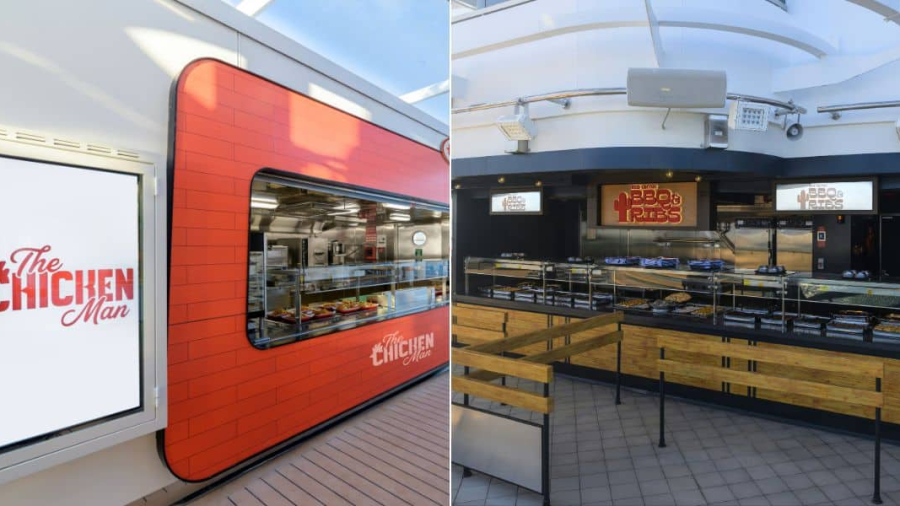
MSC Cruises has expanded the dining line-up aboard MSC Seashore with the launch of two new complimentary grab-and-go venues designed to give passengers more casual meal choices during their holiday.
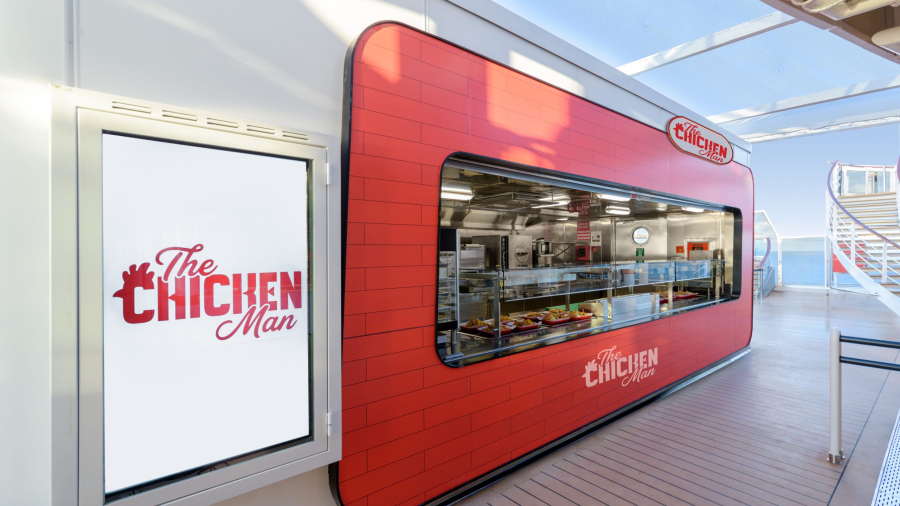
The cruise line has introduced The Chicken Man on Deck 18 and Red Cactus BBQ & Ribs on Deck 8, both offering fast-service comfort food included in guests’ cruise fares at no additional cost.
The additions arrive as MSC Cruises continues to broaden onboard dining experiences across its fleet, particularly on ships sailing from the North American market.
Located on the main pool deck, The Chicken Man offers quick-service chicken tenders, fries and chicken sandwiches from a walk-up counter conveniently positioned for passengers spending time outdoors by the pool.
Guests can customise their meals with a variety of sauces, while nearby shaded seating provides a relaxed space to enjoy lunch or a snack with ocean views.
The second new venue, Red Cactus BBQ & Ribs, has opened near the aft infinity pool on Deck 8 and serves both breakfast and lunch.
Morning menu items include barbecue burritos, pulled pork hash, biscuits and grits, while lunchtime offerings focus on traditional American barbecue favourites such as pulled pork, beef brisket, sausage, barbecue chicken and pork ribs.
Classic side dishes include baked beans, macaroni and cheese, and coleslaw. The venue also features two service lines intended to help reduce queues during busy periods.
Dessert options include banana pudding and cookie pecan butter pie.
Like The Chicken Man, Red Cactus BBQ & Ribs also offers nearby shaded seating for guests wanting a more casual dining atmosphere outdoors.
Hours for both venues may vary depending on itinerary and operating schedules. MSC Cruises has not confirmed exact opening times, with service expected to differ between sea days and port days.
Flexible Dining Rollout Continues On MSC Seashore
The launch of the two new eateries comes shortly after MSC Cruises introduced its “Dine on Your Time” programme aboard MSC Seashore on 19th April 2026.
The flexible dining initiative applies to main restaurant dining schedules rather than quick-service venues, allowing passengers greater freedom when choosing meal times during their cruise.
The 170,400-gross-ton vessel already features an extensive range of specialty dining venues, including Butcher’s Cut steakhouse, Hola! Tacos and Cantina, Kaito Sushi Bar, Kaito Teppanyaki and the seafood-focused Ocean Cay restaurant.
Passengers aboard MSC Seashore can also choose from 18 bars and lounges throughout the ship.
Homeported from Port Canaveral, MSC Seashore operates 3- and 4-night Bahamas sailings alongside 7-night Western Caribbean itineraries.
Depending on the voyage selected, the 4,540-guest ship visits destinations including Nassau, Cozumel, Costa Maya and MSC Cruises’ private destination, Ocean Cay MSC Marine Reserve.
NEW DEALS JUST RELEASED!
Don’t miss the latest MSC Cruises offers…
Related Posts
If you found this interesting, please share!
P&O Cruises has introduced new warning covers on some of its sun loungers as the long-running battle over reserving poolside beds continues to frustrate holidaymakers. The cruise line has not…
A passenger has sadly died aboard Ambassador Cruise Line’s Ambition during a gastrointestinal illness outbreak that affected dozens of people during the ship’s current sailing to Bordeaux. While early media…
Two passengers aboard Carnival Cruise Line’s Carnival Spirit are facing federal assault charges after a dispute over a priority Guest Services queue allegedly turned physical during a Bahamas cruise earlier…
An elderly passenger sailing aboard Carnival Celebration has died following a tragic accident involving a mobility scooter at Celebration Key in The Bahamas. The incident happened at around midday on…
The fastest way to start an argument in a cruise Facebook group is to mention gratuities. Someone will always say they remove them if the service is bad, and plenty of people will agree.
I’ve never done that. Not once.
That probably sounds stubborn, or even a bit soft on cruise lines. But it’s not about defending the companies at all. It’s about who actually gets hurt when those charges come off your bill.
Most people don’t realise where that money really goes, or how many people rely on it who never step foot into a dining room or a cabin corridor.
Once you understand that side of cruising, the whole “just remove the gratuities” solution starts to look very different.
What Cruise Gratuities Actually Are
On most cruise lines, gratuities are a daily charge added to your onboard account. They’re sometimes called service charges, which already tells you a lot about how they’re meant to function.
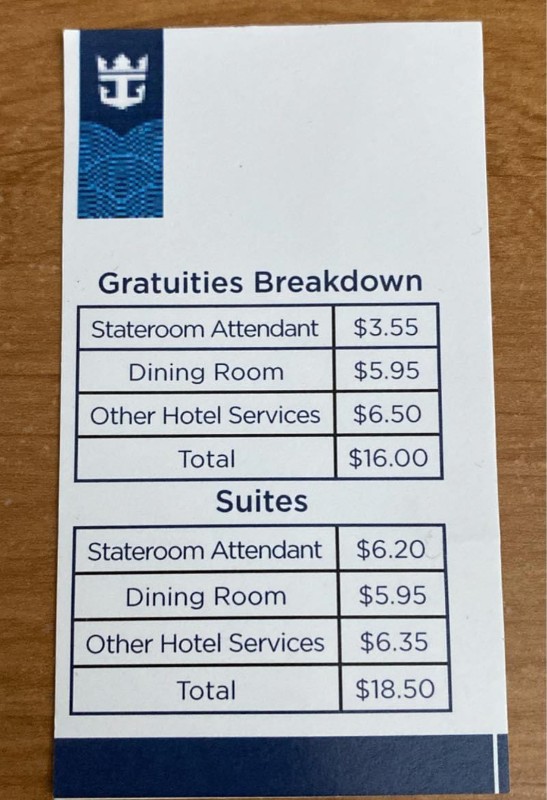
An leaflet breaking down gratuities. (Prices increased slightly since)
They aren’t just a tip for your waiter or your cabin steward. On most mainstream lines, they’re pooled and shared across a much wider group of crew.
That includes ‘other hotel services’, which may be people you never see – laundry workers, cleaners, galley workers, assistant waiters, bar back staff, and those working long shifts below deck to keep the ship running smoothly.
The exact amount varies by cruise line, but it’s usually a fixed daily figure per person. Some lines let you remove or adjust it. Others build it into the fare from the start, so you don’t see it as a separate charge at all.
The key point is this: in practice, gratuities are part of how crew are paid. They’re not a little bonus on top in the way many people imagine. For many roles, that daily charge forms a significant portion of expected earnings.
That doesn’t make the system perfect. It does mean it exists for a reason – and it supports far more people than just the person who brings your drinks at dinner.
Why People Remove Gratuities
I can understand why people do it.
Cruises aren’t cheap, and nobody likes paying extra when something has gone wrong. When you’ve saved for months – sometimes years – for a holiday, expectations are high.
Very occasionally, service does fall short. You might wait ages for drinks. Your cabin might not be cleaned to the usual standard. Mistakes might keep happening in the dining room.
But it’s important to say this clearly: that’s the exception, not the rule.
On the vast majority of cruises, the service is outstanding. Crew members are known for remembering names, dietary preferences, favourite drinks, and small personal details that make people feel genuinely cared for. That reputation doesn’t exist by accident.
When problems do happen, they tend to stand out precisely because they’re unusual.
And when they do happen, it’s normal to feel frustrated. It’s also normal to want some kind of financial acknowledgement that the experience wasn’t what you paid for.
There’s also the argument that tips should be earned. If the service is bad, why should you still pay?
Add in the fact that gratuities are often presented as “optional,” and it can feel like removing them is simply using the system as intended.
None of that makes someone unreasonable. It just means they’re reacting to a disappointing experience in the most obvious way the ship presents to them.
Who Actually Loses Out When You Remove Them
This is the part many people don’t fully realise until they look into it more closely. Removing gratuities almost never affects only the person who gave poor service.
On many ships, gratuities are shared across departments. That means your decision impacts people who may have done an excellent job all week – and who may never have interacted with you directly.
The person washing your sheets
The crew member scrubbing public toilets at 2am
The galley team prepping hundreds of meals while you sleep
The assistant server quietly topping up water glasses all evening
They’re part of that pool.
Those crew members have no control over whether your waiter was slow, whether a section was short-staffed that day, or whether a system broke down at peak time. They still rely on that money.
For many crew, gratuities aren’t pocket money. They’re a meaningful part of take-home pay. Removing them can mean a real loss, not just a symbolic one.
So while it might feel like you’re sending a message about poor service, the reality is that the message lands on a lot of people who did nothing wrong.
Why Bad Service Is Rarely Just One Person’s Fault
Cruise ships are intense places to work.
Contracts are long. Days are longer. Time off is limited. Crew members may work seven days a week for months at a time.
Staffing levels can change mid-season. People get moved between roles. New hires are constantly being trained. Ships sail full. Turnaround days are tight. Technology fails. Supply deliveries run late.
All of that affects service.
Sometimes what looks like indifference is actually exhaustion. Sometimes it’s inexperience. Sometimes it’s a temporary staffing gap. Sometimes it’s simply that the system is under pressure that day.
That doesn’t mean you should accept poor service without complaint. It does mean that punishing the entire gratuities pool is a very blunt tool for a very specific problem.
Most of the time, the issue is bigger than one crew member – and smaller than the whole team deserves to suffer for.
What I Do Instead When Service Is Bad
If something isn’t right, I deal with it while I’m still on board.
That gives the ship a chance to fix it. And more often than not, they do.
If your bathroom isn’t clean – tell your cabin steward, they will clean it again. If you food is cold – tell your waiter – they will bring you some more.
If that doesn’t work, a quiet word with a supervisor or a visit to guest services often sorts things out faster than people expect. Cruise lines care deeply about onboard satisfaction scores, and they’re usually keen to put problems right before they escalate.
I also make a point of recognising good service at the same time. Two things can be true. One department might be under pressure, while another is delivering something exceptional.
If something is serious or keeps happening, escalate it properly. That creates a record. It gives management something concrete to respond to.
None of that requires taking money away from people who may have had nothing to do with the problem.
“But Shouldn’t Tips Be Earned?”
This is probably the most common – and most understandable – argument.
On land, in many countries, tips are a direct response to the service you personally receive. You reward or withhold based on that individual interaction.
Cruising doesn’t really operate like that anymore, even if the language still suggests it does.
The system functions much more like a service charge than a traditional discretionary tip. In reality, most of us are paying part of the crew’s wages through that daily amount, whether we like the wording or not.
That’s not me defending the structure. It’s simply acknowledging how it works.
Opting out doesn’t reform the pay model. It doesn’t push cruise lines to redesign compensation structures. It just shifts the financial impact onto crew members who are least able to absorb it.
If gratuities were rolled into the fare and the word “tip” disappeared, very little would change in practice. The money would still need to come from somewhere.
So for me, this is less about “earning” a tip and more about recognising how the industry has structured pay – and who carries the consequences when passengers opt out.
When It’s Fair to Escalate or Complain
Not all problems are minor. And not all of them should be handled with a polite shrug.
If there are hygiene issues, safety concerns, repeated service failures, or anything that genuinely affects your cruise, that absolutely deserves escalation.
Guest services and onboard management are the right channels. They can investigate, log issues, review staffing, and take corrective action in a way your onboard account simply can’t.
Formal complaints – both on board and after the cruise – are also far more powerful than silent financial protests.
Cruise lines respond to documented trends far more than they respond to one passenger quietly removing gratuities at the end of a sailing.
Holding companies accountable matters. But taking pooled income away from crew members who may not even know there’s a problem is a very indirect way of trying to do that.
Removing Gratuities and Tipping Cash Instead Isn’t a Solution
Some people argue that they don’t really avoid tipping. They just remove the automatic gratuities and hand cash directly to the crew members who looked after them.
And honestly, if you want to give extra cash tips to people who gave exceptional service, I think that’s a lovely thing to do.
But replacing the pooled gratuities with cash tips isn’t quite as fair as it sounds.
The problem is that cash almost always goes to the visible crew members. Your waiter. Your bartender. Your cabin steward.
It usually doesn’t go to:
The laundry crew washing thousands of sheets
The galley staff preparing food behind the scenes
The cleaners working overnight in public areas
The assistant staff quietly helping service run smoothly
The crew members you never actually meet
When you remove the automatic gratuities, you’re not removing money from “the cruise line.” You’re changing who receives it.
The people who are already most visible and most likely to receive extra cash often end up doing fine. The quieter behind-the-scenes crew can lose out.
That’s why I see cash tipping as something extra, not something that should replace the shared gratuity system.
If someone gives amazing service, I’ll absolutely hand over extra cash. But I’ll still leave the daily gratuities in place because I know they support a much wider team.
And honestly, one of the best things you can do for exceptional crew members isn’t financial at all.
Fill in the comment cards. Mention names in post-cruise surveys. Tell guest services when somebody went above and beyond.
Cruise lines take that feedback incredibly seriously. Positive mentions can help crew members get bonuses, better contracts, promotions, and preferred assignments in future.
That kind of recognition can have a much longer-lasting impact than a few extra dollars slipped into a handshake at the end of the cruise.
The Bigger Picture
Every cruise relies on thousands of people doing unglamorous, exhausting work behind the scenes. Most of them will never be thanked directly by passengers.
Gratuities, for all their flaws, are one of the ways that work is recognised and paid for. Removing them changes real pay packets, not just abstract numbers on a screen.
I’d much rather challenge poor service through complaints, feedback, and pressure on the cruise line than through a system that mostly hits the wrong people.
That doesn’t mean accepting bad experiences. It means being precise about where responsibility actually sits.
For me, keeping gratuities in place isn’t about blind loyalty to cruise lines. It’s about fairness.
It’s about aiming consequences at systems – not at the lowest-paid people working within them.
And that’s why, no matter how bad the service is, I wouldn’t remove them.
MSC Cruises has unveiled an expanded lineup of dining options aboard MSC Seashore, further blending European flair with American comfort for an enhanced vacation experience at sea. Following a recent dry dock, the ship has resumed Caribbean sailings from Port Canaveral, with two new complimentary grab-and-go dining concepts now available in some of the vessel’s busiest guest areas, serving convenient classic comfort-food favorites.
The Chicken Man is a new addition to MSC Seashore’s main pool deck, offering walk-up service and a themed, shaded seating area on deck 18. The restaurant serves chicken tenders and a variety of chicken sandwiches, along with a selection of delicious dips.
Red Cactus BBQ & Ribs is a walk-up option near MSC Seashore’s aft infinity pool on deck 8 with a shaded seated area of its own, serving breakfast and lunch. For breakfast, options include a barbecue burrito, pulled pork hash, eggs, country grits, and biscuits. At lunch, guests can choose from dishes such as pulled pork, barbecue chicken, beef brisket, pork ribs, and sausage, along with classic barbecue sides like burnt-end mac and cheese, baked beans, and buttermilk coleslaw. Banana pudding and a cookie pecan butter pie are available for dessert.
Bernhard Stacher, Senior Vice President Shipboard Hospitality Operations at MSC Cruises, said:
“We are proud to offer our guests a variety of dining options, from elegant main restaurants to international dining concepts and convenient buffet experiences, with MSC Cruises catering to every taste and temptation through unique and authentic gastronomic experiences. The introduction of these new grab-and-go options aboard MSC Seashore further reflects our commitment to continuously enhancing the guest experience. Our guests consistently tell us they value having a wide choice of dining available, so we are focused on delivering greater convenience and flexibility, making it easier than ever to experience carefully designed and meticulously crafted local favorites while making the most of the ship’s pools and the Caribbean’s endless sun.”
Guests sailing aboard MSC Seashore can also enjoy five specialty restaurants, including the brand’s signature steakhouse, Butcher’s Cut. Additional options include Hola! Tacos and Cantina, Kaito Sushi Bar, Kaito Teppanyaki, and the seafood-forward Ocean Cay Restaurant. Plus, 18 bars and lounges serve drinks from morning to night, ranging from classic sports-bar atmospheres to elevated cocktail spots.
This summer, MSC Seashore is sailing 3-, 4-, and 7-night cruises from Port Canaveral. 3- and 4-night cruises to The Bahamas: Calling at Nassau and Ocean Cay MSC Marine Reserve, the cruise line’s private island, with select 4-night itineraries including an overnight call at Ocean Cay
7-night Western Caribbean cruises: Calling at Cozumel and Costa Maya (Mexico), and Nassau and Ocean Cay (The Bahamas)
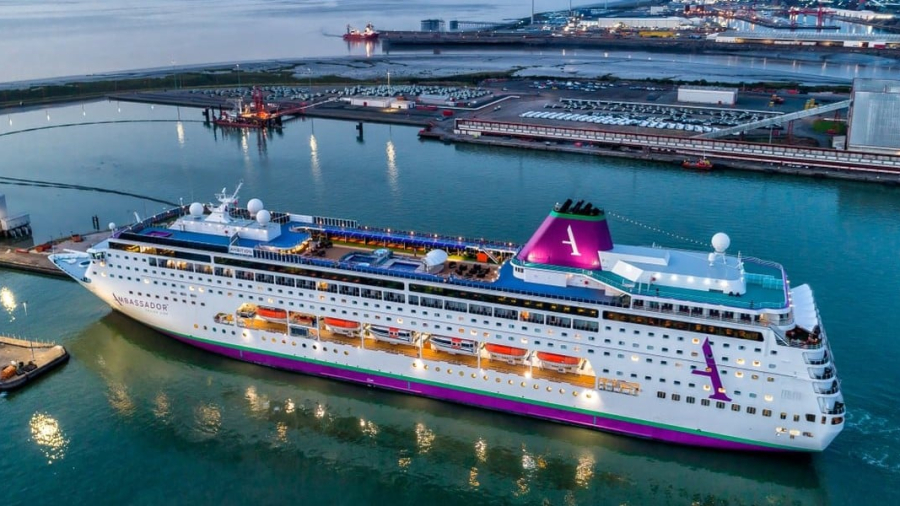
A passenger has died aboard Ambassador Cruise Line’s Ambition after a suspected norovirus outbreak affected dozens of people during the ship’s current sailing to Bordeaux.
French authorities confirmed that a 90-year-old woman passed away onboard after reportedly suffering symptoms linked to norovirus, although officials have not confirmed the exact cause of death. Around 50 passengers and crew have also reported gastrointestinal symptoms including vomiting and diarrhoea.
Ambassador Cruise Line has since introduced enhanced cleaning and health protocols onboard the vessel, with passengers temporarily asked to remain in their cabins while testing and monitoring continues.
While outbreaks of gastrointestinal illness can occur in any shared environment, cruise lines operate extensive sanitation procedures and medical protocols designed to limit the spread of viruses such as norovirus. The illness is highly contagious and commonly spreads in hotels, hospitals, schools and other busy communal spaces, not just cruise ships.
Passengers Monitored While Ship Remains In Bordeaux
French officials said the first signs of illness were reported on 11th May 2026 while Ambition was sailing with around 1,700 passengers onboard, including British guests.
Authorities in Bordeaux are now overseeing testing and precautionary measures as health teams continue monitoring the situation. It remains unclear how long passengers may remain in the French port.
Medical experts say norovirus can spread rapidly even in environments with strong hygiene standards because only a very small amount of the virus is needed to infect others.
“Gastrointestinal viruses like norovirus are very common on cruise ships,” said Dr Lucy Hooper, co-founder of Coyne Medical.
“Norovirus is often called stomach flu, and predominantly starts with nausea, vomiting and diarrhoea, sometimes with a fever as well.”
“You only need a tiny number of particles of the virus itself to pass it on between people,” Hooper added. “It can also go on surfaces, so you don’t need to touch an infected person to catch it.
“You could catch the virus by just touching a door handle or tongs at a food buffet, so that’s why norovirus can become such an issue in an environment like a cruise.”
Cruise Lines Continue Strict Sanitation Standards
Cruise operators continue to maintain strict sanitation procedures across their fleets, including enhanced cleaning, isolation measures and onboard medical support systems designed to respond quickly to outbreaks of illness.
Norovirus outbreaks remain relatively uncommon compared to the millions of passengers who cruise globally each year, although cases often receive significant public attention due to the close-knit nature of cruise holidays.
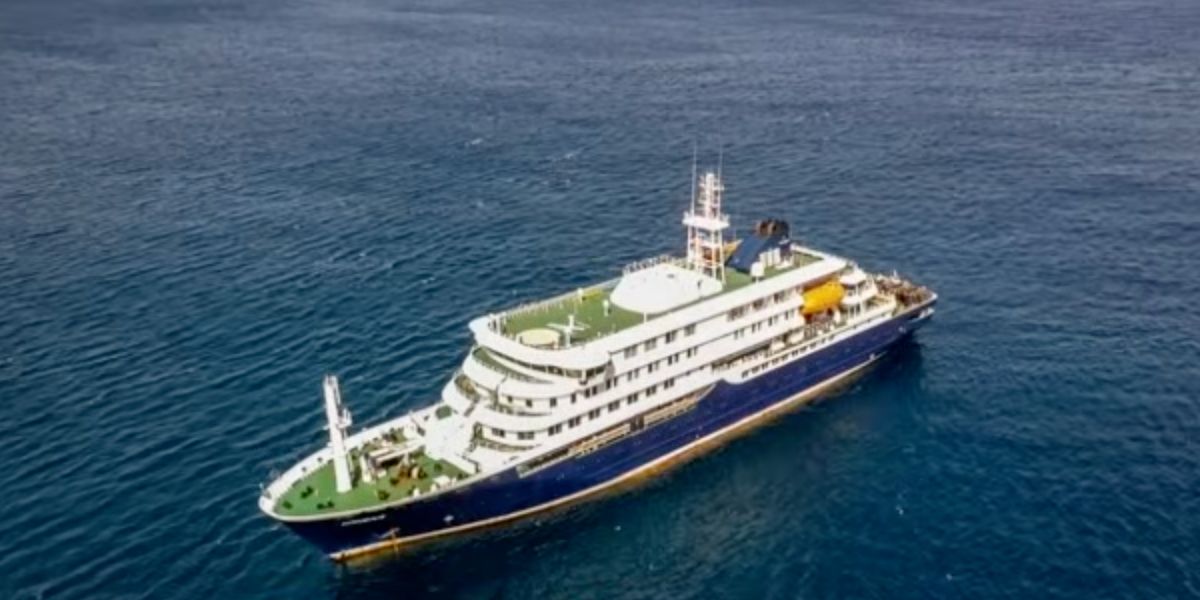
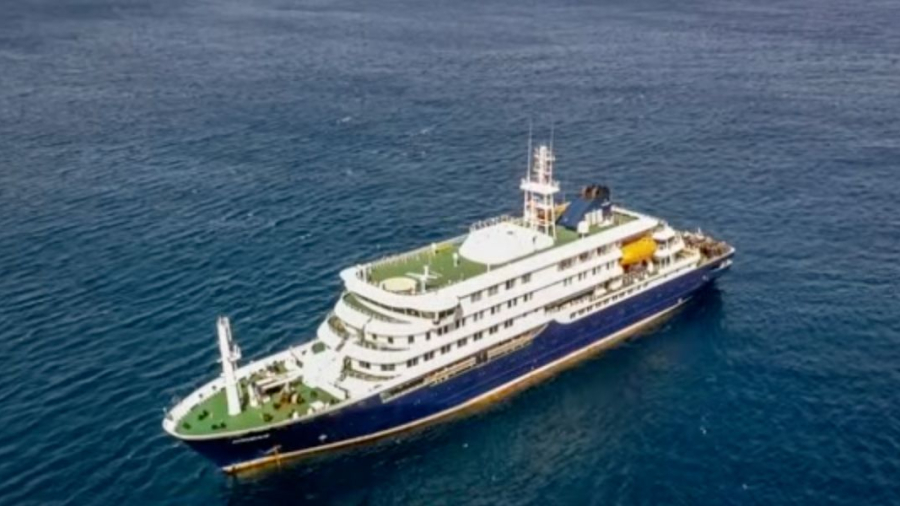
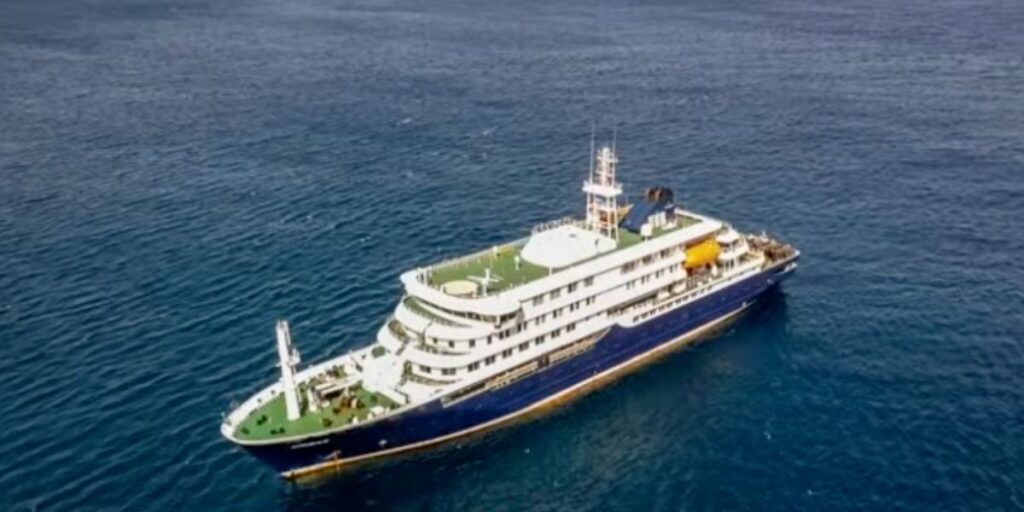
The incident also comes as health officials continue responding to a separate hantavirus outbreak connected to the expedition ship MV Hondius, where 11 cases, including three deaths, have been reported.
The UK Health Security Agency said 10 British nationals connected to that outbreak are being brought to the UK from St Helena and Ascension Island to complete precautionary self-isolation with access to specialist medical services.
Related Posts
If you found this interesting, please share!
Two passengers aboard Carnival Cruise Line’s Carnival Spirit are facing federal assault charges after a dispute over a priority Guest Services queue allegedly turned physical during a Bahamas cruise earlier…
An elderly passenger sailing aboard Carnival Celebration has died following a tragic accident involving a mobility scooter at Celebration Key in The Bahamas. The incident happened at around midday on…
The final passengers have disembarked from the virus-hit expedition cruise ship MV Hondius, while health authorities confirmed three additional positive hantavirus cases linked to the deadly outbreak. The vessel departed…
Carnival Cruise Line has cancelled a wave of bookings for its upcoming new ship Carnival Festivale after an apparent IT glitch over the weekend led to cruises being sold at…
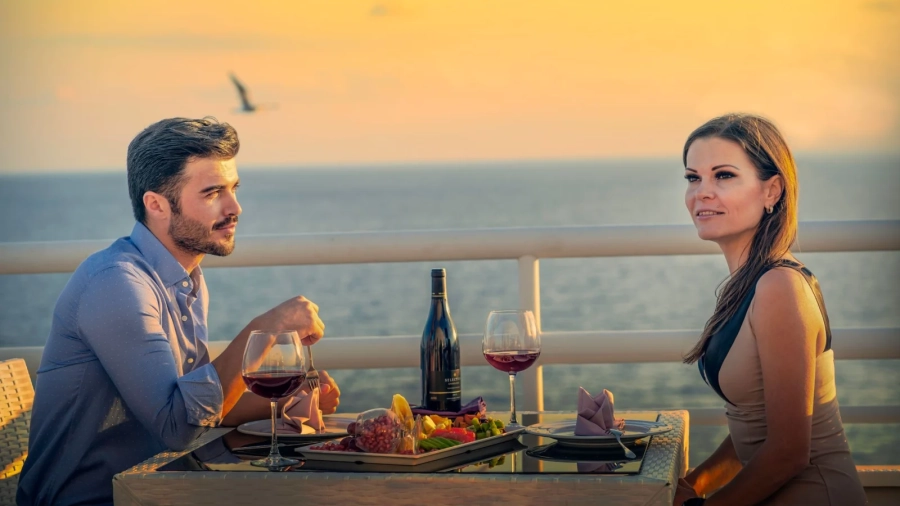
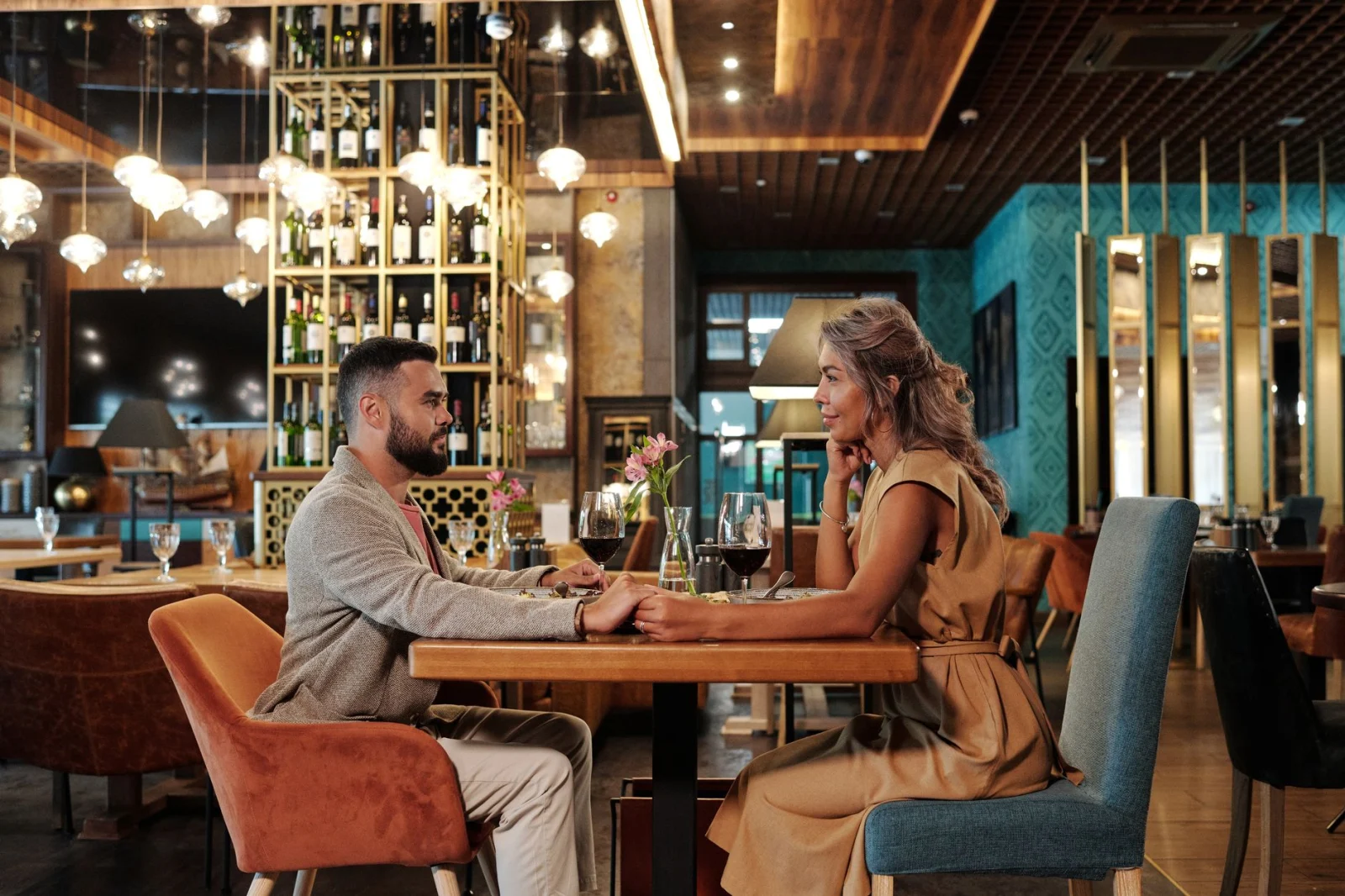
Yes, you can usually get a table for two on a cruise, but it is rarely automatic. The easiest routes are to choose a flexible dining option (Freedom, Anytime, My Time or Freestyle) and ask for two at the door each evening, or to request a table for two at booking and confirm it with the maître d’ on embarkation day. On a few lines, mainly Disney and some fixed-sitting fares, sharing is built in, so it pays to know the rules before you book.
Below we cover why shared tables exist, fixed vs flexible dining, each major line’s policy and a step-by-step plan. Policies change, so always check the current terms for your sailing.
Why cruise ships seat strangers together
Cruise table sharing is not about making you awkward; it is about logistics. A main dining room may need to feed well over a thousand people in two or three sittings, and large round tables for six, eight or ten use floor space far more efficiently than lots of small tables. Fixed sittings also let the galley plan exactly how many covers to cook for at 6pm and 8pm, and they let the same waiters look after the same guests all week.
There is a social tradition too: many long-standing British lines still treat the shared table as part of the experience, so tables for two are genuinely limited on some ships.
Fixed vs flexible dining: the choice that decides who you sit with
Which of these you pick affects table sharing more than anything else.
Fixed (traditional) dining
You are given a set time, typically an early sitting around 6pm and a later one around 8pm to 8.30pm, plus a table number that stays the same for the whole cruise. You keep the same waiters and, on a shared table, the same companions every night. P&O Cruises calls this Club Dining, Celebrity calls it Select Dining Early or Late, and Holland America calls it pre-set dining.
If you choose fixed dining and want privacy, you must request a table for two in advance. Requests are usually “subject to availability”, and late requests are often waitlisted.
Flexible (anytime) dining
You turn up within opening hours, or book a time, and are seated as tables free up. The big advantage for couples is that you can ask for a table for two every single evening. The trade-offs are possible queues at peak times, a different waiter most nights and, on some lines, prepaid gratuities or limited places.
A table for two by the window is the most requested seat in many main dining rooms. Photo: Nadin Sh on Pexels
Cruise line table-sharing policies compared
Here is how the main lines handle main dining room seating at the time of writing. Speciality restaurants will normally seat you as a couple on any line.
Cruise line
Fixed option
Flexible option
Chance of a table for two
P&O Cruises
Club Dining: same table, time and companions nightly
Freedom Dining: turn up when you please
Good with Freedom; request in advance for Club
Cunard
Britannia early or late sitting
Britannia open dining via a virtual queue in the app
Limited in Britannia; Britannia Club and Grills have a dedicated table all voyage
Fred. Olsen
6pm or 8pm sitting on Borealis, Bolette and Balmoral
Varies by fare and ship
Freedom fares can request two, four, six or eight; Saver fares are allocated
Princess
Set the same time and venue each night
Dine My Way bookings or walk-ups
Reasonable; book through the MedallionClass app and ask for two
Celebrity
Select Dining Early or Late
Select Dining Anytime (limited places)
Good with Anytime; Early/Late shares are common
Royal Caribbean
Traditional early, main or late seating
My Time Dining, roughly 6pm to 9.30pm
Good with My Time; prepaid gratuities required
Norwegian (NCL)
None
Freestyle: no fixed times or assigned seats
Good; ask the host each night
MSC Cruises
Assigned seating at a fixed time for the voyage
Dine on Your Time on selected ships; My Choice for Aurea guests
Hardest of the big lines; small tables are scarce
Holland America
Classic pre-set dining, around 5pm or 7.30pm
Flexible open dining, around 5pm to 9pm
Fair; table size is on request only for pre-set
Disney Cruise Line
Rotational dining with a fixed table and time
None in the main restaurants
Request only; small parties may be combined
Virgin Voyages
None
20+ eateries, no main dining room
Very good; no fixed seating at all
P&O Cruises
P&O is the clearest example for British cruisers. Club Dining means you share a table each night at the same time with a group of fellow guests, while Freedom Dining lets you arrive whenever you like during opening hours. You can change your preference in My P&O Cruises after booking, and Freedom Dining is the safer bet for couples. For a wider look at how P&O’s food and dining compare with a close rival, see our P&O Cruises vs Princess Cruises comparison.
Cunard
In the Britannia restaurant you can choose an early or late sitting, reserve a table at selected times, or join an open dining virtual queue in the My Voyage app that alerts you when a table is ready. Tables for two are in high demand. Guests in Britannia Club, Princess Grill and Queens Grill accommodation have their own table for the whole voyage and simply arrive during opening hours, which is the most reliable way to dine privately on a Cunard Queen.
Fred. Olsen
Fred. Olsen makes the fare type matter. On a Freedom fare you can choose your restaurant and dining time, subject to availability, and request a table for two, four, six or eight. On a Saver fare your restaurant, time and table size are assigned automatically, although at the time of writing you can pay a small nightly fee to pick your dining time.
Princess and Celebrity
Princess uses Dine My Way through the MedallionClass app, so you can book the same time and venue every night or vary it, and add a note about seating preferences in your profile. Celebrity offers Select Dining Early or Late with the same tablemates and waiters, or Select Dining Anytime, which has a limited number of places and tends to go to those who book early. Edge-class ships have four complimentary main restaurants that Anytime guests can choose between.
Royal Caribbean and NCL
Royal Caribbean’s My Time Dining lets you reserve a time, roughly between 6pm and 9.30pm, through the app or Cruise Planner, but you must prepay gratuities. Norwegian has no fixed times or pre-assigned seats at all under Freestyle Dining, so asking for two at the door is normal.
MSC Cruises
Most MSC guests have assigned seating at a fixed time for the voyage. Dine on Your Time is offered only on selected ships, and Aurea Experience guests get My Choice Dining at any time during opening hours. Small tables are relatively scarce in many MSC dining rooms, so couples should put in a request early and speak to the maître d’ on day one.
Holland America
Holland America offers classic pre-set dining at set times or flexible open dining across the evening. With pre-set dining you can ask your travel adviser for a seating time, a table size and specific companions before you sail; the maître d’ assigns the final table, and size is on request only. Open dining makes a table for two easier to get.
Disney rotational dining
Disney works differently. Your party keeps the same table number, the same servers and the same early or late time, while the restaurant changes each night. Disney may combine small to medium-sized parties at one table, so a couple can find themselves with another family. You can ask to be seated alone, but it is a request rather than a guarantee.
Virgin Voyages
Virgin has no main dining room and no traditional buffet. Instead there are more than 20 eateries included in the fare, with reservations recommended for the sit-down restaurants at peak times and walk-ins welcome. Because there is no fixed seating, table sharing simply is not part of the system.
A table for two is easiest to get with flexible dining or a request made well before you sail. Photo: Jep Gambardella on Pexels
How to request a table for two on a cruise: step by step
Pick the right dining option when you book. If privacy matters more than routine, choose flexible dining. If you love the same waiter every night, choose fixed dining but add a table-for-two request straight away.
Check your fare type. Cheaper fares on some lines, such as Fred. Olsen’s Saver fare or Cunard’s Late Saver fares, allocate your dining automatically. A higher fare can buy you the right to choose.
Put the request in writing. Add it in your online booking account or ask your travel agent to note it.
Look at your table assignment on embarkation day. It may appear in the app, on your cruise card or on a card in your cabin.
Visit the maître d’ early. Many ships hold a dining desk session on the first afternoon. Go before the first sitting, be polite and ask whether a table for two is available, even if it is at a different time. Our guide to the costly first-day cruise mistakes to avoid covers this and other embarkation-day jobs.
Be flexible on time. Tables for two at 6pm often go first. Asking for the later sitting, or an off-peak slot on flexible dining, can open up options.
Use the other venues. Speciality restaurants, the buffet and casual eateries will almost always seat you as two.
Remember that a shared table is not permanent. If your companions are not a good match, the maître d’ can usually move you quietly after the first night,.
Why sharing a table can be a good thing, especially for solo travellers
Before you rule out sharing completely, it is worth weighing the upside. A shared table gives you instant company and people to swap port tips with.
For solo cruisers in particular, a shared table removes the question of where to sit and who to talk to. Fixed dining on a shared table is one of the simplest ways to meet people. Our complete solo cruise guide has more on finding company on board, from single-cabin fares to social events.
Couples on flexible dining can also ask to join a shared table on nights when they fancy meeting new people.
A quick tip most guides miss: think about the seating plan
Even a table for two is not always private: small tables are often lined up along a wall with narrow gaps, so you may be closer to the next couple than on a round table for six. If you want genuine quiet, ask for a window table, a corner table or a later sitting when the room is less busy.
Solo travellers who would like company at dinner may prefer hosted singles cruises, where shared tables are part of the plan.
Usually, yes, but it is not guaranteed. Choose flexible dining and ask at the door each night, or request a table for two at booking and confirm with the maître d’ on embarkation day.
Do you have to sit with strangers on a cruise?
No. On most lines you only share if you choose fixed dining and do not request a smaller table. Flexible dining, speciality restaurants and the buffet let you dine as a couple. Disney is the main exception, as it may combine small parties.
What is the difference between Club Dining and Freedom Dining on P&O?
Club Dining gives you the same table, time and companions every night. Freedom Dining lets you turn up whenever you like during opening hours, which makes a table for two easier to get.
Can I change my dining table once on board?
In most cases, yes. Speak to the maître d’ or head server, ideally on the first day. They can often move you to a different table or sitting, subject to availability.
Which cruise lines have no assigned seating?
Norwegian Cruise Line’s Freestyle Dining has no fixed times or pre-assigned seats, and Virgin Voyages has no main dining room or fixed seating. Most other lines offer a flexible option alongside fixed sittings.
The final passengers have disembarked from the virus-hit expedition cruise ship MV Hondius, while health authorities confirmed three additional positive hantavirus cases linked to the deadly outbreak.
The vessel departed Tenerife for the Netherlands on Monday after the remaining six passengers, including four Australians, one British passenger and one New Zealander, left the ship alongside several crew members.
The outbreak has now been linked to three passenger deaths during the voyage, with two of those fatalities officially confirmed as hantavirus cases.
According to the World Health Organization, nine confirmed cases connected to the ship have now been identified, with two further suspected infections under investigation.
The latest confirmed infections include an American passenger and a French national who had already returned to their home countries before testing positive. Spanish authorities also said a quarantined passenger in Madrid had provisionally tested positive on Monday.
Health officials continue to stress that the overall risk of a widespread outbreak remains low, despite concerns over the rare Andes strain of hantavirus believed to have been contracted by some passengers during the cruise’s South American itinerary.
Hantaviruses are typically spread by rodents, although the Andes strain is one of the few known variants capable of limited human-to-human transmission.
Symptoms can include fever, severe fatigue, muscle pain, stomach cramps, vomiting, diarrhoea and breathing difficulties.
International Repatriation Effort Continues
Large-scale repatriation operations remain ongoing for passengers and crew from more than 20 countries.
US health officials confirmed that a second American passenger repatriated from Tenerife had developed mild symptoms. Authorities said both infected passengers travelled in specialised “biocontainment units out of an abundance of caution”.
French Health Minister Stéphanie Rist said a French passenger isolating in Paris had seen her condition worsen, while authorities had already traced 22 close contacts.
Two British nationals with confirmed hantavirus infections are currently receiving treatment in the Netherlands and South Africa.
Meanwhile, 20 Filipino crew members have now arrived in the Netherlands, with the Philippine Embassy confirming they would undergo testing and quarantine procedures. Officials said a total of 38 Filipino crew members would eventually require repatriation to the Philippines.
As of Monday evening, cruise operator Oceanwide Expeditions said 27 people remained aboard the vessel, including 25 crew members and two medical staff.
Those still onboard include crew from the Philippines, Ukraine, Russia, Poland and the Netherlands. Ukrainian officials said their nationals would assist with sailing the ship back to the Netherlands before entering quarantine on arrival.
More than 90 passengers have already been repatriated from Tenerife over recent days.
Four Canadian passengers returned to British Columbia on Sunday after travelling via a charter flight to Quebec. Canadian authorities said the passengers would self-isolate and undergo monitoring for at least three weeks.
The US Department of Health and Human Services confirmed all 17 American citizens on a repatriation flight to Nebraska would undergo clinical assessment at a specialist medical facility. A British national residing in the United States was also onboard the flight.
Another seven American passengers had previously returned home and are currently being monitored by health authorities in their respective states.
WHO And US Officials Clash Over Response Measures
The outbreak has also triggered disagreement between international health officials and US authorities over the handling of the situation.
World Health Organization Director-General Tedros Adhanom Ghebreyesus warned that the United States’ decision not to fully follow WHO isolation guidance “may have risks”.
The WHO has recommended a 42-day isolation period for anyone leaving the MV Hondius.
However, acting US Centers for Disease Control director Jay Bhattacharya argued that authorities did not want to create unnecessary public alarm, stating that human-to-human transmission remained extremely rare and should not be compared to Covid-19.
Passengers leaving the ship in Tenerife were seen wearing protective gowns, surgical masks and medical caps during evacuation procedures.
Twenty British nationals repatriated to Manchester on Sunday were transferred to Arrowe Park Hospital in Merseyside for a 72-hour isolation period. No symptoms have been reported among that group.
Spanish authorities also placed 14 Spanish passengers into mandatory quarantine at a military hospital in Madrid, while additional evacuation flights continued this week.
Another repatriation flight carrying 26 passengers and crew, including eight Dutch nationals, landed in the Netherlands on Sunday.
In a video message released by Oceanwide Expeditions, MV Hondius captain Jan Dobrogowski said the crew’s thoughts remained “with the ones that are no longer with us”.
He described the previous weeks as “extremely challenging” while thanking passengers and crew for their patience and discipline throughout the crisis.
Spanish officials also confirmed that a police officer involved in the repatriation operation died from cardiac arrest.
The outbreak began during the ship’s voyage after departing Ushuaia, Argentina, on 1st April with 147 passengers and crew from 23 countries onboard.
The first death involved an elderly Dutch passenger who died at sea on 11th April after developing symptoms consistent with hantavirus. He is believed to have been the outbreak’s initial case, although he died before testing could be completed.
His wife later disembarked on the island of St Helena before travelling to South Africa, where she died in Johannesburg on 26th April.
A German passenger later died onboard the ship on 2nd May. Both women were subsequently confirmed as hantavirus cases.
Related Posts
If you found this interesting, please share!
Two passengers aboard Carnival Cruise Line’s Carnival Spirit are facing federal assault charges after a dispute over a priority Guest Services queue allegedly turned physical during a Bahamas cruise earlier…
An elderly passenger sailing aboard Carnival Celebration has died following a tragic accident involving a mobility scooter at Celebration Key in The Bahamas. The incident happened at around midday on…
Carnival Cruise Line has cancelled a wave of bookings for its upcoming new ship Carnival Festivale after an apparent IT glitch over the weekend led to cruises being sold at…
MSC Cruises has officially entered the Alaska cruise market, with MSC Poesia departing Seattle on Monday 11th May for the line’s first-ever sailing in the region. The newly upgraded ship…
Several famous cruise stops are sold under the name of a city that is actually an hour or more away. Getting from Civitavecchia to Rome takes about 60 to 90 minutes each way, Le Havre to Paris is a two-hour train ride, and Warnemünde to Berlin is closer to three. None of these ports is a trick, but knowing the real distance before you book lets you choose between a ship excursion, a train or a quieter day closer to the pier.
Cruise lines usually show the port in brackets, for example “Rome (Civitavecchia)” or “Paris (Le Havre)”, and the city is the reason most people book. Below is a straightforward guide to which ports are far from the city they are sold as, how long the journey really takes, and how to plan the day so you are back on board with time to spare.
Cruise ports far from the city: the quick comparison
Distances are approximate road distances to the city centre. Travel times are typical each way in normal conditions and do not include getting from the ship to the station or coach park, queues, or traffic at peak times.
Port
Sold as
Approx. distance
Typical time each way
Easiest option
Civitavecchia
Rome
70-80 km (45-50 miles)
1 hr by train, 1-1.5 hrs by road
Regional train to San Pietro or Termini
Le Havre
Paris
About 200 km (125 miles)
About 2-2.5 hrs by train, 3 hrs or more by coach
Ship excursion or early train to Saint-Lazare
Livorno
Florence / Pisa
About 100 km to Florence, 25 km to Pisa
About 1.25-1.75 hrs to Florence, 20-30 mins to Pisa
Train via Livorno Centrale
La Spezia
Florence / Pisa
About 150 km to Florence, 80 km to Pisa
About 1.75-2.5 hrs to Florence by train
Cinque Terre or Portovenere instead
Cádiz
Seville
About 120 km (75 miles)
About 1.5-2 hrs by train or road
Regional train from Cádiz station
Warnemünde
Berlin
About 240 km (150 miles)
About 2.5-3 hrs by train or coach
Ship excursion (often 12+ hrs long)
Tianjin
Beijing
About 180 km (110 miles)
About 1.5-2 hrs via taxi plus bullet train, 2.5-3 hrs by road
Pre-booked transfer or ship tour
Laem Chabang
Bangkok
About 120 km (75 miles)
About 2-2.5 hrs by road, more in traffic
Ship excursion or private car
Southampton
London
About 130 km (80 miles)
From about 1.25 hrs by train to Waterloo
Train or coach transfer
Dover
London
About 125 km (75 miles)
Around 1 hr by high-speed train to St Pancras
Train from Dover Priory
Piraeus (for contrast)
Athens
About 12 km (7.5 miles)
25-30 mins by metro
Metro Line 1 to Monastiraki
Civitavecchia to Rome: the classic example
Civitavecchia is Rome’s cruise port, sitting on the coast roughly 70 to 80 km north-west of the city centre. Most ships dock at piers a fair way from the port gate, so you will normally take the free port shuttle bus to the exit first.
From there, Civitavecchia station is a short walk along the seafront. Regional trains on the FL5 line run to Rome roughly every 30 minutes on many days, stopping at Roma San Pietro (handy for the Vatican), Trastevere, Ostiense and Termini. The fastest trains take a little over 40 minutes, but an hour is a fair planning figure. Fares are low, typically under €10 each way. Check the timetable for the day of your call, because Sunday and holiday services can be thinner.
Other options for Civitavecchia to Rome include the SIT shuttle coach from the port to the Vatican area and Termini (around 75 minutes), private transfers, and the cruise line’s own coach tours. A taxi or private car usually takes 60 to 90 minutes depending on traffic and costs well over €100 for the vehicle. Realistically, you get five or six hours in Rome on a typical port day, so pick one area, such as the Vatican or the Colosseum and Forum, rather than trying to see everything.
Le Havre to Paris: a long day for a short visit
Le Havre is on the Normandy coast and Paris is about 200 km inland. Direct trains from Le Havre to Paris Saint-Lazare take about 2 hours 5 minutes at their fastest, with many taking closer to 2 hours 20 minutes. Add the taxi or shuttle from the cruise terminal to Le Havre station, and you are looking at five hours or more of travel in a day, leaving perhaps four or five hours in Paris.
Ship excursions to Paris go by coach and can take three hours or longer each way, especially if there is traffic around the Paris ring road. If you have visited Paris before, the closer alternatives are well worth considering: the harbour town of Honfleur is around 30 minutes away, Étretat’s chalk cliffs are under an hour, and Rouen, with its cathedral and old town, is about an hour by train. Le Havre’s own rebuilt centre is a UNESCO World Heritage Site.
Livorno and La Spezia for Florence and Pisa
Ships sold as “Florence” or “Pisa” usually call at Livorno or La Spezia, and the difference matters.
Livorno to Florence
Livorno is the closer of the two. Trains from Livorno Centrale to Florence take roughly 70 to 100 minutes, with direct and connecting services through the day. The catch is reaching the station: the cruise line shuttle often drops passengers in the town centre, not at the railway station, so you may need a city bus or a taxi of about 10 minutes. Allow around two hours door to door. Pisa is much easier, at about 20 to 30 minutes by train or road, which makes a Pisa-and-Lucca day a relaxed option.
La Spezia to Florence
From La Spezia, Florence is a bigger stretch. A regional train with a change at Pisa takes around 2.5 hours, and faster direct trains are about 1 hour 45 minutes when they run. The station is a 20 to 30 minute walk from the port. Many passengers find the Cinque Terre villages or Portovenere, both reachable by local train or boat, a better use of a La Spezia day. Our guide to the best shore excursions for Mediterranean cruises has more ideas for these Italian stops.
Trains are often the fastest way from a distant port into the city. Photo: Nico Kusuma Jaya on Pexels
Cádiz, Warnemünde, Tianjin and Laem Chabang
Cádiz for Seville
Cádiz is one of the easier long-distance ports. The ship docks right next to the old town, and the railway station is close to the harbour. Regional trains reach Seville in about 1.5 to 2 hours. Seville in summer is extremely hot, though, and Cádiz itself, with its cathedral, beaches and old quarter, is a pleasant day out on foot.
Warnemünde for Berlin
Warnemünde is a seaside resort on the Baltic coast, roughly 240 km from Berlin. Ship excursions to Berlin typically run around 12 hours in total, with 2.5 to 3 hours each way by train or coach and five or six hours in the city. Going independently by train is possible, but the timings are tight and delays on German rail are not unusual, so most passengers choose the ship’s tour for this one. Rostock and Warnemünde are an easy alternative if you would rather not spend six hours travelling.
Tianjin for Beijing
Tianjin’s cruise terminal is in the port district, about 180 km from Beijing. The bullet train between Tianjin and Beijing is quick, but you first need a taxi to the station, which can be 40 to 70 minutes depending on which one you use. Overall, expect around 1.5 to 2 hours each way in good conditions, or longer by road. Tianjin is normally a turnaround port, so many passengers spend a night or two in Beijing before or after the cruise rather than visiting as a day trip.
Laem Chabang for Bangkok
Laem Chabang is Thailand’s main container and cruise port, about 120 km south-east of Bangkok. The drive is around two hours on a clear road, but Bangkok traffic can easily add an hour on the way back. Ship tours and pre-booked private cars are the usual choices. If your ship stays overnight, that is the best chance to see Bangkok properly. Pattaya is much closer if you only have one short day.
Southampton and Dover for London
UK departure ports are often labelled “London”, which confuses some overseas passengers. Southampton is about 80 miles from central London, and the fastest trains to Waterloo take around 1 hour 15 minutes, though many services take longer. Dover is a similar distance, but Southeastern high-speed trains reach St Pancras in around an hour. For a London stay before or after a cruise, factor in luggage and the transfer to the terminal. If you are driving instead, see our guide to Southampton hotels with cruise parking.
Check how far the dock is from the city before you plan the day. Photo: Katja B on Pexels
How to avoid getting caught out on port day
Read the brackets. On any itinerary, the name in brackets is where the ship actually docks. Look it up on a map before you book.
Check your hours ashore. All-aboard time is usually 30 to 60 minutes before departure. Subtract travel both ways and the time to get off the ship to see what is really left.
Know who waits for whom. Ships generally wait for their own excursions if a coach is delayed. They are not obliged to wait for independent travellers, and missing the ship means paying to catch up at the next port.
Build in a buffer. Aim to be back at the port at least an hour before all-aboard, and more in cities with heavy traffic such as Bangkok, Rome and Paris.
Check strikes and timetables. Rail strikes happen in Italy and France, and weekend timetables differ. Look at official rail sites a few days before.
Carry the essentials. Take the ship’s agent phone number, your cruise card and photo ID, and some local currency for buses or taxis.
What to do instead of the long trip
A long transfer is not always the best value. If you have already seen the big city, or the time ashore is short, the port town itself or a nearby attraction can make for a more relaxed day. Good examples include Honfleur from Le Havre, Lucca or Pisa from Livorno, the Cinque Terre from La Spezia, Tarquinia’s Etruscan tombs from Civitavecchia, and the old town of Cádiz. Ports such as Piraeus, Barcelona, Lisbon and Kotor are the opposite case: the city is on the doorstep, so you can explore freely without long transport.
Is an overnight call worth it?
The best way to see a distant city is a cruise with an overnight stop or a turnaround there. Some itineraries stay overnight at Laem Chabang, Tianjin or Le Havre, and a few river-style or smaller-ship voyages sail up to Rouen or into central Bangkok. Another option is to begin or end your trip with a hotel stay in Rome, Paris or London. When comparing itineraries, check the hours in port as well as the price. Our roundup of cruise deals for 2027 is a good place to start.
Alaska has a few outlying docks too, such as Ketchikan Ward Cove, which our Alaska cruise ports guide covers port by port.
Before you plan a trip into the city from one of these distant piers, check how long cruise ships stay in port so you know how much time you really have ashore.
FAQs
How far is Rome from Civitavecchia port?
Rome’s city centre is roughly 70 to 80 km from Civitavecchia. By train it takes about an hour, and by road usually 60 to 90 minutes depending on traffic.
How much does a train ticket from Civitavecchia to Rome cost?
Regional trains are inexpensive, usually under €10 each way. Prices can change, so check Trenitalia for the current fare on your travel date.
Can you get a taxi from Civitavecchia to Rome?
Yes. Taxis and pre-booked private cars are available at the port. Expect 60 to 90 minutes each way and a fare well above €100 for the vehicle, so they make most sense for a small group.
How long does it take to get from Le Havre to Paris?
Direct trains to Paris Saint-Lazare take about 2 hours 5 minutes to 2 hours 20 minutes. Coach excursions often take three hours or more each way.
Will the ship wait if I am late back from the city?
Ships usually wait for their own delayed excursions, but not for passengers travelling independently. Leave a generous buffer before all-aboard time.
Two passengers aboard Carnival Cruise Line’s Carnival Spirit are facing federal assault charges after a dispute over a priority Guest Services queue allegedly turned physical during a Bahamas cruise earlier this year.
The incident took place in March 2026 aboard the 85,920-gross-ton ship while it was sailing from Mobile, Alabama, according to reports first published by Fox 10 News. The altercation happened near the end of the voyage as guests queued at the Guest Services desk on Deck 2.
Authorities say Tonya Nelson confronted fellow passenger Lisa Horace after noticing Horace was standing in a line reserved for Diamond and Platinum members of Carnival Cruise Line’s VIFP loyalty programme.
FBI interview summaries reportedly state that Nelson repeatedly attempted to alert Horace to the dedicated queue by tapping her husband on the shoulder. The situation escalated after Horace allegedly threatened to slap Nelson.
Investigators have not confirmed who struck first, but both women allegedly exchanged slaps before the confrontation escalated into kicking and other physical aggression. The pair were previously unknown to one another before the incident.
No serious injuries have been reported.
Because the incident occurred in international waters, the Federal Bureau of Investigation has jurisdiction over the case. Both women have now been charged with simple assault and were ordered to appear in federal court in Mobile on Wednesday, 13th May 2026.
Carnival Cruise Line has not publicly commented on the matter, though investigators confirmed surveillance footage from the ship was reviewed as part of the case.
Priority Guest Services Lines Can Cause Frustration
The incident has once again highlighted how strongly some cruise passengers value loyalty programme perks, particularly when ships become crowded near the end of a sailing.
Dedicated Guest Services queues for Diamond and Platinum VIFP members are considered one of Carnival’s most valued loyalty benefits, allowing repeat guests to avoid lengthy waits at one of the busiest areas onboard.
However, it remains unclear whether Horace was actually in the wrong queue.
Passengers who purchase Carnival Cruise Line’s Faster to the Fun package are also permitted to use the priority Guest Services line regardless of their loyalty status. If Horace had purchased the add-on package, she would have been entitled to access the queue.
Long lines at Guest Services are especially common during the final days of a cruise as passengers review onboard spending, resolve billing concerns, ask questions about disembarkation, or settle issues linked to Sail & Sign accounts.
With Carnival Spirit carrying up to 2,124 guests at double occupancy, even a relatively small number of passengers seeking assistance can quickly create lengthy queues.
Carnival has also reduced or removed dedicated priority lines on some sailings in recent years when unusually high numbers of Diamond and Platinum guests are onboard, meaning the perk is not always guaranteed.
Carnival Continues Efforts To Reduce Onboard Fights
The cruise line has faced a series of highly publicised onboard altercations in recent years, prompting increased efforts to crack down on disruptive behaviour.
Carnival Cruise Line has strengthened security presence on some sailings, issued reminders about its guest code of conduct, and warned passengers that fighting or violent behaviour can lead to removal from a ship, lifetime bans, and possible criminal prosecution.
Several recent incidents across the wider cruise industry have also drawn attention online, including fights during embarkation and disembarkation, pool deck altercations, and disputes in dining venues and public areas.
While arguments over queues and crowded spaces are not uncommon during busy sailings, incidents escalating into criminal charges remain relatively rare.
NEW DEALS JUST RELEASED!
See the latest Carnival cruise offers…
Related Posts
If you found this interesting, please share!
An elderly passenger sailing aboard Carnival Celebration has died following a tragic accident involving a mobility scooter at Celebration Key in The Bahamas. The incident happened at around midday on…
The final passengers have disembarked from the virus-hit expedition cruise ship MV Hondius, while health authorities confirmed three additional positive hantavirus cases linked to the deadly outbreak. The vessel departed…
Carnival Cruise Line has cancelled a wave of bookings for its upcoming new ship Carnival Festivale after an apparent IT glitch over the weekend led to cruises being sold at…
MSC Cruises has officially entered the Alaska cruise market, with MSC Poesia departing Seattle on Monday 11th May for the line’s first-ever sailing in the region. The newly upgraded ship…
Cruise drink package rules are where most of the cost surprises hide. The advertised daily price rarely includes the service charge, every adult in your cabin usually has to buy the same package, drinks above a set menu price are not fully covered, and some lines cap you at 15 alcoholic drinks a day. Know these catches before you book and you can decide whether a package genuinely saves you money or just encourages you to spend more.
Below is a line-by-line summary of the key rules as of November 2026, followed by the nine traps that most often catch cruisers out. If you want full price comparisons for every package, see our cruise drink packages compared guide. This article focuses on the fine print.
Cruise Drink Package Rules at a Glance (November 2026)
These figures come from each cruise line’s own terms and current reporting. Cruise lines change prices and conditions often, sometimes without notice, so check your cruise planner before you pay.
Cruise line (main alcohol package)
Per-drink price cap
Daily alcohol limit
All adults in cabin must buy?
Service charge
Royal Caribbean (Deluxe Beverage Package)
About $14 per drink (some reports of $15)
No daily limit
Yes, all guests of legal drinking age
18% added to package price
Carnival (CHEERS!)
$20; drinks above that get 25% off
15 alcoholic drinks per 24 hours
Yes, every adult in the stateroom
20% added to package price
Norwegian (Free at Sea Unlimited Open Bar)
Around $15 retail value; $15 off pricier drinks
No set limit
All guests in the stateroom must choose the same offer
Prepaid gratuities required to activate the perk (reported at $28.50 per person per day for late-2025 bookings)
Celebrity (Classic / Premium)
Classic $12, Premium $19
No daily limit
Yes, with Zero Proof swaps for pregnancy and medical reasons
20% added at checkout
MSC (Premium Extra)
Roughly $16 in the US; pay the difference above
15 alcoholic drinks per day (6am to 6am)
Yes, all guests in the cabin, with minors on a minors package
Beverage gratuities included in the quoted price
Princess (Plus / Premier)
Plus $15, Premier $20
Plus: 15 drinks per day; Premier: unlimited under current terms
Packages apply to guests 1 and 2 on the booking
Crew gratuities included in the package price
Two things stand out. First, the advertised price is often not the final price. Second, the “unlimited” label means different things on different ships.
Money Traps Hidden in the Price
1. The service charge is added on top
On Royal Caribbean, Carnival and Celebrity, the per-day price you see first is before the service charge. Carnival currently lists CHEERS! at $69.95 per person per day when bought before the cruise, plus a 20% service charge, so the real daily cost is about $83.94. On a seven-night cruise for two adults, that is roughly $1,175 rather than the $979 the headline price suggests. Royal Caribbean adds 18% and Celebrity adds 20%. Always multiply the advertised figure by 1.18 or 1.20 before comparing it with what you would normally spend.
2. Drinks above the price cap are not fully covered
Packages cover drinks up to a set menu price. Royal Caribbean’s Deluxe package has long covered drinks up to about $14; Celebrity’s Classic package stops at $12 and its Premium package at $19. Order a top-shelf spirit, a cocktail in a souvenir glass or a premium glass of wine and you may pay the difference or the full price. Bottles of wine, minibar items and room service drinks are excluded on most lines too.
3. Waiting until you board usually costs more
Pre-cruise prices are normally the cheapest. Carnival charges $74.95 a day onboard versus $69.95 in advance. Princess adds $5 per person per day if you buy within four days of sailing or on the ship, and MSC says online prices can be up to 15% lower than onboard. Royal Caribbean’s prices are dynamic and its cruise planner sales regularly beat the onboard rate, but they fluctuate, so it pays to watch the price for a few weeks rather than buying on the first day you look.
Most lines require every adult in the cabin to buy the same package. Photo: MART PRODUCTION on Pexels
Cabin and Sharing Rules That Catch Couples Out
4. Everyone in the cabin has to buy it
This is the rule that surprises most couples. If one adult in a stateroom buys an alcoholic package, Royal Caribbean, Carnival, Celebrity and MSC all require every other adult of legal drinking age in that cabin to buy the same package. A light drinker sharing with a heavy drinker therefore pays the full rate too.
Exceptions are narrow. Royal Caribbean stopped letting guests swap to a non-alcoholic package from August 2025, and in September 2026 reports emerged of a new medical accommodation form for guests who cannot drink for medical reasons or pregnancy, reviewed case by case. Celebrity offers a Zero Proof package for pregnant guests, people in recovery and guests with qualifying medical conditions. If you think you qualify, ask well before sailing rather than at the bar.
5. One drink at a time, and no sharing
Packages are linked to your cruise card, and bar staff are trained to spot sharing. Carnival allows one drink per order with a 10-minute wait between orders, and a double shot counts as two drinks. Royal Caribbean and Celebrity also limit you to one drink at a time. Passing your package drinks to a friend without a package can lead to the package being cancelled without a refund, so it is not worth the risk.
Limits, Port Days and Timing
6. “Unlimited” sometimes means 15 a day
Carnival caps CHEERS! at 15 alcoholic drinks in a 24-hour period, and bartenders can stop serving sooner if they think a guest has had enough. MSC uses the same 15-drink daily limit on its main packages, and Princess applies 15 drinks a day to its Plus package. Royal Caribbean, Celebrity and Norwegian have no set number, but every line reserves the right to refuse service. Non-alcoholic drinks generally do not count towards the limit.
7. You pay for port days too
Most lines require the package for every night of the cruise, not just sea days. On a port-heavy itinerary you may spend six or seven hours ashore each day, and drinks bought in port are not covered. Carnival’s package also does not work at its own destinations such as Celebration Key, Half Moon Cay or Princess Cays, while Norwegian stopped honouring onboard packages at Great Stirrup Cay from March 2026 and sells a separate island package instead. Royal Caribbean packages do work at Perfect Day at CocoCay and Labadee. Count your realistic drinking days, not the number of nights.
8. Cancellation deadlines are short
Changing your mind is easy before sailing and very hard afterwards. Carnival refunds a pre-bought CHEERS! package until 10pm Eastern the evening before departure; after that it is non-refundable. Celebrity gives a full refund if you cancel through its cruise planner up to two days before sailing. MSC states that once a package is activated onboard it cannot be cancelled or refunded. If you are unsure, buy early to lock in a sale price, then make a calendar reminder to review it before the deadline.
9. The Pressure to Drink Your Money’s Worth
The quieter trap is behavioural. Once you have paid $80 to $100 a day, it is tempting to order a cocktail you do not really want just to “get value”. That can mean feeling rough on an excursion day, or simply spending more than you would have without the package. A package is good value only if you would have drunk that much anyway. If you mostly drink coffee, soft drinks and the odd glass of wine, a non-alcoholic package or paying as you go is often cheaper. Our guide to avoiding extra spending once on board has more ideas for keeping the bar bill under control.
Sea days are when a drink package works hardest. Photo: Nathan Van Mullem on Pexels
Is a Drink Package Worth It? Do the Break-Even Maths
The simplest way to avoid every trap above is to work out your break-even number before you buy. Here is the method:
Find the true daily cost. Take the per-day price and add the service charge (for example, $69.95 plus 20% on Carnival is about $83.94).
Price your usual drinks. Cocktails on mainstream lines typically sell for around $12 to $15 before the service charge, beer for a little less, and specialty coffee for a few dollars.
Compare like with like. Bar drinks bought individually also carry a service charge on most lines, so compare the package price before service charge against menu prices before service charge.
Count every day. Divide the total cost by the number of nights, including port days and embarkation day, then ask whether you would really drink that much on each of them.
On Carnival, $69.95 divided by a $12 cocktail is roughly six alcoholic drinks a day, every day, before coffee and soft drinks start adding value. On Celebrity’s Classic package, with its $12 cap, the maths is similar. If both adults in your cabin would comfortably hit that number on most days, a package can save money and the convenience of not signing for every drink is a real bonus. If one of you would not, the cabin rule makes it much harder to justify.
Also check whether your fare already includes drinks. Some promotions bundle a package into the fare, and a few lines are all-inclusive. And before you buy, read our round-up of legitimate drink package loopholes that still work, such as wine allowances, which can change the maths.
Not always. Carnival limits CHEERS! to 15 alcoholic drinks per 24 hours, MSC and Princess Plus use a similar 15-drink limit, while Royal Caribbean, Celebrity and Norwegian set no fixed number. All lines can refuse service to anyone who has had too much.
Do both people in a cabin have to buy the drink package?
On most major lines, yes. Royal Caribbean, Carnival, Celebrity and MSC require every adult of legal drinking age in the same stateroom to buy the same alcoholic package, with only limited medical or pregnancy exceptions.
Is the gratuity included in a cruise drink package?
It depends on the line. Royal Caribbean adds 18%, and Carnival and Celebrity add 20% to the package price. MSC and Princess include gratuities in the quoted price, and Norwegian’s Free at Sea perk requires prepaid gratuities.
Is the Royal Caribbean drink package limited per day?
No. Royal Caribbean says there is no daily limit on its Deluxe Beverage Package, but you can only order one drink at a time and drinks above the per-drink price cap are not fully covered.
Can I cancel a cruise drink package once on board?
Usually not. Carnival packages become non-refundable after 10pm Eastern the evening before sailing, and MSC packages cannot be refunded once activated. Cancel through your cruise planner before the deadline if you change your mind.
An elderly passenger sailing aboard Carnival Celebration has died following a tragic accident involving a mobility scooter at Celebration Key in The Bahamas.
The incident happened at around midday on Saturday, 9th May 2026, during the final full day of the ship’s 7-night Eastern Caribbean itinerary. The cruise had departed from PortMiami on 3rd May.
According to local reports, the victim was an 88-year-old American woman who was travelling on a mobility scooter when she reportedly lost control near the edge of the pier and fell into the water along with the vehicle.
It remains unclear whether the guest was returning to the ship or leaving the vessel to spend time ashore when the accident occurred. Celebration Key opened in July 2025 as Carnival Cruise Line’s newest private destination and regularly welcomes multiple ships each day.
Investigators believe the woman may have struck her head during the fall. She was pulled from the water and taken aboard the ship, which served as the nearest medical facility, but despite extensive resuscitation efforts she was pronounced dead.
Carnival Cruise Line confirmed the incident in a statement, saying:
“Carnival confirmed that a female guest using a mobility scooter drove off the pier at Celebration Key and fell into the water while Carnival Celebration was in port on May 9. Carnival teams responded, successfully retrieving her from the water. Despite resuscitation efforts, she did not survive. The deceased was taken by the Royal Bahamian Police Department and the coroner’s office. Our thoughts are with her family.”
Authorities in The Bahamas are continuing to investigate the circumstances surrounding the accident. An autopsy is expected to determine the official cause of death.
At this stage, officials have not confirmed whether a medical episode, a mechanical issue with the scooter, or another factor contributed to the loss of control.
Guests Describe Chaotic Scene
The aftermath of the incident was witnessed by numerous passengers from both Carnival Celebration and Carnival Glory, which was also docked at Celebration Key at the time.
Carnival Celebration can accommodate more than 5,300 guests at double occupancy and up to roughly 6,500 passengers when fully occupied, meaning hundreds of travellers were in the port area during the emergency response.
Guests later shared accounts online describing confusion on the pier and onboard the vessel as announcements were made over the ship’s public address system. Several passengers reported seeing CPR being performed after the woman was brought back onboard.
Some eyewitness accounts suggested another individual, believed to possibly be the woman’s husband, entered the water in an attempt to assist her before rescue teams arrived.
Local police and crime scene investigators later secured the area while divers recovered the mobility scooter from the seabed.
Despite the emergency response and investigation, Carnival Celebration departed as scheduled and returned to Miami on Sunday, 10th May.
Celebration Key Has Already Seen Multiple Fatal Incidents
Although Celebration Key has been open for less than a year, the destination has already experienced several guest fatalities.
In August 2025, two separate guests died in unrelated incidents while visiting the private destination from different Carnival cruise ships. Both cases involved drownings, although reports at the time indicated underlying medical conditions may have played a role.
One incident occurred near the beach area while another took place in the island’s lagoon.
The latest tragedy also comes amid continued discussion within the cruise industry surrounding mobility scooter safety onboard ships and within port areas. Cruise lines, including Carnival, have repeatedly updated guidance and policies relating to scooters in recent years as their use among passengers has continued to increase.
Related Posts
If you found this interesting, please share!
The final passengers have disembarked from the virus-hit expedition cruise ship MV Hondius, while health authorities confirmed three additional positive hantavirus cases linked to the deadly outbreak. The vessel departed…
Carnival Cruise Line has cancelled a wave of bookings for its upcoming new ship Carnival Festivale after an apparent IT glitch over the weekend led to cruises being sold at…
MSC Cruises has officially entered the Alaska cruise market, with MSC Poesia departing Seattle on Monday 11th May for the line’s first-ever sailing in the region. The newly upgraded ship…
Disney Cruise Line was forced to cancel a sailing of its newest and largest ship, Disney Adventure, after thousands of guests had already boarded and spent a night onboard in…