An Instagram reel from a cruise guest apparently shows a flock of birds that have taken over a cruise ship cabin.
The reel, from Instagram user chanellbethley, shows the chaos as several birds are flying around the cabin.
She hasn’t provided additional information in the comments of the reel unfortunately, but others have chipped in with details.
Apparently it happened on Carnival Freedom, as the birds sought shelter from the bad weather.
Whether this is true or not is uncertain, but several commenters have said that it is authentic.
You should never leave your balcony door propped open when leaving your cabin for a number of reasons, and this is apparently one of them!
Cruise lines do tell guests to make sure the balcony doors are closed when leaving the room. Hopefully, if this video is genuine, the guests learn from their error.
Royal Caribbean is increasing gratuity prices from 1st November, adding $0.50 per guest per day to each category.
This means that guests in a regular stateroom will pay $18.50 per person, per day, up from $18.
And anyone staying in a Suite will now pay $21 per person, per day, up from $20.50.
While this may seem like a small increase, it comes just a year after the last increase of $2 across all categories, which followed another $1.50 increase in 2022.
This means that guests are now paying around 25% more than they were two years ago for gratuities.
However, anyone who books their cruise before 1st November 2024 and pre-pays their gratuities before the end of 31st October 2024 will secure them at the current rates, not the increased prices, regardless of the sailing date.
Automatic gratuities – right or wrong?
Automatic gratuities remain a controversial topic. Some guests understand that they help to reward the hard-working crew, including those behind the scenes who might not normally receive tips from guests.
Other guests prefer to give tips manually, where they feel they have received good service. And of course, tipping culture varies around the world too.
Automatic gratuities, including these with Royal Caribbean, are not mandatory. They are added to guests’ accounts, but guests can remove them if they really want to.
It’s not recommended, because unfortunately a lot of crew rely on the tips for their pay. Even if a guest receives bad service, it’s not fair to punish the rest of the crew.
The increased charges don’t impact the gratuity automatically added to drinks purchases (18%) and spa and salon treatments (20%).
The US Coast Guard made a back-to-back rescue from Princess Cruises ship Crown Princess, when two passengers suffered medical emergencies.
The ship was located 50 miles off Cape Kumukahi, Hawaii, when the rescues took place.
The Joint Rescue Coordination Center in Honolulu was alerted to the medical emergencies on 4th October at around 6 p.m.
The ship’s crew reported that two passengers, a 70-year-old man showing symptoms of a heart attack and an 86-year-old man suffering from internal bleeding, needed immediate evacuation.
Responding promptly, a Coast Guard MH-65 Dolphin helicopter crew from Air Station Barbers Point arrived the next morning.
The 70-year-old passenger was airlifted first and taken to Hilo Medical Center. Shortly after, a second helicopter was dispatched to evacuate the 86-year-old man, who was also transported to Hilo. Both men are reported to be in stable condition.
The Crown Princess had departed Kahului, Maui, on 3rd October 2024, as it repositioned for a 114-night world cruise from Sydney, Australia.
The medical emergency required the ship to briefly turn back towards Hawaii before resuming its course to its next destination, Moorea, French Polynesia.
After the rescues, the vessel continued its journey as planned, with future stops in New Zealand and a final arrival in Sydney on 26th October 2024.
Medical emergencies do happen
While two back-to-back rescues from the same ship are rare, the U.S. Coast Guard regularly responds to emergencies at sea, particularly in remote areas where access to advanced medical care is limited.
In a similar incident on 23rd September 2024, an 8-year-old boy on board the Royal Princess required emergency assistance for acute appendicitis while the ship sailed 20 miles off the coast of Eureka, California.
Despite challenging conditions with thick fog, the Coast Guard successfully evacuated the boy, who underwent surgery upon reaching a hospital.
Medical evacuations from cruise ships are a frequent necessity, as was seen earlier this year on 22nd August when a 56-year-old woman was airlifted from Carnival Venezia shortly after departing New York for Bermuda. She was transported to a medical facility in New Jersey for urgent care.
Similarly, on 27th April 2024, a 35-year-old crew member aboard Carnival Sunshine had to be airlifted 160 miles off the Florida coast due to a life-threatening condition.
The best Princess Medallion accessories are the ones that keep the small, waterproof Medallion on you all day without you thinking about it: a wristband or watch adapter for the pool and shore days, a clip or keyring for people who hate things on their wrist, and a pendant or bracelet for dressier evenings. Every guest gets the Medallion free with a basic lanyard, so an accessory is optional, but most cruisers find one worth the few dollars it costs.
This guide explains what the Medallion does, the main types of Princess Medallion accessories and holders, the pros and cons of each, which official Princess options exist, and what to do about delivery, pickup and lost devices on a 2026 or 2027 sailing.
What is the Princess Medallion?
The Medallion (originally branded OceanMedallion) is a quarter-sized wearable disc that replaces the traditional cruise card on Princess ships. It opens your cabin door as you approach, lets you pay for drinks and shopping onboard, speeds up embarkation and disembarkation, and allows crew to bring orders to wherever you are on the ship through the Princess app. Family members can also find each other on the ship in the app.
A few facts that matter when you are choosing a holder:
It is free. Each guest receives a Medallion at no charge for their cruise. Only shipping it to your home and buying optional accessories cost extra.
It comes with a basic lanyard. The Medallion arrives in a small plastic holder with a simple fabric lanyard, so you can use it straight out of the box.
It is waterproof. Princess says the device is waterproof and resistant to heat, sand and salt, so you can wear it in the pool or hot tub.
It stores no personal information. According to Princess, the device only broadcasts an encrypted guest identifier; your details sit in Princess’s own system, not on the disc.
It is roughly the size and shape of an Apple AirTag. That is why many AirTag holders and bands fit it, which hugely widens your choice of accessories.
You do not have to wear it in any particular way. Princess simply asks you to keep it with you at all times, whether that is on a lanyard, in a pocket or in an accessory.
Princess Medallion accessories compared
Here is a quick comparison of the main types of Princess Medallion accessories, from the free lanyard to jewelry-style options.
Accessory type
Best for
Pros
Cons
Free lanyard
First-timers, short cruises
Included, hands-free, easy to see
Swings about, tangles in bags, not elegant at dinner
Clip
Clipping to a belt, pocket, collar or swimwear strap
Cheap, discreet, official version available
Can be knocked off if the clip is weak
Sport band or wristband
Pool days, excursions, kids
Always on you, waterproof, secure
Looks casual; cheap silicone bands can let the disc pop out
Watch adapter
People who already wear a watch or fitness tracker
Nothing extra to remember
Must match your strap width; adds bulk to the watch
Pendant or necklace
Formal nights and dressier outfits
Looks like jewelry, frees up wrists
Plated metal can irritate sensitive skin; not ideal near a pacemaker
Bracelet
Evening wear
Smart and secure
Higher price; sizing matters
Keyring or bag holder
People who always carry a bag
Very cheap, AirTag holders fit
Only works if the bag is with you; easy to leave at a sunbed
Phone holder
People who never put their phone down
One item to carry
Leave the phone in the cabin and you are locked out
Types of Princess Medallion holders explained
The free Princess Medallion lanyard
The basic Princess Medallion lanyard is the default, and plenty of cruisers never replace it. It keeps the device visible and hands-free, and you will not lose it in a pocket. The downsides are practical: it swings when you walk, it is awkward in the pool, and many people feel it clashes with a dinner jacket or a smart dress. It is a good backup to pack even if you buy something else.
Clips
A clip is the cheapest upgrade. Princess sells an official hard plastic clip, priced at $7 when bought before the cruise. Third-party clips, including the small clip-on cases designed for fitness trackers, work in the same way. Clip it to a waistband, shirt placket, bag strap or swimsuit strap. Check the clip is firm: a loose one can drop the Medallion on deck without you noticing.
Sport bands and wristbands
Wristbands are the most popular choice for active cruisers because the Medallion stays on through the pool, the gym and shore excursions. Princess offers sports bands and also wrist straps made from reclaimed ocean plastic, which Princess says use the equivalent of two plastic bottles per strap. Families often find these fit more securely than the cheapest silicone bands, which can let the disc pop out, especially on children’s wrists.
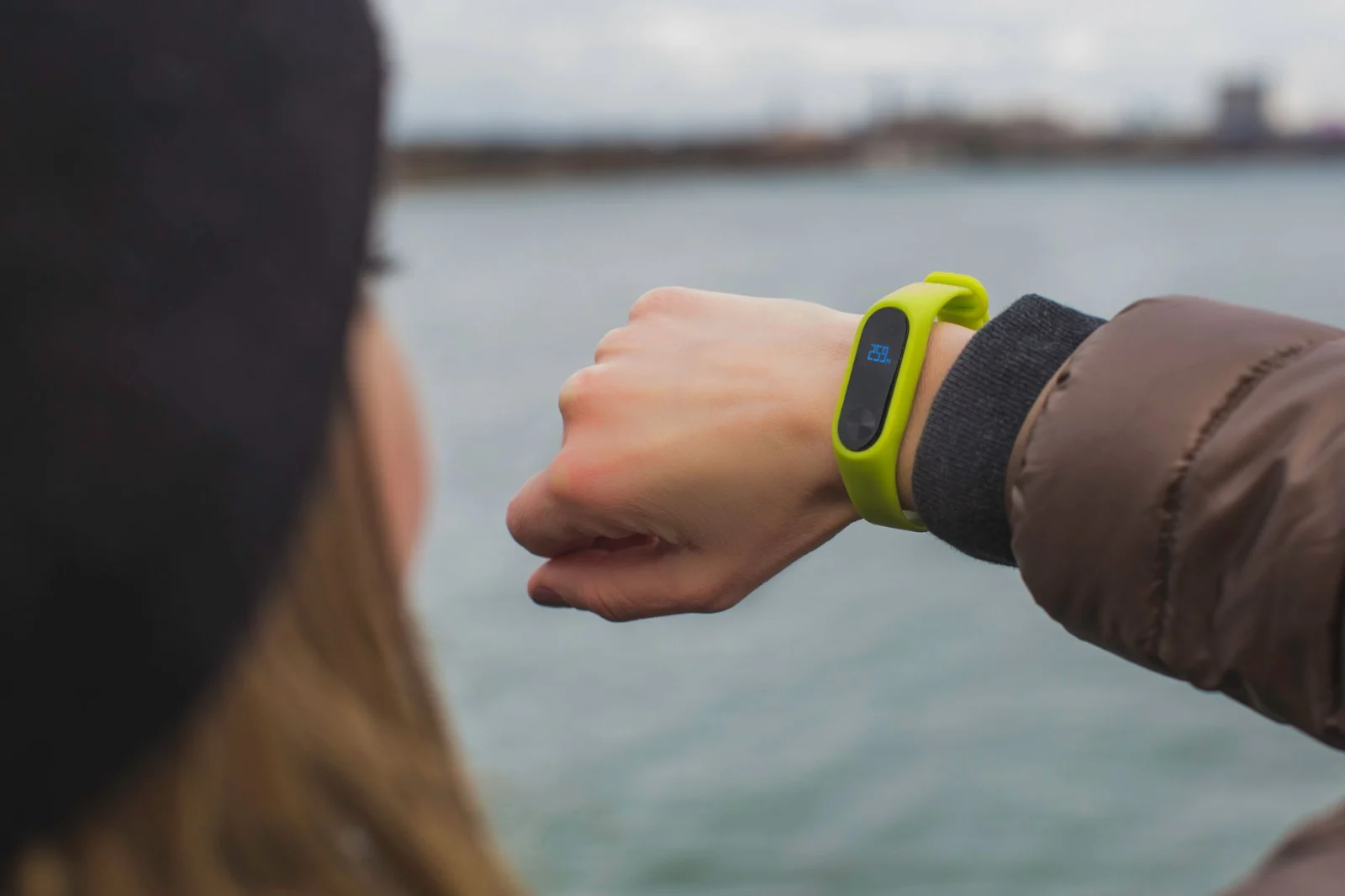
A watch adapter lets the Medallion ride on a strap you already wear. Photo: Burst on Pexels
Watch adapters
If you already wear a watch or fitness tracker, a Princess Medallion holder that slides onto the strap means there is nothing extra to remember. These adapters are made by independent sellers rather than Princess, so measure your strap width before buying and check the listing says it fits the current Medallion. The disc sits under or beside the watch face, which some people find bulky after a long day.
Pendants, necklaces and bracelets
For formal nights, a jewelry-inspired option looks far smarter than a lanyard. Princess sells necklaces and bracelets onboard and pre-cruise, with its premium bracelet listed at $45. Onboard metal pieces are plated rather than solid precious metal, so anyone with a metal allergy may prefer a fabric, leather or silicone option. Independent makers also sell lockets, bangles and beaded bracelets sized for the Medallion.
Keyrings, bag holders and phone holders
AirTag keyrings and carabiner holders are an inexpensive ocean medallion holder option, and they fit most bags and belt loops. Stick-on phone holders keep the Medallion on the back of your phone. Both work well for some people but share one risk: if the bag or phone is left on a sun lounger or in the cabin, so is your Medallion, and you will not be able to open your door or buy a drink until you get it back.
Official Princess Medallion accessories and where to buy them
Princess sells its own range of Princess Medallion accessories, described as sporty and jewelry-inspired. The current line-up on the Princess website includes:
Clip: hard plastic, $7 pre-cruise.
Sports bands: for a casual, active look.
Reclaimed ocean plastic wrist straps: the sustainable option.
Necklace and bracelet: jewelry-style pieces, with the premium bracelet at $45.
You can order through your OceanProfile in the Princess app before you sail, or buy onboard at the OceanFront store. Princess also offers Medallion customization: the face shows your loyalty level as standard, and further personalization costs $5. Accessories ordered in advance can be shipped with your Medallion; the shipping fee applies per order, and you can avoid it by collecting everything at the port. Prices and ranges change, so check the official Princess Medallion accessories page before you buy.
Third-party accessories from online marketplaces cost less and come in far more styles. Princess does not certify them, so read the sizing details and reviews carefully, and avoid anything that covers the disc with thick metal, which could affect how reliably door locks and payment points read it.
How to get your Medallion in 2026
Your Medallion is linked to you when you complete OceanReady, the online check-in in the Princess app or website. You then have two delivery choices:
Home delivery. Available to residential addresses in the US, Canada and Puerto Rico. Princess asks you to confirm shipping at least 13 days before your cruise starts. Princess raised the US shipping fee from $10 to $20 in February 2026, and cruise trade reports say it rose again to around $22 from 20 August 2026 (about $27 for Canada). Some guests who booked Plus or Premier packages before July 2025 kept free shipping. Check the exact amount at checkout in the app.
Port pickup. Free, and the only option for guests living outside those three countries, including UK passengers sailing Princess cruises from Southampton. You collect it at the terminal on embarkation day.
If your Medallion arrives at home, pack it in your hand luggage rather than your checked suitcase, because you need it as soon as you board. A small zip pocket in your cruise carry-on bag is ideal. If you forget it altogether, you can still pick one up at the terminal as long as OceanReady is complete.
Waterproof holders keep the Medallion on you around the pool. Photo: Nuh Isa El Carillo on Pexels
Practical tips for wearing your Medallion
Bring two options. A wristband for daytime and a clip or pendant for evenings covers almost every situation. Keep the free lanyard in your bag as a spare.
Test the fit before you sail. Press the Medallion into a new holder at home and give it a firm tug. Loose silicone is the most common reason Medallions go missing.
Think about children. Secure wristbands work better than lanyards for kids. Families with babies or toddlers who put things in their mouths should keep the small disc out of reach.
Pacemakers and implanted devices. The Medallion contains magnets and a battery. Cruise Critic advises keeping it at least six inches from a pacemaker, and other guides suggest a wristband or clip rather than a lanyard worn on the chest. Ask your doctor and device maker for advice before you travel.
Do not rely on your phone alone. A phone holder is convenient, but phones get left on charge in the cabin. Many cruisers keep the Medallion on their body instead.
Pack accessories with the rest of your small items. Our cruise packing tips include easy ways to keep small essentials organized.
What to do if you lose your Medallion
Report a lost Medallion to the crew straight away, either at Guest Services or through any crew member. Princess disables the missing device so nobody else can use it to charge purchases or open your cabin, and issues a replacement at no cost. Because the Medallion holds no personal information, a lost device does not expose your details. If you are travelling with family, the Princess app’s locator can sometimes help you find a misplaced Medallion before you report it.
Do you need a Princess Medallion accessory?
Strictly, no. The free lanyard works, and Princess is happy for you to carry the Medallion in a pocket or purse. But an accessory makes it easier to keep the device on you, and that is what makes the system work well: doors unlock as you arrive, and drinks and orders find you without fuss. For most people, one inexpensive wristband or clip is enough. Add a pendant or bracelet if you enjoy dressing up for formal nights. Spend more only if you want a keepsake, since Princess describes the customized Medallion as something you can take home.
FAQs
Is the Princess Medallion free?
Yes. Every guest receives a Medallion and a basic lanyard at no charge. You only pay for optional accessories, extra personalization or home shipping, and port pickup is free.
Is the Princess Medallion reusable?
Princess issues a Medallion for each sailing through OceanReady and describes it as a keepsake you can take home. Do not assume an old one will work on your next cruise; follow the Medallion step in OceanReady for each voyage.
Do AirTag accessories fit the Princess Medallion?
Generally yes. The Medallion is close to the size and shape of an Apple AirTag, so many AirTag holders, keyrings and bands fit it. Check the fit at home and make sure it holds the disc firmly.
What happens if I lose my Medallion on a Princess cruise?
Tell the crew or Guest Services right away. Princess disables the lost device and replaces it at no cost, and no personal information is stored on the Medallion itself.
Can I wear the Medallion in the pool?
Yes. Princess says the Medallion is waterproof and resistant to heat, sand and salt, so a wristband or clip on your swimwear is fine for the pool and beach.
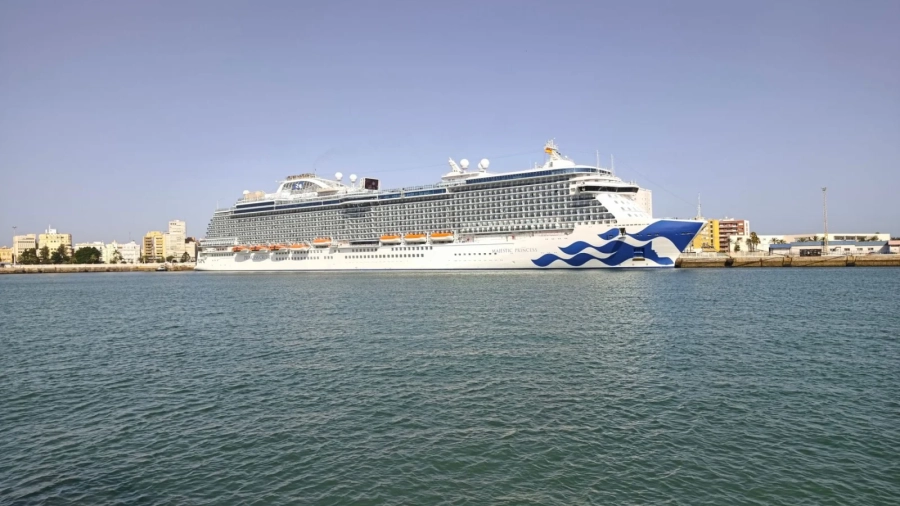
The main Majestic Princess cabins to avoid are Deck 15 cabins below the Lido Deck pools and buffet, starboard midship cabins that sit just below the glass-floored SeaWalk, and the handful of balconies with obstructed views on Decks 8, 15 and 16. Far-forward cabins are also best skipped if you get seasick. For most passengers the best value is a midship balcony or mini-suite on Decks 9 to 12, while the aft-corner Owner’s Suites are the top choice for space.
Majestic Princess is a 143,700-ton Royal-class ship that launched in 2017. She carries 3,560 guests in 1,780 staterooms, and more than 1,400 of them are outside cabins, almost all with a balcony. She is still in the Princess fleet. For winter 2026-27 she moves from Galveston to South America and Antarctica, sailing from Buenos Aires and San Antonio (Chile), and she is named in Princess’s 2027 Northern Europe programme. Whichever itinerary you book, the cabin layout is the same. This guide covers every stateroom type, where the problems are, and how to check a cabin number before you pay.
Majestic Princess cabins at a glance
The ship has no standard oceanview category to speak of. Nearly every outside cabin has a balcony, and cabins run from Deck 8 (Emerald) up to Deck 16 (Lido). There are no cabins on Decks 4 to 7, which hold the public rooms. The sizes below are approximate and include the balcony where there is one. Figures differ slightly between sources, so check the exact cabin on the Princess deck plan.
Cabin type
Number
Approx. size
Where / notes
Best for
Inside
342
166-175 sq ft
Decks 8-16; many connecting insides on Deck 10
Budget, dark-room sleepers
Balcony
715
About 222 sq ft (41 sq ft balcony)
Decks 8-16
Most couples
Deluxe Balcony
313
About 249-333 sq ft
Decks 8-16; adds a small sofa, some aft balconies deeper
Couples wanting more room or a third guest
Mini-Suite
374
About 299-329 sq ft
Decks 10-16; bathtub, separate sitting area
Best mid-price upgrade
Premium Suite
Part of 36 suites
About 554 sq ft
Forward, Decks 9-12
Space without the top price
Penthouse Suite
Part of 36 suites
About 440 sq ft
Midship, Deck 14
Suite perks in a central spot
Owner’s Suite
Part of 36 suites
About 587-682 sq ft
Aft corners, wraparound balcony
The biggest cabins and wake views
The ship also has 38 wheelchair-accessible staterooms and around 200 connecting staterooms. A note on names: Princess has rebranded what used to be called Club Class as the Reserve Collection. On Majestic Princess this covers all the suites and selected, well-placed mini-suites. Guests get a private section of the main dining room with no wait, wine on arrival, canapés on request and other extras. Suite guests also get the Concierge Lounge, breakfast in a private venue and free laundry. Older reviews that mention “Club Class mini-suites” are talking about the same cabins.
Majestic Princess cabins to avoid
Every one of these Majestic Princess cabins to avoid suits someone. What matters is whether the particular downside will bother you.
1. Deck 15 cabins below the Lido Deck
Deck 16 (Lido) holds the main Fountain Pool area, the plunge pool, the grills and the World Fresh Marketplace buffet. Cruise Critic singles out Deck 15 cabins as ones to avoid because they sit under this busy area. The usual complaint is loungers being dragged and stacked early in the morning and late at night, plus foot traffic overhead. If you want Deck 15, check that what’s directly above your cabin is more cabins rather than pool deck or buffet.
2. Starboard midship cabins under the SeaWalk
The SeaWalk is a glass-bottomed walkway that juts out from the starboard side of the top decks. It’s fun to visit but less fun to sleep under. One Cruise Critic member staying in a mini-suite two decks below it reported that passers-by could look straight down onto the balcony. They also said its blue lighting glowed all night and part of the view was blocked, including while cruising the New Zealand fjords. If balcony privacy matters, choose port side or a cabin forward or aft of the SeaWalk.
3. Obstructed-view balconies
A few standard balconies on Deck 8, and a handful of Deluxe Balconies on Decks 8, 15 and 16, have views partly blocked by lifeboats, solid steel railings or structure. Princess sells these in their own obstructed categories, so the price is usually lower. If you’ll mostly use the balcony for fresh air rather than scenery, they can be good value. For Antarctic or fjord itineraries, where the view is the whole point, avoid them.
4. Forward cabins if you’re prone to seasickness
The bow pitches the most in a swell. That matters more than usual on South America and Antarctica voyages, which cross open water around Cape Horn and the Drake Passage area. Seasick-prone travellers should book low and midship.
5. Cabins where extra berths block the balcony
In some balcony and deluxe balcony cabins, using the pull-down upper berth or sofa bed for a third or fourth guest blocks the balcony door. Cruise Deck Plans flags this on its category notes. A family of four squeezed into one balcony cabin may find two connecting cabins work far better.
6. Interconnecting cabins (if you aren’t using the connection)
With around 200 connecting staterooms on board, there’s a fair chance of booking one by accident. The connecting door lets more sound through than a solid wall. If you’re not travelling with the people next door, choose a cabin without the connecting-door symbol on the deck plan.
7. Cabins near service areas, lifts and the Deck 16 cabins by the pool
Cabins next to crew doors, laundry rooms or lift lobbies get more door noise. A small number of cabins sit on the Lido Deck itself, and those closest to the pool and buffet zones will hear more of the daytime activity.
A midship balcony on a middle deck avoids most of the common noise and motion problems. Photo: Ankit Gupta on Pexels
Majestic Princess best cabins
Midship balconies on Decks 9 to 12
These decks have cabins above and below, are close to the lifts and move the least. A standard or deluxe balcony here is the safest all-round choice and is usually the sweet spot for price.
Midship mini-suites with angled balconies
Mini-suites are the upgrade most often recommended on Royal-class ships, thanks to the bathtub, sitting area and extra room. The midship mini-suites with angled balconies have more outdoor space than standard ones. If yours is in the Reserve Collection, the dining perks add real value too.
Aft cabins and Owner’s Suites
Some aft deluxe balconies have slightly deeper balconies. The Owner’s Suites wrap around the aft corners with large balconies and are the biggest cabins on the ship. On any ship, aft cabins give wake views but can feel more vibration, particularly when manoeuvring in port.
Penthouse and Premium Suites
The Penthouse Suites are midship on Deck 14, close to the Concierge Lounge, which makes them convenient as well as roomy. The Premium Suites are larger but sit forward on Decks 9 to 12, so they suit good sailors best.
Accessible and connecting cabins
The 38 accessible staterooms come in several categories. Book them early, as they go fast. Families often do best with two connecting balcony cabins rather than four people in one room.
Avoid this, book that instead
If you were going to book…
The risk
Consider instead
Deck 15 under the pool or buffet
Early and late noise overhead
Deck 14 or lower, same category
Starboard midship below the SeaWalk
Overlooked balcony, night-time glow
Port side midship
Obstructed balcony (Antarctica or fjord cruise)
Blocked scenery
Standard balcony on Decks 9-12
Forward cabin (seasick traveller)
Most pitching
Low midship balcony
Four people in one balcony cabin
Berths block the balcony door
Two connecting cabins
Where your cabin sits on the ship shapes how much motion and noise you notice. Photo: enes çimen on Pexels
Quick checklist before booking a Majestic Princess cabin
Most Majestic Princess cabins to avoid can be spotted in a few minutes on the deck plan:
Open the official Princess deck plan and check the deck above your cabin for pools, the buffet, galleys or the SeaWalk.
Check the deck below. Deck 8 cabins sit over public rooms on Deck 7.
Look for connecting-door, accessible and obstructed-view symbols on your cabin.
Note whether you’re starboard midship near the SeaWalk.
If you need a third or fourth berth, confirm whether it blocks the balcony.
Think twice about guarantee fares if you’re a light sleeper or get seasick. Princess picks the cabin for you, and it could be any of the spots above.
Majestic Princess is a Royal-class ship, alongside Royal, Regal, Sky, Enchanted and Discovery Princess. She is 143,700 tons, carries 3,560 guests and entered service in 2017.
Which deck is best on Majestic Princess?
For most people, Decks 9 to 12 midship. They have cabins above and below, easy lift access and the least motion. Deck 14 is also good, except for cabins at the starboard midship SeaWalk location and anything beneath busy areas.
Are Deck 15 cabins on Majestic Princess noisy?
Some can be. Cabins directly below the Deck 16 pools and buffet can hear loungers being moved and foot traffic early and late. Deck 15 cabins with more cabins above them are fine. Check the deck plan for your specific number.
Is Majestic Princess still sailing with Princess in 2026-27?
Yes. For winter 2026-27 she sails South America and Antarctica voyages from Buenos Aires and San Antonio (Chile), replacing her planned Galveston season. Princess has also named her for its 2027 Northern Europe season.
While it’s not been confirmed which cruise line or ship was involved, social media images and the ship schedules for the time suggest it was Royal Caribbean’s Harmony of the Seas or Enchantment of the Seas.
No information has been released about the passenger’s well-being or how they fell overboard.
Usually, rescues involving cruise ships either involve the cruise ship crew rescuing stranded people on a boat, or the coast guard rescuing people from a ship if they suffer a medical emergency.
People do occasionally go overboard from ships, but a lot of those cases end tragically with no body found.
Rescues of this nature – with a passenger being the hero – are certainly rare and he deserves all the credit he is getting!
Yes, you can upgrade your cruise cabin after booking. The most reliable route is to call the cruise line or your travel agent and pay the fare difference for a better cabin before final payment. Closer to sailing, most big lines also run bid programs (RoyalUp, Celebrity MoveUp, NCL Upgrade Advantage, MSC UpGrade, Princess Upgrade, Cunard Upgrade) where you offer what you’re willing to pay. Free upgrades do happen, but they’re rare, so don’t count on one.
This guide covers every realistic cruise cabin upgrade route: what each one costs, when it happens, what you give up (usually your choice of cabin number), and how the major lines compare in 2026.
Can You Upgrade a Cruise Cabin After Booking?
Almost always, yes. A cruise booking isn’t locked to one cabin category. Moving up a category is the easiest change to make, because the line gets more money and frees up a cheaper cabin to sell again. Moving down is harder and often isn’t allowed on non-refundable deposit fares.
There are five main ways to upgrade your cruise cabin after booking:
Pay the difference through the cruise line or your travel agent.
Bid through the line’s upgrade auction program.
Book a guarantee cabin and hope the line assigns you something better.
Use loyalty status to get upgrade offers or better odds.
This is the only route where you choose the exact cabin. Call the line or your agent (or use “Manage Booking” online, where some lines allow it), pick the new category and cabin number, and pay the difference between your current fare and today’s price for the new cabin. The cost depends on current pricing, not the price when you booked, so an upgrade can be cheap on a sailing that isn’t selling well and expensive on one that’s nearly full.
Watch for price drops
If the fare for your sailing falls before final payment, many lines and agents will reprice your booking. Some guests take that saving and put it toward a higher category instead, so they end up in a balcony for roughly what they first paid for an ocean view. Policies differ by line and by fare type, and promotions can change when you reprice, so ask your agent to compare the whole package (fare, onboard credit, drinks or Wi-Fi perks) before switching.
Know your fare rules
Non-refundable deposit fares usually let you move up a category but not down, and change fees may apply.
After final payment, changes are still possible, but any cancellation penalties tied to the original booking may carry over.
Promotional perks such as included drinks or onboard credit can change when you switch category. Check before you confirm.
Gratuities are often higher in suites, so factor that in.
A suite upgrade usually brings more space and extra perks, but also higher gratuities. Photo: Abdou HILALI STUDIO on Pexels
Cruise Upgrade Bid Programs: How They Work
Upgrade bidding is now standard on most big-ship lines. The process is broadly the same everywhere:
After you’ve booked (and usually paid in full), the line emails an invitation, or you check eligibility on its upgrade page or app. You normally need to be opted in to marketing emails.
You choose one or more higher categories and enter a per-person offer above the minimum shown.
You give a credit card, but it isn’t charged unless the line accepts your offer.
If your bid wins, you’re moved automatically and charged. Accepted upgrades are almost always non-refundable.
If it loses, you keep your original cabin and pay nothing.
The important catch: you can’t choose your cabin number. The line puts you in whatever cabin is left in the new category. That could be a lower deck, a cabin under a noisy venue, a partly obstructed balcony, or one far from the rest of your group. Connecting cabins and adjoining rooms for families are usually not kept together.
Cruise upgrade bid programs compared (2026)
Cruise line
Program
When bids are decided
Payment
Choose cabin number?
Royal Caribbean
RoyalUp
Can be accepted up to about 2 days before sailing
Card charged only if you win; non-refundable
No
Celebrity Cruises
MoveUp
Eligible within 90 days of departure; accepted up to 2 days before
Charged on acceptance; non-refundable
No
Norwegian Cruise Line
Upgrade Advantage
By invitation; can be accepted up to sailing day
Charged on acceptance (or to onboard account on sailing day)
No
MSC Cruises
MSC UpGrade
Any time up to departure
Charged automatically if accepted; higher service charge billed onboard
No
Princess Cruises
Princess Upgrade
Opens 85 days out (115 days for 25+ night voyages)
You pay after acceptance via Manage Booking or your agent
No
Cunard
Cunard Upgrade
Opens 80 days out; final offers 7 days before
Charged on acceptance; payment due within 72 hours
No
Virgin Voyages
Level Upgrade
Most responses around 48 hours before sailing
Check current terms
No
Carnival
No bid program
Occasional paid upgrade offers; ask your agent or guest services
Fare difference
Yes, if you pay the difference
Terms above are based on each line’s published rules at the time of writing. They change, so read the terms on your invitation before you bid.
Tips for winning a cruise upgrade bid
Bid a little above the minimum. Lines generally take the highest offers first, and minimum bids often lose on busy sailings.
Compare with the fare difference. Look up the current price of the cabin you’re bidding on. If paying the difference costs about the same as a strong bid, pay it and choose your cabin.
Bid on more than one category where allowed. You’ll only be charged for one upgrade.
Think about quieter sailings. Shoulder season and repositioning cruises have more empty upper cabins, so bids are more likely to win.
Check what’s included. On some lines a suite upgrade brings lounge and restaurant access; on others the perks are limited. Celebrity, for example, awards Captain’s Club points on your originally booked category, and RoyalUp suite upgrades don’t earn the double Crown & Anchor points you’d get by booking a suite.
A guarantee (GTY) booking means you pay for a category, or “at least” a category, and the line assigns your cabin number later, often in the final weeks before sailing. Guarantee fares are usually a little cheaper than picking your own cabin.
Because the line can place you anywhere in that category or higher, guarantee cabins are where most genuinely free upgrades happen. When a lower category is overbooked, the line moves some guests up to free space. You can’t ask for this, and many guarantee guests simply get an ordinary cabin in the category they paid for, sometimes in a less desirable spot.
Guarantee cabins suit flexible travelers who don’t mind where they sleep. Skip them if you need a specific location, such as midship for seasickness, an accessible cabin, or cabins close to family.
Guest services is the place to ask about last-minute cabin upgrades once you're onboard. Photo: AS Photography on Pexels
Loyalty Perks and Cabin Upgrades
Loyalty status rarely gives you a guaranteed free upgrade, but it can help in other ways:
Some lines give top-tier members first look at upgrade offers or better pricing.
When lines do hand out complimentary upgrades to fill a ship, frequent guests and those who booked higher fares tend to be considered first.
Higher tiers may include suite-style perks (priority boarding, lounge access, laundry) without changing your cabin.
The most useful tiers sit at the top of each program, such as Royal Caribbean’s Diamond Plus and Pinnacle Club, Celebrity’s Elite and Elite Plus, and Princess Captain’s Circle Platinum and Elite. Compare them in our guide to cruise line loyalty programs compared.
Upgrading Onboard at Guest Services
If cabins are still empty after embarkation, the line would rather sell them than sail with them empty. Head to guest services (or check the app) on embarkation day and ask whether any upgrades are available and at what price. You’ll normally pay a pro-rated amount for the nights left, charged to your onboard account.
Onboard upgrades aren’t advertised on most ships, availability is unpredictable, and the busiest sailings rarely have spare cabins. Ask early on the first day, be polite, and be ready to move your luggage yourself or wait for your cabin steward to help.
What Happens to Your Cabin Number When You Upgrade?
Paying the difference: you pick the new cabin, so you control the location.
Winning a bid: the line assigns the cabin. You lose your original cabin, and you usually can’t switch back once the upgrade is accepted.
Guarantee bookings: the cabin number appears in your booking once assigned. Check your app or documents in the final few weeks.
Onboard upgrades: you’ll be offered whatever is free, sometimes with a choice of two or three cabins.
Your new key card or medallion is reissued for the new cabin, and your dining time, drinks package and other add-ons normally stay with your booking. Check with the line if you’re moving into a suite category with its own restaurant or lounge.
Is a Cruise Cabin Upgrade Worth It?
An upgrade is usually worth it when:
You’re on a scenic itinerary (Alaska, Norway, the Mediterranean) where a balcony gets heavy use.
The cruise is long. An extra $40 per person per night matters less across 14 nights than it does on a weekend sailing.
The suite category includes real extras, such as a private restaurant, lounge, or included drinks.
It may not be worth it on short, port-heavy cruises where you’ll barely be in your cabin. In that case, the money often goes further on excursions, specialty dining, or a future cruise.
FAQs
Can you get upgraded on a cruise for free?
Yes, but it’s uncommon. Free upgrades mostly go to guarantee-cabin guests when a lower category is overbooked, and sometimes to loyal or higher-fare guests. Carnival has said publicly that the chances of a free move from inside to balcony are slim.
How do I upgrade my cabin on Princess Cruises?
You can pay the fare difference through Princess or your travel advisor, or bid through Princess Upgrade. Bidding opens 85 days before sailing (115 days for voyages of 25 nights or more), and your booking must be paid in full.
Do you get charged if your cruise upgrade bid isn’t accepted?
No. On RoyalUp, MoveUp, Upgrade Advantage, MSC UpGrade and similar programs, your card is only charged if the line accepts your offer. If it’s declined, you keep your original cabin at no cost.
Can you choose your cabin number when you bid for an upgrade?
No. Bid programs only upgrade the category, and the line assigns the cabin. If location matters, pay the fare difference and choose the cabin yourself.
When is the best time to upgrade a cruise cabin?
Before final payment is often best, because you can reprice if fares drop and choose your cabin. Bid programs open roughly 2 to 3 months before sailing and are usually decided in the last few days.
Many of the world’s biggest cruise lines are making changes to cruises this week, due to the impact of Hurricane Milton.
The hurricane, hitting Florida on Wednesday 9th October, is causing major problems for cruise ships that are due to dock in the ports of the state, including Tampa, Port Canaveral, Miami, and Fort Lauderdale.
Several cruises have seen their itineraries altered even before the hurricane reached land, including the world’s biggest cruise ship Icon of the Seas, which had to cancel a planned visit to Royal Caribbean’s private island Perfect Day at CocoCay.
Grandeur of the Seas was another Royal Caribbean ship heavily impacted, sailing to the Bahamas instead of two scheduled port visits to Mexico.
Carnival has been carefully monitoring five ships which have been in the path of the hurricane, with Carnival Paradise due to return to Tampa on 10th October, and Carnival Elation set to return to Jacksonville on the same day.
Carnival Sunrise is also scheduled to return to her port of Miami on Thursday. Carnival Dream and Carnival Pride are set to have their itineraries adjusted to avoid the storm while at sea.
Celebrity Cruises ship Celebrity Reflection was due to call at Key West on Tuesday 8th October, but instead sailed to Nassau in the Bahamas to avoid the oncoming storm.
Virgin Voyages, at the time of writing, hasn’t yet altered plans for Valiant Lady but the cruise line has said that last-minute itinerary changes may be needed.
And another notable change is for Princess Cruises and their newest ship Sun Princess, which was due to complete its inaugural transatlantic cruise on Wednesday 9th October but will now remain out at sea, likely until Friday 11th October.
Obviously, the safety of passengers and crew is paramount. And while the changes to itineraries will be disappointing for many, it’s important to remember that cruise lines must make changes to avoid storms where necessary.
Cruise weight gain is common but usually modest, and a good part of what shows on the scale right after a cruise is temporary water weight from extra salt, carbohydrates and alcohol. You can avoid most of it without skipping the fun by being choosy at the buffet, watching liquid calories and using the ship’s gym, jogging track and active shore days.
This guide looks at how much weight people actually gain, why it happens, and practical, realistic ways to enjoy the food on board and feel good when you get home.
How Much Weight Do You Gain on a Cruise?
You will see claims online that the average cruise passenger gains a pound a day, or even a stone on a two-week cruise. These figures tend to come from informal surveys or anecdotes rather than solid research, so treat them with caution.
There is no large, published study of the average weight gain on a cruise specifically. The closest good evidence is a 2016 study by researchers at the University of Georgia, published in Physiology and Behavior, which followed 122 adults taking vacations of one to three weeks. On average, participants gained a little under 1 pound, though results varied widely: some lost weight while others gained up to around 7 pounds. Alcohol was a big factor, with weekly drinks roughly doubling on vacation.
A cruise, with food available almost around the clock and drinks packages that encourage you to get your money’s worth, may make bigger gains more likely for some people. But for most travelers, a sensible approach keeps the change small and short-lived.
Why Cruise Weight Gain Happens
Food is always available
On most mainstream ships you can move from a buffet breakfast to pizza by the pool, afternoon snacks, a multi-course dinner and a late-night bite without ever paying extra. It is not one big meal that adds up, but the grazing in between.
Bigger, richer meals
Main dining room menus often invite you to order an appetizer, soup, main course and dessert every night, and many dishes are richer than what you would cook at home.
Drinks packages and cocktails
Sugary frozen cocktails, specialty coffees and sodas can carry a lot of calories. A drinks package can make it easy to have more than you otherwise would. Carnival’s own healthy cruising advice notes that liquid calories count and suggests alternating alcoholic drinks with water.
Temporary water weight
Restaurant-style food is often high in salt, and the body holds on to extra water to balance sodium. Carbohydrates are stored as glycogen, and each gram of glycogen is stored with about 3 grams of water. Alcohol and travel can also leave you dehydrated, which can lead to fluid retention. This is why many people step on the scale after a cruise and see a higher number than the extra calories alone could explain, and why some of it drops away within a few days of returning to normal routines.
Starting with fruit, eggs or yogurt at the buffet makes it easier to enjoy treats later in the day. Photo: Keegan Checks on Pexels
How to Avoid Gaining Weight on a Cruise: Food Strategies
The aim is not to diet on vacation. It is to enjoy the meals you are really excited about and skip the extras you will not miss.
At the buffet
Walk the whole buffet before you pick up a plate. Decide what looks best rather than taking a little of everything.
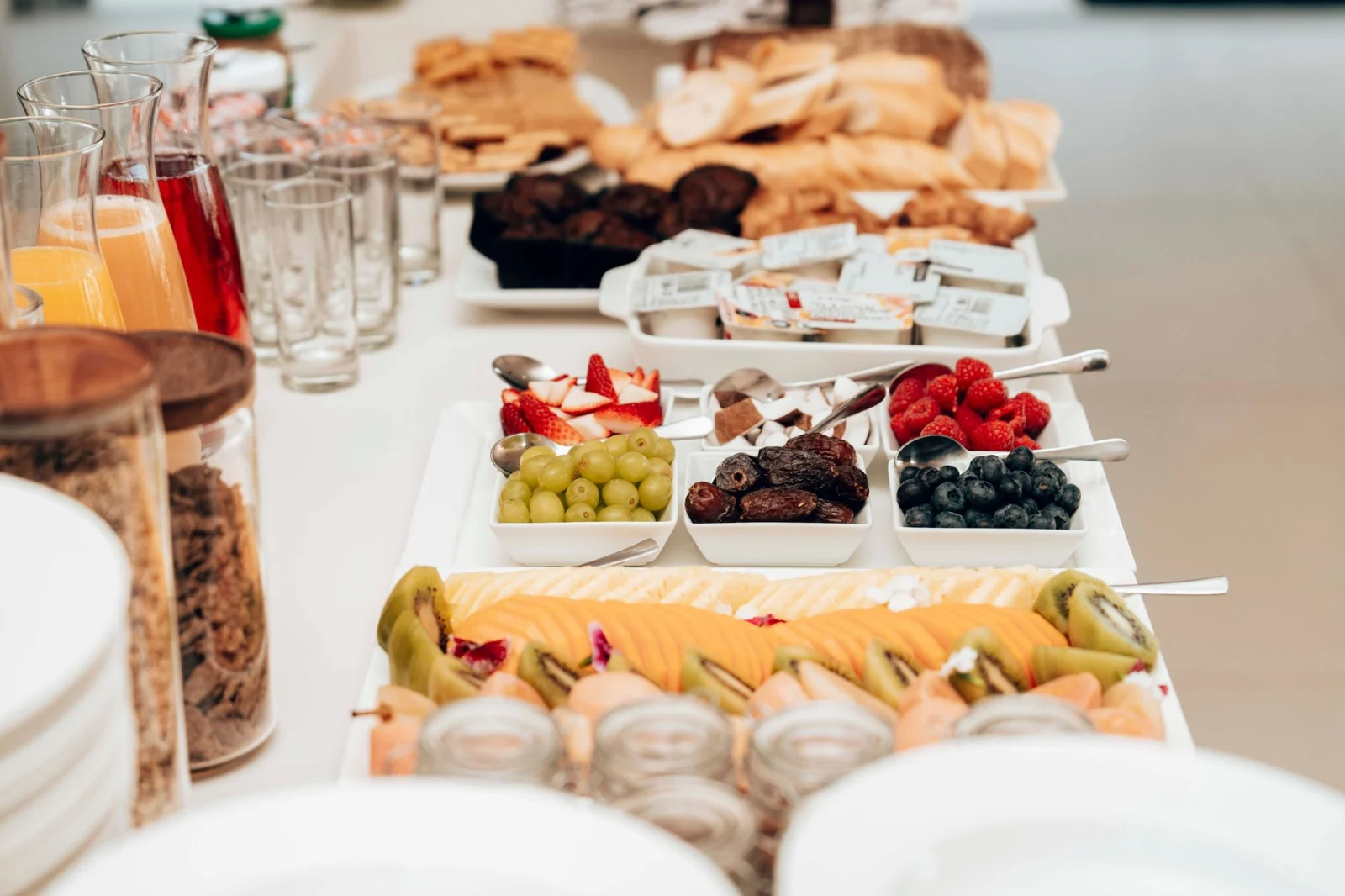
Start with protein, salad or fruit. Then add the dishes you really want.
Use a smaller plate where one is available, and sit down to eat rather than grazing as you go.
Skip the habit snacks. If you are not hungry, the pool deck pizza will still be there tomorrow.
In the main dining room
Pick two or three courses, not five. You can always order a lighter starter instead of a main if you are not very hungry.
Ask for sauces on the side or vegetables instead of fries. Dining room staff are used to requests like these.
Share desserts or choose fruit or sorbet on some nights.
Look for lighter or plant-based options. Many lines now offer them; Carnival, for example, introduced dedicated vegan dining room menus across its fleet, and most lines mark vegetarian dishes on the menu. Healthy labels and menus vary by ship and change over time, so ask your waiter what is available.
Drinks and drinks packages
Alternate every alcoholic drink with water. This helps with hydration as well as calories.
Choose simpler drinks. A glass of wine, a light beer or a spirit with soda water usually carries fewer calories than a frozen cocktail.
Do the math before buying a package. If you are drinking more just to make it pay off, it may not be the best value for your budget or your waistline.
Carry a refillable water bottle. Ships are warm, sunny places, and it is easy to mistake thirst for hunger.
Staying Active on Board and Ashore
Being active is one of the easiest ways to offset richer meals, and modern ships make it simple.
Option
What to expect
Tip
Fitness center
Most large ships have a gym with cardio machines and weights, usually free to use
Go early in the morning or on port days when it is quieter
Jogging or walking track
Common on the top decks of mainstream ships
Check how many laps make a mile, which is often posted on signs
Fitness classes
Stretching, yoga, spin, boot camp and more; some are free, others carry a fee
Check the daily planner or app on embarkation day
Stairs
Available everywhere on the ship
Take the stairs for a few decks instead of waiting for the elevator
Active shore days
Walking tours, hikes, kayaking, snorkeling and cycling
Mix in a few active excursions with your relaxing beach days
Packing makes a difference too. Bringing workout clothes and comfortable walking shoes removes an easy excuse, and our cruise packing tips from pro cruisers can help you fit everything in. If you want to know what you will need for dinners and days ashore, see our guide to what to wear on a cruise.
A morning walk or jog on deck is an easy way to stay active at sea. Photo: J VALTEN on Pexels
Simple Daily Habits That Add Up
Eat when you are hungry, not because it is there. A ship’s schedule can make you feel you should eat at every opportunity.
Plan your treats. If the chocolate buffet or a specialty restaurant is the highlight, enjoy it and go lighter earlier in the day.
Get some daylight movement every day, even if it is just a few laps of the promenade deck.
Prioritize sleep. Late nights and very early port mornings can leave you tired, which often leads to more snacking.
Do not stress about the scale. A vacation is meant to be enjoyed, and a small, temporary change is normal.
If the scale is higher when you get home, give it a few days before drawing conclusions. A lot of the early change is likely to be water rather than fat.
Return to your usual meals straight away rather than crash dieting, which can backfire.
Cut back on salty and processed foods and drink plenty of water to help your body rebalance fluids.
Get back to your usual activity. The University of Georgia study found that activity dropped in the weeks after vacation, which can make it harder to shift any extra weight.
Be patient. Most people find their weight settles within a week or two once normal routines return.
If you have a medical condition, take medication that affects fluid balance, or notice sudden swelling, speak to a doctor rather than relying on general advice.
FAQs
How much weight is normal to gain on a cruise?
There is no reliable cruise-specific figure. Research on vacations of one to three weeks found an average gain of a little under 1 pound, with a wide range. Some of the gain right after a cruise is usually temporary water weight.
Is weight gained on a cruise just water weight?
Often a good part of it is. Salty food, extra carbohydrates and alcohol can make your body hold extra fluid, which tends to drop within days of returning to normal eating. Any real fat gain usually takes longer to shift.
How long does it take to lose weight after a cruise?
Water weight often settles within a few days to a week. Any extra beyond that comes off gradually as you return to your usual meals and activity levels.
How can I eat healthy on a cruise?
Fill up on fruit, vegetables and lean protein at the buffet, choose two or three courses in the dining room, ask for sauces on the side, and look for lighter, vegetarian or plant-based dishes on the menu.
A humorous look at how Royal Caribbean’s colossal cruise ship Icon of the Seas manages to stay afloat!
There are still some great discussions on Twitter/X every once in a while. Some are super-useful and informative, but occasionally there’s a thread that is packed with great and funny replies.
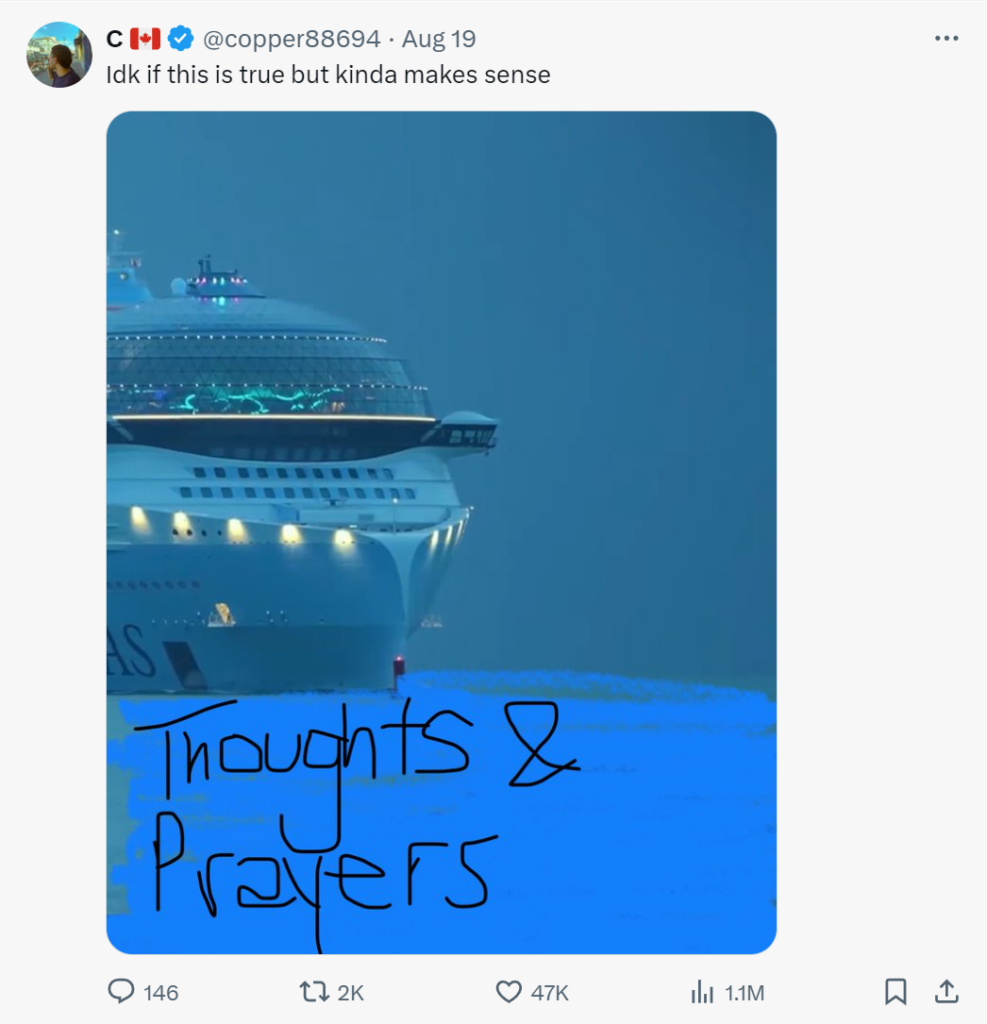
In response to a video about Icon of the Seas, user @edmsillygoose made a request:
— 𝐟𝐨𝐫𝐦𝐞𝐫 𝐥𝐨𝐜𝐚𝐥 𝐜𝐥𝐮𝐛 𝐩𝐫𝐨𝐦𝐨𝐭𝐞𝐫 (@edmsillygoose) August 19, 2024
A couple of people took the assignment a little too literally:
Simple really!
Ah, the age-old question of how something as gargantuan as a cruise ship doesn’t just go “glub glub” and sink to the bottom of the ocean. Here’s the lowdown:
1. **Archimedes’ Principle**: This is the real MVP. It states that any object placed in a fluid (like…
But there were some fantastic funny replies too, which definitely made the thread worth reading!
Here’s a look at some of the best ‘definitely real’ reasons why Icon of the Seas stays afloat:
1. Thoughts and prayers
‘Thoughts and prayers’ are apparently all that you need to keep a cruise ship floating on the water.
But does everyone onboard need to think about the ship floating, or pray for it to stay up? What happens if someone gets distracted?
Or is it just the thoughts and prayers of the captain? Maybe that’s why they’re paid so well – to always stay focused on using their brains to keep the ship afloat!
2. Iconic legs
Turns out, the real secret behind the ship’s buoyancy is its impressive set of iconic legs. Forget complicated engineering or displacement – the ship just gracefully wades through the ocean on its oversized limbs, like some sort of stylish aquatic flamingo.
It raises the question: do the legs get tired after a long journey? Maybe there’s a secret team of masseuses onboard, dedicated solely to giving the ship’s legs a well-deserved break after hours of elegant striding across the waves.
3. Magic
It’s as simple as that – magic. While the engineers might try to convince you with their fancy jargon and science, we all know it’s really just a sprinkle of pixie dust and a flick of the wand.
No need for hulls, stabilisers, or propellers when you’ve got good old-fashioned sorcery keeping the ship afloat.
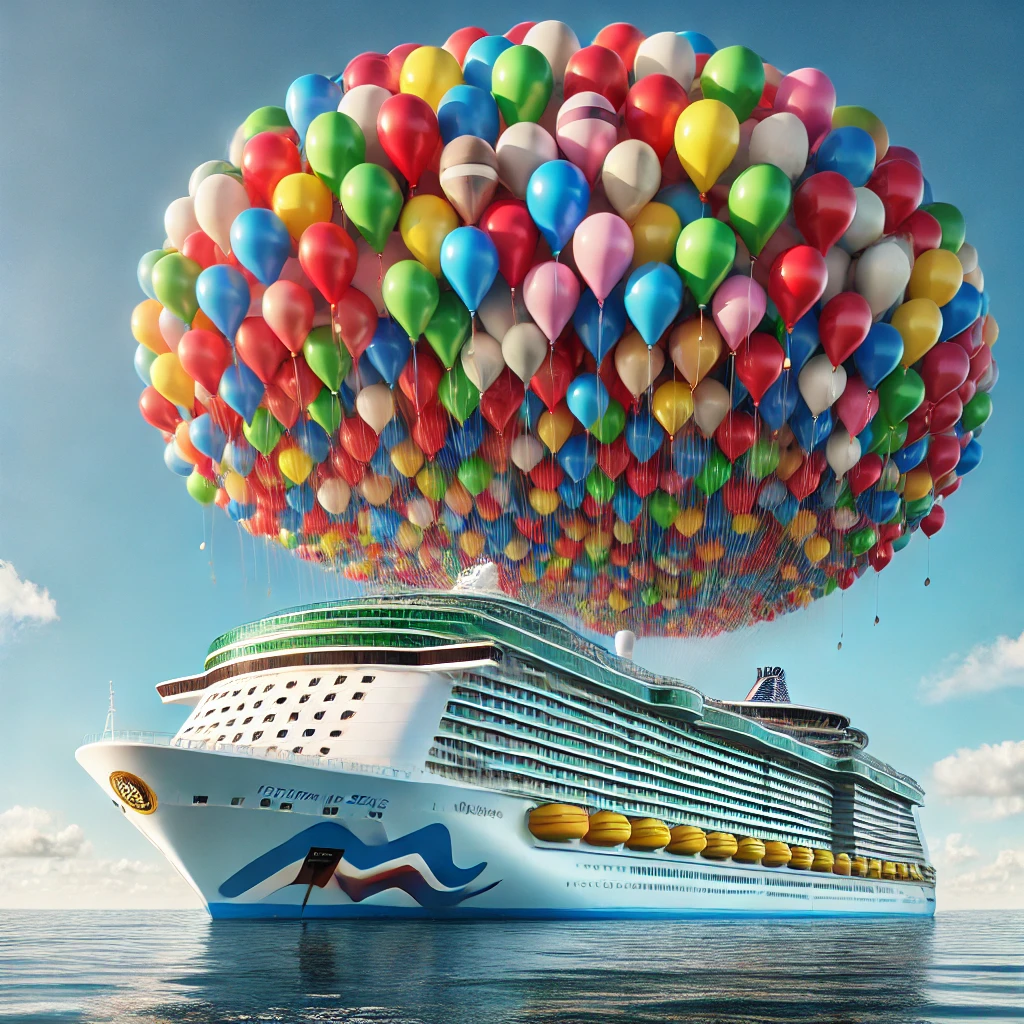
4. Floating devices
It’s a well-kept secret that the real buoyancy magic happens at the stern, where dozens of brightly coloured helium balloons keep the ship bobbing along.
It’s so obvious once you think about it. Why else would cruise ships need to stay so far from shore? They can’t risk anyone seeing the balloon setup!
And next time you’re on board, try and sneak a peek over the back. If the wind’s just right, you might catch a glimpse of a rogue balloon trying to float away.
5. Clouds
Clouds aren’t just for dramatic sunsets and holiday snaps – they’re the real reason cruise ships stay afloat. Like a giant waterbed in the sky, the ship just lounges comfortably on a soft, fluffy cloud as it glides across the ocean.
It explains why cruises are so relaxing. The passengers are basically on a floating pillow! The tricky part is making sure the clouds don’t drift away.
That’s why the crew always keeps an eye on the weather forecast – it’s all about cloud management.
6. Neanderthal poetry
In perhaps the most ancient and poetic explanation, our Neanderthal ancestors have cracked the code. With wisdom passed down from the dawn of time, they remind us that it’s all about the big air pockets. Water stays wet, air stays dry, and the boat just… floats.
Simple, right? Who needs modern science when you’ve got the primal power of Neanderthal logic? We can only assume they were also responsible for the earliest cruise designs – probably with fewer decks and a lot more mammoths.
7. Help from another Icon
When you’re the Icon of the Seas, who better to keep you afloat than another icon? That’s right – the ship doesn’t rely on engineering or physics, but on the sheer power of Beyoncé’s presence. Her energy alone is enough to keep the cruise ship gliding smoothly over the waves.
Forget lifeboats! All you need is a playlist of Queen Bey’s greatest hits, and you’ll stay above water indefinitely. Maybe that’s why the ship has such amazing sound systems – they’re secretly part of the flotation plan!
8. I’m not sure this is right…
Buoyancy? Who needs it when the ship is actually airborne? That’s right – Icon of the Seas isn’t floating on the water at all, it’s just hovering slightly above the surface, like a giant luxurious hovercraft.
The smooth ride? That’s because you’re technically flying the whole time. So next time someone asks how a cruise ship stays afloat, you can confidently tell them it doesn’t. It’s secretly just levitating in style.
9. The animal kingdom pulls its weight
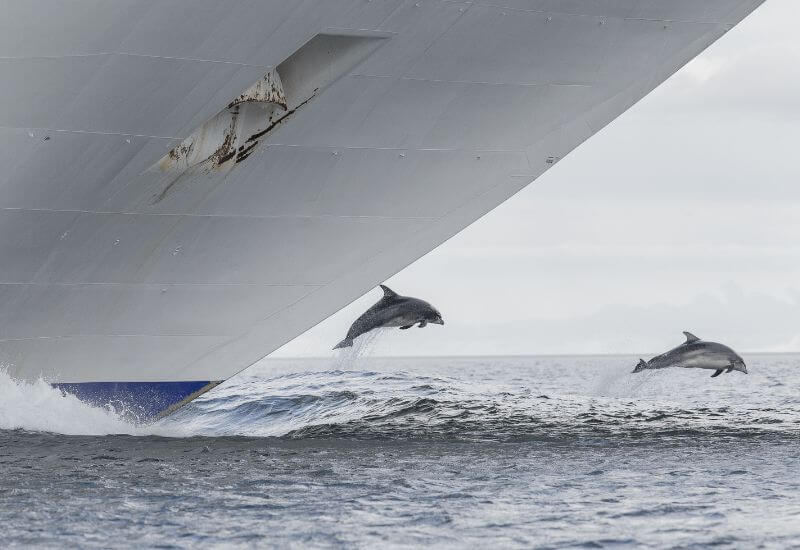
Why rely on man-made propulsion when nature’s finest are happy to help? Beneath the waves, a dedicated team of dolphins is hard at work, pushing the ship along with graceful flips and synchronised swimming.
They don’t just make for great photo ops – they’re the true power behind the ship’s movement! So the next time you spot dolphins frolicking near the bow, just know they’re not playing. They’re clocking in for another shift keeping the Icon of the Seas afloat and moving.
10. Crouching giant
Forget engines and displacement – the real reason the ship floats is thanks to a helpful giant, wading through the ocean like it’s a paddling pool.
With the ship perched delicately on his head, he carefully strolls along the seabed, making sure to keep everything balanced. You can only hope he doesn’t sneeze!
Maybe he’s on the cruise payroll, or maybe he’s just a friendly sea giant who enjoys the steady pace of ocean travel.
Either way, it explains why the ship never seems to struggle, since it’s just along for a ride on a giant’s shoulders.
11. Mythical creatures
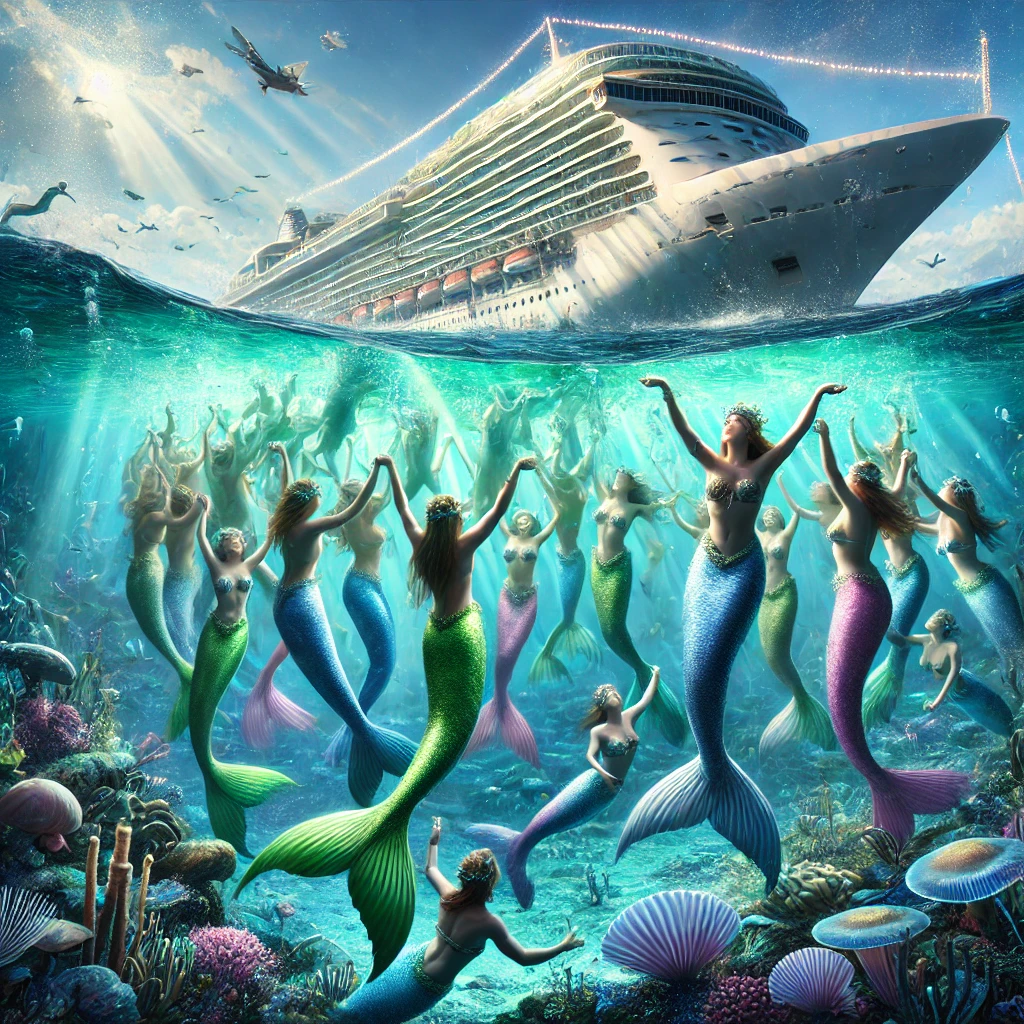
That’s right, hundreds of mermaids working tirelessly beneath the surface, holding up the ship like a mythical support crew. They don’t just save sailors from storms – they’ve upgraded to luxury cruise ships now.
Their siren songs might explain why everyone’s so relaxed on board. While passengers sip cocktails and sunbathe, a hidden mermaid workforce is keeping everything in balance. I wonder if they’re included in the daily gratuities you’ve got to pay.
12. Human-generated propulsion
Well, I know that some people do worry about the emissions of a cruise ship…
The next time you’re enjoying the smooth ride on the Icon of the Seas, just remember that somewhere below deck, there’s a hidden team of passengers contributing their share to keep the ship gliding effortlessly over the waves.
13. That’s why you always find them onboard…
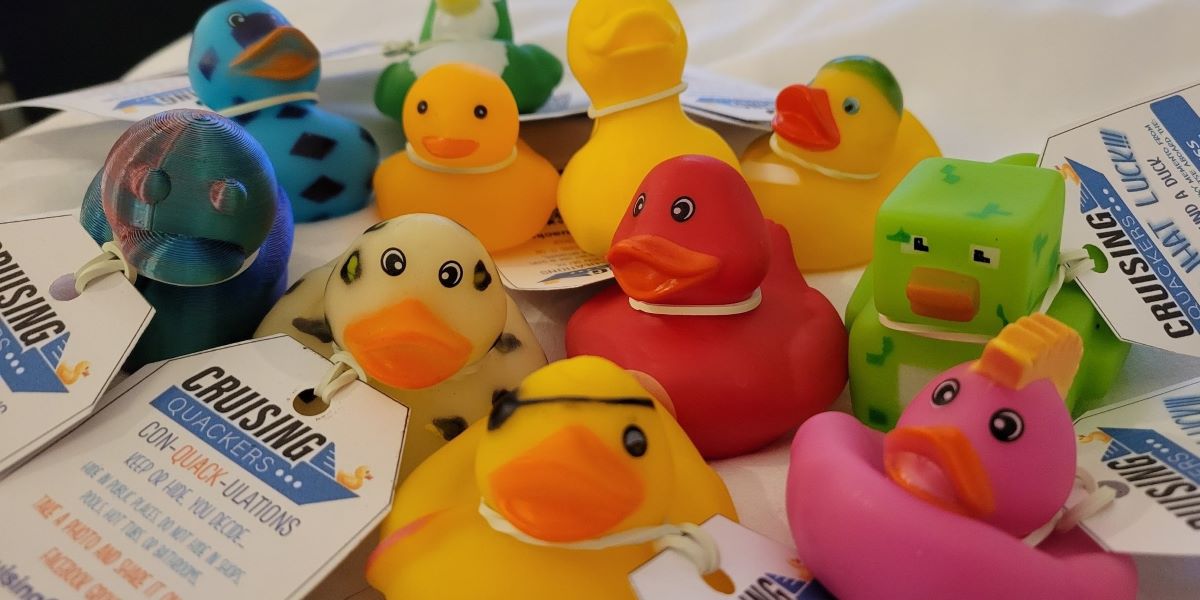
The true secret to keeping the ship afloat lies in a vast, hidden army of rubber ducks!
They’re discreetly tucked away under the deck, or all around the ship, creating a buoyant force that ensures the ship stays high and dry. Who knew those little quacking companions were actually the unsung heroes of marine engineering?
Next time you spot a rubber ducky hidden on a ship, remember: it’s not just a toy. It’s a key component in the high-tech floating system of the Icon of the Seas.
14. Ah, the Finns made it so
When in doubt, trust the Finns! Apparently, the real magic behind the Icon of the Seas is that it’s Finnish-made, and the key to its buoyancy lies in the simple command: “Float.”
In true Finnish fashion, they’ve infused the ship with a special blend of craftsmanship and polite, no-nonsense efficiency. It’s a bit like asking a well-trained husky to pull you along – you just tell it what you need, and it delivers.
15. Of course, it’s so simple…
It turns out the secret to floating is as straightforward as it gets: just make the ship’s bottom really big, and voilà, it goes ‘floaty float’. Who knew?
Science is the answer, and you don’t need to understand it to believe. Just say “Science!” and you have solved the problem!
Final word
There you have it – lots of reasons why a cruise ship as big as Icon of the Seas can stay afloat. Don’t trust anyone who tells you it’s displacement. It’s clearly a combination of magic, mermaids, rubber ducks and some human-powered emissions.
Feel free to add your own suggestions too!
Or if you’re interested in the actual answer, I spoke to my friend John who is a cruise ship pilot and he explained everything here: How Cruise Ships Float And Not Tip Over.