Bright cruise ship suite with large windows looking out to sea

Best & Worst Cabins on P&O Cruises’ Arvia

The best cabins on Arvia for most people are balcony cabins and Conservatory Mini-suites on Decks 9 to 15, midship, where you get a private, unobstructed view, a quiet deck above and below you, and the least motion. The cabins to think twice about are balconies on Deck 8 (they face the open Promenade Deck), cabins directly under the pool and sports decks or over the theatre and restaurants, and the far forward cabins if you are prone to seasickness. Below is a deck-by-deck guide to help you choose with confidence.

Arvia at a glance

Arvia is P&O Cruises’ newest ship, built by Meyer Werft and in service since December 2022. At around 184,700 gross tonnes she is one of the largest ships sailing from the UK, with roughly 2,650 cabins, up to about 5,200 guests at full occupancy and 16 guest decks. She is LNG-powered and a sister to Iona. In Europe she sails from Southampton, and in winter she is based in the Caribbean.

That size is a good thing for choice, but it also means the difference between a great cabin and an ordinary one can come down to a single deck. It pays to look at the official Arvia deck plans before you book.

Arvia cabin types explained

Inside cabins

Arvia has more inside cabins than any other P&O ship, so they are the easiest category to find and usually the cheapest. Standard insides are compact at around 13 square metres, while the Larger Inside grade gives a little more room. Every cabin has a double bed that can be split into twins, a sofa, a fridge, an interactive TV and tea and coffee facilities. If you mainly use your cabin to sleep and change, an inside on a quiet mid-ship corridor is excellent value.

Sea view cabins

Sea view (outside) cabins are found low down on Decks 4 and 5. They are surprisingly roomy, at around 20 square metres, and offer natural light through a window rather than a balcony. Being close to the waterline, they also tend to feel the ship’s movement less than higher cabins.

Balcony cabins

Balconies make up the bulk of Arvia’s accommodation. Standard balconies are about 16 square metres including a small balcony, while a handful of “smaller balcony” grades are slightly tighter. Deluxe Balconies add noticeable floor space (around 19 square metres) and are a popular step up for longer sailings.

Conservatory Mini-suites

These are a P&O signature and one of the strongest picks on the ship. They sit on Decks 8 and 9 and add a glass-fronted conservatory area between the bedroom and a deeper balcony, giving you a bright extra space to sit in whatever the weather. Curtains can close off the conservatory, which is handy for families with young children who go to bed early. Mini-suite guests get upgraded toiletries and some extra touches. Some Conservatory Mini-suites can now take five guests (see the family section below).

Suites

Arvia has 24 two-room Sky Suites, at around 37 square metres plus a larger balcony, located at the forward and aft ends of Decks 9 to 15. Perks include butler service, a whirlpool bath, complimentary room service, and breakfast in the Epicurean restaurant. There are also two Family Sea View Suites on Deck 8, which sleep four but have no balcony.

Single cabins

Solo travellers can choose from a small number of dedicated single cabins, both inside and balcony versions, spread across several decks. According to deck plan listings, the balcony singles are towards the aft of Decks 9, 11 and 14. They sell out early, so book well ahead and check how the fare is priced for one guest.

Family and connecting cabins

Many inside and balcony cabins sleep three or four using pull-down beds or sofa beds, and plenty have interconnecting doors so a larger family can take two adjoining cabins. From the summer 2026 season P&O also offers five-berth Conservatory Mini-suites on Arvia (15 of them, according to P&O), with a fixed double, a pull-down single and a double sofa bed. These have to be booked by phone or through an agent, not online.
Private cruise ship balcony with two chairs overlooking a calm blue sea
Photo: Emilio Sánchez Hernández on Pexels

Which cabins to avoid on Arvia

No cabin on Arvia is truly “bad”, but some locations come with trade-offs you should know about before paying for them.

Deck 8 balcony cabins

Deck 8 is the Promenade Deck. Its balcony cabins, including some Conservatory Mini-suites, look out over the walkway where other passengers stroll, so privacy is limited and the sea view can be partly blocked, particularly at the front. If you want a quiet, private balcony, start your search on Deck 9 or higher.

Cabins above the entertainment decks

Decks 6 and 7 hold Arvia’s main public spaces: the Headliners Theatre forward, the Limelight Club, bars around the atrium, the casino and pub area, and several aft restaurants. Cabins on Deck 5 (below) and on parts of Deck 8 (above) can pick up music, late-night noise or the clatter of furniture being moved. Light sleepers should check what is directly above and below their chosen cabin on the deck plan.

Cabins under the pool and sports decks

Deck 16 has the SkyDome, the Lido buffet and the pools, Deck 18 has more pools and sun areas, and Deck 19 has sports and golf. Cabins on Decks 15 and 17 that sit directly beneath these areas may hear sun loungers being dragged early in the morning, footsteps and evening entertainment. Cabins on Deck 16 itself are close to the busiest part of the ship.

Far forward and far aft

Forward cabins feel the most pitching in rough seas, which matters on Bay of Biscay crossings and transatlantic repositioning voyages. Some forward-facing balconies on the higher decks can also be overlooked from the bridge area. Aft cabins tend to feel more vibration from the engines and propulsion, though many people happily accept this for the wake views from aft-facing balconies.

Next to lifts, service areas and launderettes

Being near a lift is convenient on a ship this long, but cabins right beside lift lobbies, crew doors or launderettes get more corridor traffic. A few doors away is usually the sweet spot.

Best cabins on Arvia by traveller type

Traveller Best pick Why
Couples Midship balcony or Deluxe Balcony, Decks 9-12 Private view, quiet neighbours above and below, little motion
Families Conservatory Mini-suite (Deck 9) or connecting balconies Extra space and the conservatory curtain for early bedtimes
Budget Mid-ship inside cabin on a cabin-only deck Lowest fare; spend the savings on dining or excursions
Prone to seasickness Low, midship cabin on Decks 4-5 or 9-10 The centre of the ship moves least
Solo travellers Single balcony cabin Your own outdoor space without paying for two
Special occasions Sky Suite Butler service, larger balcony and extra perks

If you are torn between a standard balcony and a Conservatory Mini-suite, the mini-suite usually earns its price on cooler itineraries such as the Norwegian fjords or the Baltic, where the glass conservatory lets you enjoy the view when it is too chilly to sit outside. In the warm Caribbean or Mediterranean, a well-placed standard balcony may be all you need.
Traveller studying a ship deck plan and booking details on a laptop
Photo: Carlos Basstos on Pexels

Booking tips: choosing your Arvia cabin

Understand P&O’s fare types

P&O sells three main fares, and they control whether you get to pick your cabin:

  • Select Price lets you choose your exact cabin number, has a 15% deposit and gives first priority for upgrades and dining.
  • Early Saver is cheaper, but P&O allocates your cabin within the grade you book.
  • Saver is cheaper still, but full payment is taken at booking, it is non-refundable, and your cabin can be allocated as late as the day before departure.

If location really matters to you (a light sleeper, a family needing connecting cabins, or someone who gets seasick), Select Price is worth the extra. If you are relaxed about where you end up, a Saver or Early Saver fare can be good value, but accept that you could land on Deck 8 or under the pool deck. Check the current terms on P&O’s prices explained page, as they can change.

More practical tips

  • Check above and below. Look at the decks directly above and below any cabin you are considering, not just the cabin itself.
  • Book early for the best spots. Single cabins, Sky Suites, five-berth mini-suites and accessible cabins (Arvia has 55 accessible cabins) go first.
  • Watch for offers. Fares and upgrade promotions change frequently. Our guide to cruise deals for 2027 explains when to book.
  • Ask an agent. A cruise specialist can check cabin locations for you and hold a preferred cabin while you decide.

Comparing lines? Our guide to the best cabins on Marella cruise ships takes a similar approach for another UK favourite.

If you are comparing ships, our Enchanted Princess cabin guide covers the best and worst rooms on another big modern ship.

Sailing on an older P&O ship instead? See the best and worst cabins on Azura.

Sailing on Arvia’s sister instead? See our guide to P&O Iona cabins to avoid and the best cabins to book.

FAQs

What is the best deck for a balcony on Arvia?

Decks 9 to 12 midship are generally the best all-round choice. They are above the Promenade Deck, well below the pools and sports areas, and in the most stable part of the ship.

Are Conservatory Mini-suites worth it on Arvia?

For many guests, yes. The conservatory adds a bright, usable extra space, which is especially welcome on cooler itineraries and for families. Choose one on Deck 9 rather than Deck 8 if privacy matters to you.

Does Arvia have single cabins?

Yes. Arvia has a small number of dedicated single cabins, with both inside and balcony versions. They are popular, so book early and check the solo pricing at the time of booking.

Can I choose my cabin number on a P&O Saver fare?

No. On Saver and Early Saver fares P&O allocates your cabin. Only the Select Price fare lets you pick a specific cabin number.
Cove-balconies-on-Mardi-Gras.jpg

What Is A Cove Balcony On A Carnival Cruise (And Are They Worth Booking)? Should You Get One?

Choosing the right room can make a huge difference to your enjoyment of a cruise, so it’s a good idea to find out exactly what you’re letting yourself in for when you opt for an unusual room type like a cove balcony.

I’ve done all of the research for you, so read on to find out exactly what a cove balcony is, and whether you should book one or not.

Cove balconies on Mardi Gras
Cove Balconies on Mardi Gras

Cove Balconies – what are they?

A cove balcony on a Carnival cruise ship is more enclosed than a standard balcony. The sides and bottom half of the balcony rail are made from a solid steel panel and it has a smaller opening than a normal balcony. These factors mean that cove balconies provide greater privacy, but there are some downsides too.

Cove balconies are found on the lower decks – that’s either deck 2 or deck 5, depending on the ship.

Suggested read: The Best Deck on a Cruise Ship (to Avoid Seasickness and Noise)

As they are less open than standard balconies they feel much more private and have a more secluded and cosy feel than the normal balcony. This is despite the fact that they are actually quite a lot bigger than a regular balcony. 

NEW DEALS JUST RELEASED!

See the latest Carnival cruise offers…

The different Cove Balcony rooms

Cove balconies can be found in category 7C staterooms on Carnival’s Excel-class, Vista-class and Dream-class ships. That’s basically every ship that has been built since 2009.

The room itself is exactly the same as a normal balcony room – the only difference is the balcony outside.

Cove Balcony
Standard Cove Balcony Room

The Excel-class ships (Mardi Gras, Carnival Celebration and Carnival Jubilee) also have some Cloud 9 Spa Cove Balcony rooms. These category 7S rooms are located near to the spa and come with a pass for unlimited use of the thermal suite facilities and some other perks.

Cloud 9 Spa Cove Balcony
Cloud 9 Spa Cove Balcony Room

Families cruising on Carnival’s Vista-class ships (Carnival Vista, Carnival Horizon and Carnival Panorama) also have the option of a cove balcony with the FM and FS categories of Family Harbor Suites.

Family Harbor Cove Balcony

On Carnival Ecstasy, Carnival Elation and Carnival Paradise, the GS category Grand Suites also have cove-like enclosures where the bottom half of the balcony rail is solid steel.

Grand Suite with Cove Balcony
Grand Suite With Cove Balcony

List of Carnival Ships with Cove Balconies:

  • Carnival Breeze Cove Balcony
  • Carnival Celebration Cove Balcony and Cloud 9 Spa Cove Balcony
  • Carnival Dream Cove Balcony
  • Carnival Horizon Cove Balcony and Family Harbor Suite Cove Balcony
  • Carnival Jubilee Cove Balcony and Cloud 9 Spa Cove Balcony
  • Carnival Magic Cove Balcony
  • Carnival Panorama Cove Balcony and Family Harbor Suite Cove Balcony
  • Carnival Vista Cove Balcony and Family Harbor Suite Cove Balcony
  • Mardi Gras Cove Balcony and Cloud 9 Spa Cove Balcony

Cove Balcony Vs Balcony – the differences explained

The biggest difference between the two standard balconies and cove balconies on Carnival ships is that the cove balcony is far more enclosed with a smaller opening and more solid walls between you and your neighbour.

1. Privacy

Many of the cove balconies are underneath the suspended lifeboats. This provides another layer of privacy. The regular balconies have much less of a barrier between you and the cabin next door and also vertically so you a more likely to come into contact or hear your fellow passengers when on the balcony.

Cove balconies
View of Cove Balconies from the pier

2. Shade

As well as offering extra privacy, Carnival’s cove balconies also provide a more shaded area for sitting in on sunny days. Some people will like the shade whilst others will miss the sun. Of course, the time of day and direction of travel will also have an impact on this.

3. Size

Another big difference is that the cove balcony is quite a bit bigger, it is 45 sq ft compared to 35 sq ft for a regular balcony. This is quite a big difference (28% bigger), so it definitely gives you a bit more space to relax.

4. Views

Cove balconies are on deck 2 or 5, depending on the ship. They are the lowest possible balconies to the water so they provide fantastic views out to sea. Some guests have enjoyed great close-up views of dolphins swimming alongside the ship.

It does also mean that they can get wet at times and have a hatch that can be closed during bad weather and rough seas. It is worth getting a cabin that is not too near the front of the ship as then the spray from the movement of the ship will be less of an issue.

5. Access

If the weather on your cruise gets so bad that the open decks of the ships are closed, then you probably won’t be allowed to use your cove balcony either as it could be dangerous to be outside so close to high waves.

If this happens, a steward will close a metal storm door over your glass balcony door and you won’t have access to your balcony until the next port of call. You will, however, still be able to see out of the window.

6. Getting On and Off the Ship

The position low down on the ship is excellent when you are getting on and off at ports of call, as you’ll be right near the gangway. It’s also a better place to be in rough seas with a lower risk of motion sickness. 

It is worth noting that the actual cabins for cove balcony rooms and regular balcony rooms are the same, so there is no need to factor that into your decision.

Pros and cons of Cove Balconies

Pros:

  • Cove balconies are bigger than normal balconies
  • More private thanks to solid sides and lifeboats above
  • They are more shaded
  • Low deck position gives close-up views of the sea
  • Quick to get on and off the ship
  • Can be cheaper

Cons:

  • Some people might not like the enclosed nature of cove balconies and the smaller opening
  • Can get wet and salty
  • Might be too shady for some
  • Further from the action on-ship
  • Balconies may be off-limits in bad weather

The big question – are Cove Balcony rooms better?

Many people do think that cove balconies are better than regular balconies, but it does partly come down to personal preference. 

If you are looking for a cosy, private space then you are likely to enjoy having a cove balcony. The close views of the sea are also generally enjoyed by most people who have stayed in a room with a cove balcony but there may be times when it is too wet and windy to be used. 

It is worth noting that cove balconies are generally shadier than other balconies so if you are hoping to sit in the sun then you might be better off looking at other types of balconies, although you can always head up to the Lido deck to catch some rays.

The real risk with booking a cove balcony comes if the weather is rough. You may find that the crew members close the storm door over your balcony door, leaving you with just the window to look out of. For this reason, you should probably avoid cove balconies on cruises during hurricane season.

Cove balconies on Carnival Celebration

The bottom line

I hope that reading this post has helped you to understand what you are getting if you book a cove balcony on a Carnival cruise.

By far the majority of people that choose them are happy with their choice and the cosy cove balcony helps to make their cruise even more enjoyable.

If you’re looking for a cheaper alternative to a balcony, then you should consider an Ocean View room with a window. Some of these rooms are incredible, so they’re definitely worth looking into.

You can learn more about the different types of Ocean View rooms in my Guide to Carnival Ocean View Rooms.

NEW DEALS JUST RELEASED!

See the latest Carnival cruise offers…

Related Posts:

If you found this interesting, please share!

Cruise Mummy

Jenni Fielding is the founder of Cruise Mummy. She has worked in the cruise industry since 2015 and has taken over 30 cruises. Now, she helps over 1 million people per month to plan their perfect cruise holidays.

Read more about me

Source link

Balcony cabin on a cruise ship, the stateroom type charged standard Royal Caribbean gratuities

Royal Caribbean Gratuities 2026: Daily Rates, Prepaying and What’s Included

Royal Caribbean gratuities are $18.50 per guest, per day in interior, ocean view, balcony and Junior Suite cabins, and $21 per guest, per day in suites. The charge is added to your SeaPass account automatically each day unless you prepay it, and it applies to every guest in the cabin, children included. On top of that, an 18% gratuity is added to drinks, beverage packages, specialty dining, room service and minibar purchases, and 20% to spa and salon services.

Those are the rates as of November 2026. Below you’ll find what a typical cruise really costs in tips, who the money goes to, how and when to prepay, whether you can remove the charge, and how it works if you book through Royal Caribbean UK.

Royal Caribbean gratuities in 2026: the current rates

Royal Caribbean last raised its daily gratuity on 1 November 2024, by 50 cents per guest per day in both categories. Standard cabins went from $18 to $18.50 and suites from $20.50 to $21. That came after increases in 2022 and 2023, so the line has historically adjusted rates roughly once a year.

There has been no increase in 2025 or 2026 so far. In October 2026 a short-lived error in Royal Caribbean’s online FAQ listed a 20% gratuity on drinks and dining, and a fake “press release” claimed daily gratuities could no longer be removed. Royal Caribbean confirmed to cruise media that neither was true and that its gratuity rates had not changed. Sister line Celebrity Cruises did raise its gratuities in 2026, so it’s sensible to keep an eye out for a Royal Caribbean announcement before your sailing.

Charge Rate (USD) Applies to
Daily gratuity, standard cabins $18.50 per guest, per day Interior, ocean view, balcony and Junior Suites
Daily gratuity, suites $21.00 per guest, per day Suites above Junior Suite (Sea and Sky Class)
Daily gratuity, Star Class Included Covers standard dining and culinary staff
Automatic gratuity on purchases 18% Drinks, beverage packages, specialty dining, room service, minibar
Spa and salon gratuity 20% Spa treatments and salon services

Junior Suites are billed at the standard rate, not the suite rate. Star Class, the top tier of Royal Suite Class, includes the daily gratuity, though Royal Caribbean notes that this covers standard dining and culinary staff and that guests may tip their Royal Genie and concierge separately if they wish.

How much will gratuities cost on your cruise?

The daily charge is per day of the cruise, so a seven-night sailing is billed for seven days. Here is what that comes to per person at current rates:

Cruise length Standard cabin (per person) Suite (per person)
3 nights $55.50 $63.00
4 nights $74.00 $84.00
5 nights $92.50 $105.00
7 nights $129.50 $147.00
10 nights $185.00 $210.00
14 nights $259.00 $294.00

For a couple in a balcony cabin on a seven-night cruise, that’s $259. A family of four in a standard cabin on the same sailing pays $518, because the kids are charged at the full rate too. It’s worth adding this to your budget alongside the fare from the start, especially if you’re comparing prices with lines that include tips.

Do children and infants pay Royal Caribbean gratuities?

Yes. Royal Caribbean charges the daily gratuity per guest and publishes no age exemption, so children and infants pay the same amount as adults. This differs from some rivals: Carnival, for example, does not charge under-twos. For families on a longer cruise, kids’ gratuities can add a few hundred dollars to the bill, so factor them in when you compare lines.

Waiters serving guests at tables in a large cruise ship main dining room
Daily gratuities are shared among dining, culinary, stateroom and hotel teams. Photo: cottonbro studio on Pexels

Where the money goes: the gratuity breakdown

Royal Caribbean says daily gratuities are pooled and applied toward the pay of onboard crew. The teams covered are:

  • Stateroom attendants and housekeeping
  • Main dining room waiters, assistant waiters and head waiters
  • Culinary and galley teams
  • Other hotel services staff who keep the ship running behind the scenes

The line doesn’t publish an exact percentage split by department, and older breakdowns you may see quoted online are years out of date. What matters for passengers is that many of these crew members earn a large share of their income from the pooled tips, including people you’ll rarely meet, such as galley and laundry staff.

The 18% added to bar bills goes to bar and beverage staff, and the 20% on spa services goes to the spa team. These are separate from the daily charge.

The 18% gratuity on drinks, packages and specialty dining

The 18% gratuity catches many first-time cruisers out because it’s applied on top of advertised prices. A cocktail priced at $14 actually costs $16.52. It also applies to beverage packages, so a package listed at $80 per person per day really costs $94.40 per day once the gratuity is added. Over a seven-night cruise for two, that extra 18% alone is about $200.

The same applies to specialty dining packages, à la carte specialty restaurants, room service charges and the minibar. If you’re working out whether a package is worth it, always do the maths on the post-gratuity price. Our Royal Caribbean drink package guide covers the current packages and how to judge whether one pays off for you.

Royal Caribbean’s current terms describe these automatic gratuities as optional and adjustable at Guest Relations, but in practice they’re built into what you pay for packages, and most guests leave them in place.

How to prepay Royal Caribbean gratuities

You can either let the charge post to your SeaPass account each day or pay it in advance. To prepay:

  1. Sign in to your Royal Caribbean Guest Account online or in the app.
  2. Go to Manage Reservation and select your booking.
  3. Add prepaid gratuities for each guest and pay.

You can also prepay at the time of booking, by phone with Royal Caribbean, or through your travel advisor. Royal Caribbean UK says prepaid gratuities can be added at any time outside 48 hours of the sail date; leaving it later than that means the charge simply goes on your onboard account instead. Prepaid amounts are refunded if you cancel the cruise.

The main advantages of prepaying are that you lock in today’s rate if Royal Caribbean raises gratuities before you sail (past increases have protected prepaid bookings), your onboard bill is smaller at the end, and you can spread the cost before the holiday. The downside is less flexibility if you later want to change the amount, though adjustments are still possible onboard. Our guide on whether you should prepay gratuities on a cruise goes through the pros and cons in more detail.

Are Royal Caribbean gratuities mandatory? Can you remove them?

Royal Caribbean’s own terms describe both the daily gratuity and the automatic percentage gratuities as optional. You can ask Guest Relations onboard to reduce or remove them at any time before the morning of disembarkation. Once the cruise has ended, no changes can be made. If you’re part of a group booking, check with your group leader or travel advisor first, as gratuity arrangements may be handled centrally.

That said, removing gratuities is rarely the right call. The charge is a core part of crew pay rather than an optional bonus, and if you remove it to “tip in person” instead, the money often doesn’t reach the behind-the-scenes staff the pool supports. If something has genuinely gone wrong, raising it with Guest Relations early in the cruise gives the ship a chance to fix it, which is usually more effective than adjusting tips on the last night. For more on what not to do, see our list of cruise tipping mistakes to avoid.

Bartender mixing cocktails at a cruise ship bar, where an 18% gratuity is added to drinks
Bar staff are tipped through the automatic 18% gratuity on drinks. Photo: Airam Dato-on on Pexels

Royal Caribbean tipping beyond the daily charge

Once gratuities are covered, there’s no obligation to tip anyone extra. Many guests still choose to hand a little cash to a stateroom attendant, waiter or bartender who went out of their way, especially on longer sailings. A few other points worth knowing:

  • Royal Genie and concierge: Star Class guests have a Royal Genie, and Royal Caribbean says tipping them is at the guest’s discretion. In 2026 Royal Caribbean also began selling a Royal Genie Package to non-suite guests on more ships; tipping the Genie is still discretionary.
  • Room service: the 18% is already added to any room service charge, so you don’t need to tip on top unless you want to.
  • Shore excursions: tour guides and drivers on excursions are not covered by onboard gratuities. Tipping local guides is customary in many destinations.
  • Comment cards: naming a crew member in the end-of-cruise survey or a note to Guest Relations costs nothing and can help their career.

Royal Caribbean gratuities for UK guests

If you book through Royal Caribbean UK, the same gratuity policy applies onboard, and the onboard currency on Royal Caribbean ships is the US dollar. If you don’t prepay, daily gratuities post to your SeaPass account in dollars and are charged to the card you register, so your card provider’s exchange rate and any foreign transaction fee will apply. Prepaying through royalcaribbean.co.uk, by phone with Royal Caribbean UK or via your travel agent settles the cost before you travel, and UK bookings can add prepaid gratuities up to 48 hours before the sail date. Check the amount and currency shown on your booking before you pay.

British cruisers used to lines that include tips in the fare should note that Royal Caribbean’s headline prices don’t. When you compare deals, for instance using our guide to cruise deals for 2027, add the gratuities for every guest to get a like-for-like total.

Are there ways to get free gratuities?

Royal Caribbean doesn’t routinely include gratuities in its promotions. The main ways to avoid paying them yourself are:

  • Booking Star Class, where daily gratuities are included.
  • Booking through a travel agency that offers prepaid gratuities or onboard credit as a booking perk. Onboard credit can be used against gratuities that post to your SeaPass account.
  • Watching for occasional sales or group offers that bundle gratuities, and reading the terms carefully.

Beware of anything claiming you can “skip” tips without consequences. The legitimate route is simply to budget for them from the start.

Gratuities add up over a week, so it is worth seeing how Royal Caribbean and Carnival compare on total price once they are included.

FAQs

Do you have to pay daily gratuities on Royal Caribbean?

They’re added automatically at $18.50 per guest per day ($21 in suites). Royal Caribbean describes them as optional and lets you adjust them at Guest Relations before the morning of disembarkation, but most guests pay them because they fund crew pay.

Is it cheaper to prepay gratuities on Royal Caribbean?

The rate is the same whether you prepay or pay onboard. Prepaying can save money only if Royal Caribbean raises gratuities before you sail, because prepaid bookings have kept the older rate in past increases.

Do kids pay gratuities on Royal Caribbean?

Yes. Royal Caribbean charges every guest the daily rate, with no exemption for children or infants.

Is the 18% gratuity added to Royal Caribbean drink packages?

Yes. The 18% is added on top of the listed package price, along with drinks, specialty dining, room service and minibar purchases.

Should I tip my cabin steward on Royal Caribbean?

Your stateroom attendant is already covered by the daily gratuity, so an extra tip isn’t required. Some guests give a small cash thank-you for outstanding service, which is entirely your choice.

Large modern cruise ship at sea, the kind of mega-ship that tops MSC ships ranked best to worst

MSC Ships Ranked Best to Worst: Every Class Compared (2026)

If you want MSC ships ranked best to worst, the most useful way to do it is by ship class, because sister ships share almost the same layout, venues and cabins. Going by published guest ratings and editor reviews, the Seaside EVO ships (MSC Seashore and MSC Seascape) and the World class ships (MSC World America and MSC World Europa) sit at the top. The older Lirica class ships come last, though they still have fans who like value and a quieter pace.

This guide doesn’t use a made-up score of our own. It groups the whole fleet by class and shows ship age, size and what reviewers tend to praise or complain about. Where we mention review scores, we name the platform they come from. Those scores move up and down as new reviews come in, so treat them as a snapshot, not a final verdict.

How we ranked the MSC fleet

Every guest rating platform measures something slightly different. To keep this ranking open about its basis, we used three things:

  • Community review scores from Cruiseline.com’s “Best MSC Cruises Ships of 2026” list, which is based on reviews its members posted over the past year. The top eight ships were separated by only a few hundredths of a point, so small gaps don’t mean much.
  • Editor ratings and member feedback on Cruise Critic, which change as ships are refurbished and new reviews are added.
  • Hard facts: the year each ship entered service, its gross tonnage, its guest capacity, and whether it has the MSC Yacht Club suite enclave.

We then ranked whole classes, because a Fantasia-class ship from 2008 has far more in common with its 2013 sister than with a brand-new World class ship.

MSC ships ranked best to worst by class

Rank Class Ships In service Approx. size Max guests Yacht Club
1 Seaside EVO MSC Seashore, MSC Seascape 2021-2022 about 169,400 GT about 5,880 Yes
2 World MSC World Europa, MSC World America, MSC World Asia (from Dec 2026) 2022-2026 about 205,000-216,000 GT about 6,760 Yes
3 Meraviglia and Meraviglia-Plus MSC Meraviglia, MSC Bellissima, MSC Grandiosa, MSC Virtuosa, MSC Euribia 2017-2023 about 171,600-183,500 GT about 5,650-6,330 Yes
4 Fantasia MSC Fantasia, MSC Splendida, MSC Divina, MSC Preziosa 2008-2013 about 138,000-139,000 GT about 4,350 Yes
5 Seaside (original) MSC Seaside, MSC Seaview 2017-2018 about 153,500 GT about 5,080 Yes
6 Musica MSC Musica, MSC Orchestra, MSC Poesia, MSC Magnifica 2006-2010 about 92,400-95,100 GT about 3,220 Being added (see below)
7 Lirica MSC Armonia, MSC Sinfonia, MSC Lirica, MSC Opera 2001-2004 about 65,500 GT about 2,600-2,650 No

Sizes and capacities are rounded and differ slightly between sources. Maximum guests means every bed filled, including upper berths. Typical sailings carry fewer people. If you want the full launch-order list rather than a quality ranking, see our guide to the newest MSC cruise ships in order.

1. Seaside EVO class: MSC Seashore and MSC Seascape

These two ships come out on top for steady guest satisfaction. In Cruiseline.com’s 2026 list, MSC Seashore was first with a score of 4.119 and MSC Seascape third with 4.112. Seascape’s slight drop was put down partly to a dry-dock pause that reduced its number of reviews.

What reviewers praise: lots of outdoor deck space close to the water, infinity pools at the back of the ship, good service, and a manageable size compared with the World class giants. Both ships also have one of the biggest Yacht Clubs in the fleet.

Common complaints: the usual MSC big-ship issues. Pool decks and the buffet get busy on sea days, and many extras (drinks, specialty dining, Wi-Fi) cost more unless you book a package. For US cruisers, MSC Seashore is set to sail from Port Canaveral and MSC Seascape from Galveston in winter 2026-27.

2. World class: MSC World Europa, MSC World America and MSC World Asia

The World class ships are MSC’s largest and most ambitious. MSC World America came second on Cruiseline.com’s 2026 list (4.117) in its first year on the ranking, and MSC World Europa was further down at 4.105. Cruise Critic’s editors rate MSC World America 4.0 out of 5. They praise its big family area, top-deck attractions such as the Cliffhanger swing, lively bars, the pools and the thermal suite, and its large Yacht Club.

Common complaints: crowds and noise. The hard marble and stone surfaces make some venues, including the dining rooms, loud. Popular areas can feel packed when the ship is full, and many standard cabins are on the small side. MSC World America sails from Miami year-round on Caribbean itineraries.

MSC World Asia is the third ship in the class. It was due to be delivered in late November 2026, with a maiden voyage from Barcelona on December 4, 2026. Because it hasn’t carried guests yet, no one can honestly rate it. Expect a similar experience to its sisters, plus new features such as a dry slide called The Spiral and dining with an Asian theme.

Sunny cruise ship pool deck with loungers and a waterslide tower, typical of large modern ships
Big pool decks and waterslides are a big reason MSC's newest ships score so well with families. Photo: Ferdinand F Eman on Pexels

The middle of the MSC fleet: Meraviglia, Fantasia and Seaside

3. Meraviglia and Meraviglia-Plus class

Five ships make up this group: MSC Meraviglia and MSC Bellissima, then the slightly larger MSC Grandiosa, MSC Virtuosa and MSC Euribia. MSC Meraviglia was fourth on Cruiseline.com’s 2026 list (4.111) and MSC Virtuosa tied for fifth (4.106), only a whisker behind the leaders.

What reviewers praise: the long indoor Galleria promenade with its LED sky ceiling, a full schedule of shows and evening entertainment, and a good mix of bars. It’s a strong choice when the weather is unreliable, such as northern Europe or a New York departure. MSC Meraviglia is scheduled to sail from New York in winter 2026-27.

Common complaints: with so much of the action indoors, the promenade can feel like a busy shopping mall in the evening. Outdoor deck space feels tighter than on the Seaside EVO ships.

4. Fantasia class

MSC Fantasia, MSC Splendida, MSC Divina and MSC Preziosa entered service between 2008 and 2013. MSC Divina tied for fifth on Cruiseline.com’s 2026 list, and one reviewer quoted there called a short sailing their best vacation ever. That shows a well-run mid-size ship can match the newest ones for many guests.

What reviewers praise: classic, elegant interiors, a Yacht Club on every ship in the class, and a size that feels big but still easy to find your way around.

Common complaints: fewer headline attractions than the newest ships, and some areas look their age between refurbishments.

5. Seaside class (original): MSC Seaside and MSC Seaview

We’ve put the original Seaside pair below the Fantasia class even though they’re newer. MSC Seaside dropped from second place on Cruiseline.com’s 2025 list to the bottom of the 2026 top eight. It’s still a fun, outdoor-focused ship with a seafront boardwalk and a water park. But reviewers often say it feels crowded for its size and that the layout is harder to get around than on the EVO versions. MSC Seaside is scheduled to sail from Miami in winter 2026-27.

The older MSC ships: Musica and Lirica classes

6. Musica class

MSC Musica, MSC Orchestra, MSC Poesia and MSC Magnifica date from 2006 to 2010 and carry about 3,200 guests at most. They’re used for longer and more port-heavy itineraries, including South America and Alaska. Fans like the calmer pace and classic Italian style. Critics point to fewer dining choices and fewer attractions than on the newer classes.

The class is getting better for suite guests. According to Cruise Critic, MSC Magnifica gained a Yacht Club in a December 2025 dry dock, MSC Poesia was due to get one in February 2026, MSC Musica in late 2026 and MSC Orchestra in spring 2027. That would bring the Yacht Club to 19 ships across the fleet.

7. Lirica class

MSC Armonia, MSC Sinfonia, MSC Lirica and MSC Opera are the smallest and oldest ships in the fleet. Armonia and Sinfonia were built in the early 2000s for Festival Cruises before MSC took them over. All four were lengthened during a refurbishment program in 2014-2015, which added cabins and a spray park. Cruise Critic’s editors give MSC Lirica 3.0 out of 5.

What reviewers praise: low fares, small or no single supplements on some sailings, a quieter atmosphere, and friendly service.

Common complaints: dated decor, a small spa and gym, a buffet that feels cramped at busy times, and uneven entertainment. There’s no Yacht Club. These ships rank last for features, not because they’re unsafe or badly run. For a short, port-heavy trip at a low price, they can still be good value.

Couple relaxing on a cruise ship balcony looking out over calm blue sea
Choosing the right MSC ship depends as much on who you travel with as on the ship's age. Photo: cnrdmroglu on Pexels

Which is the best MSC ship for you?

The best MSC ship depends on who you’re travelling with and what you want from the trip. Here’s a quick guide:

  • Best for families: MSC World America or MSC World Europa. They have the biggest kids’ and teen areas, water slides, dry slides and family-focused districts. If you’d like something a little less hectic, MSC Seashore or MSC Seascape give you most of the fun with more deck space per guest.
  • Best for couples: MSC Seascape or MSC Seashore, for the outdoor spaces near the water and the infinity pools. MSC Divina is a good choice if you prefer a more classic, slightly smaller ship. On the World class ships, the adults-oriented quiet zones help, but expect noise in the main venues.
  • Best for the Yacht Club: MSC World Europa has the largest Yacht Club in the fleet, with Seashore and Seascape close behind. The Yacht Club includes butler service, premium drinks, a private restaurant and lounge, and its own sundeck. If you want a quieter enclave on a classic ship, the Fantasia class is a good fit.
  • Best on a budget: the Musica and Lirica classes usually have the lowest fares, especially on repositioning and shoulder-season sailings. In the US, the 2008-built MSC Poesia from Miami often costs much less than the newest ships. Check what’s included before comparing, and see our cruise deals for 2027 for current offers.

MSC cruise ship reviews: what to know before you book

Here’s something most rankings leave out: MSC’s guest ratings depend heavily on where the ship sails and who is on board. A ship sailing the Mediterranean in August carries many nationalities and lots of families, so announcements come in several languages and service runs on European timings. The same type of ship in the Caribbean feels much more like an American cruise. If you read MSC cruise ship reviews, look for ones written about the same region and season you’re considering. That will tell you more than the ship’s overall score.

Two other tips. Drinks and dining packages change the value of an MSC cruise a lot, so price your cruise with the package you’d actually buy. Big ships also suit sea-day-heavy itineraries, while the older, smaller ships feel best on port-heavy routes where you spend most days ashore. If you’re comparing MSC with other mainstream lines, our guide to Norwegian Cruise Line ships ranked best to worst uses a similar class-by-class approach.

For a wider view across several lines, our look at the worst cruise ships explains which ships rate lowest in sanitation scores and surveys, and why.

For a look at how the two European lines compare on price, see our guide to Costa cruises vs MSC and the hidden costs.

If you are also considering Royal Caribbean, our Royal Caribbean vs MSC Cruises comparison covers price, food, cabins and kids clubs.

FAQs

What is the best MSC ship?

Based on 2026 community ratings on Cruiseline.com, MSC Seashore and MSC World America are the highest-rated MSC ships, with MSC Seascape and MSC Meraviglia just behind. Scores are very close and change as new reviews come in.

What is the worst MSC cruise ship?

The Lirica class ships (MSC Armonia, Sinfonia, Lirica and Opera) usually rank lowest because they’re the oldest and have the fewest features. They’re still decent value for short, port-heavy cruises.

Which MSC ship is best for families?

MSC World America and MSC World Europa have the most family attractions, including large kids’ clubs, water slides and dry slides. MSC Seashore and MSC Seascape are good options if you’d like a slightly less crowded feel.

Is MSC World Asia sailing yet?

MSC World Asia was due to be delivered in late November 2026, with its maiden voyage from Barcelona on December 4, 2026. It doesn’t have guest reviews yet.

Which MSC ships have the Yacht Club?

All World, Seaside, Seaside EVO, Meraviglia and Fantasia class ships have it, and MSC is adding it to the Musica class through 2027. The Lirica class ships don’t have a Yacht Club.

Carnival-Luggage-1.jpg

The Carnival Cruise Luggage Restrictions You Need to Know (2024)

Carnival Cruise Line’s luggage limits are a little different from some other cruise lines, so it’s important that you know what you can bring before you start to pack for your cruise.

While the Carnival luggage policy has no restrictions on how many bags you can bring, there are some weight limits and suitcase size requirements that you must follow.

In this guide, I’ll go over all of the Carnival luggage restrictions, so that you know exactly how much luggage you can bring, as well as what items are allowed and not allowed on Carnival cruise ships.

Carnival Cruise luggage limits explained

On a Carnival cruise, there’s no limit to the amount of luggage that you can bring, but each bag should weigh less than 50 pounds, and it must be small enough to fit through the x-ray machine and to be stored under the bed in your stateroom.

Any bags that you check in will be taken from you outside the port and delivered to your stateroom. You can also bring carry-on bags with your essentials and valuables.

Carnival’s own website sets a size limit of no bigger than 16 inches tall by 24 inches wide when laid flat and the 50lb weight limit. This is for the benefit of the porters, more than anything. The weight likely won’t be checked at port, but if you do overpack, then please make sure you tip the porters generously!

Carnival luggage

Three Carnival Cruise luggage rules you must know

1. You can take as many bags as you want!

Carnival Cruise Line suggests that guests check in only one bag per person for 3- to 5-day cruises and no more than two bags per person for longer cruises. This is just a suggestion though – you can actually bring as many bags as you like, since there are no Carnival luggage limits.

It’s up to you whether you bring formalwear on a Carnival cruise – many people don’t – so two bags per person should be more than enough for even the longest cruise.

Suggested read: Things To Know About Formal Night On A Carnival Cruise

If you bring more bags than this, you may struggle to store them under the bed. You can use the wardrobe if you prefer, but most people prefer to put cases under the bed to maximise storage space.

If you need to bring a lot of luggage on a cruise, having suitcases of different sizes will allow you to store the smaller bag inside the larger one.

2. Bags shouldn’t weigh more than 50lbs

Each bag that you bring on a Carnival cruise should weigh no more than 50 pounds because porters must be able to lift them safely. If you need to bring more than this, you should split your luggage into two smaller bags.

It’s unlikely that the weight will be checked, but bear in mind Carnival sets this rule on their website. Many people have told me that they have packed a heavier bag than this and had no problems.

Interesting note – the Carnival Australia website suggests a higher weight limit of 32kg or 70lb. Again, more proof that the weight isn’t likely an issue.

luggage porters

If you are flying to join your cruise, you should also be aware of any luggage weight restrictions that the airline may have.

3. Bags shouldn’t be too large

On a Carnival cruise, checked and carry-on bags must be small enough to fit through the x-ray machine and to be stored under the bed in your room. The maximum allowed Carnival luggage size is 16 inches high and 24 inches wide. Length does not matter.

How to measure

Sometimes, people can get confused when measuring luggage for a Carnival cruise because 16 inches high doesn’t sound like a lot. However, you need to ensure that your suitcase is laid flat as it would be when stored under the bed, not standing tall as it would be when you pull it along.

how to measure luggage for a Carnival cruise

Here’s how to measure your luggage:

  1. Lay your bag flat
  2. Measure the height from bottom to top
  3. Measure the width from left to right
  4. The longest measurement, the length, isn’t needed
  5. Remember to include any wheels or handles
  6. Make sure that the height is less than 16 inches and the width is less than 24 inches

You can store the bags in the wardrobe if you prefer, but most people find it’s much easier to put cases under the bed.

Don’t forget luggage tags!

Luggage tags will enable the cruise ship porters to deliver your luggage to your stateroom.

After you have completed the online check-in for your Carnival cruise, you will receive your personalised luggage tags within your electronic documents. You can access these here: www.carnival.com/BookedGuest.

You should print out your luggage tags at home. Black and white is fine – you don’t need to print Carnival luggage tags in colour.

Before you arrive at the port you should fasten your luggage tags to your baggage. If you don’t have enough tags, don’t worry, you can get extra ones from the curbside porters.

If the cabin number on your luggage tag says TBA, the porters will retag your luggage with the correct cabin number.

Adding luggage tags

After printing your luggage tags you should fold them according to the instructions on the paper. You can affix the luggage tags to your bags using staples or tape.

Because luggage tags are made of paper, there’s a risk that can come off, particularly if you’re flying to the cruise port or if it is raining. For this reason, it’s a good idea to wait until you’re at the port to attach the tags.

If your luggage tags come off, there could be delays in getting your luggage. If your luggage doesn’t arrive in your stateroom, you’ll need to head down to guest services to find out what happened to it.

Read more about luggage tags.

Carnival Cruise luggage tag holders

A great solution to the problem of paper cruise luggage tags coming off is to buy luggage tag holders. These are pretty cheap and a good investment as you can use them on every cruise that you go on in the future.

Luggage tag holders mean that you don’t need to bother with tape or staples. They’re waterproof and durable, so you’ll know that your luggage tags are always secure.

Different cruise lines have different-sized luggage tags and Carnival luggage tags are generally wider than Royal Caribbean and Celebrity Cruises.

I like these luggage tag holders because they will fit the tags for all cruise lines, including Carnival…

Carrying your own luggage – you can, if you really want to

You may carry your own luggage on a Carnival cruise if you wish, but it makes much more sense to let the porters deliver it to your stateroom for you. If you arrive less than two hours before the ship’s sailing time, you will miss the baggage service and will have to carry your own bags onto the ship.

Read more about carrying your own luggage on a cruise.

Tipping porters

When you take a cruise, it’s customary to tip curbside porters $1 per bag for helping with your luggage. Curbside porters don’t work for the cruise line, they are employed by the port.

Suggested read: How Much To Tip Cruise Staff

What you CAN bring on a Carnival cruise

Carnival Cruise Line has strict requirements about what you can and cannot bring onto its cruise ships. Knowing what you can not bring on a Carnival cruise is important as they do check luggage and they will confiscate any prohibited items.

Snacks

You are allowed to bring food and snacks on a Carnival cruise as long as they are pre-packaged and unopened. Homemade food is not allowed to be brought onto Carnival cruise ships. Candy and potato chips are fine to bring.

Drinks

You are allowed to bring only one 750ml bottle of wine and 12 cans or cartons (not bottles) of soft drinks or soda per person on a Carnival cruise. You are not allowed to bring any other drinks.

Alcohol

On a Carnival cruise, each guest aged 21 or over may bring one 750ml bottle of wine or Champagne. Beer and liquor are not allowed. You must bring the wine in your carry-on luggage and drink it in your stateroom. If you wish to drink it in a dining room or bar, you will be charged a corkage fee of $15 per bottle.

Read more: Can You Bring Alcohol On A Cruise?

Wine

On a Carnival cruise, each adult may bring one 750ml bottle of wine or Champagne to be consumed in your stateroom. Pack this in your carry-on luggage, not your checked bag.

bringing wine on a cruise

Soda

Each guest may bring a 12-pack of soda on a Carnival cruise. This must be in cans or cartons up to 12 ounces (350ml) in size. Instead of soda, you could bring other non-alcoholic drinks like sparkling water, juice or milk.

Red Bull

Carnival Cruise Line treats Red Bull and other energy drinks as soft drinks. This means that you can bring 12 cans on Red Bull with you in your carry-on luggage when you board the ship. You can consume it in your stateroom.

Water

You cannot bring bottled water on a Carnival cruise, but you can buy 12 bottles, which will be delivered to your stateroom for $9.95. If you need distilled water for medical reasons or for babies, you can bring this in your carry-on luggage or purchase it from room service for $3.00 per gallon.

You can buy bottled water here: www.carnival.com/funshops.

A Cooler

On a Carnival cruise, you may bring a small cooler, no larger than 12 inches x 12 inches x 12 inches to store non-alcoholic beverages or medications. You must bring this as carry-on luggage.

Your own cup

You are allowed to bring your own personal cup, such as a Yeti cup, or reusable water bottle on a Carnival cruise. Any size is fine and you can use it to drink whatever you like.

If you plan to fill your cup from a public water or coffee machine, please use a clean drinking vessel first and then decant it for public hygiene reasons.

A vape

Vape pens are allowed on Carnival cruise ships. Vaping is treated the same as smoking, so you’re only allowed to vape in designated areas and not in your stateroom or on your balcony.

Read more: What You Must Know About Vaping On A Cruise

A fan

You are allowed to bring a fan on a Carnival cruise. The rooms have good air conditioning and your room steward will be able to provide a fan on request. But, if you prefer to bring your own fan from home, that’s okay too.

A corkscrew

You are allowed to bring a corkscrew on a Carnival cruise and it’s recommended that you do indeed bring one if you plan to bring a bottle of wine with a cork to drink in your stateroom. If you forget to pack a wine opener, you can also request one from your room steward.

Things you aren’t allowed on a Carnival cruise

An iron

Clothing irons and travel irons are not allowed to be brought onto Carnival cruise ships. However, flat irons for straightening and curling hair are allowed. There’s no reason why you can’t use this to remove creases from your clothing.

There are also laundry rooms on Carnival cruise ships where you can go to iron your clothes should you need to.

Read more: How To Do Laundry on Cruise Ships: The Ultimate Guide

A steamer

Clothes steamers are banned from Carnival cruise ships along with any other electrical appliance that produces heat. If you need to steam you clothes, you can iron them in the laundry room or send them for speciality cleaning.

A pocket knife

Carnival Cruise Line no longer allows guests to bring knives on board, even if the blade is small. The only exception is scuba diving knives. These must be checked into the security department and checked out when you visit a port.

A drone

Since May 2022, Carnival has completely banned drones from their cruise ships. It used to be the case that you could bring one in your luggage to use outside of the ship and port area. But now, you must check it in with the Chief Security Officer.

Weed

Carnival Cruise Line prohibits marijuana of all kinds, including medical marijuana with a prescription and CBD. Passengers get lifetime bans if they try to bring CBD products onboard.

Read more: What You Need To Know About Bringing Weed on a Cruise

More prohibited items

The following items are not allowed on Carnival cruise ships:

  • Illegal drugs, kava, CBD and medical marijuana
  • Weapons and ammunition
  • Explosives and fireworks
  • Compressed gases (except for personal grooming)
  • Alcohol (except for one 750ml bottle of wine per person)
  • Non-alcoholic drinks (except for 12 cans or cartons per person)
  • Electrical appliances that produce heat (except for hairdryers and hair irons/curlers)
  • Knives, scissors and open razors
  • Handcuffs or restraints
  • Hoverboards and footwear with wheels, including Heelys
  • Emergency radio beacons, communication scanners and satellite phones
  • Lasers
  • Boomboxes and large radios
  • Candles and incense
  • Helium balloons
  • Inflatable paddling pools
  • Hookahs
  • Surfboards, boats and canoes
  • Fish

You can see a full list of Carnival prohibited items and other Carnival cruise packing rules here.

Packing your carry-on bag

In your carry-on bag you should pack:

  • Passport or ID
  • Travel documents
  • Mobile phone
  • Medication
  • Valuable items like jewellery and laptops
  • Wine
  • Swimsuit
  • Sunscreen
  • Lip balm
  • Sunglasses and/or reading glasses
  • Camera
  • Hand sanitiser
  • Kids essentials

You may not receive your main luggage until later in the afternoon, so be sure to pack everything that you might need on the first day of your cruise, including your swimsuit if you might want to go swimming.

Suggested read: The Best Carry-On Bags For A Cruise

Carnival luggage searches

All luggage going onto a Carnival cruise ship will go through an X-ray scanner. This is primarily to check for alcohol, weapons and explosives It could also be checked by sniffer dogs. Any luggage that looks suspicious will be opened up for a full check, so it’s important that you leave your bags unlocked when checking in.

You’ll find more info on when and how luggage is searched here.

searching luggage at cruise port

NEW DEALS JUST RELEASED!

See the latest Carnival cruise offers…

If you found this interesting, please share!

Cruise Mummy

Jenni Fielding is the founder of Cruise Mummy. She has worked in the cruise industry since 2015 and has taken over 30 cruises. Now, she helps over 1 million people per month to plan their perfect cruise holidays.

Read more about me

Source link

Danube-River-Cruise.jpg

Major Flooding Causes Widespread Cruise Cancellations

Recent flooding on several European rivers, particularly the Danube, has caused significant disruptions, leading to multiple cruise cancellations and itinerary changes.

Danube River Cruise

High water levels have made it difficult for ships to pass under bridges, navigate through locks, and dock at ports.

Additionally, strong currents and debris carried by floodwaters pose significant safety risks.

Avalon Waterways has been forced to cancel two cruises on the lower Danube due to ship access and availability issues.

Similarly, Viking River Cruises has been updating travellers about potential itinerary adjustments on the Rhine, Main, and Danube rivers.

And TUI River Cruises has also been affected, revising itineraries to ensure current and future guests have minimal disruption.

River cruise lines are taking various measures to adapt to the flooding conditions. Some are adjusting their routes along tributaries or spending more time on less affected portions of rivers while waiting for the water levels to recede.

Others are offering alternate sailings on sister ships to their booked guests, depending on the individual circumstances of each sailing.

If you have a river cruise booked in the coming weeks, it’s crucial to stay in close contact with your cruise line. They will provide updates on potential deviations, itinerary adjustments, or cancellations.

The best way to book a river cruise

Want expert help to plan your perfect cruise?

Related Posts

If you found this interesting, please share!

Cruise Mummy

Jenni Fielding is the founder of Cruise Mummy. She has worked in the cruise industry since 2015 and has taken over 30 cruises. Now, she helps over 1 million people per month to plan their perfect cruise holidays.

Read more about me

Source link

Carnival-Casino.jpg

Carnival Quietly Removes VIFP Perk

Carnival Cruise Line has removed a casino-related perk from the top tiers of its VIFP loyalty program, but has done so without notice.

Carnival Casino

Guests on the Diamond and Platinum tiers were able to enjoy a $25 FunPlay credit in the casino, but this has now been removed, with no replacement perk announced.

The $25 credit was always advertised as a temporary benefit to replace the paused tournaments, but when it was introduced guests were informed that it was being added.

Its removal had gone under the radar until John Heald, the Brand Ambassador for Carnival, was forced to address the issue due to questions from guests on his Facebook page.

“The $25 FunPlay casino credit was one of our temporary offers to our top tier VIFP guests. With a full suite of casino promotions and activities, we are sunsetting this credit and continue to look for other ways to make sure our loyal guests have a great time while cruising with us.“

John Heald

He told Carnival fans that the removal had come at the request of the casino management team, and that it was not related to a planned renovation of the VIFP program.

The VIFP program is being looked at by the senior Carnival management team with an overhaul planned for this year.

Guests are disappointed to lose the perk, and in the way that Carnival has removed it without telling guests, leaving them to find out when they arrive at the casino to claim it.

NEW DEALS JUST RELEASED!

See the latest Carnival cruise offers…

Related Posts

If you found this interesting, please share!

Cruise Mummy

Jenni Fielding is the founder of Cruise Mummy. She has worked in the cruise industry since 2015 and has taken over 30 cruises. Now, she helps over 1 million people per month to plan their perfect cruise holidays.

Read more about me

Source link

Elegant reception desk, similar to the guest services desk where cruise complaints are handled

Cruise Complaints: What Guest Services Hears and How to Complain Effectively

The most common cruise complaints at guest services are about unexpected charges on the onboard account, noisy or faulty cabins, late luggage, crowded pools and itinerary changes. The least reasonable ones blame the crew for things nobody controls, such as the weather, rough seas or wildlife that did not appear. If you have a real problem, raise it calmly and early at guest services or with your cabin steward, because almost everything that gets fixed is fixed while you are still on the ship.

This guide sorts common cruise complaints into ones that are fair and ones that are not, then explains how to complain on a cruise and after it: who to speak to on board, how to escalate once you are home, which outside bodies can help (in the US and the UK), and what compensation you can realistically expect.

Why Guest Services Hears So Many Cruise Complaints

Guest services (also called guest relations or the front office) is the ship’s all-purpose help desk, handling billing, lost property, cabin moves, port information and complaints for thousands of passengers. Queues peak on embarkation day and the last full day, mostly for account queries.

Most cruise guest services complaints fall into a few predictable groups, and knowing which one yours belongs to tells you whether the ship can fix it.

The Most Common Cruise Complaints (and Whether They Are Reasonable)

Complaint Reasonable? What the ship can usually do
Unexpected charges on the onboard account Often, if the charge is wrong or unclear Explain or remove incorrect charges, adjust gratuities on many lines
Noisy cabin (machinery, venue above, connecting door) Yes, if the noise is excessive Investigate, move you if a cabin is free, offer an onboard credit
Broken air conditioning, toilet, shower or TV Yes Send maintenance quickly, move you if it cannot be fixed
Luggage not delivered or damaged Yes Trace bags, provide basic toiletries, start a damage report
Missed or changed port of call Partly: frustrating, but usually allowed by the ticket contract Refund prepaid port taxes and ship tours for that port
No sun loungers by the pool Fair if chair-hogging is not policed Enforce the reserving policy, suggest quieter decks
Rough seas and seasickness No, nobody controls the weather Seasickness remedies from guest services or the medical center
Rain, cold or cloud on a sunny itinerary No Indoor activities, alternative tours
No whales, dolphins or northern lights No, wildlife and auroras are never guaranteed Very little, unless a tour specifically promised a refund
Too many children on a family-focused line No, if you booked a family line in school holidays Point you to adults-only areas
Wanting the ship to turn back or wait for late passengers No Help you arrange travel to the next port at your own cost

Charges on your onboard account

Billing is probably the single biggest source of complaints at the desk. The usual culprits are automatic daily gratuities (on mainstream US lines these are roughly $16 to $25 per person per day depending on line and cabin type), service charges added to drinks and specialty dining, Wi-Fi packages, and charges from a family member’s card. Check your account on the cruise line app or cabin TV every day or two rather than waiting for the final statement. Wrong charges are far quicker to fix early in the cruise than on the final morning.

Cabin problems

Noise from a nightclub, theater, laundry or anchor machinery, a cabin that will not cool down, a blocked drain or a smell are all legitimate complaints. Report them the same day. Start with your cabin steward for small things, and go to guest services if maintenance does not fix it or the problem is structural, such as noise. If you are still choosing a cabin, the site’s cabin guides, like the one on Celebrity Cruises cabins to avoid, help you avoid the most common noise traps before you book.

Late or missing luggage

Bags handed to porters can take until the evening to reach your cabin, which is normal. Report luggage to guest services if it has not arrived by early evening or arrives damaged, and keep medication and documents in your carry-on.

Itinerary changes and missed ports

Ports get cancelled because of wind, swell, port congestion, strikes, medical emergencies or mechanical issues. Ticket contracts give the captain and the cruise line wide discretion to change the itinerary, so compensation is limited. You should normally get a refund of the port taxes and fees for the skipped port and of any excursions booked through the ship. Some lines add a goodwill onboard credit, but this is discretionary. If a ship misses ports because of a mechanical failure, the CLIA Passenger Bill of Rights adopted by member lines does promise timely updates and, if the cruise ends early, a partial refund and travel home.

Two people toasting with tropical cocktails by the ocean at sunset
Most complaints come from expectations about the perfect holiday. Photo: Yan Krukau on Pexels

The Unrealistic Complaints Cruise Staff Hear Again and Again

Lists of “funny cruise complaints” are popular online, and many of the stories cannot be verified. The patterns behind them are real, though, and crew on every line will recognize them. Most come from expectations that were never realistic:

  • Blaming the ship for the weather. Rough seas, rain or a cancelled tender port are not service failures. The ship can offer seasickness tablets and indoor entertainment, not sunshine.
  • Expecting the ship to wait or turn around. If you return late from an independent tour, the ship can leave without you. Getting to the next port at your own expense is your responsibility, which is one reason many people book ship tours on tight port days.
  • Complaining that the “ocean view” cabin looks at the ocean, or that an inside cabin has no window. Cabin categories are described clearly at booking. An obstructed view is only a valid complaint if it was not disclosed.
  • Wildlife on demand. Whale watching, dolphin spotting and the northern lights depend on nature. Read tour terms, because some operators offer a second trip if nothing is seen, but most do not.
  • Children on a family line. Booking a large resort ship in July and then complaining about children is a mismatch of ship and expectations, not a fault on board. Look at adults-focused lines or term-time sailings instead.
  • Expecting free extras. Specialty restaurants, premium drinks and Wi-Fi are usually extra on mainstream lines. Check what is included before you sail.

Most of these disappear if you read the included-items list, cabin description and port schedule before you go. The site’s guides to first time cruise tips and the worst cruise ships according to reviews are useful for setting realistic expectations.

How to Complain on a Cruise and Get Results

The best results come from complaining early, calmly and to the right person. Here is a practical order of escalation on board:

  1. Start with the person closest to the problem. Your cabin steward handles cleaning, towels, bedding and small repairs. Restaurant issues go to the head waiter or restaurant manager. Bar problems go to the bar supervisor. Many small issues are fixed within the hour.
  2. Go to guest services if it is not fixed. Explain the problem, what you have already tried, and what you would like to happen. Ask for the name of the person you spoke to and, if relevant, a reference number.

  3. Ask for a manager for serious problems. For repeated cabin faults, a safety concern or a billing dispute that the desk cannot resolve, ask to speak to the guest services manager or hotel director. These senior officers can authorize cabin moves and onboard credits.
  4. Keep a record. Note names, dates and reference numbers, photograph faults and screenshot charges. Stay polite: the crew member in front of you rarely caused the problem.
  5. Use the mid-cruise check-in and final survey. Many lines send a short survey during the voyage and a full one afterward. Mention named crew who helped and specific problems. These surveys are read and affect crew and ship ratings.
Hands typing on a laptop, as when writing a cruise complaint after getting home
A clear, dated written complaint gets the best response after the cruise. Photo: SHVETS production on Pexels

Escalating Cruise Complaints After You Get Home

If the problem was not resolved on board, write to the cruise line’s customer relations department (sometimes called guest care or post-cruise relations) through its website contact form or email. Many lines’ websites also publish a phone line for questions about shipboard operations, which is one of the CLIA Passenger Bill of Rights commitments. Include your booking number, ship, sailing date, cabin number, a short timeline of what happened, who you spoke to on board, copies of evidence, and the specific remedy you are asking for. Keep it to one or two pages.

Check your ticket contract for deadlines. US law allows cruise lines to require written notice of a personal injury claim within six months and a lawsuit within one year (46 U.S.C. 30508), and other claims can have shorter limits set in the contract. If someone was hurt, speak to a maritime lawyer early rather than relying on the complaints process.

US passengers: the Federal Maritime Commission

For cruises departing from US ports, the Federal Maritime Commission’s Office of Consumer Affairs and Dispute Resolution Services (CADRS) runs a free cruise passenger assistance program. It can help you reach the right people at the cruise line and act as a mediator or ombudsman, but it cannot force a cruise line to pay compensation. Complaints go to complaints@fmc.gov with your booking details, the outcome you want and supporting documents. The US Department of Transportation’s complaint service covers airlines, not cruises.

UK passengers: ABTA

If you booked through an ABTA member (most UK cruise lines and travel agents are members), first complain to the company and give it time to respond. If you are still unhappy, you can register the dispute with ABTA. Its first stage is free and can take up to 50 calendar days; ABTA brings both sides together but does not award compensation. An optional second stage is independent arbitration with a legally binding award, which costs £150 for claims up to £25,000.

What Compensation Is Realistic for Cruise Complaints?

Expectations matter here as well. As a rough guide:

  • Minor service issues (a slow meal, a missed towel change): an apology and a fix, rarely money.
  • Cabin faults that affected several nights: an onboard credit or a future cruise credit is common; a cash refund is less common.
  • Missed ports: a refund of port fees and ship excursions for that port, sometimes a small goodwill credit.
  • Major mechanical failure or a cruise cut short: partial or full refunds and future cruise credits, in line with the CLIA Passenger Bill of Rights.
  • Incorrect charges: removal of the charge in full.

Future cruise credits usually have expiry dates and conditions, so read them before you accept. If you are planning your next trip anyway, compare any credit against current offers in the guide to cruise deals for 2027.

FAQs

How do I complain to a cruise line and get results?

Raise the problem on board as soon as it happens, first with the relevant crew member and then guest services. Keep evidence and names. If it is not resolved, write a short, specific letter to the line’s customer relations team after the cruise stating the remedy you want.

How do I file a complaint against a cruise ship?

Start with the cruise line. If that fails and your cruise left from a US port, contact the Federal Maritime Commission’s CADRS team at complaints@fmc.gov. UK passengers who booked with an ABTA member can use ABTA’s dispute resolution service.

What are the most common cruise complaints?

Unexpected onboard account charges, noisy or faulty cabins, late luggage, crowded pool decks and missed ports top the list. Weather, seasickness and wildlife sightings are also common complaints, but the ship cannot control them.

Can I get compensation if my cruise skips a port?

Usually only a refund of the port taxes and fees and any ship excursions for that port. Ticket contracts let lines change itineraries for weather and safety, so extra compensation is a goodwill gesture, not a right.

Cunard-Queen-Mary.jpg

Is Cunard Too Posh For Me? I Cruised on Queen Mary 2 To Find Out

I’ve taken over 40 cruises but I’d never really fancied Cunard.

With over 300 cruise ships at sea and striking differences between them, I always say that there’s a cruise line for everyone. And honestly, I didn’t think Cunard was for me.

Cruise Mummy wearing sunglasses smiles at the camera while standing on the deck of the Cunard Queen Mary cruise ship, with the ocean and a setting sun in the background. The ship's deck features a pool and sun loungers.

When I think of Cunard I think of butlers wearing white gloves, afternoon tea with cucumber sandwiches and time spent doing not much more than crossword puzzles and starting at the ocean.

And while it’s true that you can do all of those things on a Cunard cruise, there’s more to it than that, as I would discover.
Is Cunard stuffy?

As a working-class mum with two young kids, I thought that I was far from the typical Cunard cruiser. I expected to stand out like a sore thumb amidst a sea of grey-haired couples who reside in the Home Counties and speak using the Queen’s English.

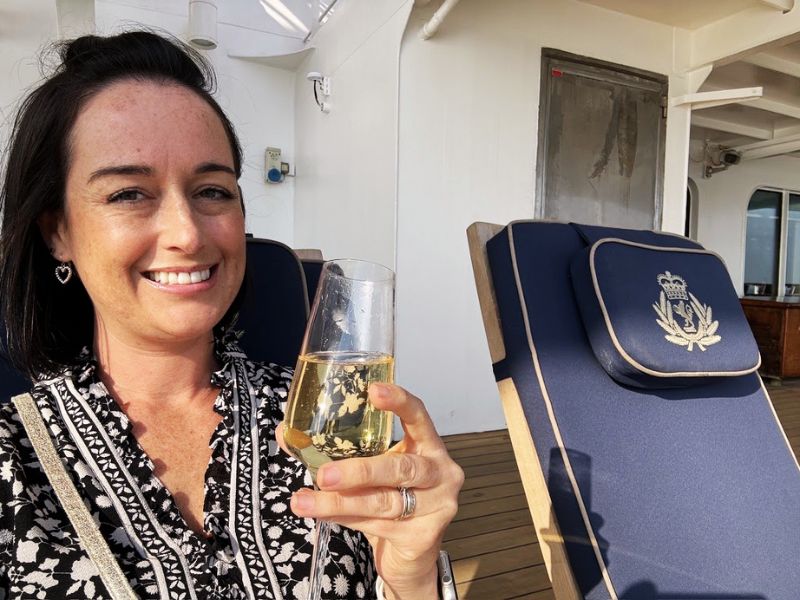
Cunard is synonymous with Royalty, with the ships named after famous British Queens. The logo features a crown, a lion and a laurel wreath, signifying the connections to the British Royal Family.

Cruise Mummy smiles at the camera while holding a glass of champagne on the deck of the Cunard Queen Mary cruise ship. She is sitting on a blue lounge chair with a regal emblem embroidered on the headrest.

And while yes, there are quite a few guests on board that wouldn’t look out of place at a Buckingham Palace garden party, on this cruise, the clientele were mixed.

As I took a short sailing from Southampton and Hamburg and back (which was a segment of the longer transatlantic voyages that Queen Mary 2 is famous for) there were plenty of Germans and Americans on board too.

While some of the Brits like to don a bow tie for breakfast, the international guests were a little more relaxed. And yes, some were even wearing jeans!

I booked this cruise because I spotted it on sale for £198pp for four nights – a price that was less than half of the going rate. I shared the deal on my Facebook page and with my email list and the remaining places were sold that day.

If you’d like to hear about the best cruise deals I find each week, you can leave your email address here and I’ll send them to you.

Cunard and P&O Cruises are both part of the Carnival group and there are many similarities between the two brands.

I love P&O Cruises but, like many, I’ve noticed that what’s included in the fare has become gradually less over the years, with the little extras like a nightly turn-down with chocolates on the pillows no longer part of the service.

Read more: 20 Things That P&O Cruises Used To Offer That They No Longer Do

On Cunard, all the little extras are there for you. Each cabin has a bottle of sparkling wine in the fridge, there’s 24-hour room service at no charge and the crew members seem to be extra friendly and helpful.

My hand holds a bottle of Pol Acker sparkling wine inside a cabin on the Cunard Queen Mary cruise ship. The background shows part of the cabin with light wooden furniture and a balcony with a glass door.

Yes, there are some niggles, and there will always be those who like to focus on the things that aren’t perfect rather than those that are. But on the whole, Cunard offers a level of luxury that matches the price point.

Queen Mary 2 is an older ship

The last of the world’s great ocean liners, Queen Mary 2 is iconic. She’s one of the fastest passenger ships in operation, with a maximum speed of 30 knots.

Of course, she’s been fully refurbished many times since her launch in 2024 and some areas of the ship look brand new. However, she is an incredibly quirky ship by design.

I’ve never known a cruise ship that was so difficult to find my way around. The lower decks, in particular, are like a maze, with certain areas only accessible by taking unusual routes that you wouldn’t expect. Without the paper deck plan that Cunard gives to every guest on embarkation, you will most definitely get lost.

A deck plan of the Cunard Queen Mary cruise ship, showing labeled diagrams of each deck from Deck 1 to Deck 13. The plan includes a side view of the ship with corresponding deck sections and details on various facilities and amenities.

The Planetarium and the G32 nightclub are two areas that some cruisers never manage to discover, even on a week-long crossing.

Some unusual features

One of most fascinating things about Queen Mary 2 is that she is the only cruise ship in the world that allows guests to bring their pet dogs and cats onboard. Indeed, the ship has its own kennels where pets can stay for transatlantic crossings.

A dog on a leash walks along the deck of the Cunard Queen Mary cruise ship, near a red fire hydrant. The deck area is designated for pet kennels, with city views in the background through the glass panels.

The prices aren’t cheap, at $800 to $2000 for a dog (depending on the size) and $1600 for a cat. But for anyone relocating across the pond with their pets, it provides a handy way to travel.

Queen Mary 2 is also the only cruise ship to feature a planetarium. With its domed ceiling and fully reclining seats, it’s an attractive feature designed to make you feel as though you’re in space. Unfortunately, the planetarium wasn’t open during my four-night cruise, which was disappointing.

The interior of the planetarium on the Cunard Queen Mary cruise ship features rows of plush, patterned seats facing a central stage and screen. The room is adorned with ornate decorations and has a large circular ceiling design, creating a luxurious and immersive atmosphere.

Those with an interest in maritime history will be sure to enjoy the Maritime Quest exhibit which chronicles the history of Cunard with rare artifacts, photos and interactive displays. There’s also an extensive library, one of the largest at sea, with over 8,000 books.

Cunard cruisers are a loyal bunch

Upon arriving at the main dining room, I was offered the option to share a table or sit alone. I always opted to share, as I love to meet new people and learn about their lives. One thing that struck me was that almost every person I dined with had cruised on Queen Mary 2 many, many times already.

Some of these had tried other cruise lines too, but described these as ‘just not Cunard’. It’s clear to me that for many people, Cunard ticks every box, prompting them to return every year.

The main dining room on the Cunard Queen Mary cruise ship features an elegant, two-story space with a grand stained-glass ceiling, large mural, and marble columns. The dining area is set with round tables adorned with white tablecloths and floral centerpieces, creating a refined and luxurious dining atmosphere.

So, is Cunard for me?

I love all kinds of cruise ships, from 6,000-passenger mega-ships, to yachts and river boats that accommodate just a couple of hundred. I also enjoy all ends of the luxury scale, with an appreciation for £30-per-night bargain breaks to ultra-luxury boutique yacht-style vessels.

My trip on Queen Mary 2 offered just what I needed for my solo trip – a quiet space to work, delicious food that met my dietary needs, an extensive gym and promenade deck for exercise and a super-comfortable bed. And, luckily, lots and lots of warm sunshine!

Cruise Mummy wearing sunglasses and a colorful bikini relaxes on a lounge chair covered with a striped towel on the deck of the Cunard Queen Mary cruise ship. She is enjoying the sunny weather, lying on a spacious deck area with additional lounge chairs in the background.

But, if I were to take a week-long cruise with my family or friends, with an absence of sunshine, I’m sure that we would quickly become bored.

While many people delight in spending days with their head buried in a book and evenings listening to the sounds of a tinkling piano with a glass of the finest whiskey and a cigar, that’s not for me.

A cozy lounge area on the Cunard Queen Mary cruise ship features several plush leather armchairs arranged around small tables with glass ashtrays. The space includes a wall of wooden cabinets displaying a collection of cigars and other items, creating an inviting atmosphere for relaxation.

I prefer a jam-packed schedule, acrobatic performances, water slides and rock climbing walls.

So, while Queen Mary 2 is a beautiful ship that’s just perfect for many people. She’s not my favourite. And that’s okay. 

Cruise Mummy in an orange top gives a thumbs-up while sitting on the deck of the Cunard Queen Mary cruise ship. Behind her, an orange lifeboat is visible, along with some outdoor seating and railings. She appears to be enjoying her time on the ship.

I made a vlog of my Cunard cruise. You can see that below if you’re interested and subscribe to my YouTube channel to see future videos.

If you found this interesting, please share!

Cruise Mummy

Jenni Fielding is the founder of Cruise Mummy. She has worked in the cruise industry since 2015 and has taken over 30 cruises. Now, she helps over 1 million people per month to plan their perfect cruise holidays.

Read more about me

Source link

Elegant restaurant tables set for dinner, illustrating early or late dining on a cruise

Early or Late Dining on a Cruise: How to Choose, With Times by Line

Choose early dining on a cruise if you want your evenings free, have young children or like to be in bed by 10:30 pm. Choose late dining if you want full days in port, a less hurried dinner and time for a show or drink first. If you can’t decide, pick a flexible option where your cruise line offers one.

Deciding between early or late dining on a cruise matters more on some lines than others. Early seatings usually start between 5:30 pm and 6:30 pm and late seatings between 7:45 pm and 8:30 pm, but every line sets its own times. The table below shows what to expect for 2026, followed by a simple way to match a seating to your itinerary.

Early or late dining on a cruise: the quick comparison

Factor Early seating Late seating
Typical start 5:30 pm to 6:30 pm 7:45 pm to 8:30 pm
Best for Families, early risers, early excursions Couples, night owls, long port days
Port days Can be a rush to get back and change Plenty of time to return and unwind
Main shows Usually straight after dinner Usually before dinner
Atmosphere Busier, often more children Quieter and more relaxed
Availability Fills first Usually easier to get
Main drawback Can feel rushed, and you may want a snack later A late finish, and a long gap after lunch

Cruise dining times by line

These are approximate main dining room times based on cruise line information and recent published guides. Ships and itineraries differ, and lines adjust times without much notice, so treat this as a guide and confirm your own time on your booking, cruise card or app.

Cruise line Early / first Late / second Flexible option
Royal Caribbean About 5:30 pm About 8:00 pm My Time Dining
Carnival About 5:30 to 6:00 pm About 7:45 to 8:15 pm Your Time Dining
Celebrity About 6:00 pm About 8:30 pm Select Anytime, about 6:00 to 9:30 pm
Holland America About 6:00 pm About 8:00 pm As You Wish, about 5:15 to 9:00 pm
Disney About 5:45 pm About 8:15 pm None in the rotational dining rooms
MSC About 6:00 to 7:00 pm About 8:30 to 9:00 pm Selected fares and ships only
Princess Set times available through Dine My Way, which vary by ship Dine My Way
Norwegian No fixed seatings Freestyle Dining
P&O Cruises (UK) About 6:30 pm About 8:30 pm Freedom Dining, about 6:00 to 9:30 pm
Cunard (Britannia cabins) About 6:00 pm About 8:30 pm Open Dining, about 6:00 to 9:00 pm
Fred. Olsen About 6:00 pm About 8:00 pm (8:15 pm on some evenings) None in the main restaurant

Royal Caribbean dining times

Royal Caribbean offers early seating, late seating or My Time Dining. It gives 5:30 pm and 8:00 pm as the typical traditional times, with some variation by ship and route. On select markets and ships, gratuities are prepaid automatically if you choose My Time Dining, so check this when you book.

Carnival dining times

Carnival times vary more than most. Many ships, including newer ones such as Celebration and Jubilee, use around 5:30 pm and 7:45 pm, while others, such as Conquest and Glory, use around 6:00 pm and 8:15 pm. A few differ again, so look up your specific ship rather than relying on a fleet-wide figure.

UK lines with fixed sittings

Fixed sittings remain central to the British-style cruise. On P&O Cruises, Club Dining keeps you at the same table with the same waiters and fellow diners all cruise, but Iona and Arvia are Freedom Dining only. Fred. Olsen’s Balmoral, Bolette and Borealis have two dinner sittings, with the second moving slightly later on embarkation day and formal nights.

On Cunard, your cabin grade decides how you dine. Britannia cabins choose early, late or Open Dining in the Britannia Restaurant, while Princess Grill and Queens Grill guests keep a reserved table and arrive when they like during service.

Family with children sharing an early evening meal at a restaurant table
Early seating often suits families with younger children. Photo: Gül Işık on Pexels

Why choose early dining?

Early seating works well if you think of dinner as the start of your evening rather than the end of it.

  • Your evening stays open. You finish in time for shows, music, trivia and a walk on deck.
  • It suits children. Younger children are less likely to be overtired, and it’s a natural fit before kids’ clubs or bedtime.
  • It suits early starts. If you have a morning excursion or a sea-day gym habit, you’ll get to bed at a sensible hour.
  • It keeps to your usual routine. Many people who normally eat around 6:00 pm find it the easiest adjustment.

The trade-offs are real, though. On a port day you may have little time to get back, shower and change, and dinner can feel paced because the room must turn over for the next seating. Early seating is also the most requested, so ask for it as soon as you book.

Why choose late dining?

Late seating gives you a longer day. It’s the better fit if you want every available hour ashore or by the pool.

  • Port days are easier. You can return close to all-aboard time and still have a relaxed hour before dinner.
  • Dinner tends to be calmer. With no seating behind you, there’s less pressure to finish.
  • You can do things first. A pre-dinner drink or an early show fits naturally.
  • It’s usually easier to get. Late seating generally fills more slowly than early.

The downsides are a long gap after lunch and a late finish, which can catch up with you if the next day starts early. Young children may also struggle to wait that long, and they can get restless at the table.

Flexible dining: a third option

Most big lines now offer some form of flexible dining, so you aren’t always limited to early vs late seating on a cruise. Royal Caribbean’s My Time Dining, Carnival’s Your Time Dining, Celebrity’s Select Anytime and Holland America’s As You Wish all let you eat at different times on different nights. Norwegian has no fixed seatings at all, and smaller premium and luxury lines such as Viking and Oceania generally use open seating.

The freedom comes with a catch. You can queue on busy nights, even with a reservation, and you won’t necessarily see the same waiter twice. You can also be left with awkward gaps around shows, which are often scheduled around traditional seatings. Princess takes a slightly different approach, and our guide to how Princess Cruises dining works explains the choices in more detail.

Disney is the main exception in the other direction. Its rotational system moves you through three themed dining rooms with your servers following along, and main stage shows run opposite your seating, so first seating sees the show after dinner and second seating sees it before.

Table size is a separate question from time. If you’d rather not share, read our advice on how to get a table for two on a cruise before you sail.

Large cruise ship docked at a sunny port beside the waterfront
Port times can decide which dinner seating works best. Photo: Jeffry Surianto on Pexels

Check your itinerary before you choose

Most advice on this topic stops at personal preference, but the cruise itself can settle the question. Before you settle on early or late dining on a cruise, look at your itinerary for these four things:

  1. Late port departures. Count how many days have an all-aboard time in the late afternoon or later. If there are several, early seating will often mean rushing back, so late seating or a flexible option is safer.
  2. Early arrivals and tours. A run of early morning excursions favors early seating, since a late dinner followed by a 7:00 am meet-up is tiring.
  3. Sea days. On a cruise with lots of sea days, the timing matters less for logistics, so go with your normal appetite and bedtime.
  4. Time changes. On a transatlantic or repositioning voyage, the ship’s clock can move repeatedly. Sailing east, clocks go forward, so a 6:00 pm dinner feels like 5:00 pm or earlier. Sailing west, clocks go back, so an 8:30 pm dinner feels later each night.

Traveling with others? Link your reservations before you choose, and confirm the arrangement on boarding day, so your group lands at the same seating and table. New to cruising? Our first-time cruise tips cover what else is worth sorting out before you board.

How to change your dining time

Your options depend on when you act, and sooner is always better.

  • Before you sail: Many lines let you switch in your online booking or app, subject to availability. On Royal Caribbean, sign in to your Guest Account, open your reservation and go to the Dining section. Carnival guests can use the Hub app or their account.
  • On embarkation day: Go to the maitre d’ or dining desk as early as you can. Royal Caribbean specifically directs guests to its hospitality desk on that day.
  • If your choice is full: Ask to be waitlisted. Disney, for example, moves waitlisted guests as main seating places open up.

Fixed-dining lines often hold fewer spare places than you’d hope, so have a backup. Booking a specialty restaurant for a night doesn’t change your main dining room assignment, and the buffet is usually there if a seating simply doesn’t suit one evening.

FAQs

Is early or late dining better on a cruise?

Neither is better for everyone. Early dining suits families, early risers and anyone who wants the whole evening free. Late dining suits people who want long port days and a slower dinner.

What time is early and late dining on Royal Caribbean?

Royal Caribbean says traditional seatings are typically 5:30 pm and 8:00 pm. Times vary by ship and itinerary, so check your SeaPass card and the app for your sailing.

What time is early and late dining on Carnival?

Early dining is usually between about 5:30 pm and 6:00 pm, and late dining between about 7:45 pm and 8:15 pm. The exact times depend on the ship, and a few older ships differ slightly.

Can you change your dining time once on board?

Often, but it isn’t guaranteed. See the maitre d’ or dining desk on embarkation day, and expect early seating to be harder to get. If you can change online before sailing, do that first.

Do you have to dress up for late dining?

No. The dress code is set by the night and the cruise line, not by your seating. Early and late diners on the same evening follow the same guidance.