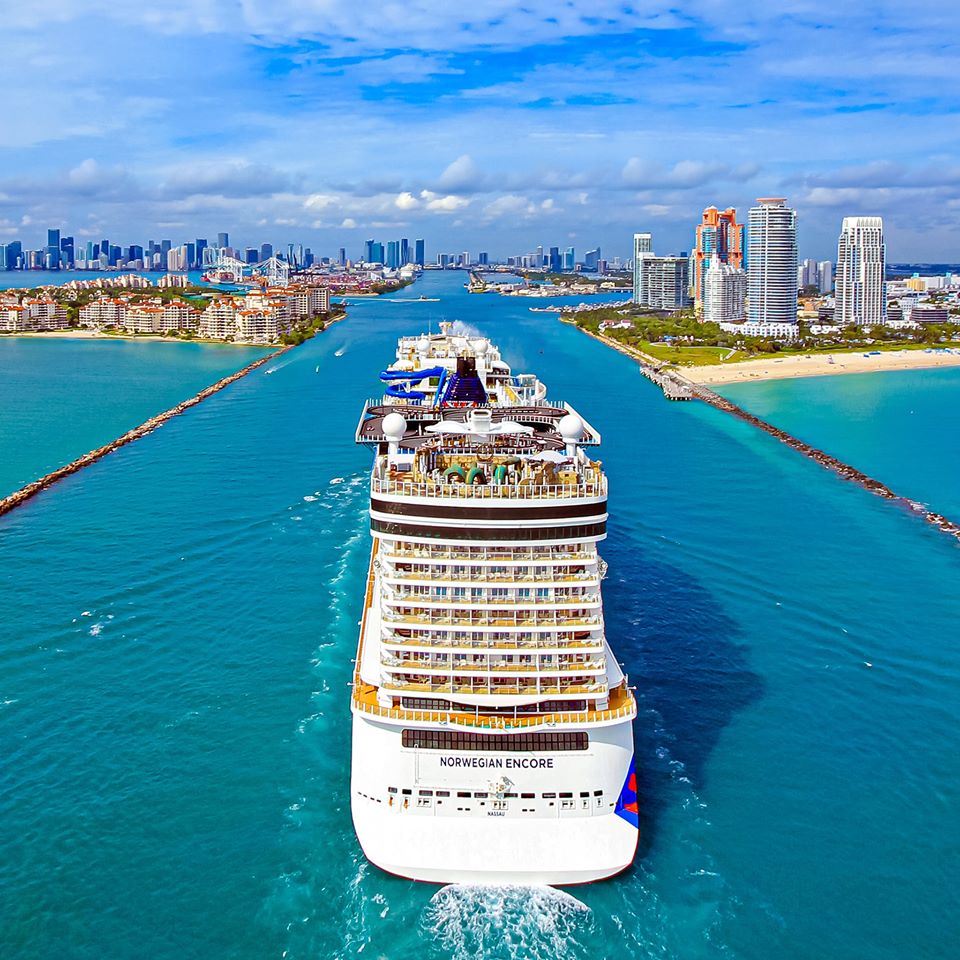
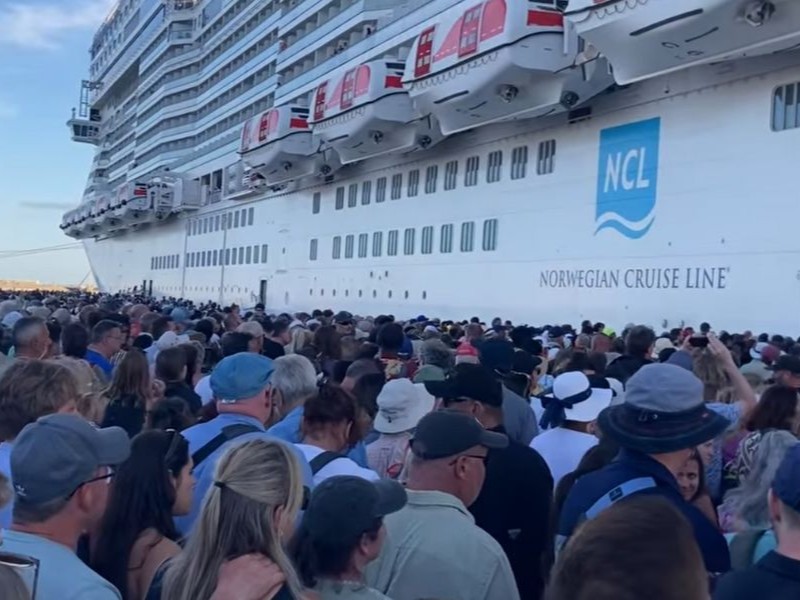
PortMiami traffic has been a problem for a while. Cruise lines have been sending out warning letters to guests on certain cruise days to make sure they leave early enough to not miss their ships.
And with more cruise passengers than ever passing through the “Cruise Capital of the World” (8.5 million in 2025), traffic isn’t going away any time soon.
But do you really need to give yourself 2 hours to get from a Miami hotel to the cruise terminal?
In a recent social media post, one person complained that they had “2 hours to kill because of all the ‘fear mongers” after arriving to the port in just 15 minutes.
And with most cruise lines utilizing different time slots for being able to board the ship, this guest was left waiting in the terminal.
Comments in the Reddit thread pushed back on the idea that 15 minutes is all that was needed to arrive on time, pointing out that depending on the day, traffic can look very different.
After a quick investigation, it appears that this traveler was cruising on a day with only six ships in port.
Not Every Cruise from the Port Means Crazy Traffic
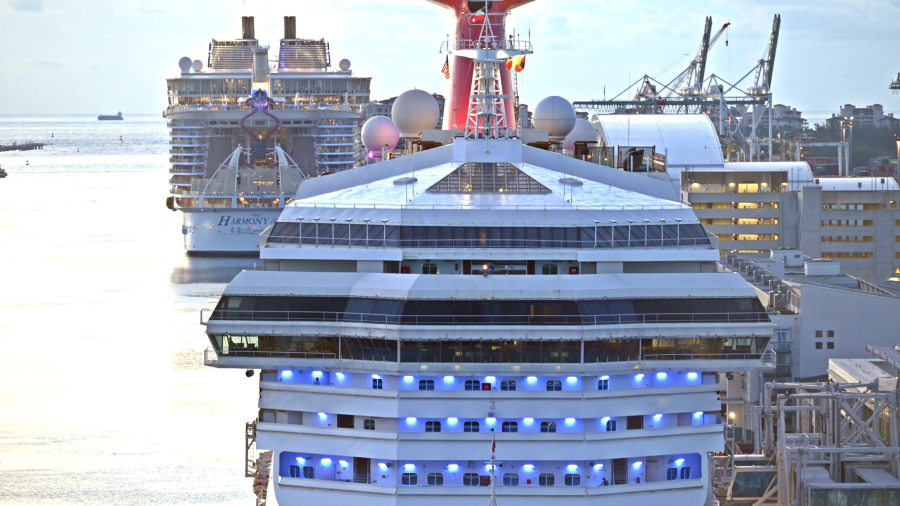
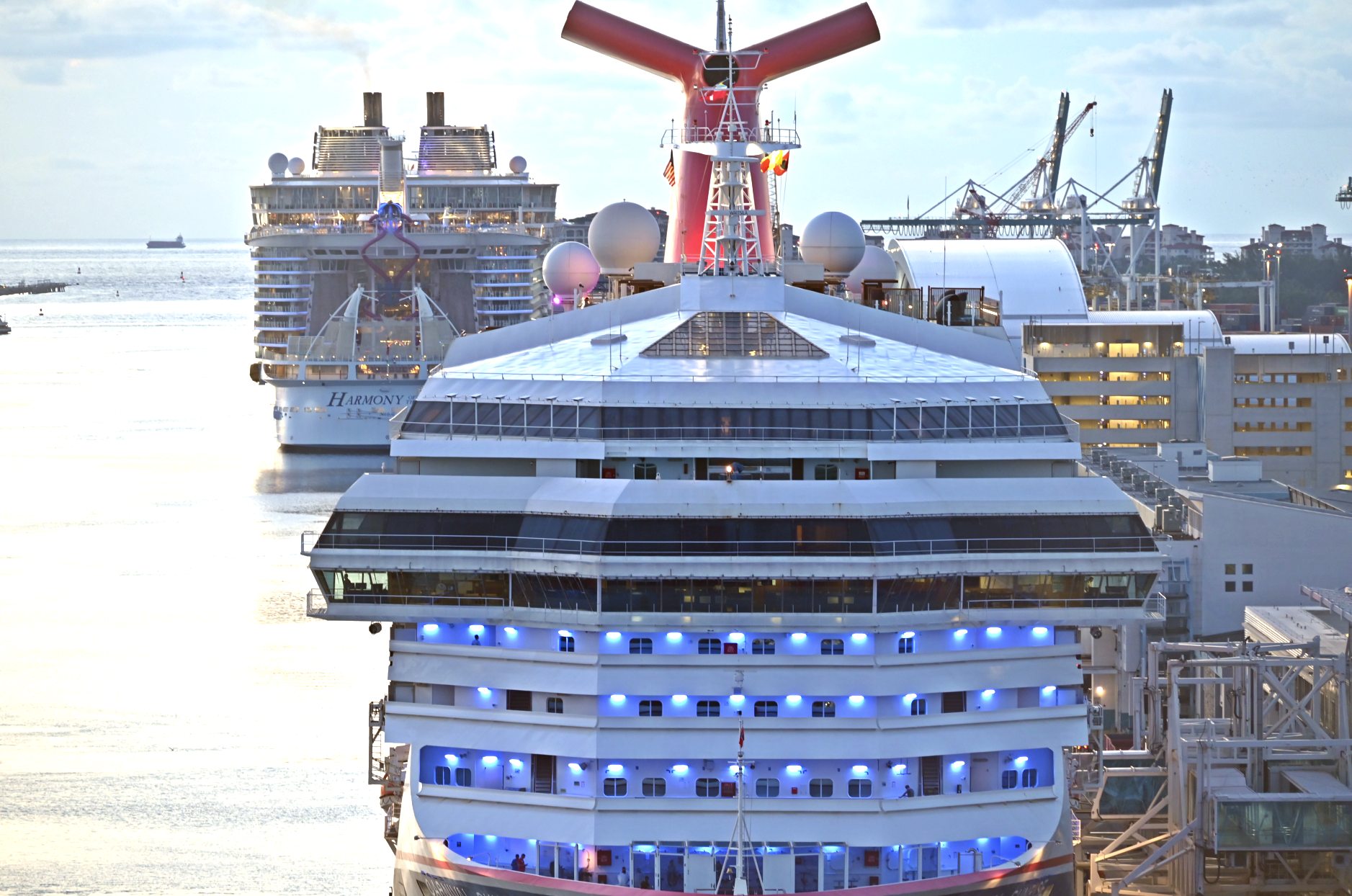
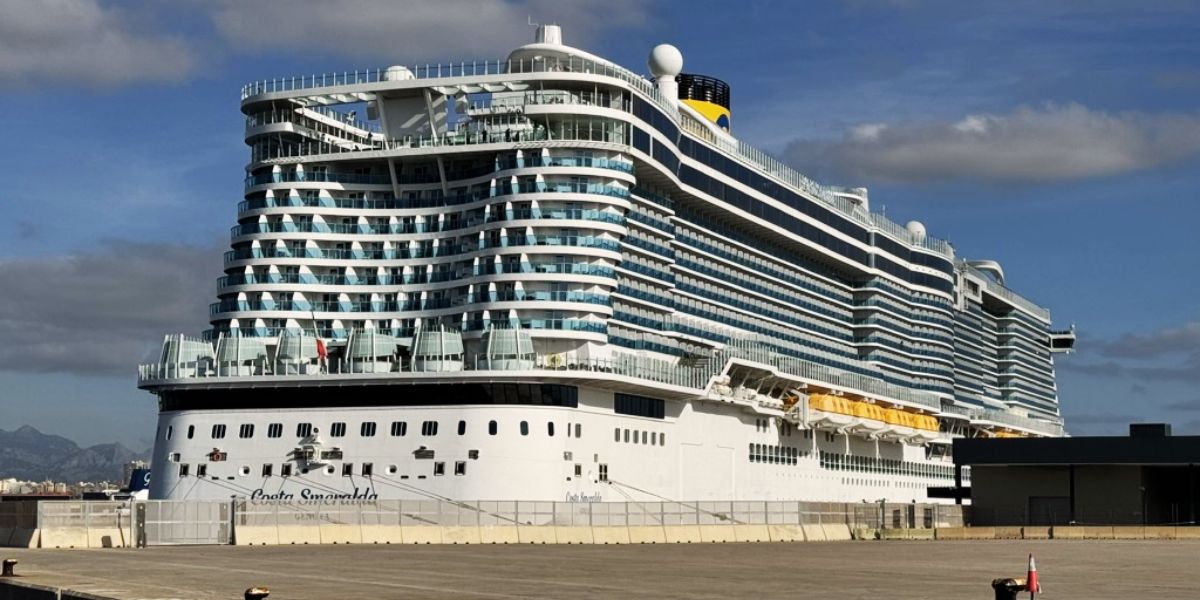
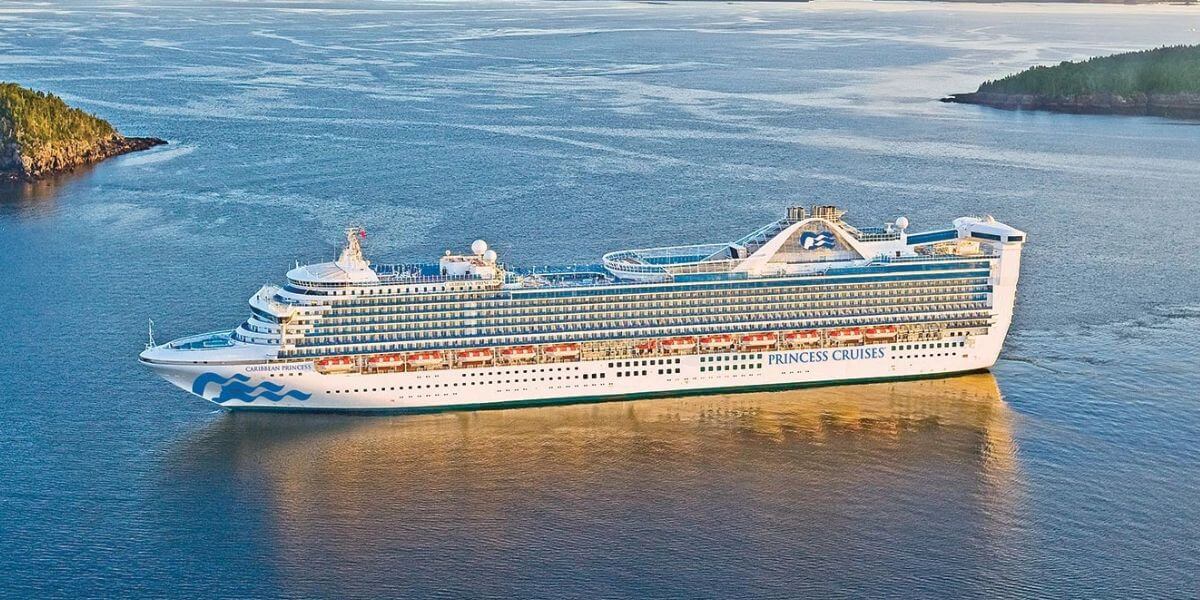
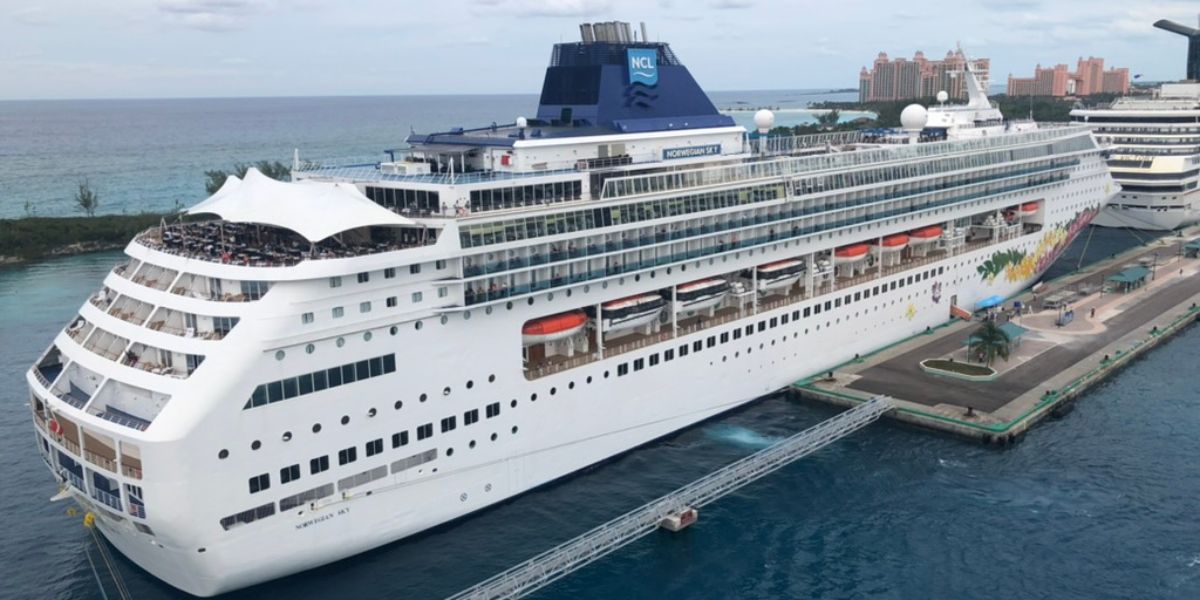
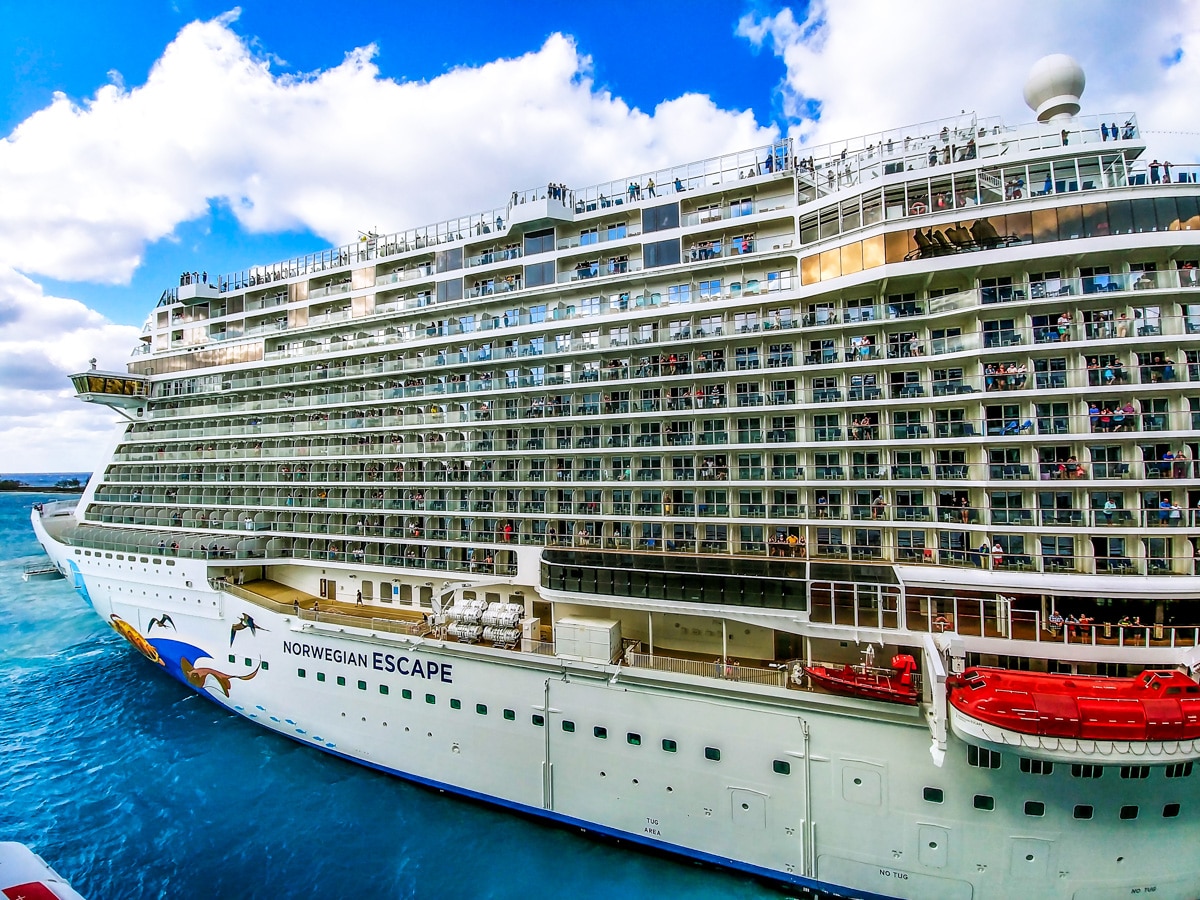
Commenters were quick to note that this particular day was pretty light. With one Oasis-class, one Freedom-class, a Virgin Voyages ship, an NCL Breakaway-class, an MSC Seaside-class, and Carnival Sunshine in port, passenger volume was quite a bit lower than on busy weekends.
In fact, I estimate that with all these ships combined it equals out to about 24,000 to 28,000 passengers. On a turnaround day like this it means roughly 54,000 people or so moving through PortMiami terminals.
Just last November, I wrote about one of PortMiami’s busiest days in which over 75,000 people traveled through the port in a single day.
Multiple cruisers in the comments explained that Fridays, Saturdays, and Sundays (when 9 to 11 ships are often turning around) can bring a lot more people into the port and a lot more traffic.
That’s when the real gridlock happens.
One longtime cruiser with 20+ Miami sailings said it doesn’t always take 1-2 hours, but it certainly can, and they’ve experienced both extremes.
Others shared real-world examples: an hour-plus from NW Broward, delays caused by I-95 accidents, tunnel closures, construction, and big events like the Miami Grand Prix.
The general consensus? “I’d rather be early than late.” Missing your ship would turn a vacation into a nightmare.
Checking the Schedule
I’ve experienced both sides of Miami traffic as well. From a quick and leisurely Uber ride in to a “I hope I make my flight on time” exit from the port, the cruise schedule for the day makes all the difference.
And it’s not just about how many ships are in port, but which ships.
Tools like CruiseMapper, the Port of Miami’s daily dock schedule, or cruise line apps make this easy to check before you travel.
Weekday sailings with fewer or smaller ships are often much smoother, while peak weekend turnarounds with multiple large ships are when the horror stories usually happen.
The social media conversation shows why those alerts exist, and it’s not fear mongering. It’s practical advice based on real experiences. Cruisers have missed their ships because they didn’t take traffic seriously.
Construction in the area and unexpected events can always throw a wrench in plans, so building in a buffer remains the smartest move for most travelers.
The goal is to get passengers there in under 30 minutes and reduce road congestion on busy cruise days.
While still in the planning stages and not yet official, it could eventually become a game-changer for cruisers tired of worrying about traffic.
Bottom Line
The cruiser who arrived in 15 minutes and had two hours to kill ultimately had a great outcome. And there was plenty of time to start relaxing.
But as the many comments from experienced cruisers showed, one smooth trip doesn’t mean the warnings are overblown. PortMiami traffic can truly be a nightmare, but it doesn’t mean you have to freak out.
I like to book a hotel as close as possible to the port and then also check the schedule, and plan ahead based on the sailing day. And if I’m going to err, I’d rather err on the side of arriving early. Better to be ‘bored’ in a cruise terminal than stressed out in an Uber.
Get the latest cruise news, tips, and deals sent straight to your inbox with our free newsletter: Sign Up Now
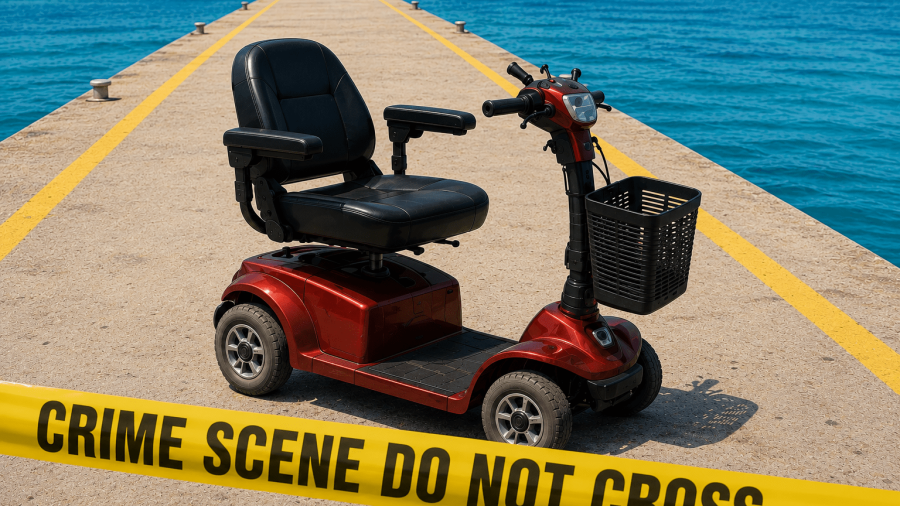
On May 9, 2026, an 88-year-old woman lost her life at Carnival’s Celebration Key destination in the Bahamas. She was riding a mobility scooter on the pier when she fell into the ocean. Her husband, watching it happen, jumped in after her. Despite the efforts of emergency responders, she did not survive.
I have spent my career representing passengers and crew members injured on cruise ships. When I read about what happened at Celebration Key, several things immediately stood out: pier design, a policy gap around mobility scooter training, and a pattern of preventable incidents the industry keeps failing to address. Taken together, they paint a picture of a tragedy that was not just foreseeable. It was foreseen.
The Celebration Key Pier
Celebration Key opened in July 2025 as Carnival’s flagship private destination in the Bahamas. It is a $600 million resort built exclusively for Carnival passengers, and by all accounts, it is stunning. But there is something important missing from that pier: a physical barrier between the walking surface and the ocean.
This is not unique to Celebration Key. Cruise ship piers generally do not have guardrails along the water’s edge because the open space is needed to secure mooring lines and allow gangways to connect. That operational reality is understandable. What is harder to accept is the gap between what passengers experience at Celebration Key versus what they would experience at a pier built under Florida or U.S. standards.
Consider the difference. At PortMiami and Port Everglades, passengers never set foot on an open pier. They move from the terminal directly into the ship through enclosed boarding bridges, essentially airport jetways. A fall into the water is structurally impossible. At ports like Key West, the pier edges are lined with concrete bull rails, raised curbs typically 8 to 12 inches high, that act as a physical stop for anyone who wanders too close or loses control of a wheeled device.
At Celebration Key? The pier surface is flush and open. The only warning is yellow paint on the concrete, and it is not everywhere.
Those design features are not accidents of good planning. In the United States, they are legal requirements. The Americans with Disabilities Act (ADA) mandates that any accessible route, meaning any path that a passenger using a wheelchair or mobility scooter is expected to travel, must be stable, firm, and free of hazards, including unguarded drop-offs. OSHA’s shipyard and marine access standards require fall protection at unprotected edges where workers and passengers face a risk of falling into the water. The Florida Building Code and local county regulations add yet another layer of enforceable requirements on top of that. They are the law, and any pier operating under U.S. jurisdiction must meet them.
Here is what is striking. Carnival operates terminals and piers across the United States and complies with every one of those requirements at each of them. The moment they build a pier in the Bahamas, those protections disappear. Is it because the legal obligation to protect passengers evaporates the moment the project crosses into a foreign jurisdiction? The answer is simple: the legal obligation evaporates the moment the project crosses into a foreign jurisdiction. That is a choice cruise lines make, and passengers deserve to know it. Passengers deserve to know that the safety standards protecting them at their home port may not follow them to their destination.
Under general maritime law, vessel owners and pier operators owe every passenger a duty of reasonable care. Cruise lines are often held to the even higher standard of a common carrier, meaning their obligation to provide safe ingress and egress is non-delegable. When a pier design creates a condition where a person using a mobility device, or a small child walking with her family, can go over the edge with nothing to stop them, that is a question worth asking in a courtroom.
International engineering standards for cruise terminals, specifically PIANC guidelines, recommend physical edge stops such as bull rails or curbs, precisely to prevent wheeled traffic from going over unprotected edges. These are recognized best practices that Celebration Key, as a brand-new, $600 million facility, had every opportunity to incorporate.
The Mobility Scooter: Who Is Responsible When Nobody Teaches You How to Use It?
The second issue this tragedy raises involves mobility scooters and the way cruise lines handle them.
Carnival, like most major cruise lines, encourages passengers who need mobility assistance to bring their own scooter or rent one through its preferred vendor, Scootaround. The rental process is simple: you book online or by phone, and in most cases the scooter is waiting in your stateroom when you board. That sounds convenient, and for many passengers it is a genuine lifeline. Without it, they could not enjoy a cruise vacation at all.
But here is what no one tells you: there is no training.
Carnival’s own published policies address scooter dimensions, battery types, storage requirements, and corridor rules in considerable detail. What you will not find anywhere in those policies is a requirement that passengers demonstrate they know how to operate the device safely, or that anyone from Carnival or Scootaround walks them through the controls before they head out onto a borderless, curbless pier.
Scootaround describes its staff as “trained professionals” who help passengers select the appropriate mobility scooter for their needs. But selecting a scooter is very different from training someone how to safely operate it aboard a cruise ship. There does not appear to be any routine hands-on instruction, safety demonstration, or individualized guidance for elderly or first-time users navigating crowded terminals, sloped gangways, tight ship corridors, or areas near open edges.
The investigation has yet to reveal whether the passenger who died on May 9 owned her scooter or rented it from the cruise line. We do not know whether she was experienced with the device or was using one for the first time on this trip. The autopsy results have not been released, and the investigation is ongoing. But those questions matter enormously, both to understanding what happened and to determining who bears responsibility for it.
A cruise ship is not a shopping mall or a hospital corridor. It involves motion, wet surfaces, inclines, gangways, crowded decks, and tight transitions. The open pier at a destination like Celebration Key adds yet another layer of complexity. Placing an elderly passenger on a mobility scooter in that environment, with no verification of their ability to operate it and no physical safeguards at the pier’s edge, is a combination that the industry should have addressed long before now.
When Two Failures Become One Tragedy
Here is what I think is critical to understand, and what I believe any jury would understand as well.
Neither of these failures, the unprotected pier edge or the absence of scooter training, had to be catastrophic on its own. But Carnival made both choices simultaneously. They built a pier with no physical edge protection. And they actively encourage passengers with limited mobility to rent motorized scooters, deliver those scooters with zero operational instruction, and send those passengers out onto that same pier.
You do not need to be a safety engineer or a prophet to know where that leads. You just need to pay attention.
And here is what makes this legally significant: Carnival had already been put on notice. On December 21, 2025, less than five months before this woman died, a four-year-old child fell off the same pier and into the water between the ship and the dock. Her mother jumped in after her. The story went viral, made international news: Carnival was aware.
In the law, we call that notice. Before December, a defense attorney might have argued that Carnival could not have anticipated the danger. After December, that argument no longer exists. The company knew the pier edge was creating serious risk for guests. This is not Murphy’s Law. This is a foreseeable outcome that followed from two documented, deliberate design and policy choices. And it will continue to happen until those choices are reversed.
What Needs to Change
The fixes here are not complicated. Celebration Key needs physical edge protection, whether bull rails, raised curbs, or another engineered solution that creates a mechanical stop before the waterline. That is not a radical ask for a $600 million facility. It is standard practice at virtually every comparable pier operating under U.S. jurisdiction.
And the cruise industry needs to take scooter safety seriously. That means a mandatory operational briefing for any passenger renting or bringing a motorized scooter aboard, particularly elderly or first-time users. Mobility-challenged passengers deserve an actual conversation with an actual human being before someone drives off a pier.
What This Means for Passengers
If you or someone in your family uses a mobility scooter on a cruise, please take this seriously. Ask questions before you board. Understand how the device operates, including how to brake quickly and how it handles on inclines. Be especially cautious near any open pier edge, where yellow lines may be the only thing standing between you and the water.
The woman who died at Celebration Key on May 9 was someone’s wife, someone’s mother, possibly someone’s grandmother. She was on vacation. She deserved better protection than a stripe of yellow paint on a concrete pier. So does every passenger who follows her onto that dock.
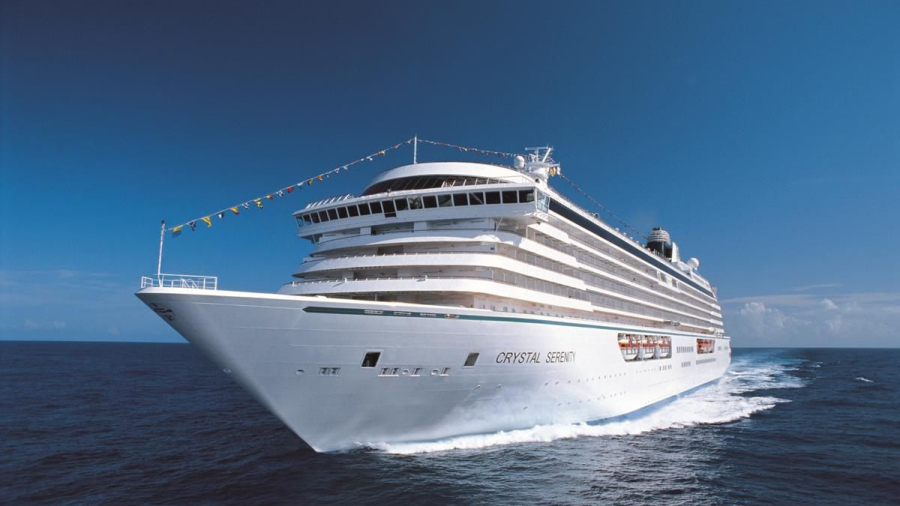
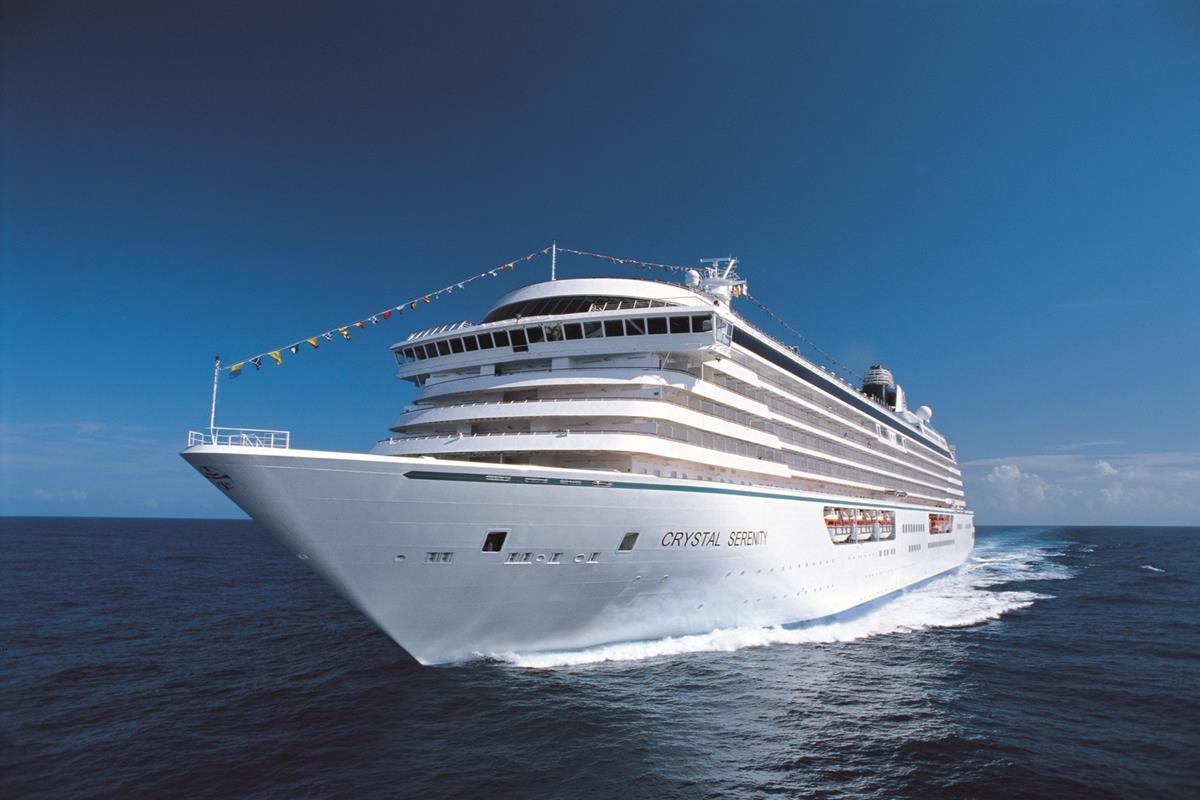
Crystal Cruises has announced that Crystal Serenity will go into dry dock later this year for a renovation and general maintenance.
The ship’s three-week dry dock will take place in October 2026, and several areas of the vessel will receive a refurbishment.
The project will be focused on refining the onboard experience through various updates to the Aquamarine Classic Suite category and several key public spaces.
The drydock will see a complete refit of the Aquamarine Classic Suites living area and bathrooms on Deck 10.
While preserving their existing layout and spacious bathrooms featuring separate bathtub and shower configurations, these suites will be outfitted with new furnishings, aligning with the design style introduced during the ship’s 2023 transformation.
Public spaces on the ship that will receive a renovation include the following:
New pool bar on Deck 12
Atrium and Crystal Cove
Waterside Restaurant
Stardust Club
Seahorse Pool
Marketplace
The cruise ship will also receive technical upgrades that will optimize performance, efficiency and environmental responsibility.
These improvements are intended to maintain the highest operational standards while helping to reduce fuel and water consumption, lower emissions and minimize environmental impact.
Bernie Leypold, senior vice president of hotel operations for Crystal, gave the following statement:
“Following the successful drydock of Crystal Symphony, our work aboard Crystal Serenity is guided first and foremost by the guest experience. These enhancements underscore our commitment to creating meaningful, memorable experiences for our guests at every touchpoint, while ensuring that Crystal Serenity continues to feel as welcoming and enriching as the journeys themselves.”
Crystal Serenity will return to service on November 8, 2026, a 15-day Transatlantic cruise from Lisbon to Fort Lauderdale, Florida. Once the ship is in Florida, it will offer winter cruises to the Caribbean.
Get the latest cruise news, tips, and deals sent straight to your inbox with our free newsletter: Sign Up Now
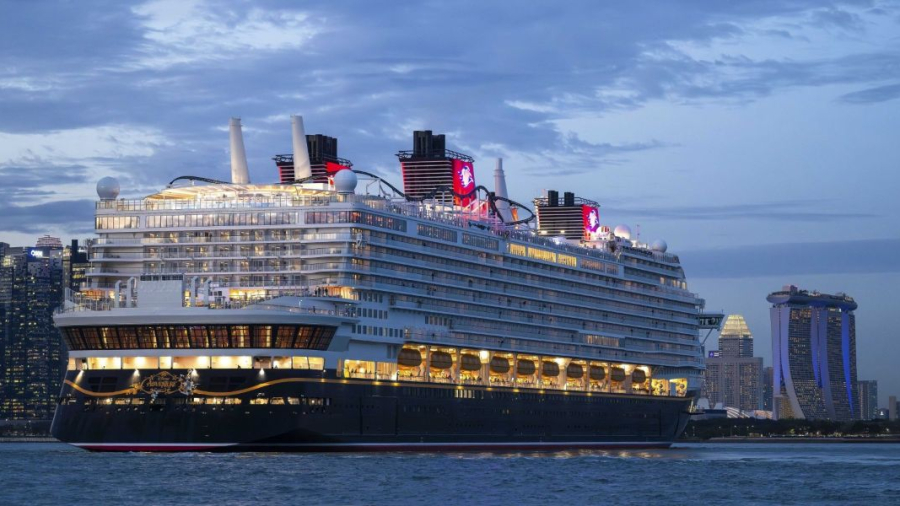
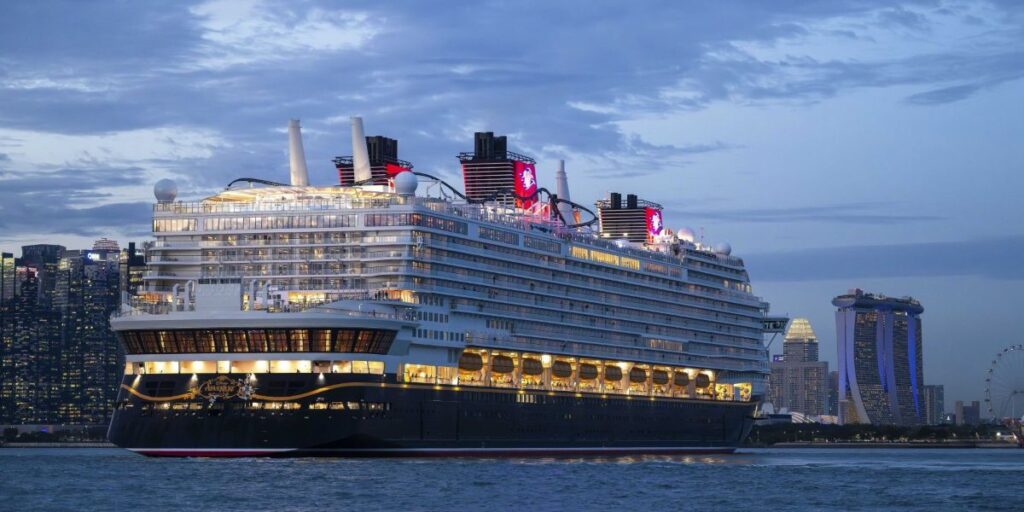
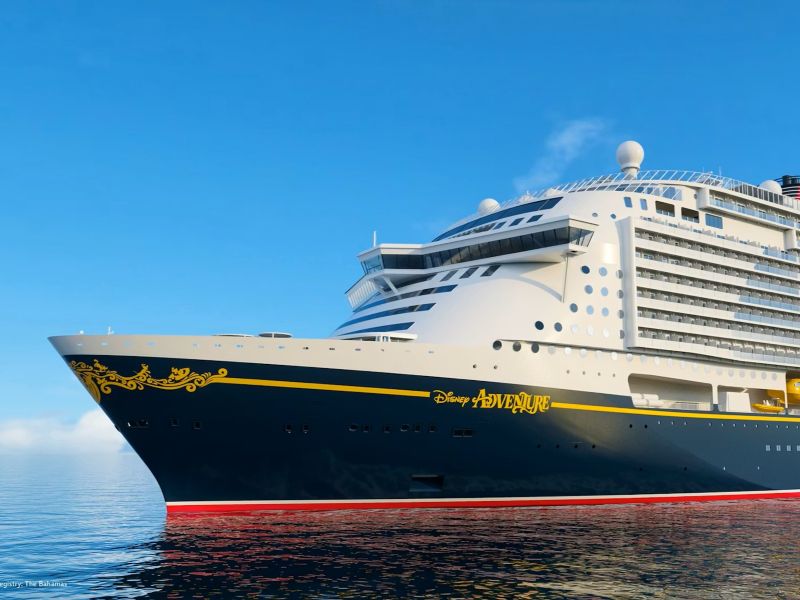
Disney Cruise Line was forced to cancel a sailing of its newest and largest ship, Disney Adventure, after thousands of guests had already boarded and spent a night onboard in Singapore.
The 208,100-gross-ton vessel had been due to depart on a four-night cruise to nowhere from Marina Bay Cruise Centre on 7th May 2026. Instead, passengers were informed the following afternoon that the sailing would no longer go ahead because of technical problems affecting the ship.
In a letter delivered to staterooms, Disney Cruise Line told guests: “We are truly sorry to let you know that we are unable to proceed with your Disney Adventure experience from May 7-11, 2026 as planned.”
The cruise line instructed guests to prepare their belongings for disembarkation and confirmed that luggage tags would be delivered directly to cabins.
Passengers were offered a full refund for the cancelled cruise, including unused onboard purchases such as internet and beverage packages. Disney Cruise Line also provided guests with a 50% future cruise credit for another sailing.
Additional compensation included complimentary hotel accommodation in Singapore for one night, reimbursement for flight change fees, and up to $500 per stateroom for incidental expenses. Free WiFi was also made available onboard so guests could rearrange onward travel plans.
Guests were later transported from the ship to hotels across Singapore via complimentary shuttle services.
Reports from passengers onboard suggested the issue involved the ship’s propulsion system, though Disney Cruise Line did not publicly confirm the exact technical fault.
One guest onboard wrote on Reddit: “After embarking the cruise yesterday, we were informed by the captain that the cruise is having some technical issues and engineers are working and that we will set sail soon.”
The same guest later added: “Today at approx 2pm Singapore time the captain announced that they are cancelling the adventure.”
While many guests were understandably frustrated by the sudden cancellation, several passengers praised Disney Cruise Line for how it handled the situation once the decision had been made.
One guest described the operation as “a highly logistically organized chaotic situation” as passengers were transferred to luxury hotels including the Fairmont, JW Marriott, Swissôtel and Shangri-La properties across Singapore.
Another passenger shared details of the support being provided after arriving at their assigned hotel.
“This has been a pretty seamless experience,” the guest wrote. “At the hotel there was a team waiting for us to answer all our questions and help us get a (second) dinner (Disney paid).”
The guest added that Disney had also provided a $200 hotel credit alongside the previously announced compensation package.
Disney Adventure is the newest ship in Disney Cruise Line’s fleet and only entered service in March 2026. The vessel operates short three- and four-night cruises from Singapore without visiting any ports, instead focusing entirely on onboard entertainment and themed experiences.
Because the cruises are centred completely around the ship itself, any major technical issue affecting onboard operations would significantly impact the guest experience.
Return To Service Went Ahead As Planned
Despite concerns that the cancellation could affect future departures, Disney Adventure returned to service just days later.
The ship departed Singapore on schedule on 11th May 2026 for a three-night sailing after undergoing tests in open waters on 9th May.
Tracking data showed the vessel travelling at a slower-than-usual speed of around eight knots, though that is less significant for cruises to nowhere which do not operate on strict port schedules.
One guest booked on the resumed sailing confirmed online: “Yes. Sailing confirmed. Ship docked yesterday – sorted and ready to sail.”
Disney Cruise Line has not announced any further cancellations or itinerary changes for upcoming Disney Adventure sailings from Singapore.
Get Expert Help Planning Your Disney Cruise
Get your trip planned to perfection, at no extra cost
Related Posts
If you found this interesting, please share!
A cruise director has been awarded around €130,000 after court ruled that the company unlawfully kept him on temporary contracts for 18 years despite using him as a long-term employee….
MSC Cruises is expanding its new AI-powered MSC Concierge across its entire fleet after a large-scale trial generated more than one million guest messages and achieved a 93 percent satisfaction…
Norovirus has struck another cruise ship, with more than 100 passengers and crew members falling ill onboard Caribbean Princess during its current Caribbean sailing. According to the US Centers for…
Norwegian Cruise Line Holdings has cut its 2026 profit forecast after warning that higher fuel costs, weaker demand and earlier booking problems are putting pressure on the business. The company,…
Disney Cruise Line’s special offers this week now extend through October 2026 — with 61 different sail dates available from a variety of departure ports, including Barcelona, Civitavecchia, Fort Lauderdale, Port Canaveral, and Vancouver. Additional special offers are also available across the domestic fleet for these sailings.
The Disney Wish continues to lead the fleet with 34 sailings (up 4 from last week), followed by the Disney Magic, which dipped 1 to 18 sailings. The Disney Treasure eased 3 to 22 sailings, while the Disney Wonder dropped sharply 11 to just 3 sailings. The Disney Destiny gained 1 to 8 sailings, the Disney Dream fell 2 to 6 sailings, and the Disney Fantasy held steady at 5 sailings.
The Florida Resident rate jumped 2 sailings for a total of 25, the US Military Personnel offer dropped 13 to 47 sailings while the Canadian Resident offer dropped 1 to 24 sailings. The special bonus US Military offer for $250 onboard credit, announced in November, for select sailings in 2026 remains available.
Finally, the extra savings for those with placeholder reservations where the standard 10% is applicable for some concierge levels on select sailings and a bump in the discount up to 25% off on select sailings remain active.
The special offers listed below are available to book today while inventory lasts.
Special Offers for U.S. Military Personnel
Special Rates for U.S. Military Personnel (MTO) are limited to 50 staterooms per category and sailing. Pricing varies, the lowest priced category per person per night listed below. New sailings added this week are in bold. To take advantage of military cruise rates, at least one adult in each stateroom must provide Proof of Military Service. Please note: This offer cannot be combined with any other special offers or discounts. Valid for new bookings only.
Disney Destiny
4-Night Bahamian Cruise from Fort Lauderdale Fort Lauderdale, Florida • Nassau, Bahamas • Castaway Cay • At Sea
5-Night Bahamian Cruise from Fort Lauderdale Fort Lauderdale, Florida • Castaway Cay • Nassau, Bahamas • Lookout Cay • At Sea
5-Night Western Caribbean Cruise from Fort Lauderdale Fort Lauderdale, Florida • At Sea • Cozumel, Mexico • At Sea • Castaway Cay
7-Night Eastern Caribbean Cruise from Fort Lauderdale Fort Lauderdale, Florida • Lookout Cay • At Sea • San Juan, Puerto Rico • Philipsburg, St. Maarten • At Sea • At Sea
7-Night Western Caribbean Cruise from Fort Lauderdale Fort Lauderdale, Florida • Lookout Cay • Castaway Cay • At Sea • Cozumel, Mexico • Grand Cayman • At Sea
Disney Dream
12-Night Mediterranean with Greek Isles Cruise from Civitavecchia ending in Barcelona Civitavecchia (Rome), Italy • At Sea • Messina (Sicily), Italy • Corfu, Greece • At Sea • Mykonos, Greece • Piraeus (Athens), Greece • Rhodes, Greece • Rhodes, Greece • At Sea • Valletta, Malta • At Sea
7-Night Mediterranean Cruise from Barcelona Barcelona, Spain • At Sea • Naples, Italy • Civitavecchia (Rome), Italy • Livorno, Italy • Ajaccio, France • At Sea
7-Night Mediterranean Cruise from Barcelona Barcelona, Spain • At Sea • Livorno, Italy • Civitavecchia (Rome), Italy • Naples, Italy • Cagliari, Italy • At Sea
9-Night Mediterranean with Greek Isles Cruise from Barcelona ending in Civitavecchia Barcelona, Spain • At Sea • Messina (Sicily), Italy • At Sea • Piraeus (Athens), Greece • Santorini, Greece • Mykonos, Greece • Chania, Greece • At Sea
9-Night Mediterranean with Greek Isles Cruise from Civitavecchia Civitavecchia (Rome), Italy • At Sea • Chania, Greece • Mykonos, Greece • At Sea • Dubrovnik, Croatia • Corfu, Greece • Valletta, Malta • Valletta, Malta
Disney Fantasy
5-Night Bahamian Cruise from Port Canaveral Port Canaveral, Florida • Nassau, Bahamas • Lookout Cay • At Sea • Castaway Cay
5-Night Bahamian Cruise from Port Canaveral Port Canaveral, Florida • Nassau, Bahamas • Castaway Cay • Lookout Cay • At Sea
Disney Magic
7-Night Alaskan Cruise from Vancouver Vancouver, Canada • At Sea • Glacier Viewing (Stikine Icecap), Alaska • Skagway, Alaska • Icy Strait Point, Alaska • Ketchikan, Alaska • At Sea
7-Night Eastern Caribbean Cruise from Port Canaveral Port Canaveral, Florida • At Sea • At Sea • Tortola, British Virgin Islands • St. Thomas, USVI • At Sea • Castaway Cay
7-Night Western Caribbean Cruise from Port Canaveral Port Canaveral, Florida • At Sea • Cozumel, Mexico • Grand Cayman • Falmouth, Jamaica • At Sea • Castaway Cay
Disney Wish
3-Night Bahamian Cruise from Port Canaveral Port Canaveral, Florida • Castaway Cay • At Sea
3-Night Bahamian Cruise from Port Canaveral Port Canaveral, Florida • Nassau, Bahamas • Castaway Cay
4-Night Bahamian Cruise from Port Canaveral Port Canaveral, Florida • Castaway Cay • Lookout Cay • At Sea
4-Night Bahamian Cruise from Port Canaveral Port Canaveral, Florida • Nassau, Bahamas • Lookout Cay • At Sea
4-Night Bahamian Cruise from Port Canaveral Port Canaveral, Florida • Nassau, Bahamas • Castaway Cay • At Sea
4-Night Bahamian Cruise from Port Canaveral Port Canaveral, Florida • At Sea • Lookout Cay • Castaway Cay
Disney Wonder
5-Night Pacific Coast Cruise from Vancouver to San Diego Vancouver, Canada • Victoria, Canada • At Sea • At Sea • At Sea
Special military rates are available to retired and active US military personnel (and their spouses), including US Coast Guard, US National Guard and US Military Reserves. Members of the US National Guard or the US Military Reserves (or their spouses) must show active-duty orders dated January 1st of the previous year to qualify. Third and fourth Guest prices valid with 2 full-fare Guests in the same stateroom. Rates may vary by sail date and category. Other restrictions may apply. Other categories and sail dates may be available. To take advantage of military cruise rates, at least one adult in each stateroom must provide Proof of Military Service. Active and retired members (or spouse) of the US military must provide valid identification at time of check-in. Valid for new bookings only.
Special Offers for Florida Residents
Special Rates for Florida Residents (FLR) are limited to 50 staterooms per category and sailing. Pricing varies, the lowest priced category per person per night listed below. New sailings added this week are in bold. Please note: This offer cannot be combined with any other special offers or discounts. Valid on new and existing reservations.
Disney Destiny
4-Night Bahamian Cruise from Fort Lauderdale Fort Lauderdale, Florida • Nassau, Bahamas • Castaway Cay • At Sea
5-Night Western Caribbean Cruise from Fort Lauderdale Fort Lauderdale, Florida • At Sea • Cozumel, Mexico • At Sea • Castaway Cay
Disney Fantasy
5-Night Bahamian Cruise from Port Canaveral Port Canaveral, Florida • Nassau, Bahamas • Castaway Cay • Lookout Cay • At Sea
Disney Treasure
7-Night Eastern Caribbean Cruise from Port Canaveral Port Canaveral, Florida • At Sea • At Sea • Tortola, British Virgin Islands • St. Thomas, USVI • At Sea • Castaway Cay
7-Night Western Caribbean Cruise from Port Canaveral Port Canaveral, Florida • At Sea • Cozumel, Mexico • Grand Cayman • Falmouth, Jamaica • At Sea • Castaway Cay
Disney Wish
3-Night Bahamian Cruise from Port Canaveral Port Canaveral, Florida • Nassau, Bahamas • Castaway Cay
3-Night Bahamian Cruise from Port Canaveral Port Canaveral, Florida • Castaway Cay • At Sea
4-Night Bahamian Cruise from Port Canaveral Port Canaveral, Florida • Nassau, Bahamas • Lookout Cay • At Sea
4-Night Bahamian Cruise from Port Canaveral Port Canaveral, Florida • Nassau, Bahamas • Castaway Cay • At Sea
To take advantage of Florida residency cruise rates, proof of Florida Residency for at least one adult in each stateroom must be presented at time of check-in. Guests unable to show proper proof of Florida residency at check-in will have their cruise re-priced and the balance must be paid before being allowed to sail.
Proof of residency must be valid at the time of sailing, and includes the following:
Florida Driver’s License
Florida Identification Card
If you do not have one of the IDs indicated above, then you must provide one of the following—dated within the past 2 months—verifying a Florida residential address and your name, along with a corresponding, valid government-issued photo ID (such as passport, driver’s license, state identification card):
Monthly mortgage statement
Renter’s lease agreement
Current automobile registration, insurance policy or bill
Current homeowner’s insurance policy or bill
Current utility bill (power/phone/cable/water)
Mail from a financial institution, including checking, savings or investment account statements
Mail from a federal, state, county or city government agency
Note: property deeds and P.O. boxes are not considered acceptable proofs of residency.
Children’s rates are also available to Guests ages 3 through 12 that are traveling with 2 adults in the same stateroom.
Canadian Resident Rates
Special Rates for Canadian Residents with savings on prevailing rates as quoted on Disneycruise.com for non-concierge Verandah, Oceanview, and Inside Staterooms on select cruises. Pricing varies, the lowest priced category per person per night listed below. New sailings added this week are in bold. Proof of residency is required an you must mention the special offer code CAN when booking. NOTE: Offers may be applied to existing bookings if requested when calling in. This offer cannot be combined with any other special offer or discounts, or onboard credits.
Disney Fantasy
4-Night Bahamian Cruise from Port Canaveral Port Canaveral, Florida • Nassau, Bahamas • Lookout Cay • At Sea
5-Night Bahamian Cruise from Port Canaveral Port Canaveral, Florida • Nassau, Bahamas • Lookout Cay • At Sea • Castaway Cay
Disney Magic
4-Night Pacific Coast Cruise from Vancouver ending in San Diego Vancouver, Canada • At Sea • At Sea • At Sea
7-Night Alaskan Cruise from Vancouver Vancouver, Canada • At Sea • Glacier Viewing (Stikine Icecap), Alaska • Skagway, Alaska • Icy Strait Point, Alaska • Ketchikan, Alaska • At Sea
Disney Treasure
7-Night Eastern Caribbean Cruise from Port Canaveral Port Canaveral, Florida • At Sea • At Sea • Tortola, British Virgin Islands • St. Thomas, USVI • At Sea • Castaway Cay
7-Night Western Caribbean Cruise from Port Canaveral Port Canaveral, Florida • At Sea • Cozumel, Mexico • Grand Cayman • Falmouth, Jamaica • At Sea • Castaway Cay
Disney Wish
3-Night Bahamian Cruise from Port Canaveral Port Canaveral, Florida • Castaway Cay • At Sea
3-Night Bahamian Cruise from Port Canaveral Port Canaveral, Florida • Nassau, Bahamas • Castaway Cay
4-Night Bahamian Cruise from Port Canaveral Port Canaveral, Florida • Nassau, Bahamas • Lookout Cay • At Sea
4-Night Bahamian Cruise from Port Canaveral Port Canaveral, Florida • Nassau, Bahamas • Castaway Cay • At Sea
Disney Wonder
7-Night Alaskan Cruise from Vancouver Vancouver, Canada • At Sea • Glacier Viewing (Stikine Icecap), Alaska • Skagway, Alaska • Juneau, Alaska • Ketchikan, Alaska • At Sea
The Canadian Resident rate excludes suites and categories with restrictions (VGT, OGT, and IGT). Proof of Canada residency will be required at time of check-in. Taxes, Fees and Port Expenses are not included. If booking through Disney Cruise Line’s Contact Center, you must mention code CAN. Offers may be applied to existing bookings if requested by caller. This offer cannot be combined with any other special offer or discounts, or onboard credits. Offer valid for new and existing reservations.
Please note, the offers listed are not to be taken as official quotes. Prices and availability can change at any time without notice. More importantly, the deals listed above are a snapshot in time based on DCL’s online cruise search tool.
Last but certainly not least, I wanted to invite you to consider joining us on an upcoming DCL Blog Group Cruise! This summer, we are heading to Fort Lauderdale to sail to the Western Caribbean on the all new Disney Destiny. Click here to learn more out this group opportunity. We look forward to seeing you aboard.
Norwegian Cruise Line is now offering their first ever First Responder Discount that gives police officers, firefighters and EMTs cheaper cruise fares.
This new First Responder Discount from NCL compliments their existing community programs that offers discounts to members of the military and teachers.
This new 5% discount on Norwegian cruise ships was created exclusively for first responders in the United States and Canada. It offers a 5% discount on all cruises or a 15% discount on select sailings.
The discount is for both active and retired first responders.
Marc Kazlauskas, president of Norwegian Cruise Line, gave the following statement about this new discount:
“Every day, first responders, teachers and members of the military put others first. We’re proud to honor them with these new and enhanced deals, so they can enjoy the kind of vacation they truly deserve.”
Norwegian Cruise Line’s year-round Military Appreciation Program honors veteran and active military members in the United States and Canada with a special military reception onboard, exclusive challenge coins as well as a 10% discount off voyage fares.
In recognition of Military Appreciation Month in May, Norwegian has expanded the program’s perks to offer 20% off voyage fare on select sailings for a limited time.
Additionally, for the first time ever, military guests on these select voyages can extend their 20% discount to non-military travel companions sailing with them in separate staterooms, making it easier for friends and family to vacation together.
To take advantage of the First Responder Discount, Military Appreciation Program, or Teacher Cruise Discount, eligible guests must register and verify through ID.me.
Get the latest cruise news, tips, and deals sent straight to your inbox with our free newsletter: Sign Up Now
Holland America Line probably isn’t the first cruise line that comes to mind for a family holiday.
There are no waterslides. No go-karts. And certainly no ziplines.
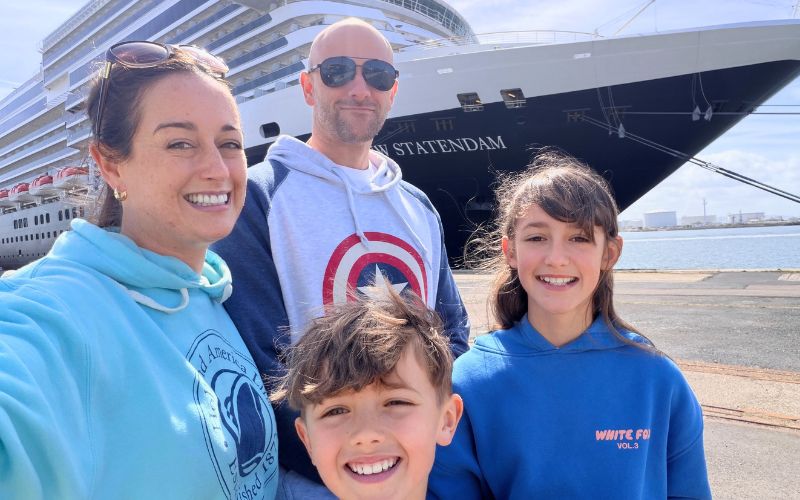
In fact, before I boarded Holland America Line’s Nieuw Statendam for a two-week transatlantic cruise with my kids, I was genuinely worried they might be bored.
And honestly? I couldn’t have been more wrong.
Not only did my kids have a fantastic time, but it also turned out to be one of the most relaxing family cruises we’ve ever taken. The biggest surprise of all was that there were fewer than ten children onboard… and that actually made the experience better.
Note: We paid for this cruise, Holland America kindly offered us a discounted media rate.
Why Most Families Don’t Choose Holland America Line
Holland America Line has a reputation for attracting older guests. Compared with cruise lines like Royal Caribbean International or MSC Cruises, the atmosphere is definitely calmer and quieter.
On our sailing, most passengers were retirees enjoying the long and leisurely transatlantic crossing.
I knew that would be the case, but as we were sailing to the UK in the Easter school holidays, I thought that there might be plenty of kids too.
I was so wrong!
After boarding, we headed to the kids club to register them and I asked how many other kids there would be in the club. The answer was five. Our two, plus three more. Wow.
We also spotted a couple of toddlers and a couple of teenagers, but that was it.
This was set to be a very different kind of family cruise experience from their last cruise, which was a week onboard Royal Caribbean’s original mega ship, Oasis of the Seas.
Transatlantic cruises naturally attract an older crowd. Two weeks at sea with lots of sea days isn’t every family’s idea of a holiday.
I noticed something similar last year on a Holland America cruise to Iceland from the UK. Even during peak summer holidays, there were still only a handful of children onboard.
So why do families not choose Holland America Line?
From chatting to other guests and crew members, it seems that some do. But it’s mostly American families on shorter itineraries.
The week before our sailing, during US Spring Break, the same ship reportedly had several hundred children onboard.
Like any cruise, the number of kids depends heavily on the itinerary and school holiday dates.
But for British families wanting a cruise that feels family-friendly without being chaotic, a Holland America Line sailing from Dover could actually be an ideal choice.
NEW DEALS JUST RELEASED!
Don’t miss the latest Holland America Line offers…
The Kids Club Was Surprisingly Good
I didn’t expect my kids to be particularly excited about the kids club on Holland America Line.
With more than 20 cruises under their belts, they’ve become quite picky. If they don’t enjoy a kids club, they simply won’t go.
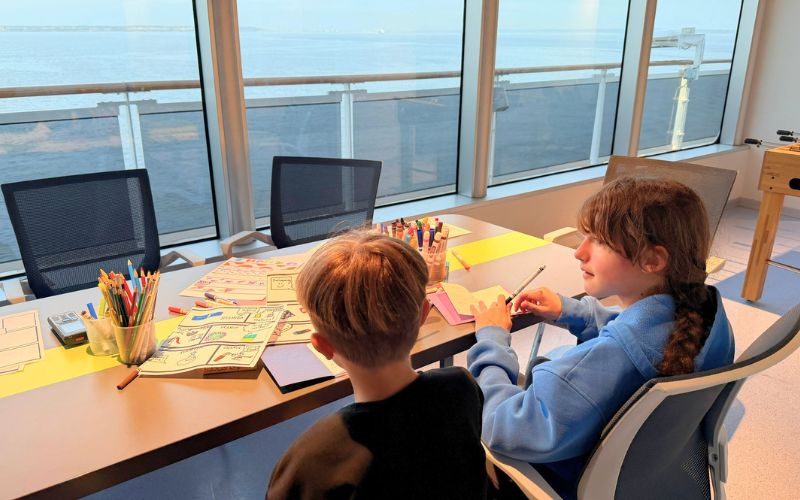
But they genuinely loved Club HAL and chose to spend several hours there most days.
The space itself isn’t huge compared with mega-ships, but the activities were really well organised.
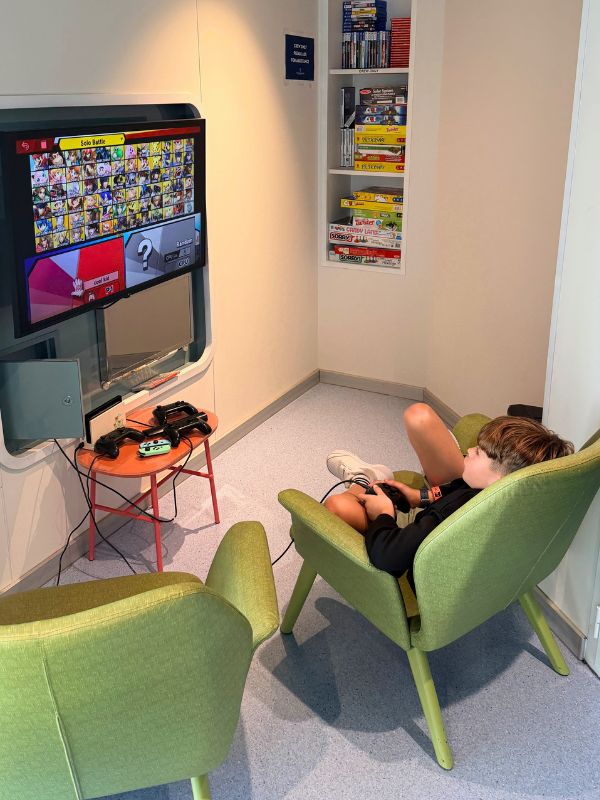
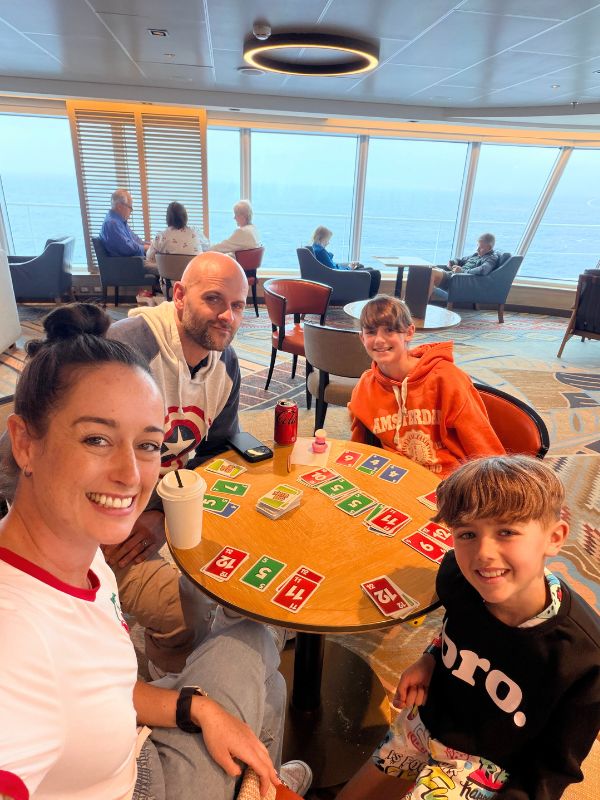
There were craft sessions, board games and video games. My daughter opted for crafts most of the time, and came home with a huge folder of artwork at the end of the cruise. My son opted to mostly play on the Xbox, and the chair in the corner became known as “Adam’s chair”.
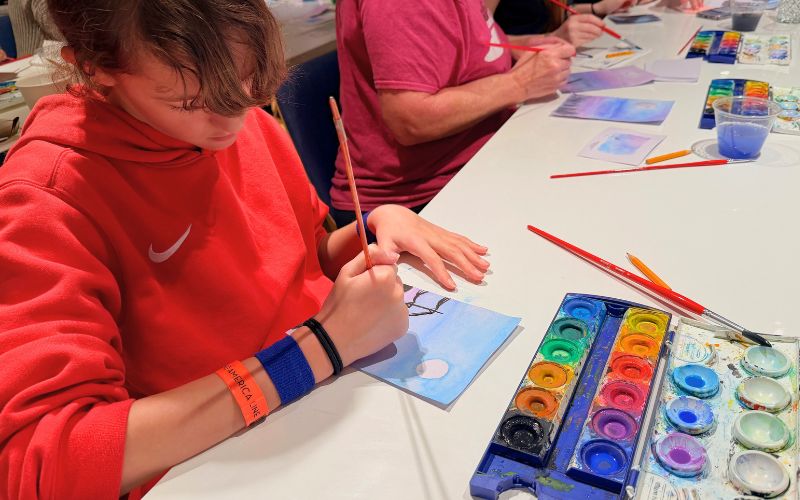
The staff were fantastic too and we got to know them all really well. As well as running the kids club, they had other jobs like hosting quizzes, sports and painting classes. They always took the time to say hello to us wherever we saw them.
The kids club was open for three seperate three-hour sessions per day. Because numbers were low, we needed to sign the kids up the day before so crew schedules could be planned.
It wasn’t inconvenient at all. In fact, we actually grew to like the routine because it helped structure our sea days nicely.
The Free Arcade Became A Family Favourite
The teen club on Holland America’s Pinnacle-class ships is actually much more like an arcade.
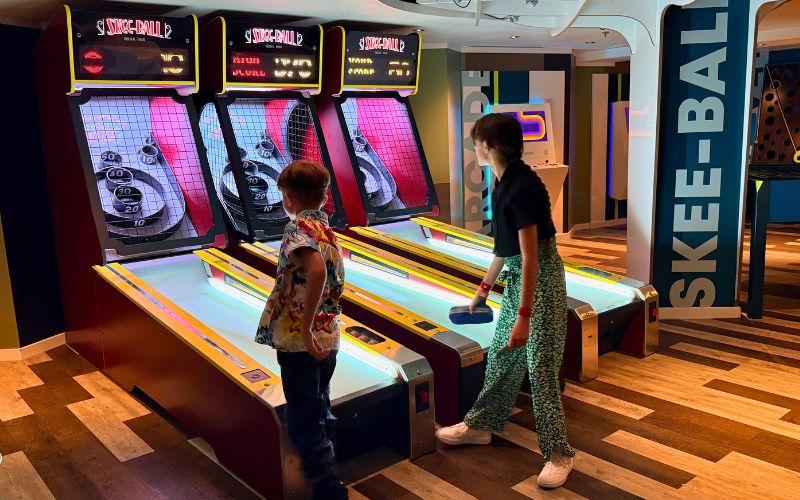
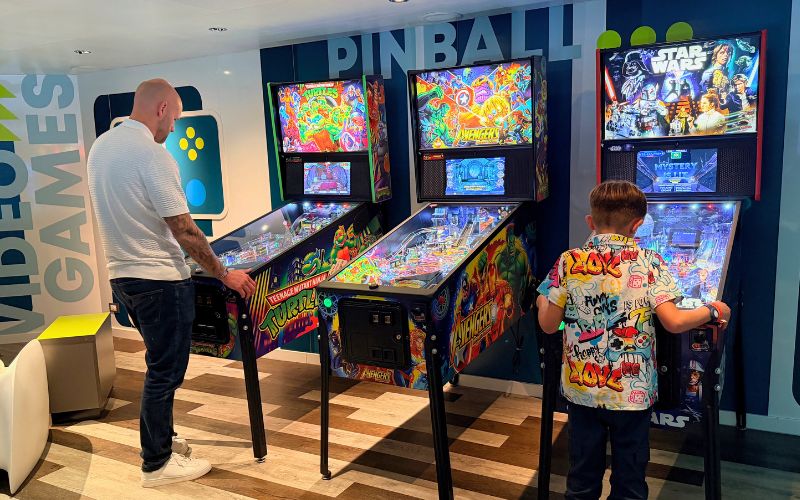
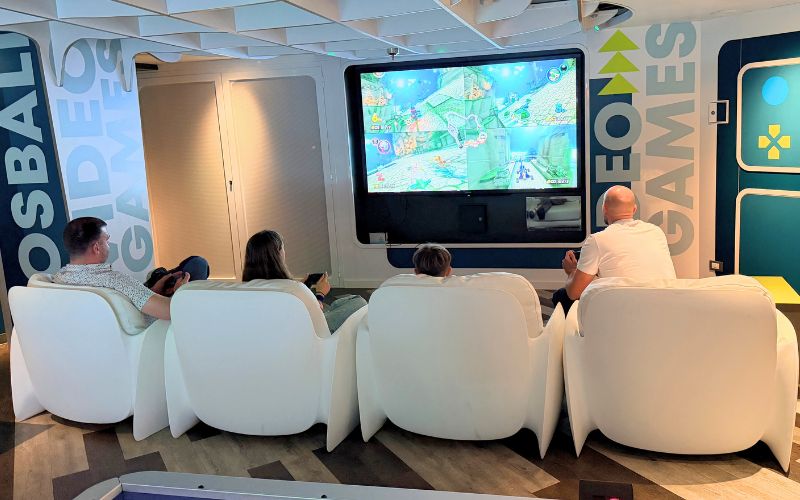
There are pinball machines, air hockey, giant table football, skeeball, retro arcade games and an Xbox with a huge screen and comfy armchairs.
The best part was that on our sailing it was open to all ages for several hours each day. Children under 12 needed an adult with them, but we found it became one of our favourite places to spend time together as a family.
On many cruise ships, games like air hockey and skeeball cost extra every time you play. Here, we could play as much as we liked for free.
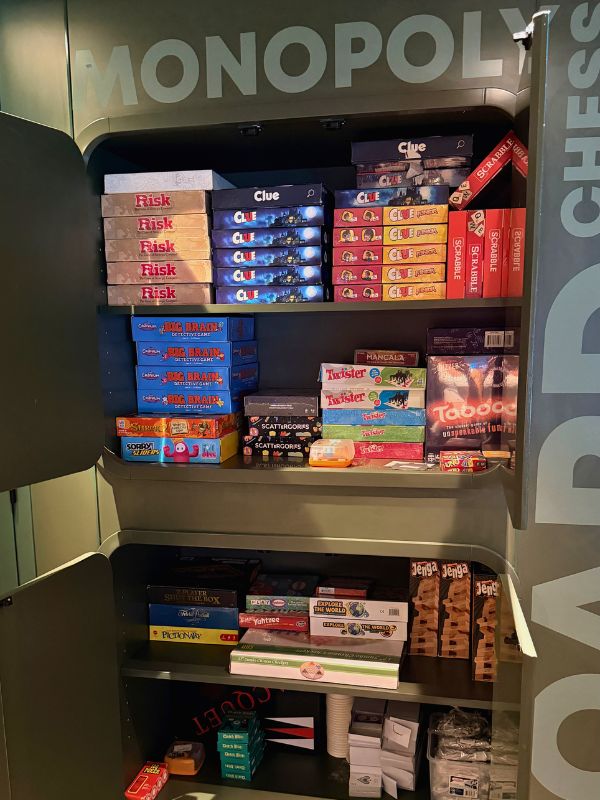
There was also a huge selection of board games and children’s books that guests could borrow and take anywhere around the ship.
The Pools Were Calm Instead Of Chaotic
One of the biggest differences compared with mainstream family cruise lines was the atmosphere around the pools.
There were no loud pool games blasting all afternoon. No impossible hunt for sun loungers. No shoulder-to-shoulder crowds.
And honestly? I loved that.
The kids spent hours swimming, while adults who preferred peace and quiet could head to the separate adults-only pool.
Nieuw Statendam also has a retractable roof over the main pool, which was especially useful during cooler Atlantic sea days.
There are five hot tubs too, and they were rarely busy. Most of the time, we managed to have one completely to ourselves.
At night, the pool deck movie screen became a really cosy place to watch movies under blankets with popcorn.
Even My Fussy Kids Ate Well
Our children can be quite fussy eaters, but they had absolutely no trouble finding food they liked onboard.
The main dining room had an excellent kids menu, including several vegetarian options. The waiters were also very accommodating when the children wanted something simple yet off-menu, like a jacket potato with cheese.
The pizza by the pool was always a hit. You can get a square slice that’s ready to go, or build your own pizza and get a whole 9-inch thin-crust pizza just how you like it.
The burgers by the pool were excellent too, and we also loved the buffet which had so many choices.
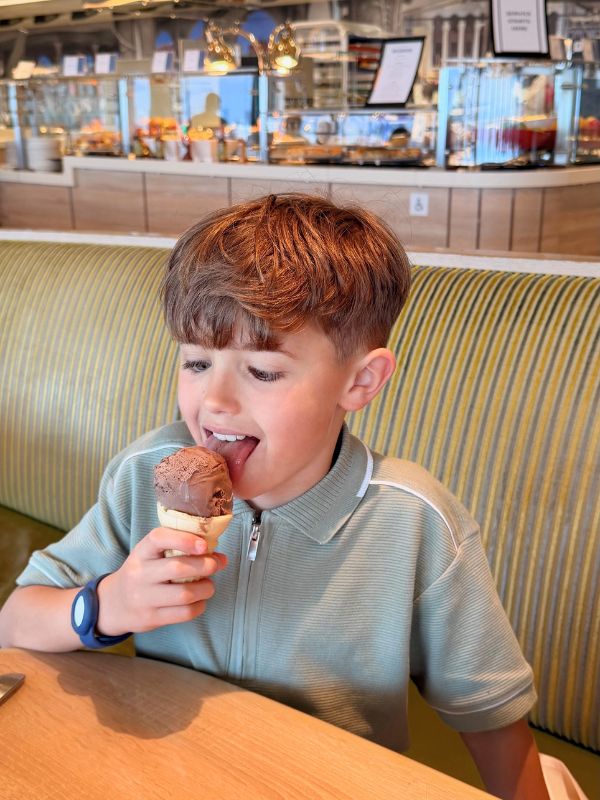
Ice cream costs extra, but its free of charge in the buffet, with a choice of flavours to enjoy there.
Room service quickly became one of our favourite little luxuries, especially because it was included free of charge. We loved to order snacks and then get cosy on the bed with a movie.
We also purchased the Have It All package, which included speciality dining credits. Sometimes we’d feed the kids at the buffet before dropping them at kids club so we could enjoy a quiet meal together. Other times, they joined us because children can order free from the kids menu in speciality restaurants.
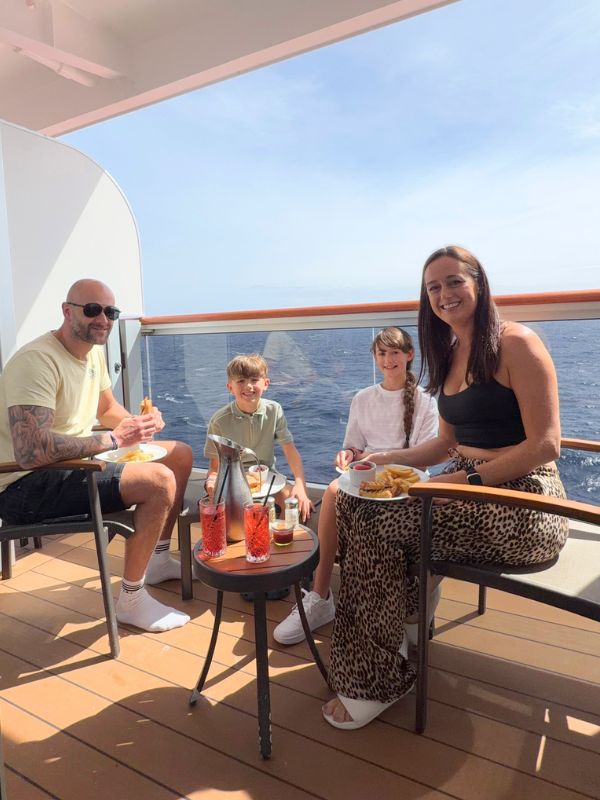
We stayed in a balcony cabin on Nieuw Statendam and found it worked really well as a family space. At first, I wasn’t sure about the layout, as we had one bed that came out in front of the balcony doors and another that came down from the ceiling over the double bed.
However, we quickly got used to it. Our cabin stewards visited in the morning and evening to change the layout, so the extra beds were not in the way.
There was so much storage, including clever drawers under the bed and overhead cupboards. The room never felt as cramped as some cruise cabins do with children sharing the space.
The beds were comfortable, the cabin was quiet at night and having the balcony made a huge difference during the long sea days crossing the Atlantic.
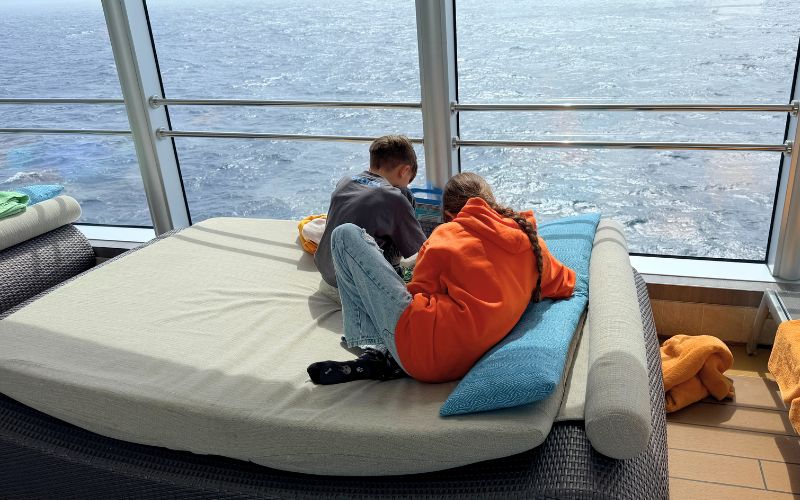
There’s something really special about watching the ocean with a coffee while the kids relax inside after a busy day.
What My Kids Honestly Thought About Holland America
I asked my children what they thought about the cruise…
They loved:
The kids club
The pools and hot tubs
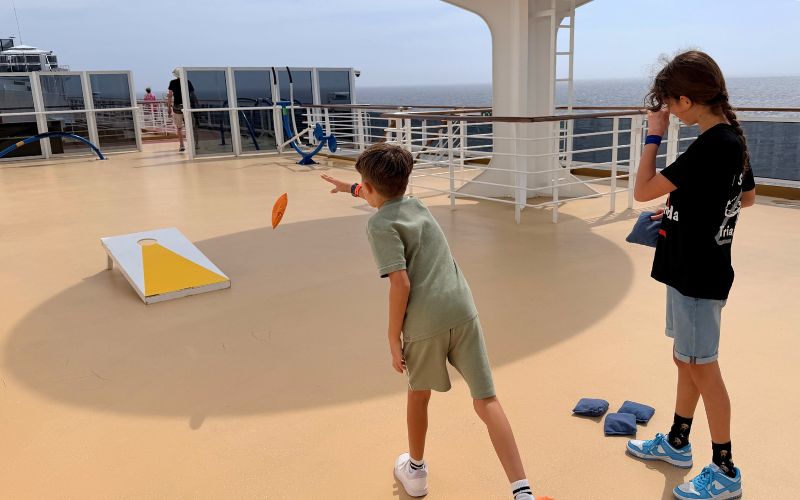
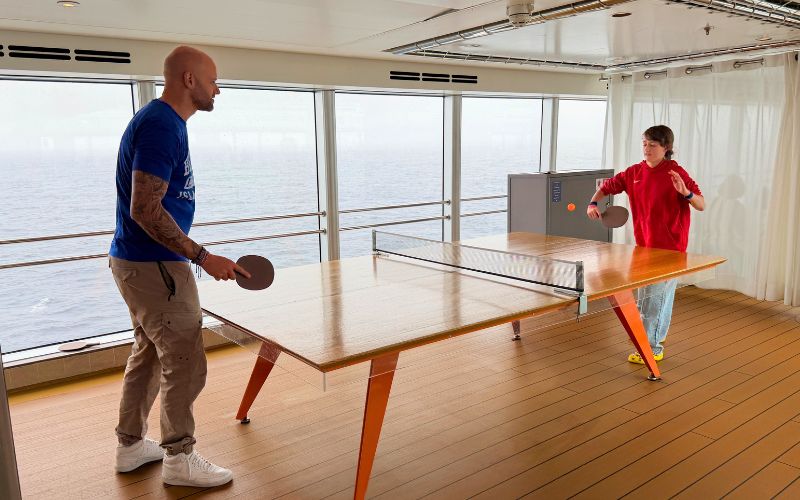
Playing table tennis and shuffleboard
Borrowing books from the library
Watching movies on deck
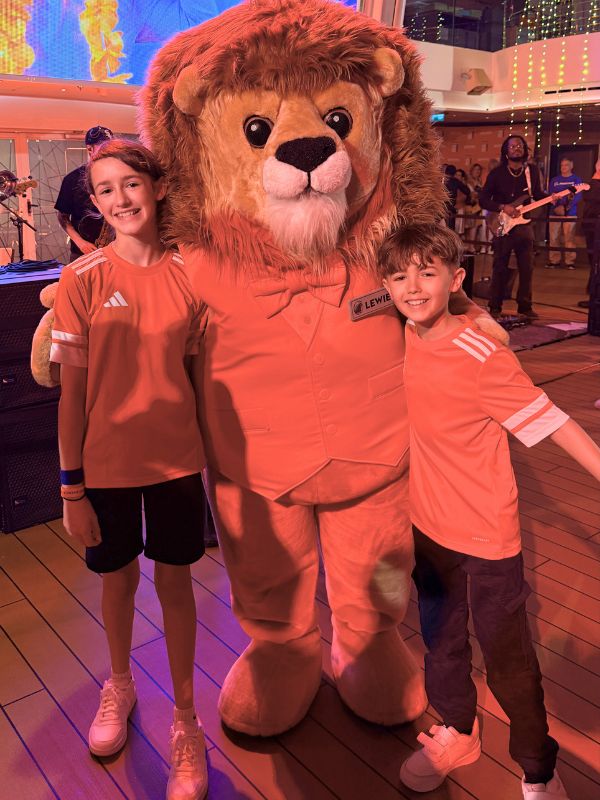
The Orange party
What they didn’t love quite as much was the lack of “wow” attractions.
If your children are obsessed with waterslides, bumper cars and constant thrills, they would probably prefer Royal Caribbean International or Carnival Cruise Line.
But for my kids, the slower pace worked beautifully.
This Was One Of Our Most Relaxing Family Cruises
On most family cruises, I come home feeling like I need another holiday afterwards.
This wasn’t one of them.
Because Holland America Line attracts a quieter crowd, the entire experience felt calmer from start to finish. There was less rushing, no queuing and far less overstimulation.
Instead of constantly racing between pre-booked activities, we spent quality time together as a family.
My daughter and I regularly attended the watercolour painting classes, while my son and his dad became extremely competitive at table tennis.
It felt slower, simpler and far more relaxing than most family holidays we’ve taken.
So… Is Holland America Good For Kids?
Absolutely, yes.
I wouldn’t necessarily recommend Holland America Line for every family. If your children want non-stop thrills, giant attractions and huge kids clubs packed with hundreds of children, another cruise line would probably suit you better.
It’s also worth noting that with so few children onboard, kids naturally stand out more. If your child is at the stage where public meltdowns are common, some parents may feel more comfortable on a ship where children blend into the crowd a little more.
Throughout our cruise, strangers regularly commented on how well-behaved our children were. That was lovely to hear, but it also reminded me that people definitely notice children more on Holland America ships.
If your family enjoys a slower pace and quality time together doing simple activities, then Holland America Line can actually be fantastic.
I boarded Nieuw Statendam expecting my kids to tolerate the cruise.
Instead, they loved it. And so did I.
NEW DEALS JUST RELEASED!
Don’t miss the latest Holland America Line offers…
Step onboard a cruise ship that’s designed for Asia guests and you’ll notice something feels different almost immediately – and it’s not just the language on the daily programme.
From the way meals stretch late into the evening to the kinds of social spaces that stay busy long after sunset, these ships are designed around habits many western cruise lines barely consider.
Most people assume cruise ships are built to one global template, with only minor tweaks for itinerary. In reality, ships designed for the Asian market often make very deliberate design and programming choices – some obvious, others quietly tucked into deck plans and cabin details.
Some of these features are instantly appealing, others take a bit of adjustment, and a few might genuinely change how you feel about a ship once you’re onboard. And there’s one small detail in particular that tells you more about a ship’s intended audience than almost anything else…
Ships Designed For the Asian Market
Not all cruise ships serving Asia are designed in the same way, and it’s definitely worth knowing which market a ship was originally built for.
The most Asia-focused ships belong to the Dream Cruises brand, but main mainsteam American and European-owned cruise lines also have ships that are marketed almost exclusively for Asian guests.
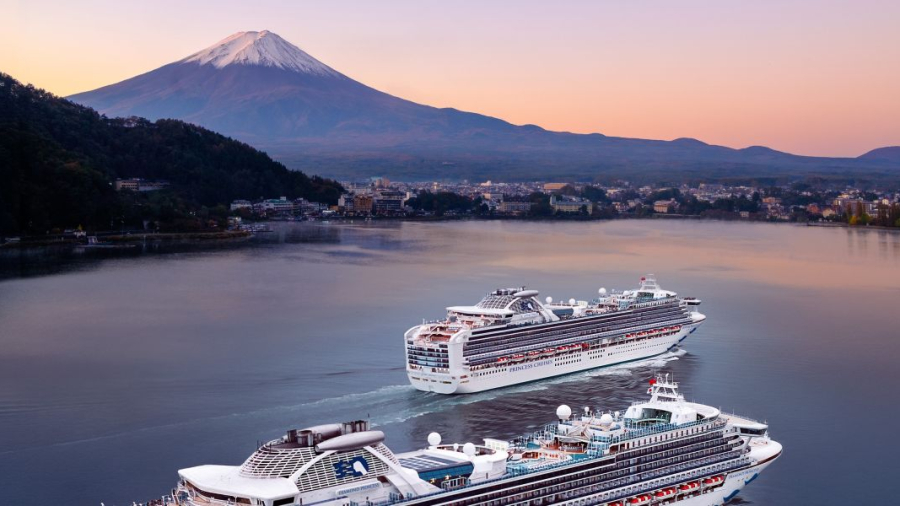
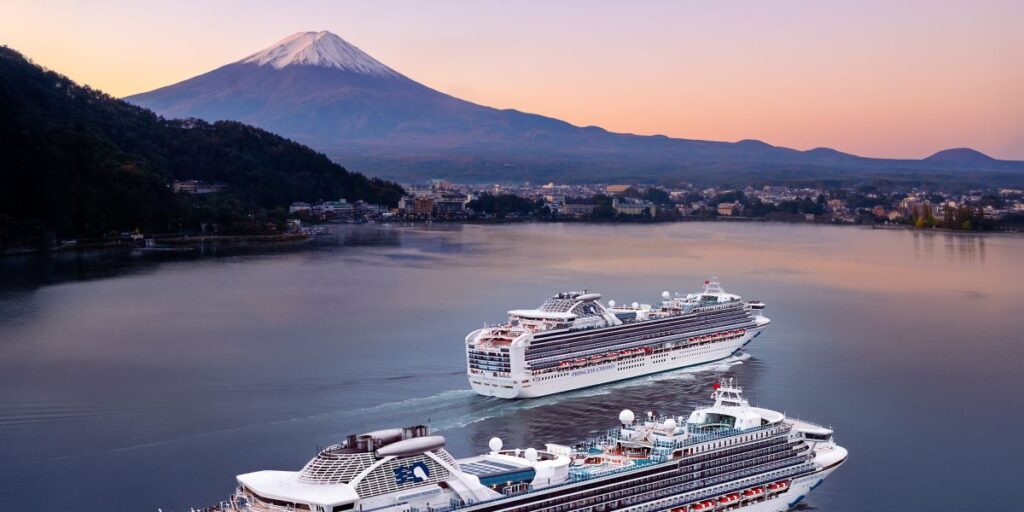
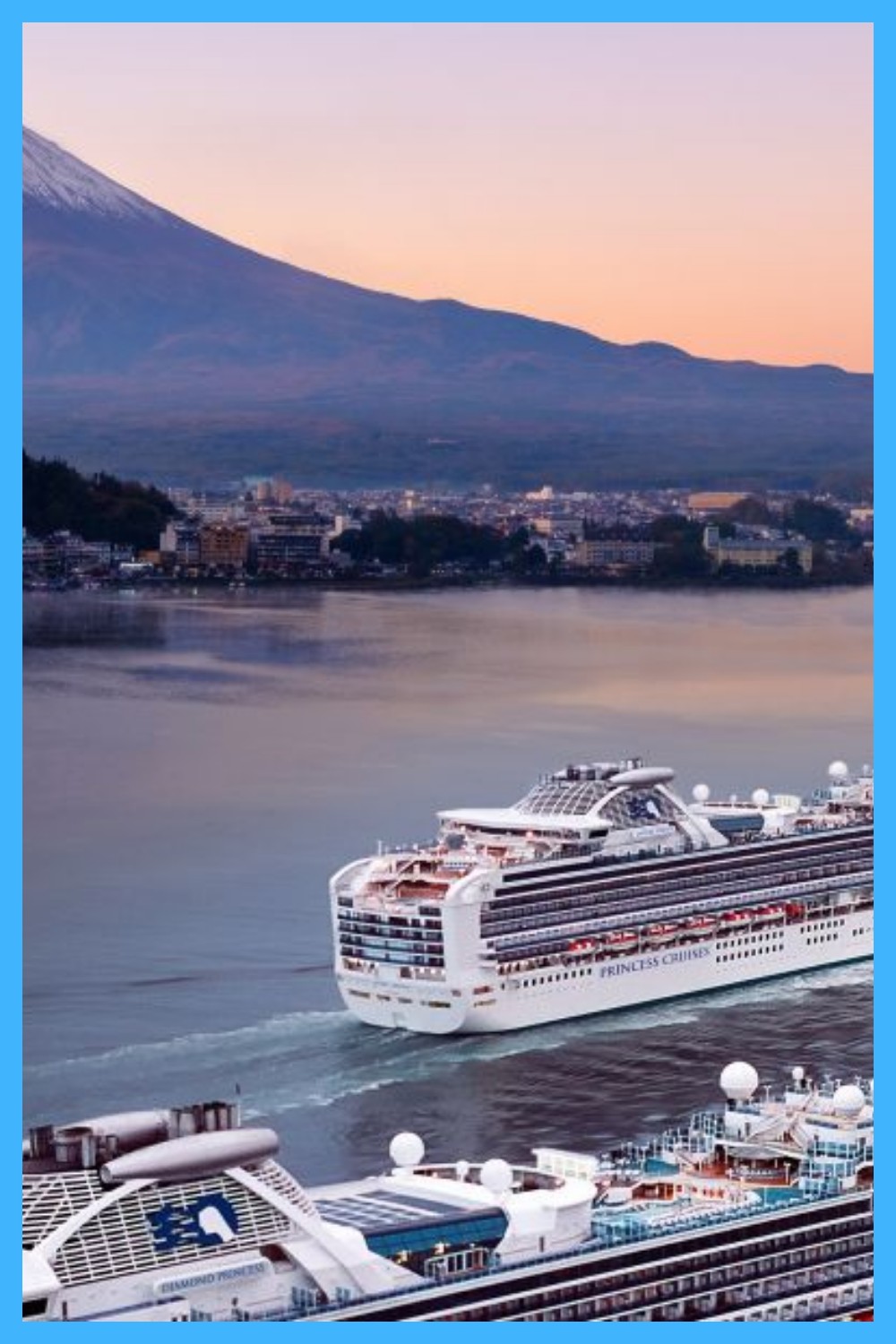
Royal Caribbean’s Spectrum of the Seas was purpose-built for the Asian market from the outset, while Princess Cruises has taken a more tailored approach: Diamond Princess leans more heavily towards Japanese preferences, whereas Majestic Princess incorporates stronger Chinese influences.
Norwegian Joy is a good reminder that these design choices aren’t fixed – it was originally launched as Norwegian Cruise Line’s Asia-focused ship before being extensively renovated for an American audience.
Cruise lines are still evolving in this space too, with Disney Cruise Line’s Disney Adventure set to become its first ship designed specifically for the Asian market, bringing Disney’s own take on regional cruising preferences.
Cruise Ship Features For The Asian Market
1. Special Dining That Genuinely Reflects Asian Tastes
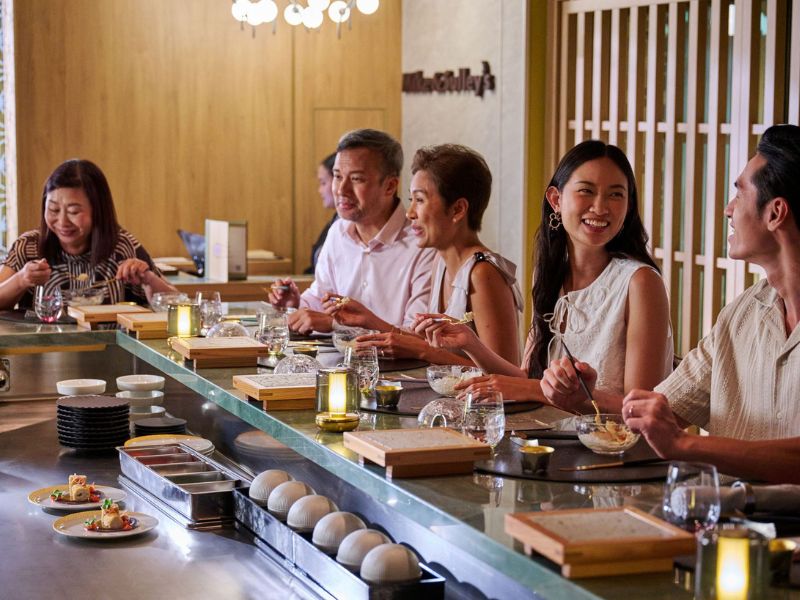
Cruise ships designed for the Asian market usually treat food as a headline feature, not an afterthought. Rather than adding one token Asian restaurant, these ships build whole dining ecosystems around regional cuisines and eating habits.
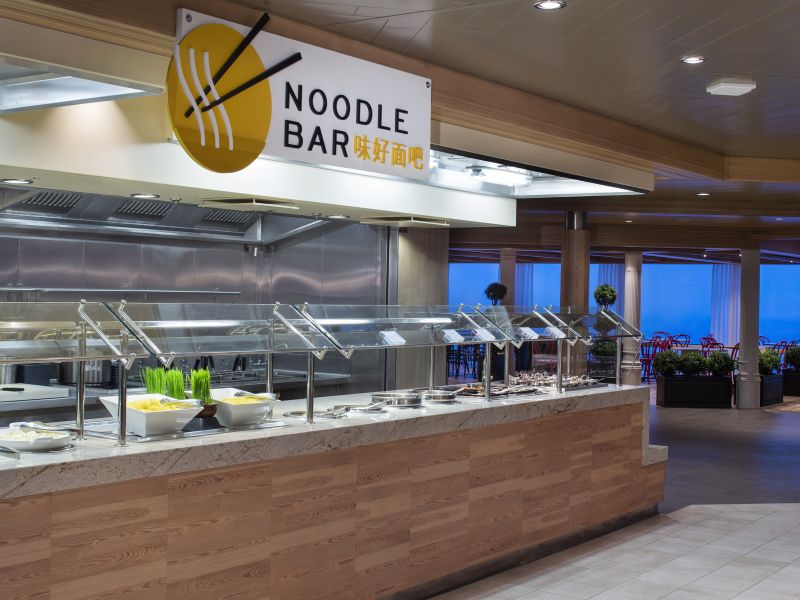
Spectrum of the Seas, for example, was designed specifically for Asia and includes venues such as Sichuan Red and a dedicated Noodle Bar, alongside a buffet that places far more emphasis on Chinese dishes than Royal Caribbean’s Western-deployed ships – though still with a lean into world cuisine.
On Genting Dream, dining is similarly central to the onboard experience, with hot pot, Asian specialities and late-night options designed for group dining. These ships recognise that meals are social events, often shared by extended families or groups of friends, and they’re built to accommodate longer, more leisurely dining styles.
For western cruisers, the key difference is that Asian food isn’t “alternative” dining on these ships – it’s mainstream, plentiful and woven into the rhythm of the day.
2. Larger, More Prominent Casinos
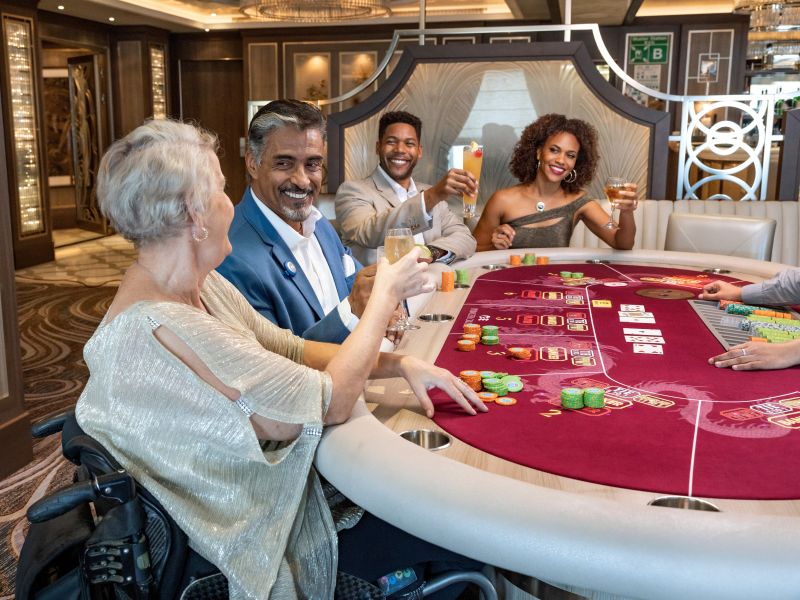
While most cruise ships have casinos, Asia-market ships often treat them as a core attraction – and they tend to have more of a focus on table games than slots. Casinos on these ships are noticeably larger and more central than you might expect, with layouts designed to handle high footfall and long playing sessions.
There is also a clear emphasis on VIP gambling areas, reflecting the importance of premium gaming to the Asian cruise market.
Similarly, ships such as Genting Dream position their casinos as flagship venues, closely integrated with nearby bars and late-night dining. The result is an onboard flow that supports social gambling as an evening activity, rather than something you dip into briefly before a show.
Many American cruise ships are now doing similar things with casinos, particularly with a market of cruisers who gamble in order to get perks through casino loyalty programmes.
But there are still differences, especially with the slot-to-table game ratio on the ships.
3. Karaoke Rooms, Often in Private KTV Style
Karaoke is a huge cultural touchstone across much of Asia, and ships designed for this market take it seriously. Ships designed for the Asian market will often host a dedicated karaoke venue where guests can sing throughout the cruise, rather than just on one themed night. The experience is designed to be accessible and social, with constant turnover and a relaxed attitude to participation.
On Majestic Princess, karaoke goes a step further with private karaoke suites that can be booked by small groups.
This mirrors the KTV model popular across East and Southeast Asia, where friends and families sing together in their own space rather than performing in front of strangers.
It’s a subtle but important design difference and can feel surprisingly liberating: no stage fright, no waiting list, just a room, a microphone and a group of people egging each other on. It’s one of the clearest signs that a ship has been designed with Asian social habits in mind.
4. Tea Rooms and a Stronger Tea Culture Onboard
On ships designed for the Asian market, tea is treated as a cultural pillar rather than a background beverage. Instead of tea simply being folded into cafés or afternoon tea service, these ships often feature dedicated tea rooms or lounges focused on high-quality loose-leaf teas and calm socialising.
On Royal Caribbean’s Asia-deployed ships, including Spectrum of the Seas, tea venues are positioned as daytime gathering spaces, appealing to multi-generational groups who may not gravitate towards bars or pool decks. The emphasis is on authenticity, ritual and choice, with menus that go well beyond basic black or green tea.
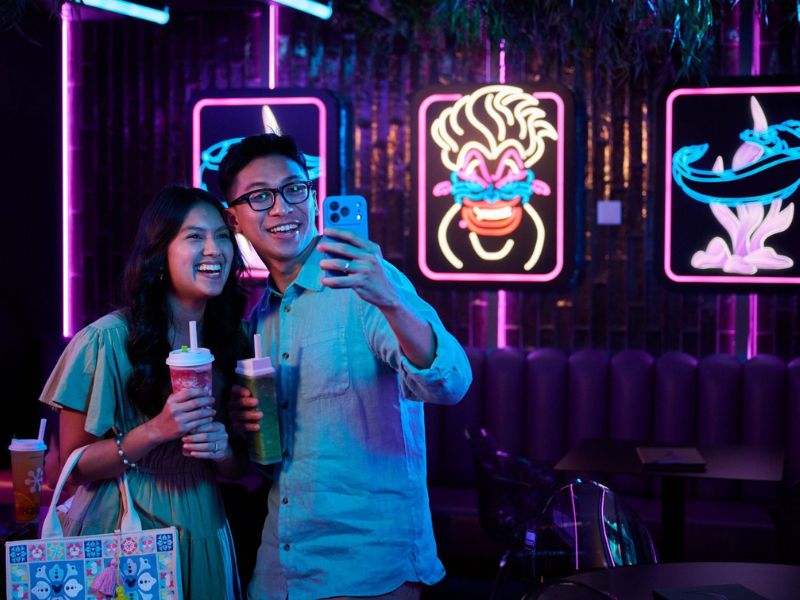
Disney Adventure, which sails on short cruises out of Singapore, features ‘Bewitching Boba and Brews’, a cafe focusing on fashionable bubble teas.
This approach reflects how tea is consumed across much of Asia: slowly, socially and with intention. It also broadens the onboard social landscape, offering a relaxed alternative to louder venues. For travellers more familiar with coffee-led cruise culture, these tea spaces can feel like a subtle but meaningful shift in how ships accommodate different rhythms of daily life.
5. Smaller Pool Areas and Less Emphasis on Sunbathing
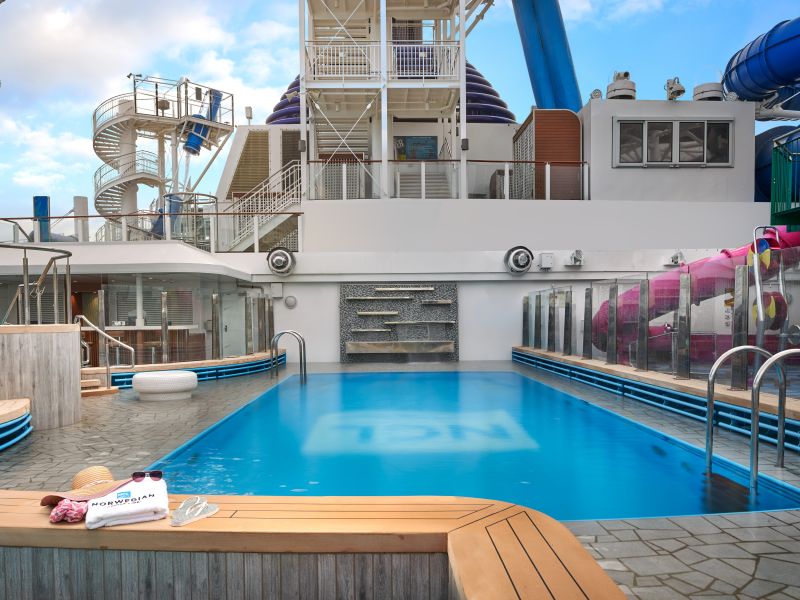
Another noticeable difference on ships designed for Asian markets is the reduced emphasis on large, resort-style pool decks. While pools are still present, they are often smaller relative to the ship’s size, with less space devoted to all-day sunbathing and more allocated to indoor venues.
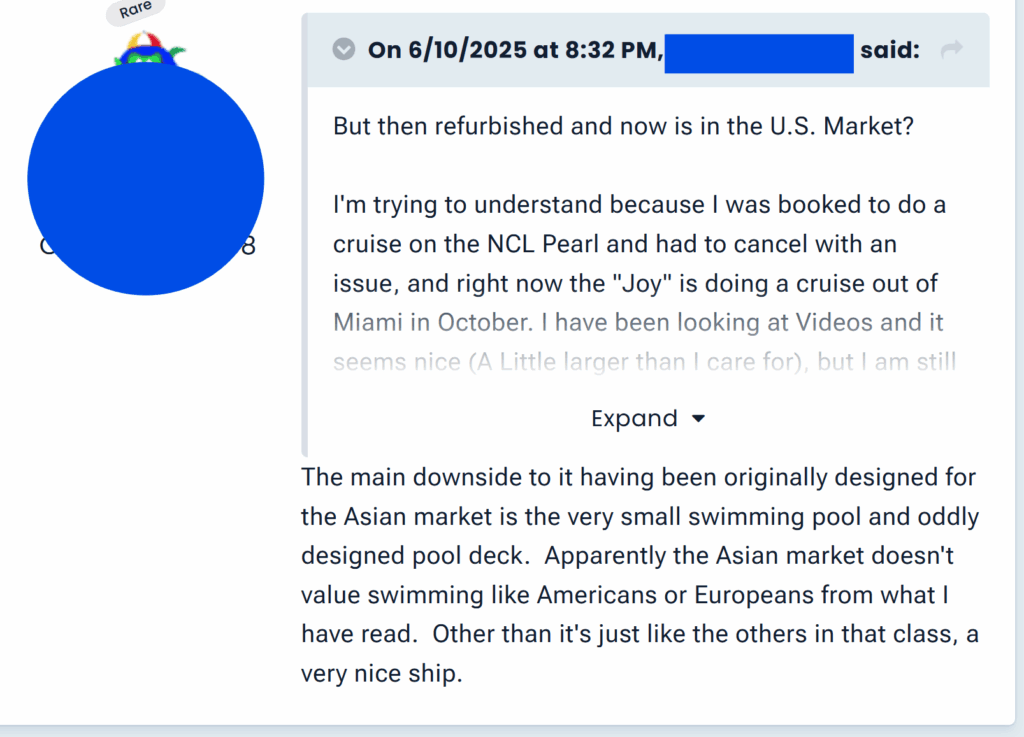
Some cruisers of Norwegian Joy, a ship originally built for the Asian market but renovated for US guests, have noticed it has a (slightly) smaller pool compared to sister ships.
This reflects different travel habits and itinerary patterns. Many Asian cruises operate on shorter sailings, port-intensive routes, or during seasons when sunbathing isn’t the primary focus.
The weather in Asia is often too hot and humid to be outdoors for long and many people prefer to stay out of direct sunlight. As a result, designers prioritise indoor entertainment, dining and retail venues that remain busy regardless of weather.
Ships like Genting Dream illustrate this balance well, offering pools and outdoor areas without making them the defining feature of the ship. The trade-off is often a livelier indoor atmosphere, particularly in the evenings, with more places for groups to gather, eat and socialise long after sunset.
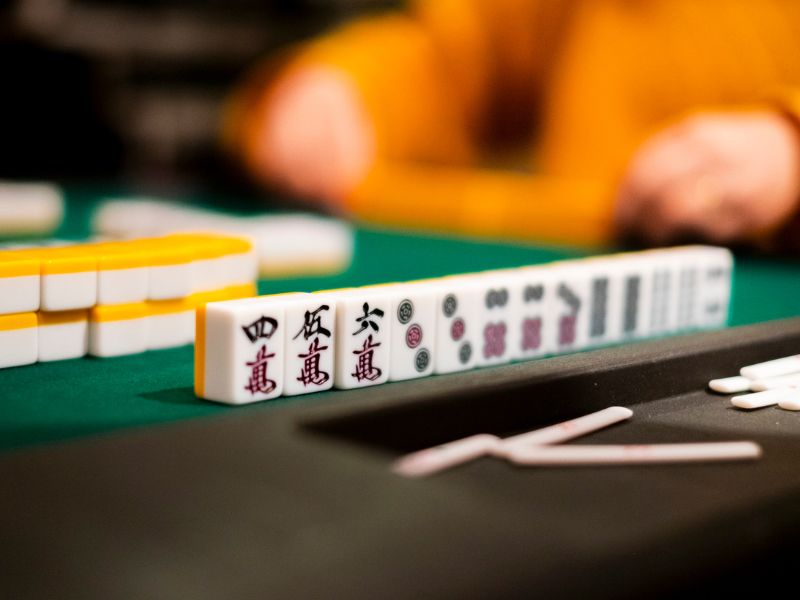
6. Mahjong Rooms and Dedicated Card Spaces
Mahjong is more than a casual pastime across much of Asia; it’s a deeply social activity that can anchor entire afternoons or evenings. Cruise ships built for this market often reflect that by including dedicated mahjong or card rooms, rather than relying on generic libraries or multi-purpose lounges.
These spaces are designed with long sessions in mind: comfortable seating, appropriate table layouts and a tolerance for noise and animated conversation. On ships such as Genting Dream, mahjong rooms are clearly defined venues, signalling that this is an expected and valued part of the onboard experience.
The inclusion of a mahjong room is a strong indicator of who the ship is really built for. It acknowledges group travel, extended family cruising and social activities that don’t revolve around scheduled entertainment. Even for guests who don’t play, these rooms contribute to the ship’s overall character and sense of cultural specificity.
7. Bidets and Washlets in Cabins and Public Bathrooms
One of the most quietly telling features of Asia-focused deployment is the inclusion of bidets or washlets. On ships operating extensively in Japan and surrounding markets, these are often installed not only in higher-category cabins but also in public restrooms. Diamond Princess is a well-known example, having incorporated bidets as part of its Japan-facing design and refurbishment strategy.
In regions where washlets are standard at home, their absence would be noticeable, so their presence onboard signals a clear understanding of guest expectations. For cruise lines, this is less about luxury and more about normality.
For travellers from regions where bidets are less common, it can feel like an unexpected upgrade. More importantly, it highlights how ships designed for specific markets adapt at a very practical level, right down to the bathroom fixtures, rather than relying on a one-size-fits-all global template.
TODAY’S BEST CRUISE DEALS!
Don’t miss these offers…
Final Word
Cruise ships designed for the Asian market aren’t better or worse – they’re just built around different assumptions about how people actually spend their time onboard.
Food is social and central, evenings run late, group activities matter, and quiet comforts are designed in rather than added as upgrades. And maybe that sounds like how you cruise anyway? If so, maybe you’d love an Asian cruise ship even more!
For some travellers, these ships will feel instantly intuitive. For others, they can be a fascinating culture shift, where karaoke rooms replace piano bars and tea lounges rival cocktail venues for popularity. Even details like pool layouts or bathroom fittings start to make sense once you view the ship through that lens.
The key takeaway is that cruise ships aren’t as universal as they look in marketing photos. If you know what a ship was designed for – and who it was designed for – you’re far more likely to enjoy it. And you might even discover a few features you didn’t know you’d been missing.
Cruises are sold as the ultimate stress-free holiday, so why do so many people come home quietly seething about towels, elevators and hot tubs?
I started noticing the same complaints popping up again and again on my Facebook page, so I did what any curious cruiser would do and dug deeper. After reading through thousands of comments from real passengers, some clear patterns emerged and a few of them genuinely surprised me.
From the obvious annoyances everyone expects to the ones nobody warns you about, these are the cruise pet peeves people feel most strongly about.
And yes, there’s one that causes far more arguments than you’d ever imagine.
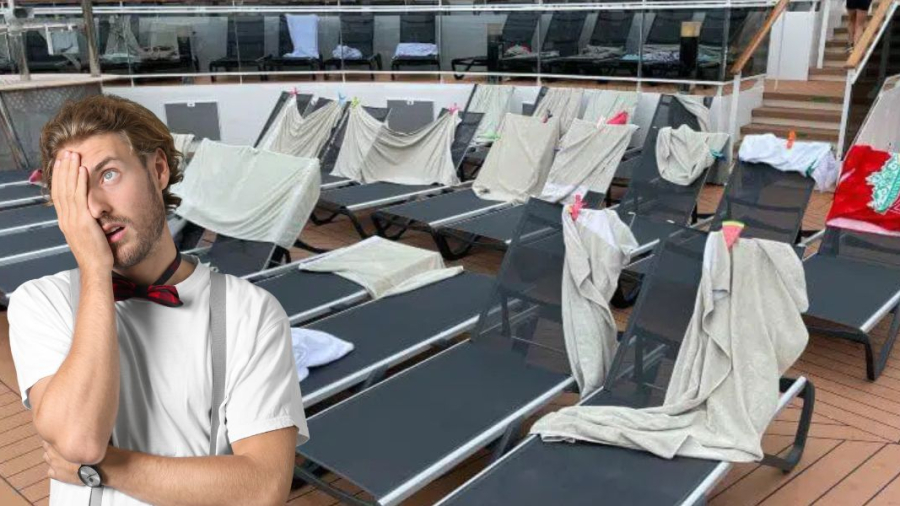
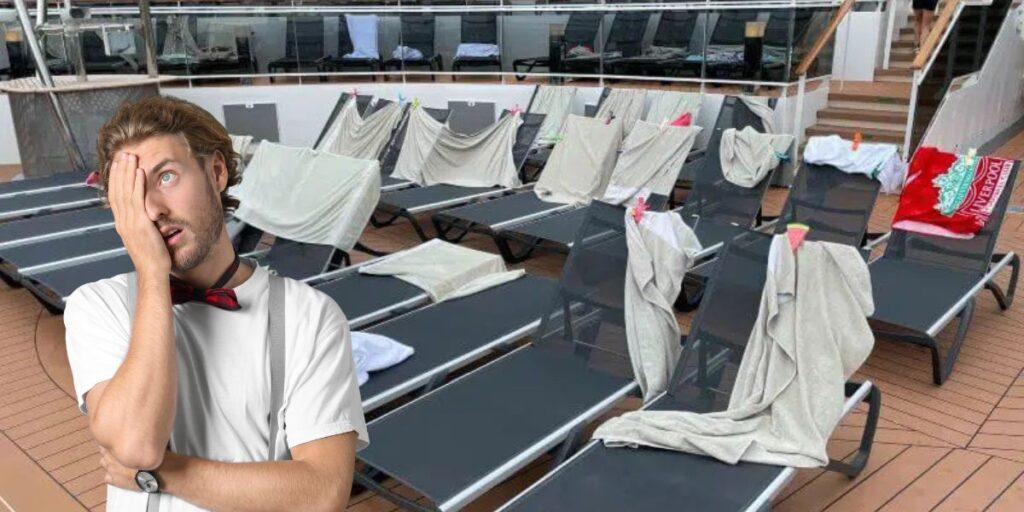
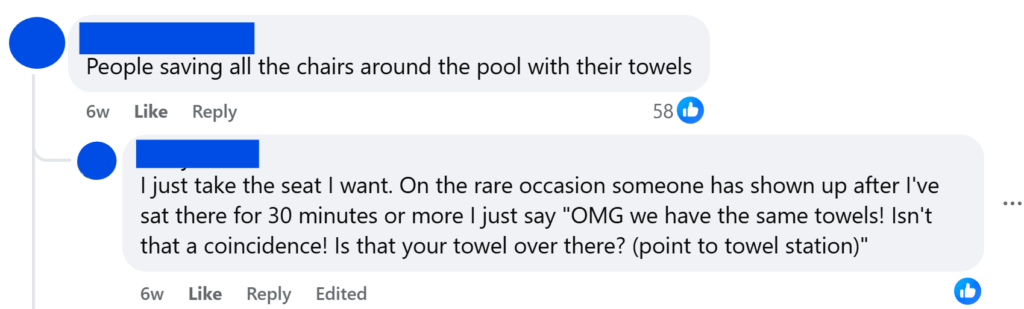
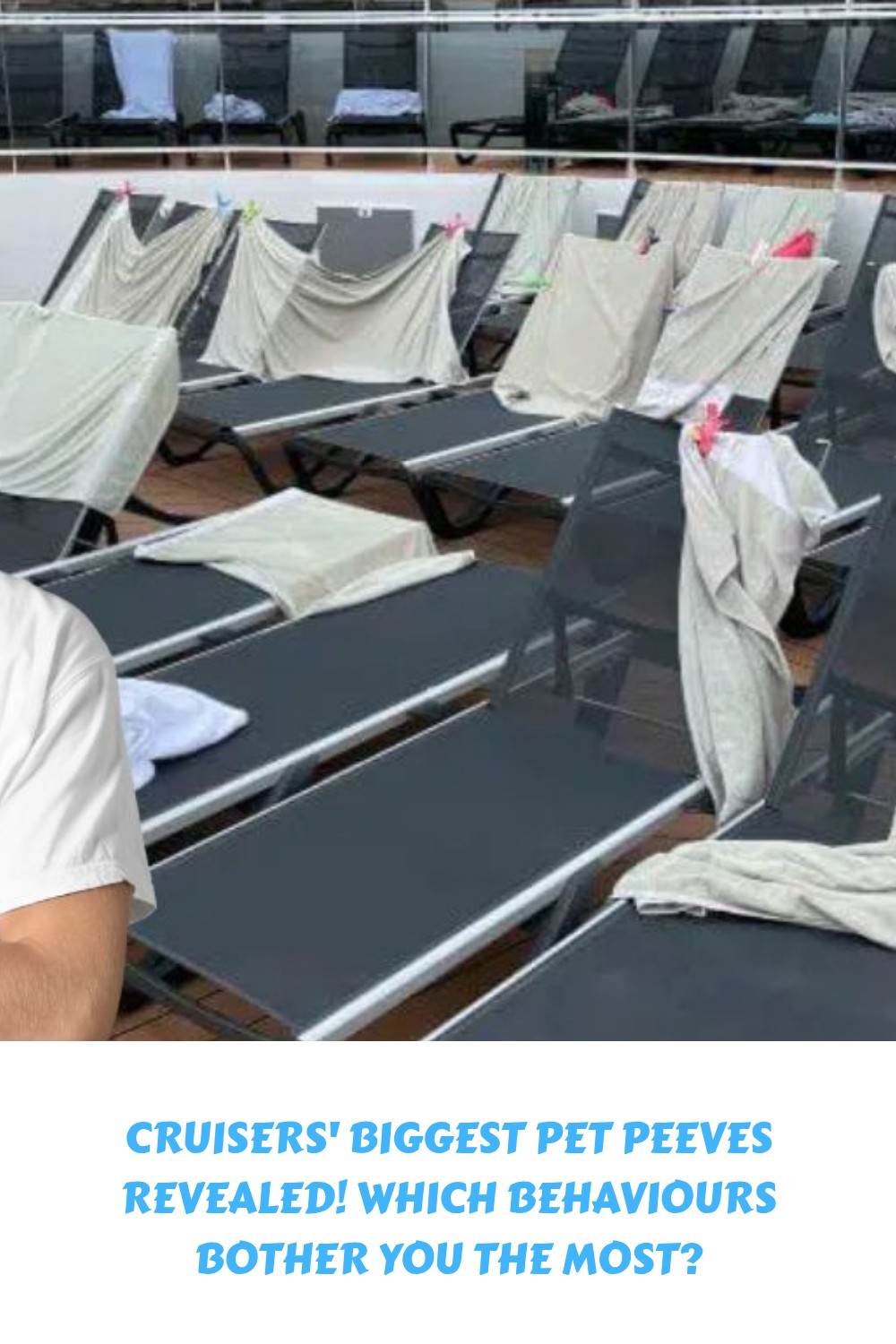
1. Pool chair hogging and towel reserving
If cruising had an unofficial sport, pool chair hogging would win gold every time.
Towels appear at dawn like clockwork, sometimes draped across multiple loungers, yet the owners are nowhere to be seen for hours. People talk about families reserving prime spots then vanishing off to breakfast, the spa or even back to bed.
It’s not just about the chairs, it’s the entitlement that comes with them. Nobody wants to play towel police on holiday. It’s consistently the top pet peeve because it feels selfish, unnecessary and easily solved with a bit of basic consideration.
Cruise lines are trying to crack down on it – but I don’t think it’ll ever completely stop.
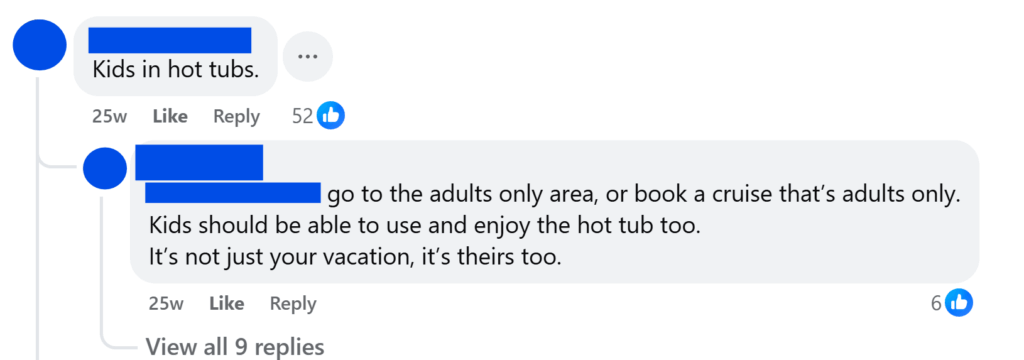
Hot tubs are meant for soaking and relaxing, not turning into splash zones.
A huge number of cruisers complain about kids using them like swimming pools, jumping, splashing and dominating the space while parents look the other way. Most people aren’t anti kids, they’re anti chaos.
Health and safety concerns come up a lot too, especially when rules are clearly posted and ignored. When a small hot tub gets taken over, it stops being enjoyable for anyone else. This one always sparks debate, but it’s easily one of the most passionately mentioned cruise annoyances.
I don’t mind kids in the hot tubs – I let mine use them but I know they’ll behave. What do you think?
Elevators seem to make otherwise polite people forget all social rules.
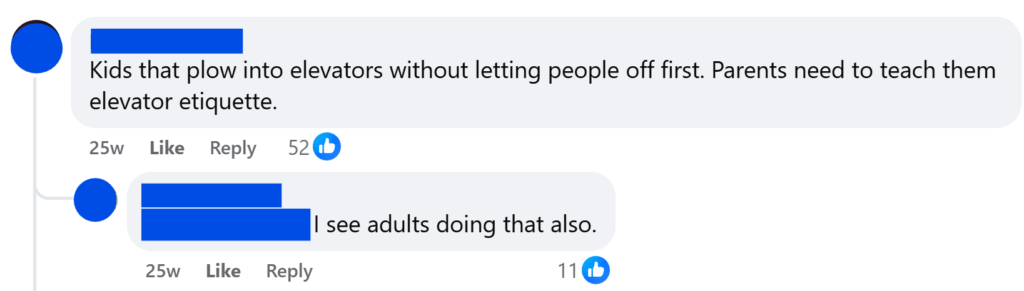
Common grumbles include people barging in before others can get out, queue jumpers, cramming in when it’s clearly full and repeatedly hammering the close door button before people have the chance to get in.
Personally, I also can’t stand it when people say “let’s go up to go down, it will be faster” during busy periods. While it may be faster for them, it makes it slower for everyone else. That’s just selfish.
Those using wheelchairs or scooters often feel completely ignored, watching lift after lift fill up in front of them. The confined space only makes tempers flare faster, especially at busy times.
For many cruisers, poor lift manners aren’t just annoying, they feel like a basic lack of courtesy that shouldn’t be hard to fix.
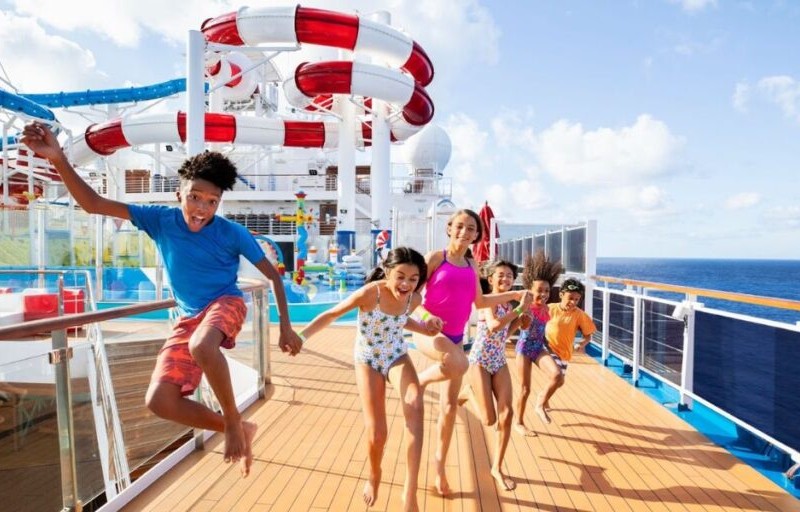
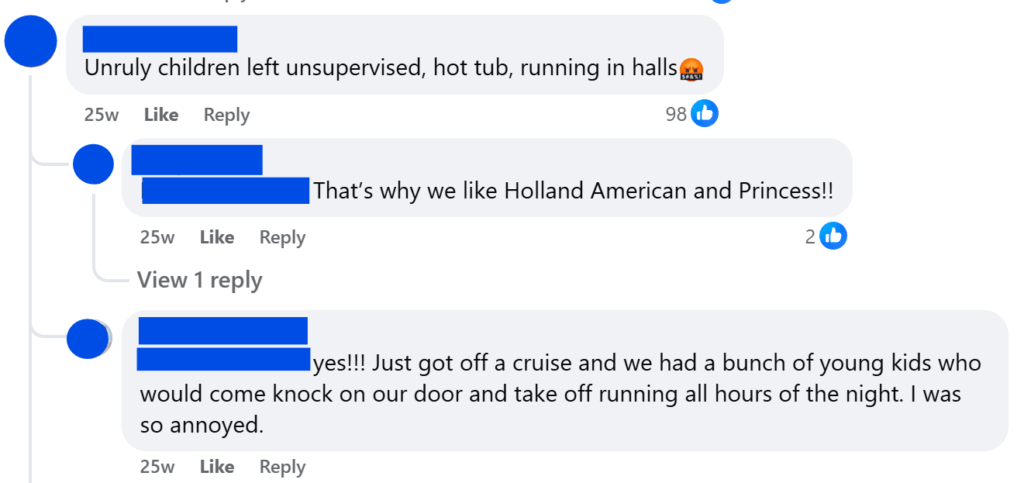
4. Unsupervised or unruly kids around the ship
Kids racing down corridors at midnight, shouting outside cabins and roaming the ship late at night without parents nearby comes up again and again.
Most passengers make it clear they don’t hate kids, they just want some peace. Late night noise is especially unpopular, particularly with people who’ve paid good money to relax.
Several stories mention kids doing genuinely unsafe things while parents are nowhere to be seen. Cruise ships aren’t lawless playgrounds, yet some adults treat them that way. A bit of supervision would solve a lot of this frustration.
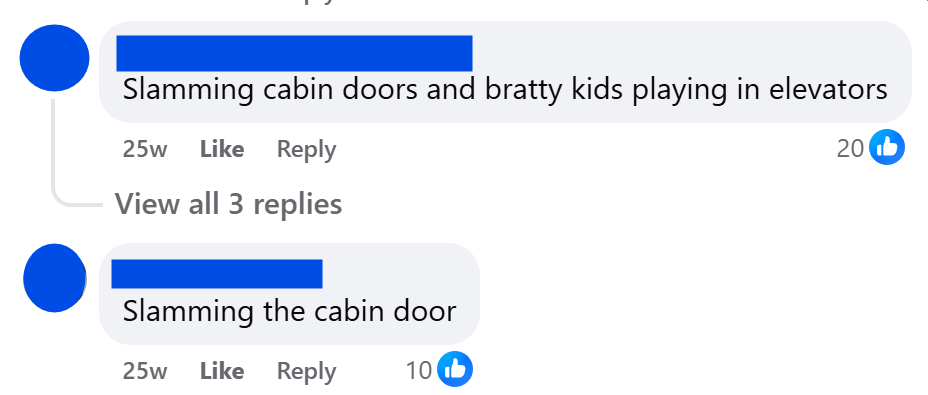
There are few sounds more jarring on a ship than a cabin door being slammed shut.
Because the doors are heavy, the noise echoes and can shake nearby cabins. Balcony doors are even worse, especially early in the morning or late at night.
Many cruisers point out how easy it is to hold the door and let it close gently.
When it happens repeatedly, it feels careless rather than accidental. For light sleepers, this can genuinely ruin nights of rest, making it one of the most commonly mentioned noise-related complaints.
6. Blocking walkways and entrances
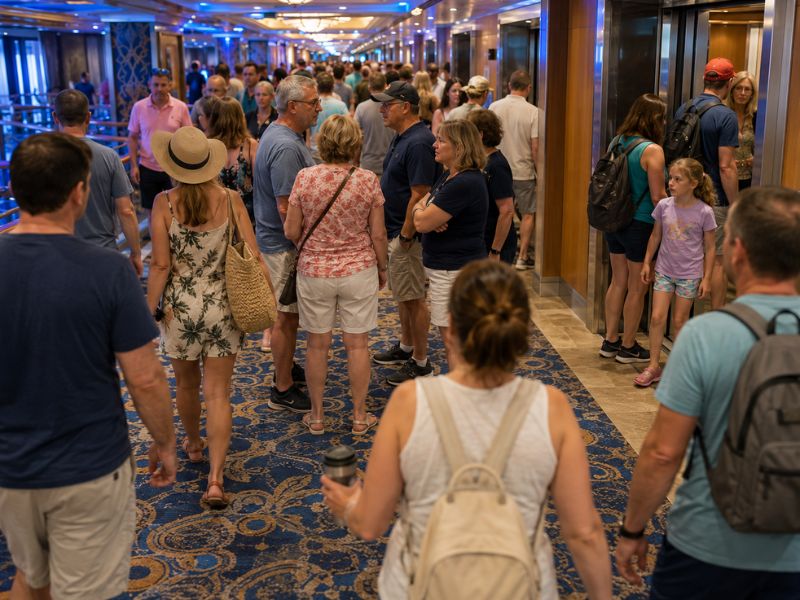
Stopping dead in the middle of a busy walkway seems to be a universal cruise habit. Groups gather for chats, families block corridors and people step out of elevators only to freeze while deciding where to go. The result is congestion, near collisions and rising irritation.
On ships where space is already tight, poor awareness stands out even more.
Most people don’t mind slow walkers or those needing breaks, but stopping without stepping aside drives others mad. It’s less about impatience and more about keeping things moving for everyone.
7. Buffet chaos and lack of flow
The buffet brings out strong feelings, especially at peak times. Complaints include line cutting, people walking the wrong way, hovering indecisively and general crowding that feels unnecessary.
Some describe it as more of a stampede than a dining area. Ignoring signs or basic flow rules only adds to the stress.
For somewhere meant to be convenient and relaxed, it can quickly become one of the most stressful spots on the ship.
Part of this is down to the design of the buffet. For example, if you just want to grab a boiled egg, you may be expected to join long queue past the bacon and sausages. Should you be able to just nip in for the egg? Nobody is sure.
8. Poor hygiene around food and bathrooms
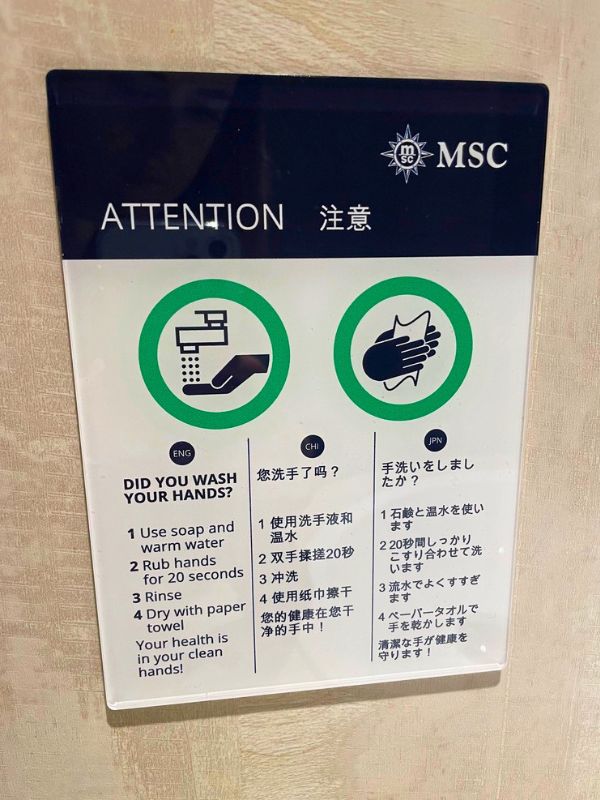
Nothing puts people off quicker than watching someone skip handwashing and head straight to the buffet.
Many ships have ‘washy washy people’ who enforce handwashing. But on those ships that don’t, walking straight past the sinks is sadly becoming more common as people forget what it was like in stricter, more hygenic times.
Lack of hygiene is a huge concern, with repeated mentions of people coughing, sneezing or touching food before putting it back.
On a ship where illnesses can spread fast, this feels especially risky. Some cruisers say they actively avoid buffets after seeing questionable behaviour.
The frustration isn’t just about squeamishness, it’s about shared responsibility. Better habits and a bit of enforcement would make dining areas feel safer and far more pleasant.
Smoke has a way of travelling, especially at sea. Complaints include cigarette smoke drifting onto balconies, people vaping around pools and being forced to walk through smoky casino areas.
Even non smokers who accept designated areas get annoyed when rules aren’t followed. Lingering smells in corridors or cabins can ruin otherwise lovely spaces.
Many feel the issue is poor enforcement or bad ship design. People simply want to enjoy fresh air and shared spaces without inhaling someone else’s habit.
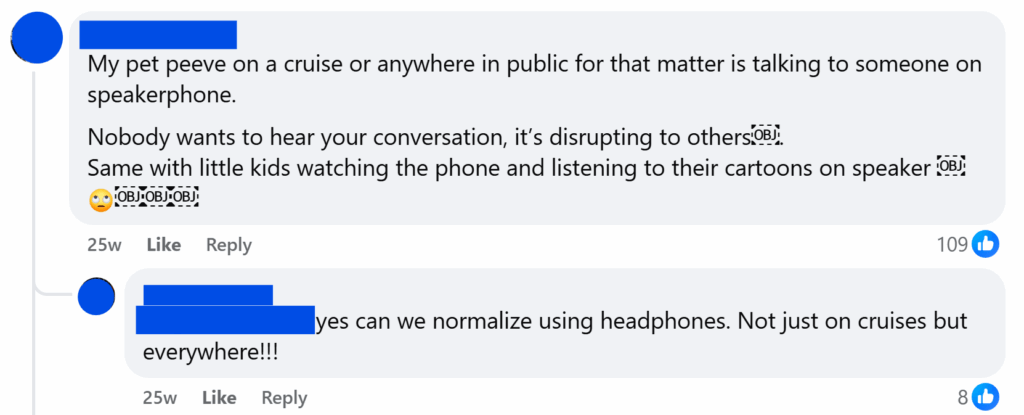
Few things irritate cruisers faster than someone using speakerphone in a shared space.
FaceTime calls in dining areas, loud personal conversations by the pool and kids blasting videos without headphones all come up repeatedly. It feels intrusive, especially when you’re trying to relax.
People often mention feeling trapped, forced to move rather than confront it.
The annoyance comes from the assumption that everyone else wants to hear it. Headphones exist for a reason, and many cruisers feel using them should be the norm, not the exception.
11. Dirty dishes left around the ship
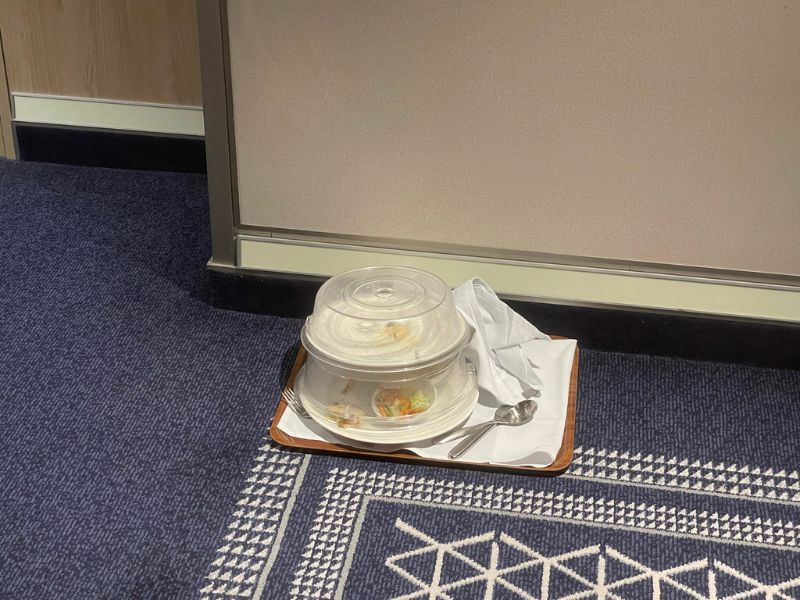
Plates, glasses and trays left in hallways, lifts and stairwells are another surprisingly common gripe.
Aside from looking messy, they can smell and create obstacles, particularly for anyone with mobility issues.
Some passengers aren’t sure what they’re meant to do, while others just assume staff will handle it. Fellow cruisers see it as disrespectful to both crew and other guests.
While rules vary by cruise line, the frustration comes from seeing mess pile up in shared spaces when it really doesn’t need to.
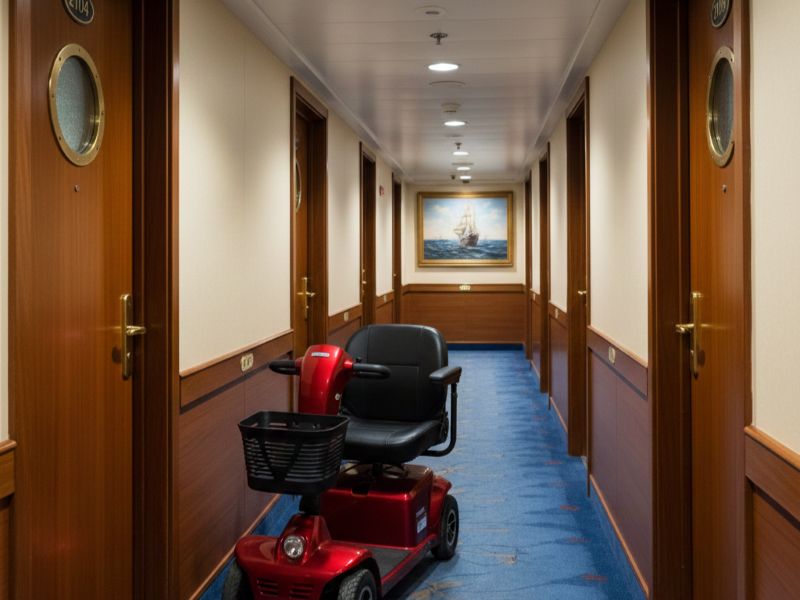
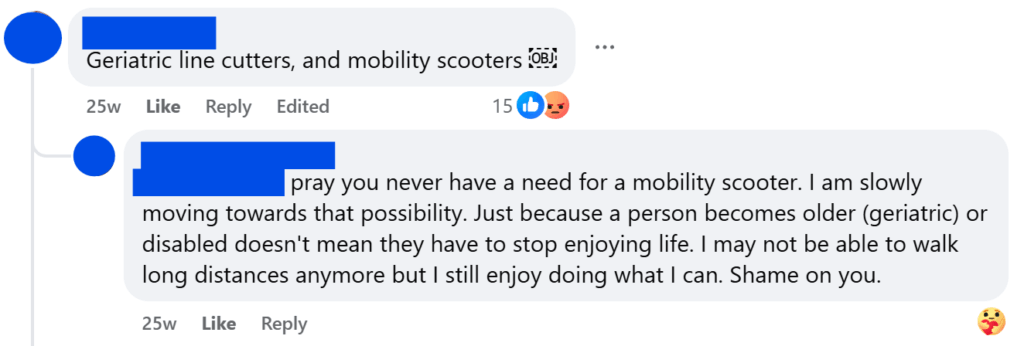
12. Scooters and mobility tensions
Mobility aids themselves aren’t the issue, behaviour is. Some cruisers feel cut off by scooters pushing ahead in queues or charging out of elevators.
Others who actually need wheelchairs describe being completely ignored or blocked by standing passengers. There’s also debate around perceived misuse, which quickly gets heated.
At heart, this is about patience and empathy on all sides. On crowded ships, small moments of courtesy make a big difference. When space is limited, awareness and kindness matter more than ever.
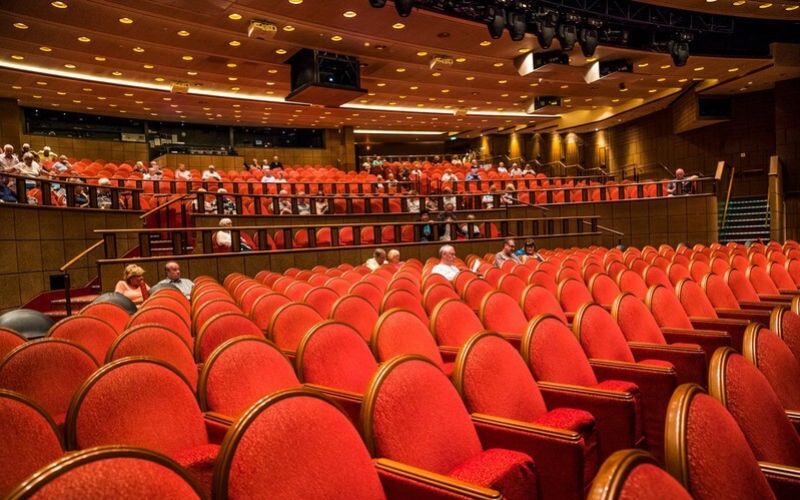
13. Seat and table saving beyond the pool
It’s not just sun loungers. Theatre seats blocked hours in advance, buffet tables held during peak times and one person reserving space for a whole group all annoy fellow passengers.
This often leaves others wandering with trays or missing out on shows altogether. Planning ahead is one thing, but excessive reserving feels unfair.
When space is limited, first come, first served feels like the fairest system. Many cruisers would happily wait their turn if they knew everyone else was playing by the same rules.
14. Overcrowded pools and hot tubs
Even without bad behaviour, pools and hot tubs can feel uncomfortably busy.
Sea days in particular see every splash of water filled to capacity. People mention feeling squeezed, overheated and unable to relax. Hot tubs packed shoulder to shoulder lose their appeal fast, especially when the same people stay in them all afternoon.
Some cruisers simply stop trying and avoid these areas altogether. The frustration is less about people and more about poor capacity management in spaces designed for relaxation.
15. Late night noise in corridors and cabins
Ships never fully sleep, but passengers do. Loud conversations, shouting, arguments and door slamming after nights out are a frequent complaint.
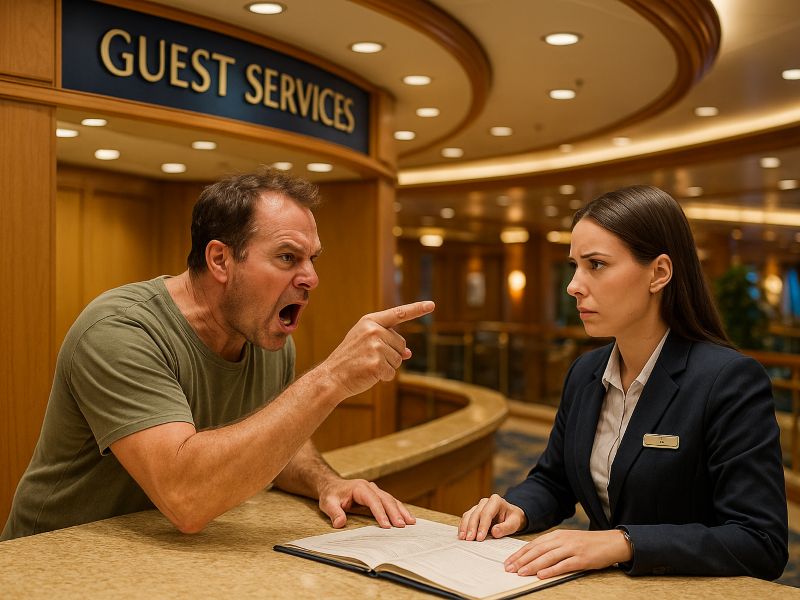
Noise travels easily through corridors and thin walls don’t help. Several people mention having to call guest services just to get some peace.
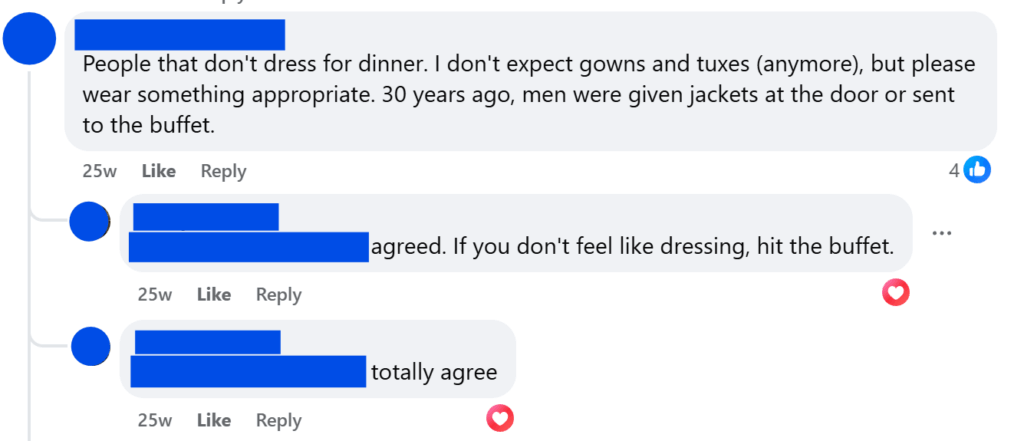
Most understand others are on holiday too, but there’s an expectation of quieter behaviour late at night. Broken sleep is one of the quickest ways to sour a cruise, especially when it feels avoidable.
16. Dress code frustrations
Dress codes divide opinion, but many cruisers feel standards have slipped too far.
Common complaints focus on beachwear, swimwear or ultra casual outfits in main dining rooms. Others miss the sense of occasion that evening meals used to have.
It’s rarely about wanting formality, more about atmosphere. Dining is a shared experience, and some feel dressing appropriately shows respect for the space and other guests.
For those who enjoy making an effort, seeing guidelines ignored can be disappointing rather than inclusive.
17. Food waste and unpleasant dining habits
Food waste at the buffet bothers a lot of people, especially when plates are piled high and left half eaten. Others mention habits like blowing noses at tables or touching food directly.
These behaviours feel unnecessary and inconsiderate in shared dining spaces.
Sampling is part of buffet life, but excess feels wasteful. For some, watching it happen repeatedly takes the enjoyment out of meals. Dining should be relaxed and pleasant, not an exercise in tolerance.
18. Cabin announcements at awkward times
Being woken up by loud announcements while enjoying a lie in is a surprisingly common irritation.
Night owls and late sleepers often mention early morning messages broadcast straight into cabins. While announcements are sometimes necessary, many feel the timing could be better handled.
Being jolted awake on holiday feels especially unwelcome. It’s not the information that annoys people, it’s when and how it’s delivered.
19. Embarkation and debarkation stress
Getting on and off the ship is rarely anyone’s favourite part of cruising.
Complaints focus on long waits, ignored time slots, crowding and lift chaos. Debarkation day in particular brings out impatience as everyone wants to leave quickly. When passengers ignore instructions, it creates delays for everyone else.
While logistics play a big role, many cruisers feel a bit more cooperation would make the whole process far smoother and far less stressful.
20. Nickel and diming onboard
Extra charges frustrate many cruisers, from drink limits to paid add-ons that appear everywhere onboard. Some feel constantly sold to once they’ve embarked.
Others argue over what all inclusive really means. The irritation usually comes from mismatched expectations rather than the prices themselves.
When costs feel unclear or sneaky, enjoyment suffers. Most people accept cruising is a business, they just don’t want to feel like their holiday is being itemised at every turn.
21. Bar service issues
Slow bar service can test even the calmest cruiser. Long queues, being overlooked and not enough staff in busy areas come up repeatedly.
When drink packages are involved, frustration builds quickly if access feels restricted. Some mention staff chatting while guests wait, which never helps.
On a holiday where drinks are part of the fun, delays feel magnified. A smooth bar experience can make or break the vibe of a sea day.
22. Cruise bragging and social one-upmanship
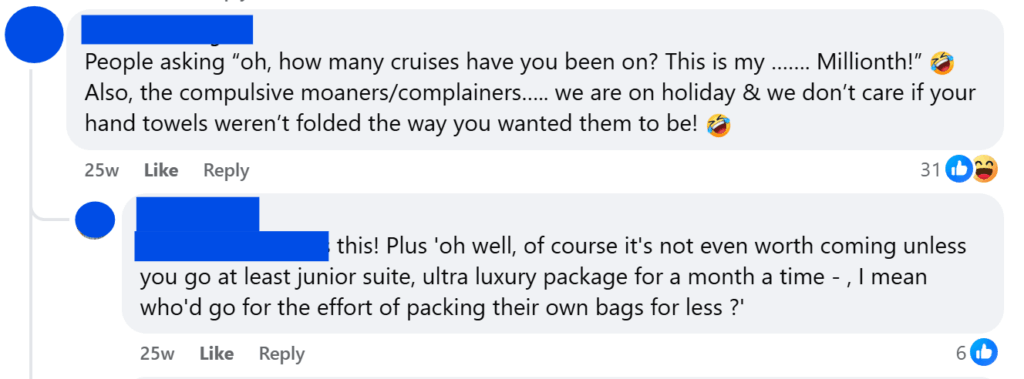
Cruise conversations sometimes turn competitive. Constant mentions of how many cruises someone’s done, how much they spent or what they’ve booked next can wear thin fast.
Many people just want to enjoy the moment, not compare statistics. The irritation comes from feeling trapped in boastful conversations rather than friendly ones.
Sharing experiences is great, but constant one-upmanship quickly becomes exhausting, especially when nobody asked.
23. Complaining as a pet peeve itself
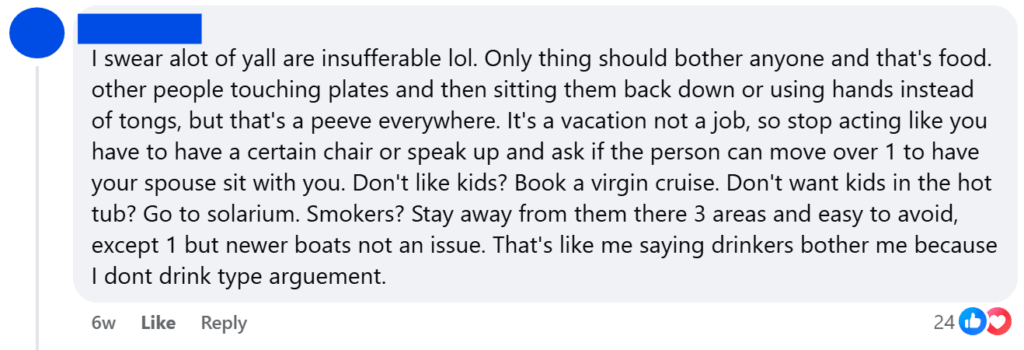
One of the more amusing themes is people saying their biggest pet peeve is… other people’s pet peeves. Some cruisers believe you can always find something wrong if you look hard enough.
Their view is that you can usually walk away and enjoy your holiday anyway. Others push back, pointing out that basic courtesy still matters.
It adds an interesting layer to the discussion and highlights the balance between reasonable expectations and choosing what’s worth letting go.
24. Smaller recurring annoyances
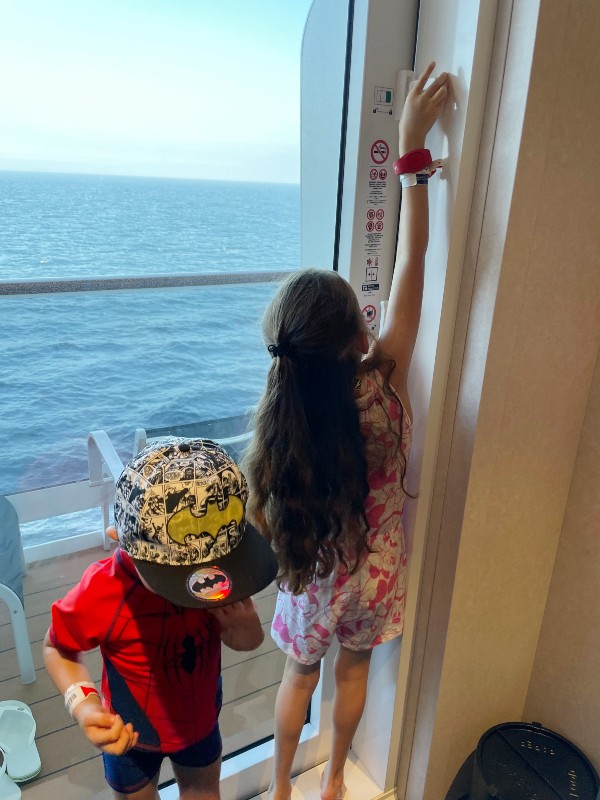
Beyond the big issues, there’s a long list of smaller but familiar grumbles. Kids pressing every elevator button, strollers blocking hallways, balcony lights left on all night, photographers interrupting dinner and missing amenities all pop up repeatedly.
On their own, they’re minor. Together, they paint a realistic picture of life on a busy ship. They’re the kind of annoyances that make people roll their eyes, laugh and say “classic cruise” rather than completely lose their patience.
Final Word
Wow. If you’d never cruised before, it would sound like a nightmare based on all of that, wouldn’t it?
The good thing is we know that these are, in the most part, minor gripes.
Reading through the comments, one thing is clear. Most cruise pet peeves come down to the same simple issue: courtesy. A little awareness, patience and consideration would wipe out a surprising number of these frustrations.
That said, part of cruising is sharing space with lots of other people, quirks and all. You can either let the small stuff ruin your holiday or laugh, move on and order another drink.
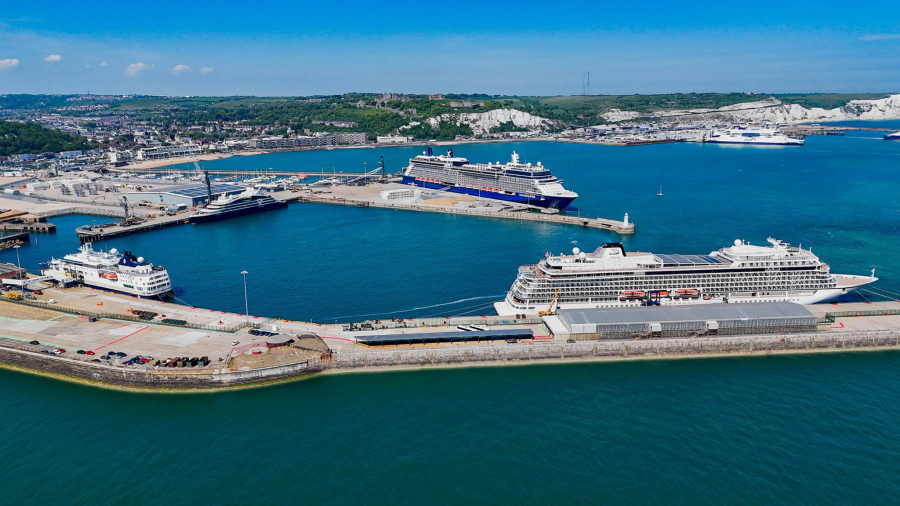
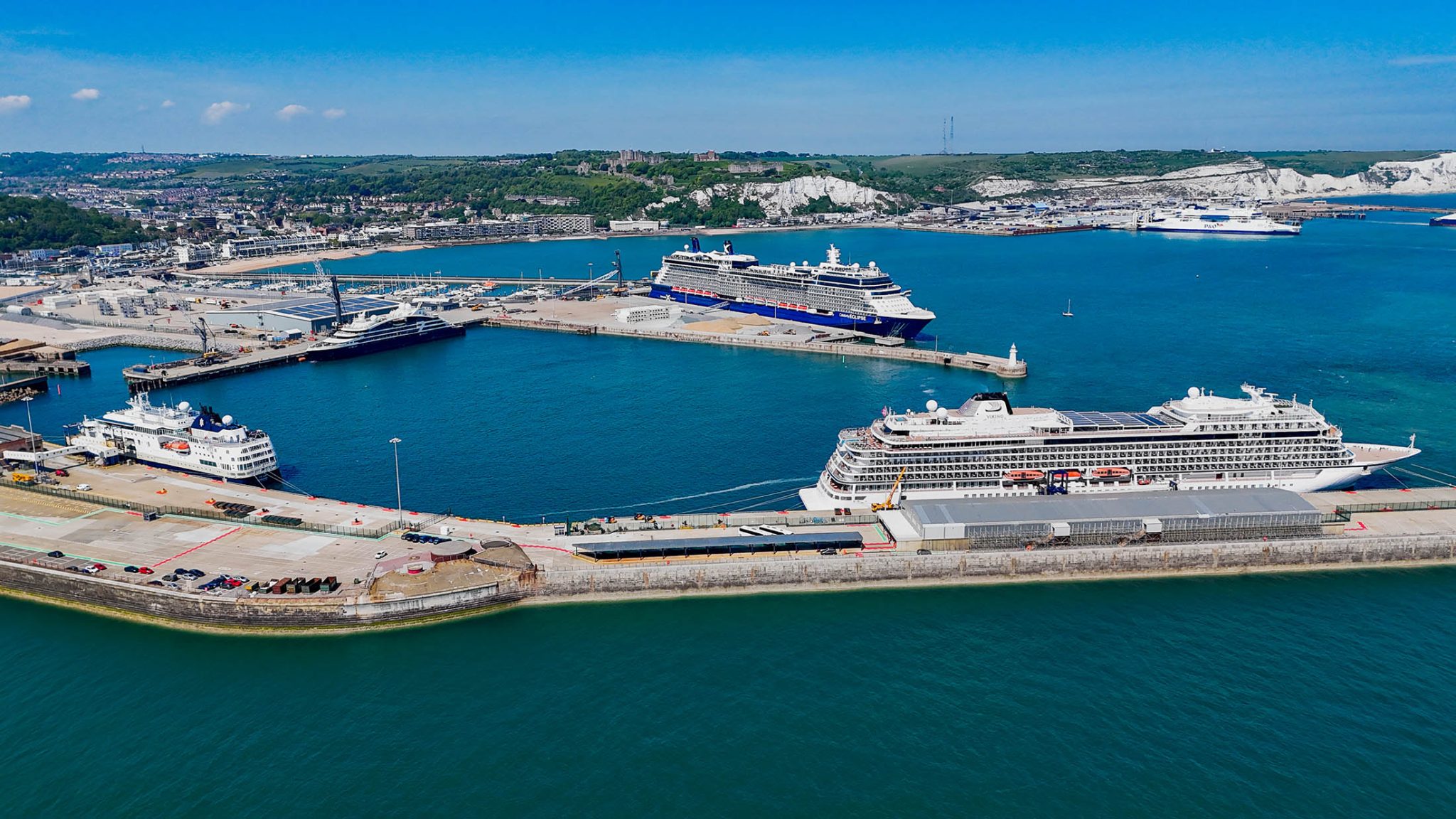
A cruise port had four ships visit in the same day for the first time, and it was the port’s busiest day ever.
The Port of Dover welcomed four cruise ships for the first time on May 8, 2026. This landmark moment is an example of the continued growth of Dover Cruise, and its status as a premier cruise hub in the UK for both turnaround and transit calls.
The four ships that were in port were:
Celebrity Eclipse
Viking Sky
HX Expeditions’ MS Fram
Ponant’s Le Bellot
CLIA hosted 100 travel agents that day on MS Fram, as part of its annual Expedition Summit.
The cruise port is in the middle of several upgrades to allow larger ships to visit. This includes the installation of quick release hooks that allow cruise ships up to 350 meters in length to dock.
A new passenger boarding bridge will become operation in 2027 at Cruise Terminal 1.
Peter Wright, Head of Cruise at the Port of Dover, gave the following statement about the port’s historic day:
“We are excited to be celebrating this milestone, which is the culmination of months of planning. I’d like to thank our fantastic operations team for their efforts on the day, and throughout the season to ensure that guests and cruise lines receive the best travel experiences here in Dover.
“Delivering these four vessels demonstrates the significant capability that we have as a cruise port. This, combined with the investments that we are making, our excellent transport links, great customer service, and rich heritage show that 30 years on from the opening of our first cruise terminal, we remain a world class destination.
“I would also like to thank our cruise line partners. It was amazing to see our terminals and waterfront bustling with their guests from all over the world.”
Get the latest cruise news, tips, and deals sent straight to your inbox with our free newsletter: Sign Up Now